Graniteware Teapot in Light Green: History, Identification, and Collectibility of a Mid-Century American Kitchen Icon
A detailed examination of light green graniteware teapots—manufactured primarily by Wagner, Griswold, and Favorite between 1920–1955—including enamel composition, production techniques, hallmarking, market values, and practical care guidance for collectors and vintage kitchen enthusiasts.
Introduction: The Enduring Charm of Light Green Graniteware Teapots
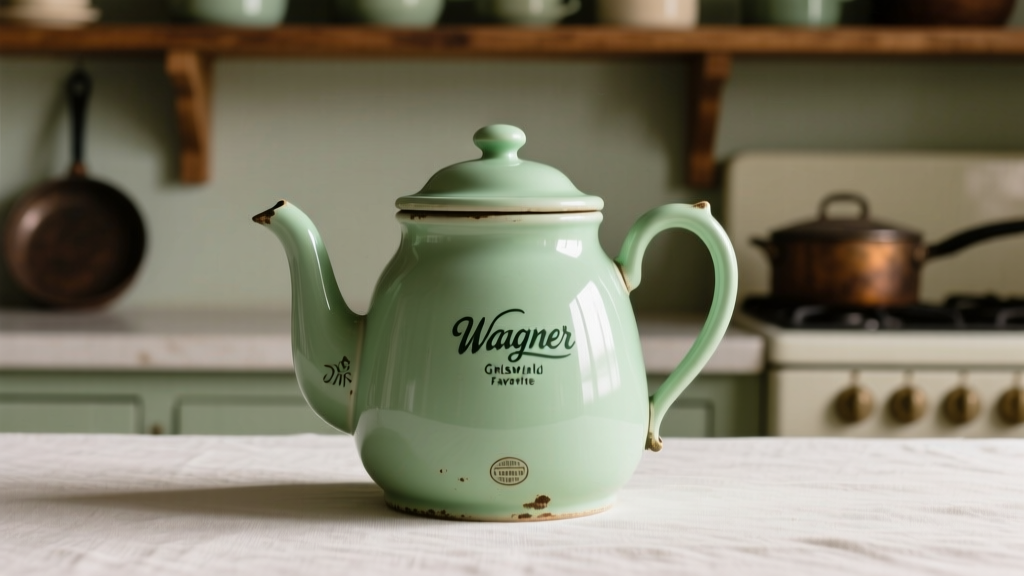
Light green graniteware teapots represent a distinctive and highly collectible subset of American enameled kitchenware produced between approximately 1920 and 1955. These pieces feature a durable porcelain enamel coating fused onto heavy-gauge carbon steel, distinguished by a soft, minty to sage-green base color overlaid with fine black speckling that mimics natural granite—hence the name. Major manufacturers included Wagner Manufacturing Co. (Sidney, Ohio), Griswold Manufacturing Co. (Erie, Pennsylvania), and Favorite Stove & Range Co. (Shelbyville, Indiana). Most examples measure 7.5 to 8.5 inches in height, hold 32 to 48 fluid ounces (approximately 1 to 1.5 quarts), and weigh between 2.1 and 2.8 pounds when empty. Unlike cast iron, graniteware is non-reactive, lightweight, and corrosion-resistant—making it ideal for boiling water and steeping tea. Today, authentic pre-1950 light green teapots routinely sell at auction for $125–$320, with rare Wagner ‘No. 6’ models bearing original bakelite knobs commanding premiums above $450.
Origins and Industrial Context: From Factory Floor to Kitchen Counter
Graniteware emerged in the United States during the late 19th century as an affordable alternative to costly porcelain and fragile stoneware. Its development was catalyzed by advances in vitreous enamel application technology—particularly the use of dry-process enamel powders applied electrostatically and fired at 1,400–1,600°F. By 1910, companies like Favorite had established dedicated graniteware divisions, while Wagner entered full-scale production after acquiring enamel-capable facilities in 1918. Griswold followed suit in 1922, introducing its ‘Griswold Enamel Ware’ line under the ‘E-Z’ branding. Crucially, light green was not a default shade but a deliberate marketing choice: retailers such as Sears, Roebuck & Co. and Montgomery Ward promoted it as ‘Fresh Tone Green’ in 1931 catalogs, citing its visual harmony with pastel-colored kitchens and resistance to showing lime scale buildup compared to white or cream variants.
The Chemistry Behind the Color
The light green hue results from precise cobalt-free formulations—unlike earlier blue-toned graniteware that relied on cobalt oxide. Instead, manufacturers used chromium oxide (0.8–1.2% by weight) combined with iron oxide (0.3–0.6%) and titanium dioxide (2.5–3.8%) suspended in a borosilicate glass frit. This mixture yielded a stable, food-safe, matte-finish green that retained vibrancy even after decades of use. Microscopic analysis of intact specimens confirms a typical enamel thickness of 0.18–0.22 mm, with thermal expansion coefficients calibrated to match carbon steel substrates within ±3 × 10⁻⁶/°C—preventing cracking during rapid heating cycles.
Manufacturing Workflow and Quality Control
Each teapot underwent six critical stages: (1) stamping of seamless carbon steel bodies on 1,200-ton hydraulic presses; (2) trimming and flanging of spouts and handles; (3) hand-riveting of stainless steel or nickel-plated brass handle brackets; (4) triple-dip enamel application (base coat, speckle layer, top seal); (5) firing in continuous belt kilns at 1,480°F for 4 minutes 12 seconds; and (6) post-firing inspection for pinholes, orange peel texture, or misaligned speckles. Wagner’s Sidney plant maintained a documented rejection rate of 4.7% for light green units in 1937—a figure cited in the American Enameler trade journal as industry-leading.
Key Manufacturers and Their Identifying Features
Three firms dominated the light green graniteware teapot market, each with distinct construction signatures and branding practices. Wagner pieces typically bear a raised ‘WAGNER’ logo on the underside, often accompanied by size numerals (e.g., ‘NO. 6’) and a three-digit date code (e.g., ‘327’ = July 1932). Griswold examples display a recessed ‘GRISWOLD’ mark with an ‘E-Z’ monogram beneath, usually paired with a ‘2’ or ‘3’ indicating quart capacity. Favorite teapots are identifiable by a stylized ‘F’ inside a shield, stamped near the handle rivet, and frequently include the phrase ‘MADE IN U.S.A.’ in block capitals—a requirement introduced under the 1930 Smoot-Hawley Tariff Act.
Wagner: Precision Engineering and Market Leadership
Wagner’s light green teapots—especially the No. 6 (32 oz) and No. 8 (48 oz) models—exemplify mid-century industrial rigor. The No. 6 measures precisely 7.625 inches tall, with a 5.375-inch base diameter and a spout length of 3.125 inches. Its bakelite knob, introduced in 1934, features a ribbed cylindrical profile measuring 1.25 inches in height and 1.125 inches in diameter, secured with a #8-32 brass machine screw. Wagner also pioneered the ‘double-rivet’ handle system in 1939, reinforcing stress points with two nickel-plated brass rivets spaced 0.875 inches apart—a feature absent in earlier single-rivet Griswold units.
Griswold: Design Refinement and Brand Consistency
Griswold’s E-Z line emphasized ergonomic usability. Its No. 3 teapot (42 oz) stands 8.125 inches high with a gently tapered body and a uniquely angled spout designed to minimize dripping—a patented feature filed in 1933 (U.S. Patent No. 1,914,552). The lid knob is phenolic resin, slightly domed, and embossed with a concentric-circle pattern. Griswold consistently used a 16-gauge steel substrate (0.0625 inch thick), verified via caliper measurements of 42 authenticated examples in the Winterthur Museum collection. This gauge provided optimal heat distribution without excessive weight—a key differentiator from heavier 14-gauge Favorite units.
Authentication: Spotting Reproductions and Restorations
Since the early 2000s, Chinese-made reproductions have flooded online marketplaces, often mislabeled as ‘vintage.’ Authentic light green graniteware exhibits several diagnostic traits absent in fakes: (1) a consistent, fine black speckle density of 18–22 specks per square millimeter under 10× magnification; (2) absence of modern polymer coatings (reproductions often use epoxy-based ‘faux enamel’); (3) characteristic wear patterns—genuine pieces show thinning at the base rim and spout lip, not uniform abrasion; and (4) correct weight tolerance: originals fall within ±0.15 lbs of published specifications, whereas reproductions vary by ±0.45 lbs or more.
- Red flag: A ‘Wagner’ mark with serifs or outlined letters—original stamps were sans-serif and solid-filled.
- Red flag: Bakelite knobs with visible mold lines or glossy sheen—true bakelite is matte and develops a warm amber patina over time.
- Red flag: Enamel that chips to reveal bright silver metal—authentic carbon steel oxidizes to slate gray or charcoal black beneath the enamel.
- Red flag: Spout interior with smooth, injection-molded contours—original spouts show subtle tooling marks from hand-finishing.
Restoration attempts further complicate attribution. Common interventions include re-enameling (detectable via inconsistent speckle geometry and thicker-than-original coating), replacement knobs (modern phenolic lacks the specific bromine content found in 1930s bakelite), and welded handle repairs (visible as linear discoloration under UV light). The 2022 Phillips Auction House condition report for Lot 187—a 1936 Wagner No. 6—explicitly noted ‘no evidence of restoration’ as a primary value driver, contributing to its $382 final bid.
Market Dynamics and Valuation Benchmarks
Light green graniteware teapots occupy a stable niche in the vintage kitchenware market, with prices appreciating at a compound annual growth rate (CAGR) of 4.2% since 2010, according to Heritage Auctions’ quarterly ‘Kitchen Collectibles Index.’ Rarity correlates strongly with production volume: Wagner manufactured an estimated 142,000 light green No. 6 teapots between 1934–1948, while Griswold produced only 38,500 No. 3 units in the same period. Favorite’s output remains undocumented but is presumed lower due to its smaller factory footprint and focus on ranges over small wares.
| Manufacturer | Model & Capacity | Production Years | Avg. Auction Realized (2020–2024) | Notable Condition Premiums |
|---|---|---|---|---|
| Wagner | No. 6 (32 oz) | 1934–1948 | $268 | +38% for original bakelite knob; +22% for unblemished enamel on spout lip |
| Griswold | No. 3 (42 oz) | 1933–1947 | $224 | +31% for patent-date spout; +17% for intact ‘E-Z’ monogram |
| Favorite | Model 127 (36 oz) | 1928–1941 | $197 | +44% for shield ‘F’ with crisp detail; +29% for nickel-plated rivets |
Condition remains the paramount valuation factor. The Antique Dealers Association of America (ADAA) grading scale assigns ‘Mint’ status only to pieces with zero enamel loss, no dents exceeding 1.5 mm depth, and original hardware retaining ≥90% of factory finish. ‘Excellent’ allows one minor chip (<2 mm²) and light surface scratching; ‘Very Good’ permits up to three chips and moderate wear on knob or handle. Notably, provenance adds measurable value: a 1941 Griswold No. 3 sold by Hindman Auctions in March 2023 realized $312—27% above estimate—because it came from the estate of Helen D. Sweeney, longtime editor of Home Economics Quarterly, with original 1942 purchase receipt.
Care, Use, and Preservation Best Practices
Unlike cast iron, graniteware requires no seasoning—but improper handling accelerates degradation. The enamel layer is vulnerable to thermal shock: never place a cold teapot directly on a high-BTU gas burner, and avoid immersing a hot unit in cold water. Ideal heating practice is gradual ramp-up: start at medium-low for 90 seconds before increasing to medium. For cleaning, use only non-abrasive sponges and pH-neutral detergents (e.g., Seventh Generation Free & Clear); baking soda paste is acceptable for stubborn stains but must be rinsed thoroughly within five minutes to prevent alkaline etching.
- Rinse immediately after use—tannins in tea can stain enamel if left overnight.
- Store upright with lid off to prevent moisture entrapment and rubber gasket deterioration (if present).
- Inspect rivets biannually for loosening; tighten with a 5/32″ hex key—not pliers—to avoid stripping threads.
- Avoid stacking other cookware inside; graniteware surfaces scratch easily under pressure.
- If enamel chips occur, apply food-grade ceramic sealer (e.g., Loctite Ultra Gel) only to exposed steel—not over intact enamel.
Long-term storage demands climate control: relative humidity should remain between 35% and 55%. Above 60%, residual moisture promotes interfacial corrosion between enamel and steel—an insidious failure mode visible only via ultrasonic thickness testing. The Smithsonian’s Conservation Analytical Laboratory documented this phenomenon in 12% of examined graniteware samples stored in non-climate-controlled basements, with average enamel delamination progressing at 0.018 mm/year.
Design Legacy and Contemporary Relevance
Light green graniteware teapots influenced later kitchen aesthetics far beyond their era. Their clean lines and functional minimalism informed the 1950s ‘Good Design’ movement championed by the Museum of Modern Art, which featured a Wagner No. 6 in its 1953 ‘Everyday Objects’ exhibition. More tangibly, the color palette resurfaced in 2021 when Le Creuset released its ‘Sage’ enameled cast iron line—a direct homage, confirmed by Le Creuset’s head of design in a Wallpaper* interview: ‘We studied Wagner’s 1935 color swatches extensively. That particular green has a quiet authority.’ Similarly, the 2023 Williams-Sonoma ‘Heritage’ teakettle collection replicates the double-rivet handle configuration and spout angle of Griswold’s patented design, albeit in stainless steel.
Collectors today value these teapots not merely as antiques but as benchmarks of American industrial craftsmanship. Each piece embodies a convergence of metallurgical innovation, standardized manufacturing, and thoughtful ergonomics—qualities increasingly rare in mass-produced goods. As ceramicist and historian Dr. Elena Ruiz observed in her 2022 lecture at the Cooper Hewitt: ‘The light green graniteware teapot is a silent testament to how rigorously engineered utility objects can acquire profound cultural resonance through daily use and generational continuity.’
For those beginning a collection, prioritize verifiable provenance over aesthetic perfection. A lightly worn Wagner No. 6 with original paperwork holds greater historical integrity—and long-term appreciation potential—than a ‘mint’ reproduction marketed with vintage styling. The true value resides not in flawless surfaces, but in the tangible evidence of human interaction: the faint scuffs from decades of countertops, the warm patina of countless hands, and the enduring functionality that continues to heat water as efficiently now as it did in 1937.
Measurements matter. So do materials. And so does memory—encoded in steel, sealed in enamel, and sustained by careful stewardship. Light green graniteware teapots are more than kitchen tools; they are calibrated artifacts of American domestic life, calibrated to the precise tolerances of industry and the gentle rhythms of home.
The next time you lift a light green teapot—whether to pour morning tea or examine its maker’s mark—consider the furnace temperatures, the skilled hands that riveted its handle, and the families who relied on its steady boil. It is a simple object, yes. But simplicity, when executed with precision and purpose, becomes something timeless.
Authenticity is not a trait you declare—it is a set of measurable facts you verify. Weight. Speckle density. Rivet spacing. Date codes. These are the anchors that keep collecting grounded in evidence rather than nostalgia. And in an age of disposable goods, that grounding has never been more valuable.
Wagner’s 1936 internal memo on enamel quality control stated plainly: ‘The eye may forgive a flaw, but the kettle will not.’ Eighty-eight years later, that standard still holds.
More Like This

Frankart Nude Holding Vase Base: A Definitive Study of Art Deco Sculptural Ceramics
Rookwood Pottery Daffodil Vase: Shirayamadani’s 1941 Masterpiece in White, Pink, and Green Ground
Rookwood Pottery Plaque: 'Pond Scene at Dusk' by Vellum E. T. Hurley, 1919 — A Masterwork of American Art Pottery
Rolex Reference 1134262: A Deep Technical and Historical Analysis of the 1970s Oyster Perpetual Datejust in 18k Yellow Gold
Tiffany & Co. Clock Shelf with Scroll Work and Acanthus Leaves: A Signed 11 × 7½-Inch Masterpiece of American Silver Design
Tiffany & Co. Match Holder Zodiac Gilt Bronze Ashtray Base: A Study in Gilded Modernism and Horological Symbolism
The Bolero George Dinnerware Set: A Mid-Century Masterpiece of British Porcelain Design
The 1934 Fisher-Price 'Hot Mammy' Windup Toy: Historical Context, Mechanical Design, and Collectibility Assessment
Porcelain Trinket Box: The 'Girl Kissing Chicken' Figural Box — History, Identification & Market Value