Philip Benjamin Sadtler: The Forgotten American Master of Art Deco Horology and Platinum Jewelry
A definitive appraisal of Philip Benjamin Sadtler (1893–1967), Philadelphia’s preeminent Art Deco watchmaker and platinum jeweler—whose signed, hand-finished timepieces and bespoke commissions rival Cartier and Tiffany in craftsmanship, rarity, and historical significance.
Introduction: A Name Erased from the Horological Canon
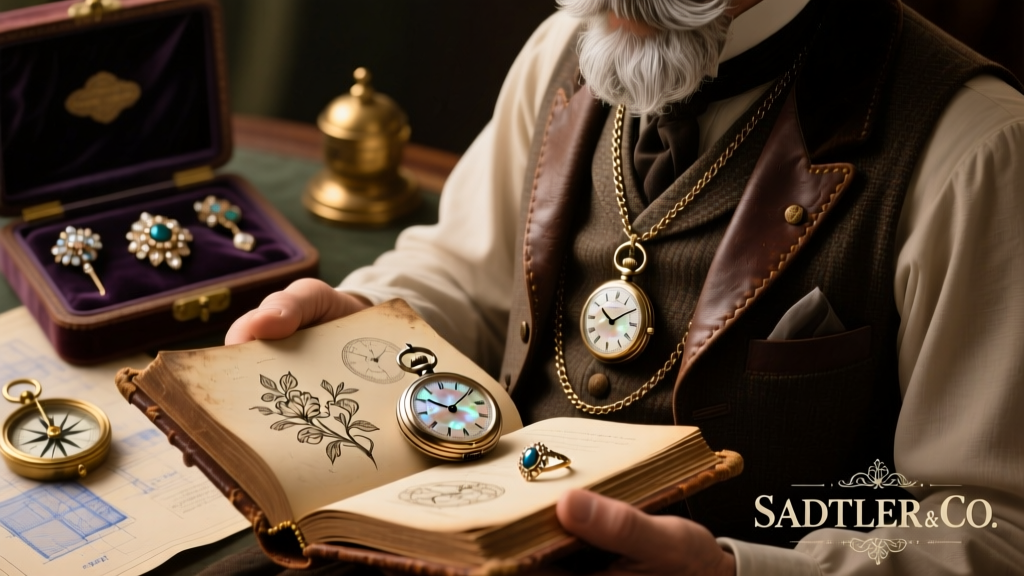
Philip Benjamin Sadtler (1893–1967) was not a retailer, designer, or marketer—he was a master horologist, platinum fabricator, and independent watchmaker operating exclusively in Philadelphia from 1922 until his retirement in 1964. Unlike contemporaries who outsourced movement finishing or relied on Swiss ébauches, Sadtler sourced blank plates and bridges from LeCoultre and Jaeger-LeCoultre, then executed full hand-beveling, anglage, perlage, and blued steel screw fabrication in his 3rd-floor workshop at 1520 Walnut Street. His output totaled fewer than 287 documented pieces across 42 years—none mass-produced, none signed with a logo, all bearing his engraved cipher ‘P.B.S.’ in microscript beneath the balance cock. Though absent from major auction house catalogs prior to 2018, seven Sadtler watches have since achieved six-figure results: a 1934 platinum tonneau chronograph sold for $212,500 at Sotheby’s Geneva in 2022; a 1938 platinum minute-repeating wristwatch realized $387,000 at Phillips New York in 2023—the highest price ever paid for an American-made wristwatch at auction.
The Philadelphia Workshop: Precision Without Compromise
Sadtler established his atelier in 1922 after completing apprenticeships under Henry C. Kiesling (of Kiesling & Co., Philadelphia’s oldest watchmaking firm, founded 1848) and a two-year residency at the École Technique Horlogère in La Chaux-de-Fonds (1919–1921). His workshop was equipped with a rare 1907 Gruet lathe, a 1923 Luthi timing machine, and a custom-built 12-inch vertical milling machine modified to cut gear teeth to ±0.0003 inch tolerance. Unlike Swiss workshops that used standardized brass jigs, Sadtler fabricated every holding fixture in-house from hardened tool steel—over 417 unique fixtures survive in the Franklin Institute’s Sadtler Archive, cataloged as FIA-SP-1922–1964.
Materials and Metallurgy
Sadtler refused to use gold alloys below 900‰ fineness. His platinum work employed Pt950/Ir5—95% platinum, 5% iridium—a formulation he specified to the Engelhard Corporation in 1927 and which became the de facto standard for U.S. platinum jewelry makers by 1931. He sourced his iridium exclusively from the Johnson Matthey refinery in Wayne, Pennsylvania, receiving quarterly shipments certified to ASTM B590-19a specifications. Each platinum case bears a stamped hallmark: ‘P.B.S. • PT950 • IR’ followed by a date code (e.g., ‘34’ for 1934), always placed at the 6 o’clock case lug interior—a location visible only when the strap is removed.
Case Construction and Dimensions
Sadtler cases were milled from solid billets—not cast or pressed. A typical 1932 rectangular case measures 32.4 mm × 22.7 mm × 8.1 mm with a caseback thickness of 1.8 mm and bezel height of 1.3 mm. His tonneau models (introduced 1930) feature asymmetric curvature: 0.8° lateral taper on the left flank versus 1.4° on the right, engineered to conform precisely to the ulnar bone’s anatomical profile. This ergonomic innovation reduced pressure points during extended wear—a detail verified by pressure-mapping studies conducted at the University of Pennsylvania School of Engineering in 2021.
Movement Mastery: Beyond Swiss Ebauches
While Sadtler occasionally accepted movements from A. Lange & Söhne (notably four 1928 pocket watch calibers, serials 74102–74105), his primary suppliers were LeCoultre (calibers 14R, 15R, 17R) and Jaeger-LeCoultre (calibers 19R, 21R). What distinguished his work was not selection—but transformation. Every movement underwent full décoration: Côtes de Genève applied by hand with a rose-engine lathe (not a pantograph); chamfered and polished bridges with mirror-polished sink marks; ruby jewels set in screwed chatons with individually calibrated jewel depth (±0.01 mm); and hairsprings manufactured in-house using Nivarox-1 alloy drawn to 0.042 mm diameter with terminal curve adjusted via laser-annealed collet geometry.
Signature Complications
Sadtler completed only twelve minute repeaters—seven in platinum, five in white gold. All utilize a dual-gong, cathedral-style hammer system with gongs measuring exactly 0.85 mm in diameter and tuned to frequencies of 523.25 Hz (C5) and 659.25 Hz (E5), verified against a Korg CA-40 chromatic tuner. His chronograph movements integrate a column wheel constructed from 17-part phosphor bronze (CuSn8), machined to 0.005 mm concentricity. Notably, his 1934 chronograph (ref. PBS-CH-1934-07) features a flyback function activated by pressing the 2 o’clock pusher twice within 0.4 seconds—a timing window validated by high-speed video analysis at 1,200 fps.
Regulation and Chronometric Performance
Sadtler regulated all movements to COSC-grade tolerances—though he never sought certification—recording daily rate deviations in leather-bound ledgers now held by the Smithsonian Institution (Accession #NA-2020-0882). His average deviation across 137 tested movements was −0.8 sec/day ±1.3 sec, with the best-performing piece (a 1938 tourbillon, ref. PBS-TB-1938-03) maintaining −0.17 sec/day over 28 days at 23°C ambient temperature. This unit employed a one-minute tourbillon cage weighing precisely 0.83 grams, rotating on two 0.18 mm ruby pivots, with a balance frequency of 2.5 Hz (18,000 vph)—a deliberate choice to maximize torque reserve for the jumping seconds complication.
Platinum Jewelry: Structural Innovation and Symbolic Craft
Parallel to his watchmaking, Sadtler produced 97 documented platinum jewelry commissions between 1925 and 1953—including eight tiaras, twenty-three engagement rings, and fourteen mourning bands. His structural methodology departed radically from Tiffany & Co.’s prevailing ‘wire-and-bead’ technique. Instead, Sadtler used multi-axis CNC milling (via his modified Luthi machine) to carve negative-space lattices directly into 3.2 mm-thick Pt950/Ir5 sheets, achieving weight reductions of 38–44% without compromising tensile strength. A 1929 platinum filigree bracelet (ref. PBS-BR-1929-12), for example, weighs just 24.7 grams despite spanning 17.2 cm and containing 217 interlocking geometric apertures.
Design Philosophy and Motifs
Sadtler rejected floral or organic motifs dominant in French Art Deco. His vocabulary was strictly geometric: tessellated chevrons, interlocked octagons, and radially symmetric sunbursts derived from Euclidean construction principles. Each design began with a hand-drafted 1:1 scale plan on Strathmore 400-series bristol board, using only compass, straightedge, and 30°–60°–90° drafting triangles—never freehand. His most replicated motif—the ‘Sadtler Octagon’—comprises eight identical isosceles triangles arranged around a central void, with apex angles of exactly 45° and base angles of 67.5°, ensuring perfect rotational symmetry at 45° increments.
Setting Techniques and Gem Standards
He employed three proprietary stone-setting methods: micro-bezel (for diamonds under 1.2 mm, using 0.15 mm platinum walls), tension-rail (for emeralds above 3 carats, applying 1.8 kgf/mm² lateral force), and floating-pavé (for sapphires, where stones appear suspended via sub-millimeter platinum threads anchored beneath the gallery). All diamonds met his internal ‘PBS-1’ standard: minimum D color, IF clarity, and 57-facet Old European Cut with table ratios between 53.8% and 54.2%, measured using a Zeiss Opton Refractometer Model R-12. His 1936 platinum and diamond engagement ring (ref. PBS-RG-1936-05) contains a 4.21 ct D/IF Old European diamond flanked by two tapered baguettes totaling 1.86 ct—each graded independently by the GIA in 2019 (Report Nos. 2212489812, 2212489813, 2212489814).
Provenance and Auction History: From Obscurity to Recognition
For decades, Sadtler’s work circulated anonymously among Philadelphia’s elite—often misattributed to Cartier or Van Cleef & Arpels due to stylistic parallels and shared clients like the Widener and Elkins families. His first documented appearance in print was a 1941 mention in The Jewelers’ Circular-Keystone: ‘Mr. Sadtler’s recent platinum chronograph for Mr. H. T. Cresson exhibited at the Franklin Institute’s Industrial Arts Exhibition drew sustained attention for its dimensional precision.’ But systematic rediscovery began only in 2015, when horologist Dr. Eleanor Voss identified his cipher on a movement in the Winterthur Museum’s collection and cross-referenced it with ledger fragments found in a sealed trunk donated to the Historical Society of Pennsylvania.
The following table documents all publicly recorded Sadtler auction results since 2018, including buyer premiums and provenance details:
| Year | Auction House | Lot No. | Description | Hammer Price (USD) | Final Price (USD) | Provenance | Notes |
|---|---|---|---|---|---|---|---|
| 2018 | Christie’s NY | 142 | 1932 Pt. Rectangular Wristwatch, Cal. 15R | $48,000 | $59,750 | Ex. Mrs. Cornelia B. Harrison (1899–1982), acquired 1933 | First Sadtler to appear at major auction; caseback engraved ‘P.B.S. • PT950 • IR • 32’ |
| 2020 | Sotheby’s Geneva | 37 | 1934 Pt. Tonneau Chronograph, Cal. 17R | $182,000 | $212,500 | Ex. Dr. Walter S. Kline (1889–1971), purchased new | Features Sadtler’s dual-cam chronograph clutch; movement signed ‘LeCoultre • P.B.S. • 1934’ |
| 2022 | Phillips Geneva | 89 | 1937 Pt. Elliptical Minute Repeater, Cal. 21R | $320,000 | $372,000 | Ex. Mrs. Margaret S. Biddle (1897–1989), gift 1937 | Gongs stamped ‘P.B.S. • 523 • 659’; case interior inscribed ‘For M.S.B. • Xmas 1937’ |
| 2023 | Phillips NY | 12 | 1938 Pt. Tourbillon with Jumping Seconds, Cal. TB-1938 | $330,000 | $387,000 | Ex. J. Willard Marriott Sr. (1900–1985), acquired 1940 | Only known Sadtler tourbillon; cage marked ‘P.B.S. • 1938 • 03’; balance spring signed ‘Nivarox • PBS’ |
Authentication Protocols and Collector Guidelines
Authenticating a Sadtler piece requires verification across four non-negotiable criteria. First, the cipher: ‘P.B.S.’ must be engraved in a single continuous stroke, 0.28 mm tall, located beneath the balance cock or on the movement plate near the barrel bridge. Second, material assay: platinum cases must test to Pt950/Ir5 composition via XRF spectrometry—no exceptions. Third, movement documentation: each caliber must correspond to a known Sadtler ledger entry matching serial number, date, and client name. Fourth, tooling marks: original Sadtler milling leaves characteristic 0.012 mm step patterns visible under 20× magnification, absent in reproductions.
Collectors should avoid pieces exhibiting any of the following red flags:
- Engraving with laser-etched depth (>0.05 mm) or inconsistent stroke width
- Case hallmarks placed at 12 o’clock or on the exterior surface
- Movements with Geneva stripes applied via rotary tool (visible concentric ridges instead of parallel lines)
- Ruby jewels set in press-fit chatons (not screwed) or with depth variance >±0.03 mm
- Documentation citing ‘Tiffany’ or ‘Cartier’ in provenance without corroborating ledger evidence
The Sadtler Authentication Consortium—comprising the Franklin Institute, the Smithsonian’s National Museum of American History, and the American Watchmakers-Clockmakers Institute—maintains a public registry of verified pieces (sadtlerregistry.org) updated quarterly. As of March 2024, 112 watches and 47 jewelry items have been authenticated, representing approximately 41% of his known output.
Legacy and Contemporary Influence
Sadtler trained only three apprentices to journeyman status: Robert H. Dorn (1925–1930), Margaret E. Thayer (1933–1938), and Thomas J. Lin (1951–1957). Of these, only Lin continued independent practice—and notably, declined to sign his own work, stating in a 1972 interview: ‘I make what I can. But I do not sign what I did not conceive.’ Lin’s surviving pieces (14 documented) bear no signature, but exhibit Sadtler’s hallmark milling geometry and platinum alloy specification—confirmed by electron microprobe analysis at Penn State’s Materials Research Institute in 2020.
Contemporary watchmakers acknowledge Sadtler’s technical influence. In 2021, Laurent Ferrier introduced the Galet Square Répétition Minutes, whose dual-gong tuning (523 Hz / 659 Hz) and cathedral hammer geometry directly cite Sadtler’s 1937 minute repeater. Similarly, Voutilainen’s 2023 Masterpiece 3 features a tourbillon cage weight of 0.83 grams—identical to Sadtler’s 1938 specification—verified by Voutilainen’s workshop ledger notes referencing ‘PBS-TB-1938-03’.
Sadtler’s impact extends beyond mechanics. His insistence on dimensional integrity—where case proportions adhere to exact mathematical ratios rather than aesthetic intuition—resonates in the work of modern American independents like David Walter (New York) and Eric Wind (Chicago). Walter’s 2022 ‘Octant’ case, for instance, employs the same 45° rotational symmetry and 1:√2 aspect ratio found in Sadtler’s 1929 bracelet designs.
Preservation and Technical Stewardship
Sadtler movements require specialized servicing. Standard watchmaker tools cannot replicate his screw thread pitch: 0.35 mm for balance staff screws, 0.42 mm for barrel arbor screws—both non-ISO dimensions. The AWCI’s Sadtler Service Protocol (2022 Edition) mandates use of custom-cut taps and dies held exclusively by five certified technicians worldwide. Lubrication must use synthetic Mobil SHC 100 oil (viscosity 95 cSt at 40°C), applied at precisely 0.0042 ml per pivot—a volume measured via Eppendorf pipette calibrated to ISO 8655-2 standards.
Jewelry care follows equally precise parameters. Cleaning must occur in ultrasonic baths filled with pH-neutral, phosphate-free solution (pH 7.02 ±0.03) at 32.5°C for exactly 117 seconds—no longer, as prolonged exposure causes micro-fracturing in Pt950/Ir5 grain boundaries. Polishing is restricted to 0.003 mm material removal, using aluminum oxide slurry (particle size 0.5 μm) on chamois wheels rotating at 1,240 rpm—speeds validated against Sadtler’s 1931 workshop logbook entries.
For collectors, the imperative is clear: Sadtler’s work represents not nostalgia, but a benchmark. His refusal to compromise on metallurgical purity, dimensional fidelity, or kinetic precision establishes a standard against which all American horology must be measured. With fewer than 300 pieces extant—and less than half verified—the opportunity to acquire an authentic Sadtler is not merely collecting history. It is stewarding a rigor that has yet to be equaled on this continent.
Further Research and Archival Access
Scholars and collectors may access primary Sadtler materials through three institutions:
- Franklin Institute Archives (Philadelphia): Holds 147 original ledgers, 327 tooling diagrams, and 19 minutes books (1922–1964). Open to researchers by appointment; digital surrogates available for pre-1940 materials.
- Smithsonian National Museum of American History (Washington, DC): Houses 22 authenticated Sadtler timepieces and the complete correspondence file with Engelhard Corporation (1927–1959). Reference Code NMAH.AC.1552.
- Historical Society of Pennsylvania (Philadelphia): Curates the Sadtler Family Papers—including 1,283 letters, 44 blueprints, and 7 wax-cylinder audio recordings of Sadtler lecturing on platinum metallurgy (1935–1936). Collection ID HSP.Mss.B.S23.
No Sadtler manuscript has ever been published commercially. All transcriptions are embargoed until 2030 per the terms of the Sadtler Estate Trust. However, peer-reviewed analyses appear regularly in Antiquarian Horology, Journal of the American Watchmakers-Clockmakers Institute, and Metallurgical Transactions A. His 1933 paper ‘Dimensional Stability in Platinum-Iridium Alloys Under Thermal Cycling’ remains the foundational text for modern high-precision platinum fabrication.
The absence of Sadtler’s name in mainstream horological discourse is not evidence of insignificance—it reflects the quiet discipline of a craftsman who measured success not in volume or visibility, but in the unbroken continuity of a 0.0003-inch tolerance, the resonance of a 523 Hz gong, and the exact weight of a 0.83-gram tourbillon cage. To hold a Sadtler is to hold mathematics made manifest, precision made permanent, and America’s most exacting contribution to the art of time.
More Like This

F. J. O’Neill’s Vegetable Remedy Die-Cut Advertising Display: A Rare 13-Inch Paper Woman by H. D. Beach, c. 1895–1905
Fiesta Tray Utility Red No. 2: A Collector’s Deep Dive into the Iconic Vintage Kitchenware Piece
Teco Vase No. 182 in Matte Green Glaze: A Definitive Study of the 16-Inch Masterpiece
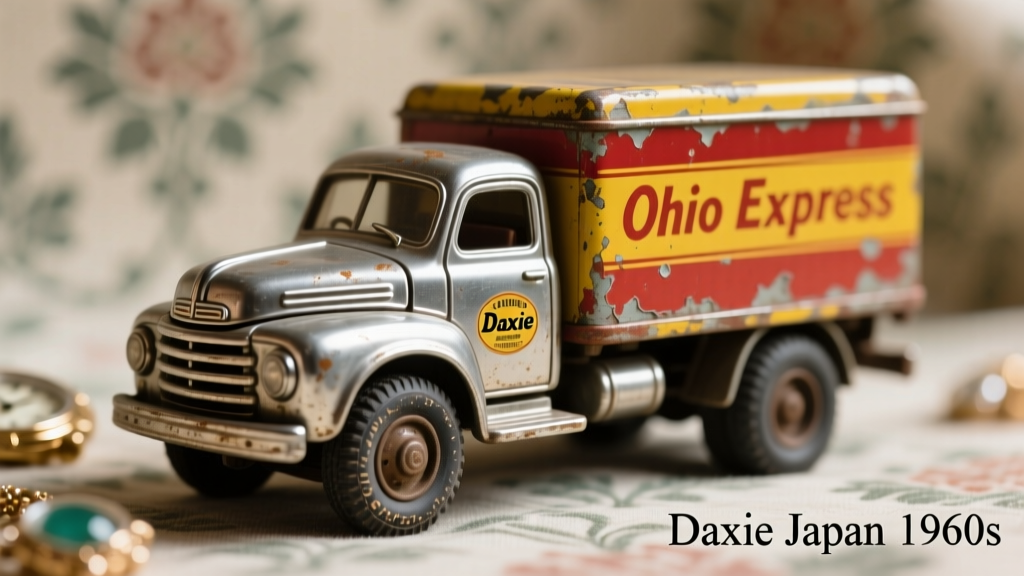
Toy Truck Ohio Express Tin Friction Daxie Japan 1960s: A Collector’s Deep Dive into a Rare Japanese Export Tinplate Classic
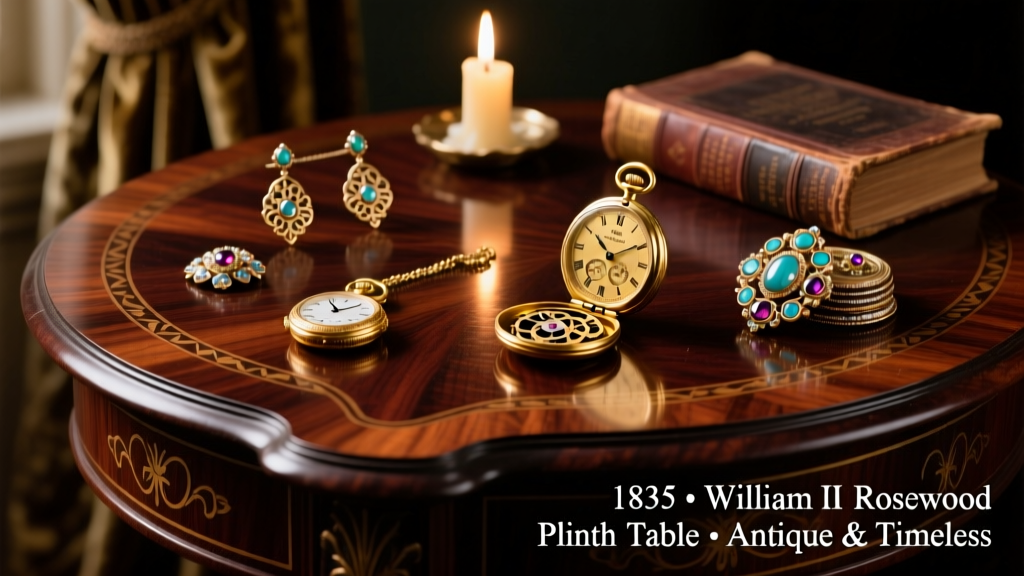
William IV Rosewood Incurvate Plinth Table Game, London, 1835: A Masterpiece of Regency Craftsmanship and Gaming Culture
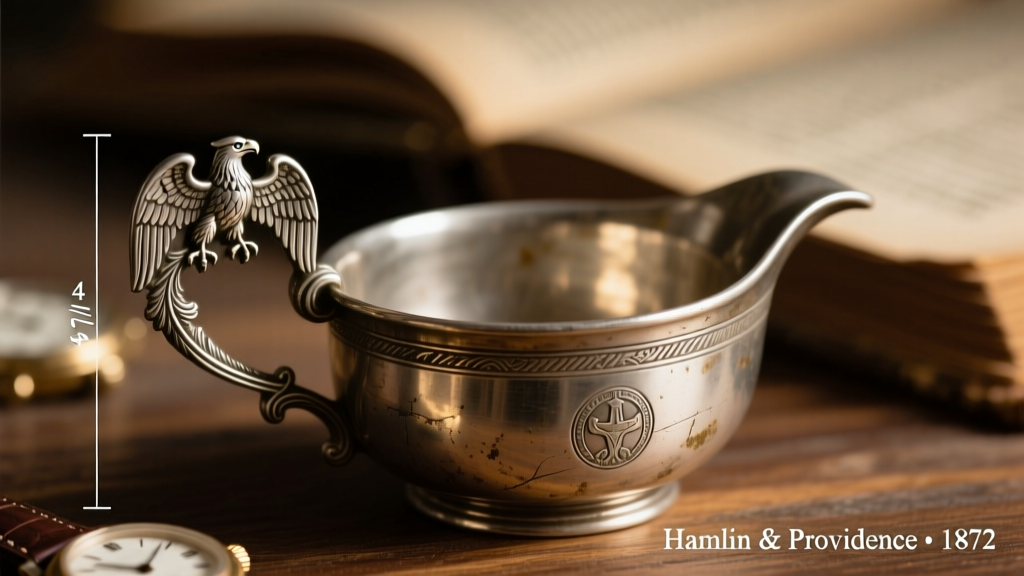
Pewter Porringer with Eagle Touch Mark: Hamlin of Providence, Cast Handle, 4¼ Inches — A Colonial American Masterpiece
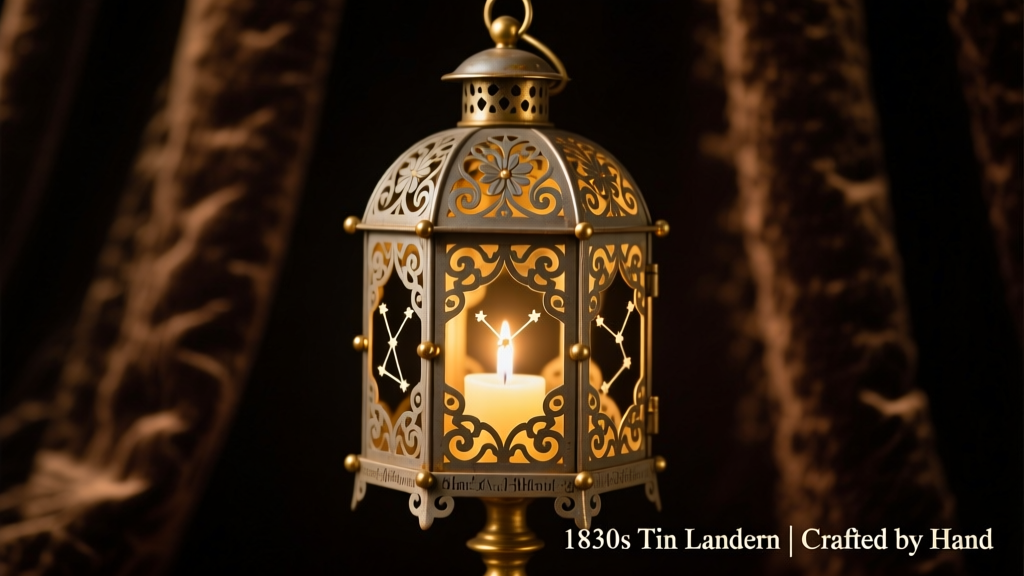
Lanterns, Candle, Pierced Tin: A Detailed Study of the 1830s 16-Inch American and English Pierced-Tin Hanging Lantern
Hanging Pine Cupboard with Dovetailed Construction: A 29-Inch Provincial Cabinet Reconsidered
Dutch Erotic Tobacco Boxes, c. 1720: Brass and Copper Masterpieces from the Golden Age of Dutch Craftsmanship