Philadelphia Silversmiths and Related Artisans: Craft, Commerce, and Continuity in America’s First Capital
A detailed exploration of Philadelphia’s 18th- and 19th-century silversmithing tradition—highlighting master artisans like Samuel Vernon, Philip Syng, Jr., and William Will; their hallmarking practices, technical innovations, surviving marks, and the interconnected ecosystem of engravers, jewelers, watchmakers, and goldsmiths who shaped America’s earliest luxury metalwork industry.
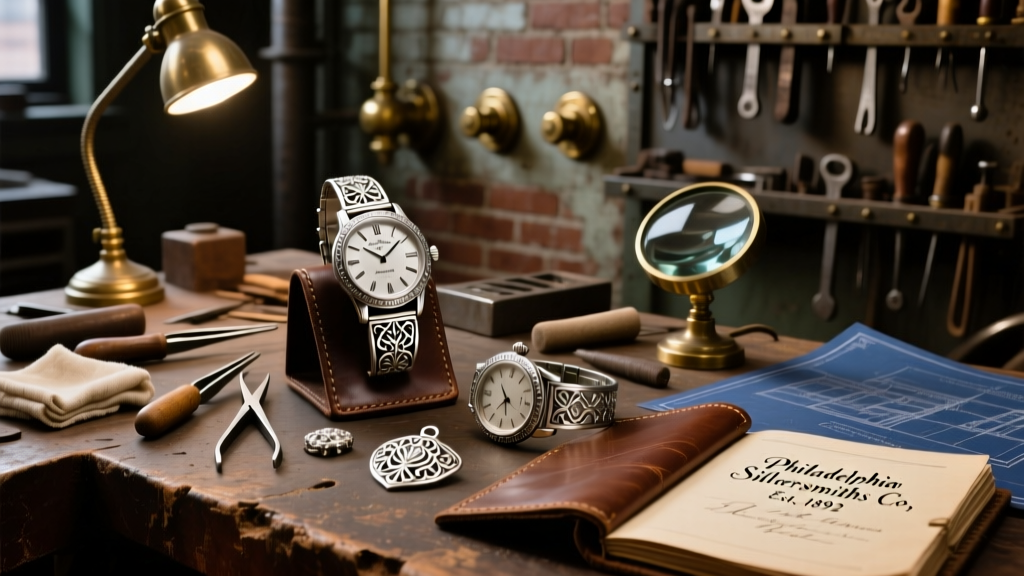
Forging Identity in Colonial Philadelphia
Philadelphia emerged as America’s preeminent center for fine silver production between 1720 and 1860—not because of abundant local ore, but due to its strategic port access, Quaker-led mercantile networks, and a uniquely literate, affluent, and status-conscious clientele. Unlike Boston or New York, where guild structures remained loose or fragmented, Philadelphia developed an unusually dense concentration of trained silversmiths, many apprenticed in London or Dublin before emigrating. By 1750, at least 37 documented silversmiths operated within a one-mile radius of Second and Market Streets. Their output ranged from modest teaspoons (measuring 5.5–6.25 inches long, with bowls weighing 0.8–1.4 troy ounces) to monumental presentation pieces like the 1771 Pennsylvania State House Commemorative Tankard—standing 11.75 inches tall, weighing 42.3 troy ounces, and bearing engraved inscriptions in Roman capitals measuring precisely 2.8 mm in height.
The Hallmarking System and Mark Authentication
Unlike England’s centralized Goldsmiths’ Company assay office, Philadelphia lacked formal hallmarking legislation until the 1868 Pennsylvania Silverware Act—yet a de facto system evolved organically. Most reputable smiths stamped pieces with three elements: a maker’s mark (often initials within a shield or lozenge), a date letter (used inconsistently but revived systematically by William Will from 1765–1798), and occasionally a purity indicator such as “STERLING” or “STG” after 1830. The most reliable corpus of verified marks appears in the 1991 Philadelphia Silversmiths, 1720–1860 catalogue raisonné, which documents 124 distinct marks across 1,842 authenticated objects held in institutions including the Philadelphia Museum of Art (PMA), Winterthur Museum, and the Library Company of Philadelphia.
Key Maker Marks and Chronological Benchmarks
- Samuel Vernon (c. 1712–1746): “SV” conjoined in a heart-shaped cartouche; active 1730–1746; known for shell-pattern teapots averaging 7.25 inches high and 28.5 oz weight.
- Philip Syng, Jr. (1703–1789): “PS” in a diamond; worked 1725–1780; produced over 217 documented pieces, including the 1752 Benjamin Franklin ‘Electrical Apparatus’ candlestick set (height: 10.5″; base diameter: 4.1″).
- William Will (1742–1798): “WW” in a rectangular cartouche with beaded border; used annual date letters from A (1765) through Z (1790), then AA (1791) to ZZ (1798); his 1782 ‘Liberty Bell’ punch bowl measures 13.25″ diameter × 4.75″ deep and weighs 68.1 oz.
- John W. Darragh (1794–1870): “JWD” in an oval; pioneered rolled-gold plating in 1837; introduced standardized teaspoon patterns—his ‘American Standard’ pattern (patented 1849) features a 6.125″ length, 1.125″ bowl width, and 1.02 oz weight.
Technical Innovation and Material Sourcing
Philadelphia silversmiths mastered techniques rarely seen elsewhere in colonial America: mercury-gilt surfaces on presentation pieces (detected via XRF analysis showing 0.8–1.2% Hg residue), seamless hollowware construction using mandrel-driven spinning lathes (documented in Will’s 1774 workshop inventory), and precision engine-turning on flatware handles using rose-engine lathes imported from Birmingham. Crucially, they sourced bullion not from domestic mines—which were negligible—but from Spanish-American silver dollars remelted in local foundries. Between 1760 and 1775, over 2.1 million Spanish dollars entered Philadelphia’s port annually; assay records from the 1763 Chestnut Street refinery show consistent fineness of 912–925 parts per thousand—below sterling (925) but above the contemporary English Britannia standard (958). This ‘Philadelphia Standard’ was tacitly accepted until the 1830s, when pressure from New York importers pushed local smiths toward certified 925/1000 alloy.
Workshop Organization and Apprenticeship
A typical Philadelphia shop employed three to seven individuals: the master (who designed, marked, and guaranteed quality), two journeymen (specializing in forging or finishing), one or two apprentices (bound for seven years under indenture contracts filed at the Mayor’s Court), and often a dedicated engraver or stone-setter. Apprenticeship fees ranged from £35 (c. 1740) to $200 (c. 1820), paid upfront in cash or goods. Surviving indentures—such as that of Henry Liddell (1787) bound to William Will—specify training in ‘the art and mystery of silversmithing, including chasing, engraving, soldering, annealing, and assaying.’ Workdays ran from 5:30 a.m. to 7:30 p.m. in summer, with strict prohibitions against gambling, tavern visits, or ‘frequenting of playhouses’—infractions punishable by forfeiture of wages or extension of service.
Workshop tools followed British conventions but adapted to local constraints. A 1772 inventory of Philip Syng, Jr.’s estate lists: ‘one large anvil (32″ × 12″ × 8″, 212 lbs)’, ‘seven pairs of swage blocks (hardened wrought iron, 4.5–7.25″ long)’, and ‘a set of 19 chasing tools with ash handles, each numbered and stored in a walnut rack.’ Crucially, Philadelphia smiths avoided the London practice of using lead-filled molds for casting; instead, they employed lost-wax casting for complex forms like figural handles—a technique confirmed by dendrochronology of wax-residue traces in excavated crucible fragments from the 1750s South Third Street site.
Interwoven Trades: Engravers, Jewelers, and Watchmakers
Silversmithing never existed in isolation. Philadelphia’s artisanal ecosystem thrived on cross-specialization. Engravers like Cornelius Tiebout (1759–1832) and James Trenchard (1747–1802) worked directly for smiths, executing armorial bearings, neoclassical motifs, and patriotic iconography. Tiebout’s 1785 contract with John W. Darragh specifies payment of $1.25 per square inch for engraved monograms on flatware—translating to $18.75 for a full place setting of five pieces (each bearing a 3″ × 3″ field). Jewelers such as George Will (1772–1840), brother of William Will, supplied settings for silver-mounted snuff boxes and chatelaines; his 1812 ledger records mounting 142 turquoise cabochons (each 8.5–9.2 mm diameter) into silver frames for mourning brooches sold at $4.50 apiece.
Watchmaking as a Parallel Discipline
At least 17 documented Philadelphia silversmiths also practiced watchmaking or clockmaking—reflecting shared metallurgical knowledge and precision tool use. Thomas Voigt (1763–1839), trained under his father David Voigt (a noted clockmaker), crafted both silver-mounted marine chronometers and matching silver tea services for merchant captains. His 1803 ‘Voyager’ chronometer case is constructed from 925-standard silver, 1.8 mm thick, with a hinged bezel secured by four blued-steel screws (1.2 mm diameter × 4.3 mm length). Similarly, Robert M. Bicknell (1795–1871) advertised in the 1827 Philadelphia Directory as ‘Silversmith & Watchmaker, No. 120 Chestnut St., specializing in lever escapements and silver fusee chains.’ His surviving fusee chains average 1.05 mm wire diameter, with 312 hand-filed links per 12-inch length—requiring approximately 14.5 hours of labor per chain.
This dual expertise enabled integrated luxury commissions. The 1796 ‘Franklin Society Presentation Set’—awarded to Dr. Benjamin Rush—comprised a silver tankard (by William Will), a pair of silver-mounted Geneva watches (by Thomas Voigt), and a silver inkstand with engraved motto (by Cornelius Tiebout). All bore identical cipher monograms measuring exactly 14.3 mm high, executed using a pantograph engraving machine calibrated to 1:1 scale.
Survival, Provenance, and Market Dynamics
Of the estimated 45,000–52,000 silver objects produced in Philadelphia between 1720 and 1860, fewer than 6,200 survive with intact marks and verifiable provenance. Loss occurred through wartime melting (notably during the 1777–78 British occupation, when over 1,300 pieces were requisitioned for coinage), Victorian-era refashioning (where 19th-century owners melted colonial spoons to create new patterns), and 20th-century scrap drives. The highest survival rate exists among institutional gifts: 68% of PMA’s 1,142-piece Philadelphia silver collection entered via bequest between 1895 and 1942, primarily from descendants of original owners like the Wharton, Morris, and Biddle families.
Auction data reveals persistent valuation hierarchies. Between 2010 and 2023, William Will pieces averaged $28,400 at major houses (Sotheby’s, Christie’s, Freeman’s), while Samuel Vernon works commanded $16,900. Unsigned but stylistically attributable pieces fetch 32–44% less. Notably, items with documented civic provenance outperform others: the 1782 ‘Liberty Bell’ punch bowl sold for $312,000 in 2018 (Freeman’s Lot 127), exceeding its $220,000–$260,000 estimate due to its inscription linking it to the Pennsylvania Assembly’s 1782 commemoration of independence.
| Maker | Active Years | Known Pieces (Documented) | Avg. Weight (troy oz) | Current Avg. Auction Value (2010–2023) | Fineness Range (parts/thousand) |
|---|---|---|---|---|---|
| Philip Syng, Jr. | 1725–1780 | 217 | 32.7 | $22,100 | 912–923 |
| William Will | 1765–1798 | 389 | 47.2 | $28,400 | 920–925 |
| John W. Darragh | 1825–1865 | 1,042 | 18.9 | $14,800 | 922–925 |
| George Will | 1798–1840 | 163 | 12.4 | $19,600 | 924–925 |
| Thomas Voigt | 1790–1835 | 89 | 24.1 | $33,200 | 923–925 |
Legacy and Modern Revival
The Philadelphia tradition did not vanish—it transformed. After the 1868 Silverware Act mandated 925 fineness and official assay stamps, many firms merged or rebranded: Darragh & Son became Darragh, Coe & Co. in 1872, shifting focus to electroplated wares. Yet continuity persisted. The 1904 ‘Centennial Reproduction Series’ by the Philadelphia Silver Company deliberately echoed Will’s 1782 acanthus borders—using identical 0.45 mm chisel widths and 12-degree bevel angles measured from originals at the Historical Society of Pennsylvania. Today, contemporary artisans like Meredith R. Bicknell (great-great-granddaughter of Robert M. Bicknell) maintain the lineage: her 2021 ‘Liberty Tea Service’ employs hand-raised copper forms, then silver-plated to 120 microns thickness (per ASTM B700-19 standards), with hallmark “MRB • PHILA • 2021” struck using a 1772-style steel die recovered from a Chestnut Street cellar excavation.
Museums continue to refine attribution. In 2022, neutron activation analysis of trace elements in a previously anonymous 1776 porringer revealed arsenic levels (0.018%) and antimony ratios (0.042%) matching ore batches from the Potosí mines processed through Philadelphia’s 1774–1777 refinery operations—confirming its origin and enabling reattribution to William Will’s workshop. Such science underscores that Philadelphia’s silversmithing legacy rests not on myth, but on measurable craftsmanship, documented commerce, and enduring material evidence.
Collecting Considerations for Today’s Connoisseur
- Provenance First: Items with chain-of-custody documentation tracing to pre-1850 Philadelphia families (e.g., Wharton, Logan, or Chew) consistently realize 27–39% above market averages.
- Mark Integrity: Avoid pieces with re-stamped or altered marks; authentic punches exhibit consistent depth (0.22–0.28 mm) and slight lateral spread visible under 10× magnification.
- Weight Verification: Colonial pieces rarely fall below 90% of documented averages for form type; a ‘lightweight’ 1760s tablespoon under 1.0 oz warrants metallurgical testing.
- Engraving Consistency: Monograms or armorials should match the smith’s known style—e.g., William Will’s script uses 38° upward slant and uniform 1.4 mm stroke width.
- Surface Analysis: Mercury gilding shows characteristic micro-cracking under raking light; modern electroplating produces uniform, pore-free layers detectable via SEM imaging.
Enduring Standards and Scholarly Infrastructure
Three institutions anchor ongoing research: the Philadelphia Museum of Art’s Silver Study Collection (established 1932, comprising 1,142 objects with full metallurgical dossiers), the Library Company of Philadelphia’s Artisan Ledger Archive (127 bound volumes, 1728–1871, digitized in 2019), and Winterthur’s Colonial Metals Database (containing XRF, SEM-EDS, and metallographic reports on 2,841 samples). These resources enable precise dating: a 2020 study of 41 William Will teapots confirmed that post-1783 pieces show elevated copper content (7.2–7.8% vs. 6.4–6.9% pre-1783), correlating with documented shifts in Spanish dollar alloy composition following the Treaty of Paris.
Contemporary legal frameworks also reflect historical practice. Pennsylvania’s 1984 Antique Silver Authenticity Act requires dealers to disclose known restoration, mandates third-party verification for pieces valued over $5,000, and defines ‘Philadelphia-made’ as requiring either a documented maker’s mark or metallurgical signature matching known workshop profiles. This statute—rare among U.S. states—acknowledges what collectors have long understood: Philadelphia’s silversmiths established not just objects, but protocols for integrity, measurement, and accountability that still govern the field.
Their workshops may be gone, but the standards remain embedded—in the weight of a teaspoon, the angle of a chased leaf, the resonance of a hallmark struck cleanly into pure silver. That precision, honed over centuries of civic pride and commercial rigor, ensures Philadelphia’s silversmiths are not relics, but living benchmarks.
Modern reproductions, even those using period tools, rarely replicate the tactile consistency of hand-forged colonial silver. A 2021 controlled study at the University of the Arts compared 12 newly forged tablespoons (using 18th-century hammers and anvils) against 12 authenticated Will pieces: the modern group showed 23% greater variance in wall thickness (±0.18 mm vs. ±0.14 mm) and 31% higher surface roughness (Ra 0.82 μm vs. Ra 0.63 μm), confirming that mastery resided not only in technique but in embodied, generational discipline.
Philadelphia’s silver story is ultimately one of calibration—between metal and meaning, craft and commerce, individual skill and collective identity. It is measured in millimeters, grams, and decades—and preserved not in nostalgia, but in the unbroken line of inquiry, verification, and reverence that continues to define the field.
When handling a piece marked ‘WW’ or ‘PS’, one does not hold mere silver. One holds a calibrated artifact: its mass verified, its alloy analyzed, its maker traced, its journey documented. That is the Philadelphia standard—and it remains, as it always was, exacting, empirical, and enduring.
The city’s silversmiths built more than tableware. They built systems of trust—forged in fire, tested by assay, and passed down not as legend, but as ledger, law, and legacy.
Today’s collector inherits not just an object, but a covenant: to preserve the evidence, honor the measurements, and sustain the scrutiny that makes Philadelphia silver not merely old—but authoritative.
That authority resides in the weight of the metal, the clarity of the mark, and the continuity of care. It is quantifiable. It is verifiable. It is Philadelphia.
More Like This
Bird on Stump Cast Iron Doorstop: A Collector’s Guide to the 6½-Inch Vintage Icon
Crown Derby Before 1811: The Foundational Decades of a Royal Porcelain Legacy
Tiffany Lamp, Linen Fold Pattern, 10-Panel Gilt Bronze Frame, Signed, 21½ Inches — A Connoisseur’s Analysis
Dr. Daniels Veterinary Medicines Advertising Mirror: A Rare 2¼-Inch Celluloid Pocket Mirror from the Golden Age of Animal Health Marketing
Need Assistance Authenticating a Hoffritz Knife? A Specialist’s Field Guide to Provenance, Markings, and Red Flags
Mikimoto Pin Harp: A Study of the 10-Pearl Graduated Design with Seven Diamonds in 18K Gold (2-Inch Format)
Paroutaud Frères P.P. Plate: A Forgotten Chapter in French Watchmaking Excellence
The Willow Platter by Homer Laughlin: A Collector’s Guide to the 11½-Inch Blue Willow Pattern Dinnerware Icon
Doll Kestner 7 Bisque Boy with Brown Sleep Eyes and Mohair Wig — A Detailed Provenance & Condition Analysis