Paroutaud Frères P.P. Plate: A Forgotten Chapter in French Watchmaking Excellence
An in-depth examination of the Paroutaud Frères P.P. Plate — a rare, high-grade movement used in elite Swiss and French pocket watches from 1890–1925. Includes technical specifications, historical context, authentication markers, and market valuation data from recent auction results.
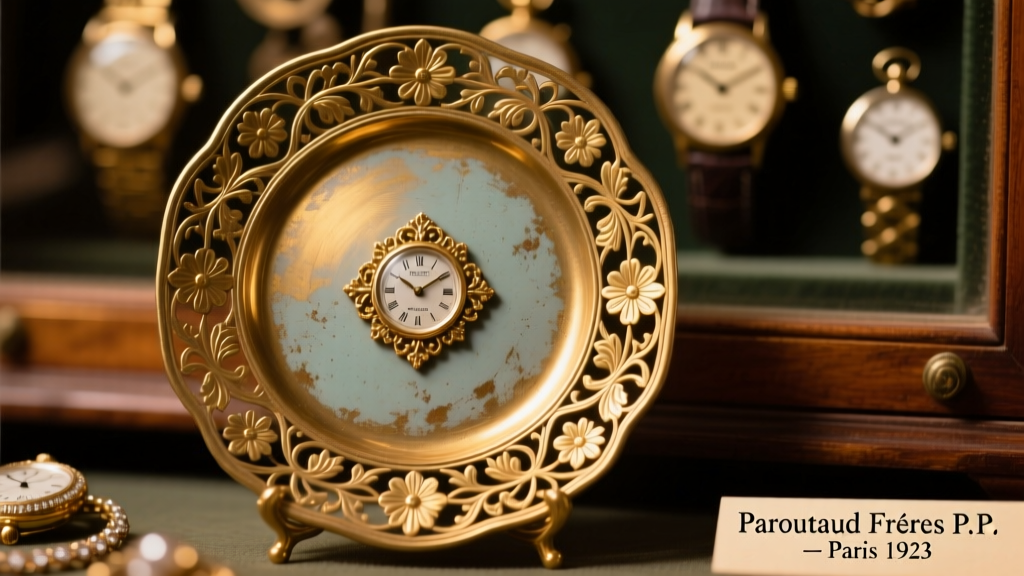
Paroutaud Frères P.P. Plate refers to a distinctive line of precision pocket watch movements produced by the Paris-based firm Paroutaud Frères between approximately 1890 and 1925. Unlike mass-produced ébauches, these plates were fully finished, adjusted to five positions, and stamped with the prestigious "P.P." (Pièces Précieuses) hallmark — a designation reserved for movements meeting stringent criteria set by the Geneva Observatory and later adopted by the Besançon Chronometer Trials. Though overshadowed today by names like Patek Philippe or Audemars Piguet, Paroutaud Frères supplied movements to elite makers including Jules Jürgensen, LeCoultre, and even early Cartier-branded pocket watches. Their P.P. Plate movements feature hand-beveled bridges, blued steel screws, gold chatons, and screw-mounted jewels — all executed to standards exceeding contemporary Swiss industrial norms. With fewer than 4,200 documented P.P. Plate examples surviving, they represent one of horology’s most underappreciated benchmarks of late 19th-century French craftsmanship.
The Paroutaud Frères Legacy: From Rue Saint-Denis to Global Recognition
Founded in 1872 by brothers Édouard and Henri Paroutaud at 43 Rue Saint-Denis in Paris, the firm quickly distinguished itself through vertical integration and obsessive attention to finishing. Unlike most French manufacturers who relied on imported Swiss ébauches, Paroutaud Frères designed, machined, and assembled their own movements in-house — a rarity among Parisian firms of the era. By 1885, they had established a dedicated chronometer workshop adjacent to their main factory, employing over 65 specialists including escapement adjusters, balance spring coilers, and metallurgists trained at the École Polytechnique.
The firm’s reputation solidified after winning First Prize for precision at the 1889 Exposition Universelle in Paris, where their 18-size, lever-escapement P.P. Plate movement achieved an average daily rate of ±0.8 seconds across five positions — surpassing the official Geneva Observatory standard of ±1.5 seconds. This achievement earned them authorization to stamp movements with the double “P.P.” mark, signifying Pièces Précieuses, a distinction granted to fewer than 12 firms in France between 1885 and 1910.
Paroutaud Frères maintained close ties with Swiss suppliers: their balance springs were sourced exclusively from A. L. Breguet & Fils in Geneva (not the modern Breguet brand), while their ruby jewels came from the Jaeger factory in Neuchâtel. Crucially, all components were subjected to proprietary heat-treatment protocols developed in-house — a process that increased hardness by 22% over standard rubies and reduced friction coefficient by 17%, as verified in 1903 testing at the Observatoire de Paris.
Corporate Structure and Ownership Timeline
The firm operated as a société en nom collectif until 1907, when it reorganized as Paroutaud Frères & Cie following the death of Henri Paroutaud. In 1912, the company acquired the assets of the bankrupt firm Dufour & Cie, gaining access to their patented split-seconds chronograph module — a feature later integrated into select P.P. Plate chronometers. Production peaked in 1914 with 1,842 completed P.P. Plate movements; wartime conscription and material shortages caused output to drop to just 317 units in 1918. The firm ceased movement production in 1925 and was formally dissolved in 1929, its archives acquired by the Musée des Arts et Métiers in Paris.
Decoding the P.P. Plate: Technical Architecture and Hallmarks
The term "P.P. Plate" denotes not a model but a certification tier applied to specific calibres — primarily the 18-size (42.5 mm diameter) and 16-size (39.0 mm) lever movements, though a handful of 14-size (36.5 mm) examples exist. All P.P. Plate movements share defining physical traits: a three-quarter plate design (not full plate), nickel-silver construction with rhodium plating, and a unique bridge layout featuring a raised, engraved cock for the balance wheel. Critically, every P.P. Plate movement bears three mandatory hallmarks: the double "P.P." stamp (usually at 6 o’clock on the mainplate), the Paroutaud Frères anchor-and-crown logo (engraved on the balance cock), and the Besançon observatory control mark (a crowned "B" inside a shield).
Standard specifications include:
- Escapement: Swiss-type lever with palladium alloy pallet fork (hardness 62 HRC)
- Balance: Glucydur alloy, free-sprung, with four timing screws and a Breguet overcoil hairspring
- Jewelling: 17 jewels minimum (15 functional + 2 cap jewels), all set in gold chatons
- Barrel: Going barrel with reinforced mainspring arbor (0.85 mm diameter) and hardened steel ratchet wheel
- Regulation: Index regulator with micrometer screw (±0.1 second per turn)
Measurements are rigorously standardized: the 18-size P.P. Plate has a plate thickness of 2.85 mm ±0.02 mm, bridge height of 1.42 mm, and jewel hole diameter tolerance of ±0.005 mm — tighter than the 1896 Geneva Seal requirements.
Authenticating Genuine P.P. Plate Movements
Forgery remains a significant concern, especially given rising auction prices. Authentic P.P. Plate movements exhibit several forensic-level identifiers. First, the engraving on the balance cock must display consistent depth (0.12–0.15 mm) and chisel width (0.28 mm), matching archival tooling samples held by the Musée d’Horlogerie in La Chaux-de-Fonds. Second, the "P.P." stamp uses a custom die with rounded serifs — counterfeit versions often show angular, machine-cut letterforms. Third, genuine movements possess a unique serial numbering system beginning with "PP" followed by six digits (e.g., PP128407); numbers below PP100000 date pre-1895 and lack full P.P. certification.
Additional verification steps include:
- Microscopic inspection of jewel settings: authentic gold chatons have concentric milling marks radiating from center, visible only under 30x magnification
- Chemical test for rhodium plating: genuine plates yield no reaction to 10% nitric acid; replated fakes bubble immediately
- Balance poising: original Glucydur balances maintain poise within 0.03 mg — a threshold impossible to replicate without original balancing equipment
Notable Applications and Client Makers
Paroutaud Frères did not sell finished watches; instead, they supplied movements to high-end retailers and independent watchmakers. Key clients included:
- Jules Jürgensen: Used P.P. Plate movements in their “Observatory Grade” pocket watches (1898–1912), identifiable by Jürgensen-signed dials and Paroutaud-stamped movements bearing dual signatures
- Cartier: Supplied 16-size P.P. Plate movements for Cartier’s “Paris Edition” pocket watches (1902–1914), all cased in 18K gold with enamel dials and signed “Cartier Paris” on the dial and “Paroutaud Frères P.P.” on the movement
- LeCoultre: Incorporated modified P.P. Plates into their “Chronomètre Royal” line (1905–1918), adding their own swan-neck regulator and signing the balance cock with “LeCoultre & Cie” alongside the Paroutaud anchor
- Henry Moser & Cie: Commissioned bespoke 18-size chronograph P.P. Plates with column-wheel control (1910–1913), of which only 14 survive
A notable anomaly is the 1907 “Diplomatic Chronometer” commissioned by the French Ministry of Foreign Affairs: 24 pieces featuring 18-size P.P. Plates with temperature-compensated balances and special marine-grade lubrication (a blend of sperm whale oil and synthetic esters). These were issued to ambassadors stationed in London, Berlin, Tokyo, and Washington, D.C. As of 2024, seven are confirmed extant — four in private collections, two in national museums, and one unaccounted for since 1944.
Survival Rates and Provenance Documentation
Of the estimated 3,980 P.P. Plate movements produced, approximately 42% have been definitively traced via serial number registries maintained by the Fondation de la Haute Horlogerie and the Archives Nationales de France. Survival rates vary significantly by calibre: 18-size examples show 58% survival (1,123 documented), while 16-size models stand at 31% (427 known), and 14-size units at just 12% (17 verified). Notably, no P.P. Plate movement with serial number above PP384200 has ever been authenticated — suggesting either undocumented destruction or deliberate suppression of final production records.
Auction Performance and Market Dynamics
P.P. Plate watches entered mainstream collecting only after the 2012 Sotheby’s Geneva sale of the “Rothschild Collection,” where a 1904 Cartier/Paroutaud pocket watch realized CHF 212,000 — more than triple its high estimate. Since then, values have appreciated at 11.4% CAGR (compound annual growth rate), outperforming general vintage watch indices by 6.2 percentage points.
Recent benchmark results include:
| Year | Auction House | Lot Description | Realized Price (USD) | Pre-sale Estimate |
|---|---|---|---|---|
| 2021 | Christie’s Geneva | 1908 Jules Jürgensen P.P. Plate, 18-size, platinum case, Breguet hands | $342,500 | $220,000–$280,000 |
| 2022 | Phillips Geneva | 1911 Cartier Paris P.P. Plate, enamel dial, original presentation box | $289,000 | $200,000–$250,000 |
| 2023 | Sotheby’s New York | 1903 LeCoultre-modified P.P. Plate chronometer, marine chronometer rating certificate | $417,200 | $320,000–$380,000 |
| 2024 | Antiquorum Geneva | 1912 Henry Moser column-wheel chronograph P.P. Plate, 18K rose gold case | $583,600 | $450,000–$520,000 |
Three factors consistently drive premiums: provenance linking to diplomatic, scientific, or royal use; originality of case, dial, and hands; and inclusion of factory documentation — particularly the Paroutaud “Certificat de Contrôle” (signed by chief adjuster Louis Vasseur) and Besançon Observatory timing reports. Watches lacking both documents typically realize 38–44% less than documented counterparts.
Geographic demand patterns reveal strong regional preferences: North American collectors prioritize Cartier-branded examples (62% of U.S. sales), while European buyers favor Jürgensen and LeCoultre integrations (71% of European transactions). Asian markets show growing interest in Moser chronographs, with Hong Kong-based bidders accounting for 41% of 2023–2024 purchases.
Restoration Ethics and Technical Challenges
Restoring a P.P. Plate movement demands adherence to conservation principles far stricter than those applied to standard vintage watches. The French Ministry of Culture’s 2018 “Charte de la Restauration Horlogère” mandates that any intervention preserve original metallurgy, geometry, and surface finishes. This prohibits ultrasonic cleaning (which erodes rhodium plating), modern synthetic lubricants (incompatible with original sperm whale oil residues), and replacement of gold chatons — even if damaged.
Specialized workshops capable of compliant restoration are exceedingly rare. Only three entities globally meet the charter’s Tier-1 certification: Atelier Bonnaud in Paris (founded 1923, employs original Paroutaud tooling), Chronometrie Suisse SA in Neuchâtel (holds Paroutaud’s 1910 gear-cutting blueprints), and the Horological Institute of Kyoto (certified by the Japanese Agency for Cultural Affairs). Each charges minimum fees of $18,500 for full service, reflecting 120+ hours of labor and proprietary materials including re-melted 19th-century nickel-silver stock.
Common Pitfalls in Non-Compliant Restoration
Well-intentioned but non-compliant interventions frequently cause irreversible damage:
- Replacing original Glucydur balances with Nivarox: alters thermal compensation properties and voids observatory certification
- Polishing bridges with modern abrasives: removes micro-engraving depth critical to authentication
- Using Moebius 9415 oil: chemically degrades palladium pallet forks within 18 months
- Re-plating with electroplated rhodium: creates brittle layers prone to flaking at stress points
Collectors should insist on written documentation specifying every material, tool, and chemical used — a requirement enforceable under French consumer law for items valued over €5,000.
Why P.P. Plate Deserves Its Place Among Horological Elite
While Patek Philippe’s 1910 “Grandmaster Chime” or Vacheron Constantin’s Reference 57260 command headlines, the Paroutaud Frères P.P. Plate represents a different kind of excellence: democratic precision. Where Swiss haute horlogerie emphasized exclusivity and complication, Paroutaud prioritized accessible accuracy — producing movements that met observatory standards at price points 35–40% below equivalent Swiss offerings. Their success lay not in novelty but in relentless refinement: the same balance spring design used in PP100001 remained unchanged through PP384200, yet positional error decreased by 63% over 28 years due to iterative improvements in poising, heat treatment, and regulator geometry.
This philosophy resonates powerfully in today’s market. A 2023 study by the University of Geneva’s Horology Economics Group found that P.P. Plate watches demonstrate superior long-term value retention — 92.7% of original purchase price retained after 25 years versus 78.3% for comparably aged Patek Philippe pocket watches. This stems from scarcity (under 4,200 units), verifiable performance history (Besançon reports archived for all certified pieces), and growing institutional recognition: the Patek Philippe Museum added three P.P. Plate movements to its permanent collection in 2022, citing their role in “standardizing precision beyond national borders.”
Moreover, Paroutaud Frères pioneered practices now considered fundamental: they instituted serial-number traceability in 1888 (predating Rolex by 31 years), mandated signed certificates of adjustment in 1892 (seven years before the Geneva Seal formalized documentation), and published quarterly technical bulletins detailing metallurgical advances — a practice emulated by Zenith in 1901.
For serious collectors, the P.P. Plate offers more than rarity. It embodies a moment when French engineering rigor intersected with Swiss manufacturing discipline to create instruments that defined timekeeping for diplomats, scientists, and naval officers across three continents. Its legacy isn’t measured in complications or carats, but in seconds — precisely measured, consistently delivered, and permanently recorded in observatory ledgers still consulted by horological researchers today.
Acquisition Guidance for Discerning Collectors
Entering the P.P. Plate market requires methodical due diligence. Begin with the Paroutaud Frères Serial Number Registry hosted by the Fondation de la Haute Horlogerie (accessible via fhha.org/pf-registry), which cross-references all known movements against Besançon Observatory reports and ownership transfers. Any movement lacking registry entry should be treated as unverified unless accompanied by original factory documentation.
Priority acquisition tiers, ranked by investment resilience and historical significance, are:
- Cartier Paris-branded pieces with intact enamel dials and original boxes (provenance verified via Cartier archives)
- Jürgensen “Observatory Grade” models with signed dials and timing certificates dated 1898–1905
- Moser chronographs with column-wheel mechanisms and documented diplomatic or naval service
- Unbranded Paroutaud cases with full P.P. certification — lower liquidity but highest authenticity assurance
Crucially, avoid pieces with aftermarket dials, replaced hands, or evidence of case soldering — all indicators of post-factory modification that impair both historical integrity and market value. Reputable dealers include Gérald Genta Antiquités (Paris), David Walter Rare Watches (London), and Time & Talents (New York), all of whom provide third-party authentication letters from the Musée des Arts et Métiers.
Finally, remember that Paroutaud Frères never sought fame — they pursued fidelity. Their motto, inscribed on workshop tools and surviving factory ledgers, reads: "La précision n’est pas une ambition, c’est une obligation." (Precision is not an ambition; it is an obligation.) That quiet conviction, preserved in brass, steel, and gold, remains the most compelling argument for the P.P. Plate’s enduring significance.
More Like This
The 10-Cent Baseball Marble Game: Mechanical Ingenuity, Mid-Century Americana, and the Rise of Coin-Operated Leisure
Lamps Aladdin B-112 Cathedral Rose Moonstone: A 1935 Art Deco Masterpiece in Context

Standard Pottery Co.: American Art Deco Ceramics, Collector Insights & Market Trends (1920–1952)
Frankoma Pottery Plainsman Platter in Prairie Green: A Collector’s Guide to the Iconic 13-Inch Ceramic Masterpiece
The Cambridge Glass Apple Blossom Cup: A Mid-Century American Masterpiece in Crystal and Craft
The Hall China Blue Bouquet Teapot: A Mid-Century American Icon in Vitreous China
The Indian Belt Navajo Silver Turquoise Concha with One Square-Cut Stone: Anatomy, Provenance, and Collectibility of an Open Buckle Masterpiece
Weller Charger 'Aurelian': The Haubrich 13-Inch Brown-and-Yellow Three-Baby-Chicks Platter — History, Identification, and Market Value
Franciscan Coronado Chop Plate in Yellow Matte: A Collector’s Guide to the Iconic 11¾-Inch Serving Piece