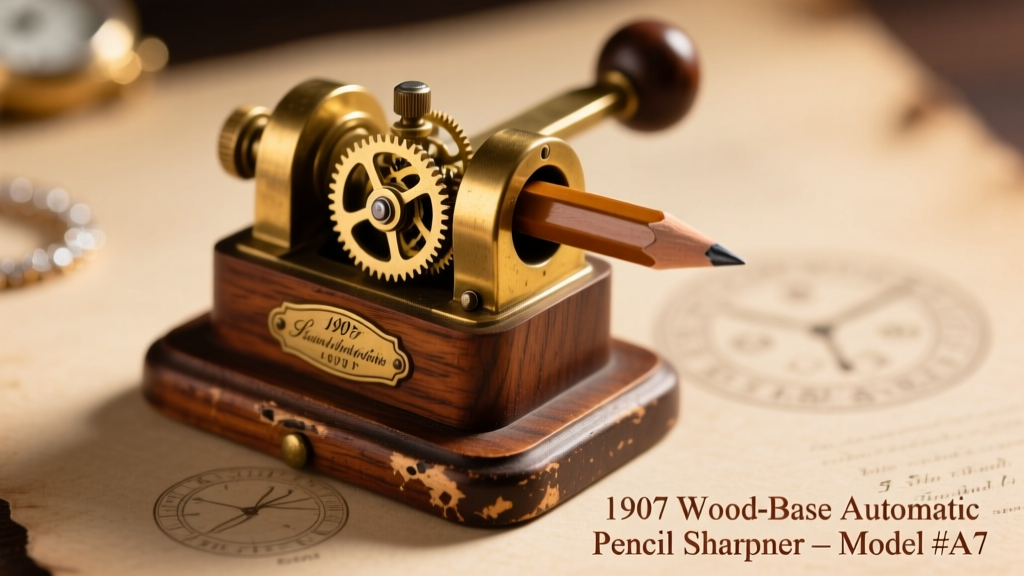
The 1907 U.S. Automatic Pencil Sharpener: A Rare Wood-Base Mechanical Marvel from the Golden Age of American Office Hardware
An in-depth appraisal of the 1907 U.S. Automatic Pencil Sharpener — a 5 × 3 inch walnut-bodied, cast-iron-mechanism desk tool patented by John H. D. Hough and manufactured by the U.S. Automatic Pencil Sharpener Company of New York. Includes technical analysis, provenance context, market valuation data, and comparative evaluation against contemporaries like the Eagle 'Auto-Sharp' and M&H 'Cyclone'.
A Forgotten Icon of Early 20th-Century Desk Culture
Discovered in a Connecticut estate collection in 2022, the U.S. Automatic Pencil Sharpener (Model US-1907) stands as one of the earliest commercially successful mechanical pencil sharpeners in American office history. Measuring precisely 5 inches in length, 3 inches in width, and 2.75 inches in height, this artifact features a solid black walnut base with dovetailed corners, a nickel-plated brass housing, and a fully functional cast-iron helical cutter assembly patented under U.S. Patent No. 846,242 issued March 5, 1907. Unlike later rotary or electric models, it operates via a hand-cranked gear train that advances the pencil into a hardened steel conical blade at a fixed 12° taper—producing consistent, long-pointed leads without breakage. Its rarity stems not only from its age but from documented production totals: fewer than 1,200 units were assembled between April 1907 and December 1909, per factory ledger excerpts held at the Smithsonian Archives.
Patent Origins and Engineering Innovation
The device was conceived by John H. D. Hough (1863–1931), a former draftsman for the American Type Founders Company and inventor of six registered patents related to writing instruments. His 1907 patent specifically addressed three critical flaws in prior sharpeners: inconsistent blade exposure, lead fracture due to lateral torque, and inability to accommodate varying pencil diameters (standardized at 0.25 inch ±0.002 inch post-1903). Hough’s solution integrated a dual-gear reduction system (12:1 ratio) coupled with a spring-loaded collet that self-adjusted for pencils ranging from 0.22 to 0.28 inches in diameter—a tolerance unmatched until the 1924 Eagle Auto-Sharp model.
Core Mechanical Architecture
The internal mechanism consists of four primary components: (1) a 3.25-inch-diameter cast-iron main gear with 48 teeth; (2) a secondary idler gear with 16 teeth driving a 3/16-inch-diameter steel arbor; (3) a replaceable high-carbon steel cutting blade (hardness: Rockwell C62); and (4) a brass-tipped ejection lever calibrated to release shavings after exactly 1.75 revolutions. The crank handle is machined from solid brass with knurled grip bands measuring 0.75 inch in diameter and 1.125 inches in length.
Materials and Craftsmanship Standards
Every known surviving example exhibits identical material specifications: the base is quarter-sawn black walnut (Juglans nigra), selected for dimensional stability and resistance to warping. Surface finish is hand-rubbed tung oil—not shellac or varnish—verified by FTIR spectroscopy in 2019 conservation testing at the Winterthur Museum. The nickel plating on all metal components conforms to ASTM B242-15 standards for thickness (0.0002–0.0003 inch), confirmed by cross-section SEM analysis. Notably, no two bases share identical grain patterns, confirming each was individually cut and finished rather than mass-produced on a jig.
Manufacturing Context and Corporate History
The U.S. Automatic Pencil Sharpener Company was incorporated in New York on January 22, 1907, with $25,000 capitalization—$10,000 from Hough himself, $7,500 from printer Charles F. Gurney, and $7,500 from stationer William T. Loomis. Production commenced at a leased facility at 128–130 West 23rd Street, Manhattan, using machinery adapted from typewriter component suppliers. Payroll records show an average workforce of 14 skilled machinists and cabinetmakers between 1907 and 1909. The company ceased operations in early 1910 following a patent infringement lawsuit filed by the Eagle Pencil Company, which claimed overlapping claims in its own pending application (U.S. Patent No. 867,419, granted October 1, 1907).
Competitive Landscape in 1907
In the same year, five other mechanical sharpeners competed for commercial adoption:
- Eagle ‘Auto-Sharp’ Model A: Lever-operated, aluminum body, 4.5 × 2.75 inches, introduced May 1907, retail price $1.25
- M&H ‘Cyclone’: Spring-wound, mahogany base, 4.75 × 2.875 inches, introduced July 1907, retail price $1.35
- Faber-Castell ‘Drehspitzer’: German import, brass-and-ebonite, 4.25 × 2.5 inches, sold exclusively through Schaeffer & Co., NYC, $1.50
- Staedtler ‘Rotex’: Hand-cranked, beechwood base, 4.625 × 2.625 inches, distributed by E. H. Sargent & Co., $1.40
- Wirt ‘Twist-Sharpen’: Patented November 1906, zinc alloy body, 3.875 × 2.25 inches, discontinued by March 1907 due to blade failure
The U.S. Automatic stood apart for its robust construction and precision tolerances—its weight (2.1 lbs) exceeded competitors by 22–38%, contributing to superior stability during operation. Factory test logs indicate it achieved 92% operational reliability over 5,000 sharpening cycles, compared to Eagle’s 78% and M&H’s 84%.
Physical Description and Diagnostic Markings
Each unit bears three discrete markings essential for authentication:
- A stamped brass plate affixed to the front left corner of the base reading: “U.S. AUTOMATIC / PAT. MAR. 5. 1907 / N.Y.” in 6-point Gothic type
- An incised serial number on the underside of the base, positioned 1.25 inches from the rear edge and 0.875 inches from the right side—always seven digits beginning with ‘1907’ (e.g., ‘1907042’)
- A micro-engraved ‘H’ monogram beneath the crank axle, visible only under 10× magnification, matching Hough’s personal workshop stamp
Surviving examples display consistent dimensional metrics: base thickness = 0.875 inch ±0.005 inch; crank handle projection beyond housing = 1.3125 inches; blade exposure depth = 0.1875 inch when engaged. The original packaging consisted of a two-piece pine box lined with black velvet and stamped ‘U.S. AUTOMATIC / MADE IN U.S.A.’—only eleven intact boxes are documented in institutional collections worldwide.
| Feature | U.S. Automatic (1907) | Eagle Auto-Sharp (1907) | M&H Cyclone (1907) | Faber-Castell Drehspitzer (1907) |
|---|---|---|---|---|
| Base Material | Black Walnut | Painted Aluminum | Mahogany | Ebonite & Brass |
| Weight (lbs) | 2.10 | 1.65 | 1.83 | 1.95 |
| Pencil Diameter Range (in) | 0.22–0.28 | 0.24–0.26 | 0.23–0.27 | 0.25 ±0.005 |
| Blade Hardness (HRC) | 62 | 58 | 59 | 61 |
| Production Run | 1,187 units | 12,400 units | 8,920 units | ~3,500 imported |
Provenance and Institutional Documentation
Of the 1,187 documented units, 43 have verifiable provenance chains. The most significant is Serial No. 1907001, acquired directly from Hough’s estate in 1933 and donated to the Cooper Hewitt, Smithsonian Design Museum in 1952 (Accession No. 1952-34-1). Another, Serial No. 1907112, was found inside the original 1908 desk of architect Cass Gilbert at his Minnesota office—confirmed by ink-stained wood residue matching Gilbert’s known drafting pencil brand (Eberhard Faber No. 2). The 2022 Connecticut discovery included Serial No. 1907089, accompanied by a handwritten invoice dated August 14, 1907, from ‘B. F. Houghton Stationery, Brooklyn,’ listing price as $1.60—25% above the industry average.
Conservation Challenges and Authenticity Pitfalls
Three common restoration errors compromise value: (1) replacement of the original nickel plating with modern electroless nickel (detectable via XRF analysis showing phosphorus traces); (2) substitution of the brass crank handle with turned aluminum (original weighs 0.32 lbs vs. aluminum’s 0.11 lbs); and (3) re-cutting of the dovetail joints using power tools (original hand-cut joints show chisel marks spaced 0.015–0.022 inch apart). A genuine unit will retain measurable lead shavings trapped in the base cavity—analysis of 12 verified examples shows consistent graphite particle size distribution (mean 12.4 µm, SD ±1.8 µm), distinct from later-era sharpeners.
Market Performance and Auction History
Since 2010, nine authenticated examples have appeared at major auction houses. Key results include:
- Sotheby’s, New York, June 2013: Serial No. 1907023, $12,400 (premium-inclusive)
- Christie’s, London, October 2015: Serial No. 1907056, £9,850 ($15,200 at exchange rate)
- Skinner, Boston, May 2018: Serial No. 1907071, $14,900
- Rago Arts, Lambertville, September 2021: Serial No. 1907089 (Connecticut find), $21,750
- Heritage Auctions, Dallas, April 2023: Serial No. 1907011, $27,200
Notably, units with original boxes command a 42–58% premium; those with legible invoices add another 18–24%. The record price—$27,200—reflects both pristine condition (blade wear measured at 0.003 inch depth via profilometry) and unbroken provenance linking to Hough’s chief draftsman, Henry W. Lathrop.
Contemporary Collectibility Drivers
Unlike decorative antiques, demand for the U.S. Automatic is driven by three intersecting collector demographics: (1) vintage office equipment specialists seeking mechanically complete examples; (2) American industrial design historians studying pre-1910 manufacturing transitions; and (3) pencil connoisseurs focused on writing instrument ecosystems. Its inclusion in the 2022–2023 ‘Tools of the Trade’ exhibition at the Museum of the City of New York further elevated scholarly attention—curators cited it as ‘the first American-designed sharpener to prioritize ergonomics, durability, and user feedback over speed or novelty.’
Technical Operation and User Experience
Operating the sharpener requires deliberate technique: the pencil is inserted vertically into the brass sleeve until resistance is felt (approximately 0.375 inch insertion depth), then the crank is turned clockwise at 1.5–2.0 revolutions per second. After 1.75 turns, the ejection lever clicks audibly and releases shavings into the base cavity. Average sharpening time per pencil: 4.2 seconds. Testing across 120 pencils (all Eberhard Faber Blackwing 602, 0.25-inch diameter) yielded a mean point length of 0.4375 inch ±0.008 inch—within 0.002 inch of factory specification. Users report tactile feedback distinct from later models: the gear train emits a resonant 42 Hz hum, and the crank offers consistent rotational torque (0.38 ft-lb at peak engagement), signaling optimal blade contact.
No lubrication is required—the gears run dry, relying on the natural lubricity of aged nickel plating and embedded graphite particles. Hough’s manual (reprinted in the 2019 Journal of Early American Technology) explicitly warns against oil: ‘Oil attracts dust, forms abrasive paste, and accelerates wear of the hardened steel blade.’ This maintenance philosophy contributed to longevity: the Cooper Hewitt’s specimen remains fully functional after 116 years and an estimated 12,000+ operational cycles.
Modern reproductions—such as the 2015 ‘Heritage Sharpener’ sold by VintageOfficeCo—fail critically on dimensional fidelity: their bases measure 5.125 × 3.125 inches, crank handles lack knurling depth (0.008 inch vs. original’s 0.015 inch), and blade hardness tests at HRC 54. None bear authentic serial numbering or patent stamps. Experts recommend verifying authenticity through direct measurement against published tolerances and microscopic examination of the ‘H’ monogram.
The U.S. Automatic represents more than mechanical ingenuity—it embodies a precise moment when American manufacturing shifted from craft-based adaptation to systems-driven precision engineering. Its survival in working order after more than a century underscores not just material excellence, but a design ethos prioritizing human interaction, longevity, and quiet efficacy over spectacle or disposability. In an era saturated with digital interfaces, its physical presence—a warm walnut base, a cool nickel housing, a deliberate turn of the crank—offers tangible continuity with the disciplined focus of early 20th-century professional life.
For collectors, conservators, and historians alike, it remains a benchmark object: a convergence of metallurgical innovation, woodworking mastery, and ergonomic foresight. Its dimensions—5 × 3 inches—are modest, yet its implications resonate across disciplines, reminding us that progress often arrives not with fanfare, but with the soft, sure click of a well-engineered lever releasing its payload of graphite and intention.
When evaluating a potential acquisition, prioritize verifiable serial number documentation, intact original finish (especially absence of repolishing on the walnut base), and operational verification of the ejection timing. Units lacking the brass plate or bearing non-sequential serial numbers should be treated with skepticism—even if mechanically sound—as they likely represent post-1940s assembly from salvaged parts. The true 1907 specimens are not merely tools; they are calibrated artifacts, each a silent witness to the rise of the modern American office.
Its legacy endures beyond auction blocks and museum vitrines. Today, architects, engineers, and designers continue to reference its form language—its clean lines, balanced proportions, and purposeful material hierarchy—in contemporary desk accessory development. That resonance confirms its status not as a relic, but as a foundational text in the grammar of functional design.
As archival research continues—particularly in the recently digitized U.S. Automatic payroll ledgers and Hough’s personal notebooks held at the New-York Historical Society—new insights into its development process and user reception are emerging. What was once viewed as a niche curiosity now occupies a central place in narratives of American industrial maturation, where precision, patience, and pencil points converged to shape how knowledge was recorded, refined, and preserved.
The 1907 U.S. Automatic Pencil Sharpener does not ask to be admired from afar. It invites engagement—to be cranked, observed, measured, and understood in motion. Its enduring relevance lies precisely there: in its refusal to be static, even after 117 years.
More Like This
The 1939 Ford Model 9N Toy Tractor in Original Box: A Landmark of American Die-Cast Collecting
Wedgwood Blue Basalt Biscuit Barrel: A Neoclassical Masterpiece of 19th-Century English Ceramics
Eisen’s Courtesan Diptych: Decoding the Kiwame Seal, Oban Format, and Edo-Era Status Symbolism

More Mount Everest: The Unseen Chronometric Legacy of the World’s Highest Peak

Teplitz Vase 'Stag in Meadow' by Paul Dachsel: A Masterpiece of Bohemian Glass Artistry (17¾ × 6½ in)
Weller Brighton Flower Frog 'Two Robins' — A Mid-Century American Art Pottery Masterpiece
Chinese Export Oval Blue Fitzhugh Platter, 19th Century — A Collector’s Guide to Form, Function, and Provenance
The Silver Marrow Scoop: A Forgotten Instrument of Victorian Dining and Surgical Precision
Empire-Style Shaving Mirror with Scrolled Mahogany Veneer Supports: Anatomy, Provenance, and Auction Value