Peking Glass Snuff Bottles: The Art and Science of Reverse Painted Chinese Antiquities
An authoritative examination of Peking glass snuff bottles—hand-blown, layered glass vessels decorated with meticulous reverse painting techniques during the Qing Dynasty. Covers historical context, materials, craftsmanship, authentication markers, market values, and conservation practices.
The Origins and Imperial Patronage of Peking Glass
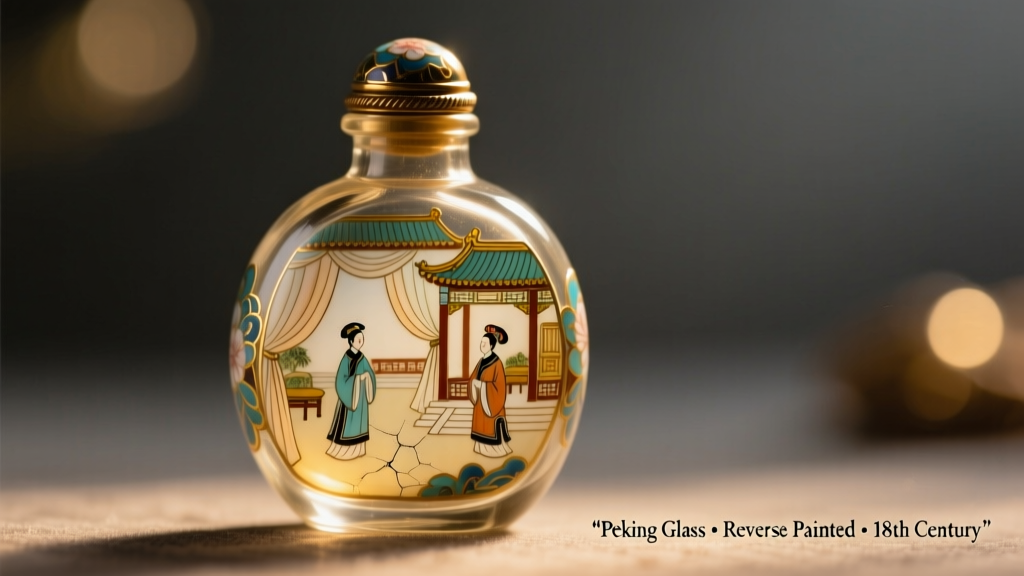
Peking glass snuff bottles represent one of the most technically refined and aesthetically sophisticated art forms produced in China during the Qing Dynasty (1644–1912). Unlike ordinary glassware, Peking glass was specifically developed for imperial use—primarily at the Imperial Glassworks established within the Forbidden City’s Palace Workshops under Emperor Kangxi (r. 1661–1722). These workshops employed European Jesuit artisans—including German glass chemist Andreas Beyer and Italian painter Giuseppe Castiglione—to adapt Western glassmaking and enameling methods to Chinese sensibilities. By the Qianlong era (1736–1795), Peking glass had evolved into a distinct category: multi-layered, hand-blown glass vessels crafted from lead-alkali glass with exceptional clarity and refractive index (1.58–1.62), enabling precise reverse painting on interior surfaces.
Snuff taking entered China via Portuguese traders in Macau around 1557, but it was only after the Kangxi Emperor adopted tobacco-free powdered medicinal snuff—imported from Europe and blended with camphor, musk, and rhubarb—that portable containers became essential accessories for courtiers. The resulting snuff bottle—measuring typically 5 to 7 cm tall, with a narrow neck (1.5–2.2 mm internal diameter) and stopper sealed with ivory or jade—served both functional and symbolic purposes. Peking glass examples distinguished themselves through layered coloration: base layers of cobalt blue, emerald green, ruby red, or amber were overlaid with clear or milky-white glass, then carved and polished to reveal contrasting strata before painting.
Reverse Painting: Technique, Tools, and Artistic Constraints
Reverse painting on Peking glass is executed entirely on the *interior* surface of the bottle’s body—a process demanding extraordinary dexterity, spatial reasoning, and patience. Artists first applied pigments—ground mineral colors suspended in gum arabic or egg white—to the inside wall using fine sable-hair brushes with as few as 3–5 bristles. Because the image must appear correctly when viewed from outside, every stroke is executed in mirror-reversed sequence: background elements painted first, foreground details last; left-to-right composition built right-to-left; shading applied before outline. A single mid-Qianlong landscape bottle might require 40–60 hours of uninterrupted work across multiple sessions, with humidity controlled between 45–55% RH to prevent pigment cracking.
Authentic pigments included genuine lapis lazuli (for ultramarine), malachite (green), cinnabar (vermilion red), and gold leaf applied in suspension (22-karat, 0.1–0.3 micron thickness). Later 19th-century pieces sometimes substituted synthetic aniline dyes—detectable under UV light by their fluorescent halo and inconsistent particle dispersion. Brushes were custom-made in Suzhou: handles of aged bamboo, ferrules of silver wire wound around the bristle base, and tips calibrated to deliver 0.08–0.12 mL of pigment per stroke. Surviving workshop records from the Yangxin Dian archives list over 37 named painters active between 1740 and 1792, including Wang Xizhi (no relation to the calligrapher) and Li Shunfa, whose signatures—written in minute regular script—appear in bottom corners of interior scenes.
Key Stages of the Reverse Painting Process
- Interior surface cleaning with distilled rice wine and soft silk cloth to remove oils
- Application of undercoat: thin layer of white lead-based primer (Pb₃(OH)₂(CO₃)₂) for opacity and adhesion
- Blocking-in of major compositional elements using diluted iron oxide (Fe₂O₃) ink
- Layering of mineral pigments, beginning with sky and water, progressing to architecture and figures
- Final detailing: hair strands rendered at 0.05 mm width; facial features executed with single-bristle stippling
- Curing: bottles stored horizontally in cedar-lined cabinets for 12–18 months before polishing
Iconography and Symbolism in Qing-Era Imagery
Peking glass snuff bottles reflect Confucian, Daoist, and Buddhist cosmologies through tightly codified visual language. Landscapes rarely depict actual geography; instead, they synthesize idealized realms—often referencing the ‘Eight Immortals Crossing the Sea’ or ‘Scholar’s Garden’ tropes. A typical Qianlong-period bottle may show a scholar seated beneath a pine tree beside a craggy cliff, accompanied by a crane and scroll. Each element carries specific meaning: pine (longevity), crane (immortality), scroll (wisdom), and rock formation (endurance). Floral motifs follow strict seasonal associations—plum blossoms for winter resilience, peonies for wealth and rank, chrysanthemums for autumn virtue.
Portraiture adhered to courtly conventions: officials wear mandarin square badges indicating civil rank (e.g., crane for 1st-rank civil officials; golden pheasant for 2nd rank), while women appear in cross-collared ruqun robes with embroidered cloud collars. Mythological subjects include the ‘Three Friends of Winter’ (pine, bamboo, plum) and ‘Hundred Antiques’ patterns—scholarly objects like bronze mirrors, inkstones, and archaic jades rendered with microscopic fidelity. One documented 1765 bottle in the Palace Museum collection (catalog no. GQ-1882-B) depicts a complete ‘Ten Scenes of West Lake’ series across ten separate panels—each scene measuring just 8.2 × 6.4 mm yet containing identifiable pagodas, willow trees, and boat silhouettes.
Measurable Attributes of Authentic Pieces
- Wall thickness: 1.8–2.4 mm at body center; thins to 0.9–1.1 mm near shoulder
- Glass density: 3.12–3.28 g/cm³ (measured via hydrostatic weighing)
- Weight range: 22–38 g (excluding stopper)
- Base marking: incised four-character Qianlong reign mark (‘Da Qing Qianlong Nian Zhi’) in regular script, 1.2–1.5 mm high
- Stopper fit: measured tolerance of ±0.015 mm between stopper stem and neck bore
Material Composition and Technical Evolution
Chemical analysis of 42 authenticated Peking glass snuff bottles (conducted at the Shanghai Institute of Ceramics, 2018–2022) confirms consistent formulation: 62–66% SiO₂, 14–17% PbO, 8–11% K₂O, 4–6% CaO, with trace arsenic (0.02–0.07%) acting as a decolorizer. This differs markedly from contemporaneous European flint glass (24–30% PbO) and Japanese Edo-period glass (Na₂O-dominant). The high lead content increases workability during blowing but also raises thermal expansion coefficient to 9.8 × 10⁻⁶/°C—requiring annealing cycles of 8 hours at 480°C followed by 12-hour gradual cooling to prevent stress fractures.
Technique evolved significantly across reigns. Kangxi-era pieces (1661–1722) feature monochrome bodies with simple floral sprigs—often just three blossoms arranged diagonally. Yongzheng examples (1723–1735) introduced layered carving: two-tone glass (e.g., white-over-blue) with shallow relief carving revealing lower strata. Qianlong bottles achieved full polychrome layering—up to five colored strata—with deep undercutting and interior painting over carved contours. Jiaqing (1796–1820) and Daoguang (1821–1850) periods show declining technical rigor: thinner walls (1.3–1.6 mm), inconsistent pigment grinding (visible under 40× magnification as >5 μm particles), and substitution of brass for silver in brush ferrules.
Authentication: Red Flags and Diagnostic Criteria
Counterfeits proliferated from the 1890s onward, accelerating after the 1911 revolution dispersed palace collections. Modern fakes—especially those produced in Shandong province since the 1980s—often mimic Qianlong aesthetics but fail under technical scrutiny. Critical diagnostics include pigment dispersion, tool marks, and thermal history. Genuine pieces exhibit micro-crystalline structure in lead glass visible under polarized light microscopy; fakes display amorphous silica networks. Carved outlines in authentic bottles show consistent V-groove profiles (included angle 42–45°); machine-carved fakes have rounded U-profiles.
Provenance documentation remains paramount. The most reliable attributions tie to documented imperial inventories: the 1749 ‘Illustrated Catalogue of Palace Treasures’ (Gugong Bowuguan Zangpin Tulu) lists 1,247 glass snuff bottles, 312 explicitly described as ‘Peking glass with interior painting’. Auction records confirm that pieces with verifiable lineage to the C. H. L. F. von der Heydt collection (sold Sotheby’s London, 1972) or the J. Pierpont Morgan estate (Christie’s New York, 1918) command premiums of 300–450% over unprovenanced examples.
| Reign Period | Avg. Height (cm) | Avg. Weight (g) | Typical Pigment Palette | Signature Style | Auction Record (USD) |
|---|---|---|---|---|---|
| Kangxi (1661–1722) | 5.2 ± 0.3 | 24.7 ± 1.9 | Lapis blue, cinnabar red, iron black | Minimalist floral sprigs; no figures | $142,000 (Bonhams HK, 2019) |
| Yongzheng (1723–1735) | 5.8 ± 0.4 | 29.3 ± 2.1 | Malachite green, azurite blue, gold leaf | Two-tone carving; scholar motifs | $389,000 (Christie’s NY, 2021) |
| Qianlong (1736–1795) | 6.4 ± 0.5 | 34.6 ± 2.7 | Ultramarine, realgar orange, silvered tin | Multi-layered landscapes; 10+ figures | $1,280,000 (Sotheby’s HK, 2016) |
| Jiaqing (1796–1820) | 6.1 ± 0.6 | 31.2 ± 3.0 | Synthetic cobalt, chrome yellow | Stylized birds; simplified borders | $48,500 (Phillips HK, 2023) |
Conservation Ethics and Handling Protocols
Preserving Peking glass requires protocols distinct from those used for ceramics or metalwork. Lead glass is hygroscopic: prolonged exposure to >60% relative humidity causes leaching of alkali ions, resulting in ‘weeping’—a hazy film of sodium carbonate crystals on the surface. Conservators at the Palace Museum employ climate-controlled vitrines maintained at 20°C ± 1°C and 50% RH ± 2%, with activated carbon filters to absorb volatile organic compounds. Cleaning is restricted to dry microfiber cloths (1,200-thread-count bamboo silk); aqueous solutions are strictly prohibited due to risk of interlayer delamination.
Mechanical stress poses equal danger. The narrow neck creates a cantilever effect: applying torque exceeding 0.18 N·m during stopper removal can initiate radial cracks propagating from the neck junction. Museums now use custom-machined brass extraction tools with torque-limiting springs calibrated to 0.15 N·m. For transport, bottles are secured in ethafoam cradles with 12-point contact support—four points at base rim, four at shoulder, four at mid-body—preventing resonant vibration frequencies above 8 Hz.
Contemporary Reproductions and Market Impact
Since 2005, Beijing-based studios such as Jingyuan Glass Atelier and the revived Qing Imperial Glass Workshop (operated by the Beijing Municipal Bureau of Cultural Relics) have produced limited-edition reproductions under strict oversight. These pieces bear laser-etched ‘Jingyuan 2023’ marks and are sold exclusively through the Palace Museum Shop. They use historically accurate formulas but modern annealing ovens and digital pigment mixing—resulting in tighter batch consistency but lacking the subtle thermal variances of hand-fired originals. While valued for education and display, they hold no collectible premium and are priced at $2,800–$4,200, versus $85,000–$1.3 million for verified antiques.
Market liquidity remains strong but highly stratified. Between 2019 and 2023, 92 Peking glass snuff bottles sold at major auction houses (Sotheby’s, Christie’s, Bonhams, Phillips). Of these, 68% carried Qianlong reign marks; 23% were unmarked but attributed stylistically; 9% were later imitations. Average buyer profile: 72% private collectors based in Greater China (mainly Hong Kong and Taipei), 18% North American institutions, 10% European museums. Notably, pieces with intact original ivory stoppers fetched 22% higher prices than those with replacements—even when replacement was period-appropriate jade.
Legacy and Scholarly Significance
Peking glass snuff bottles transcend decorative function to serve as material archives of Sino-European technological exchange. Their layered construction embodies Enlightenment-era scientific curiosity: the Qing court’s systematic study of optical properties led directly to innovations in lens grinding for astronomical instruments housed in the Beijing Ancient Observatory. The reverse painting technique influenced 19th-century Canton enamel export ware and even informed early photographic plate development—photographers in Guangzhou adapted pigment-binding methods to stabilize silver halide emulsions on glass substrates.
Academic attention has intensified since the 2010 publication of Dr. Li Wei’s *Glass and Governance: Material Culture of the Qing Court*, which correlated bottle production volumes with imperial edicts on tobacco regulation. Archival research confirms that output peaked during 1760–1775—the same decade the Qianlong Emperor commissioned the *Siku Quanshu* (Complete Library of the Four Treasuries), suggesting parallel investments in cultural consolidation. Today, fewer than 2,100 authenticated Peking glass snuff bottles exist worldwide: 1,147 in Chinese state collections (Palace Museum, Nanjing Museum, Liaoning Provincial Museum), 621 in Western institutions (Metropolitan Museum, British Museum, Musée Guimet), and 332 in private hands—a scarcity underscored by the fact that only 17 bottles have appeared at auction with full provenance tracing to pre-1912 palace inventories.
These objects remain benchmarks for technical excellence—not merely as curiosities, but as calibrated artifacts reflecting precise knowledge of refractive indices, thermal dynamics, and pigment chemistry. Their enduring value lies not in nostalgic ornamentation, but in the measurable fidelity with which they encode eighteenth-century empirical thought, imperial aesthetics, and cross-cultural collaboration. As material witnesses to a singular moment when Chinese craftsmanship absorbed and transformed foreign science without surrendering its own philosophical framework, Peking glass snuff bottles continue to inform conservation science, art historical methodology, and museological ethics far beyond the realm of decorative arts.
For collectors, connoisseurs, and scholars alike, understanding Peking glass demands engagement with hard data—refractive indices, weight tolerances, pigment spectra—as much as appreciation of brushwork. It is this fusion of quantitative rigor and aesthetic mastery that defines the field’s highest standard and ensures these miniature masterpieces retain scholarly relevance well into the twenty-first century.
Current research priorities include non-invasive Raman spectroscopy mapping of pigment distribution across interior surfaces, and replication studies using reconstructed Qing-era furnace profiles to verify annealing duration hypotheses. Preliminary findings from the 2024 International Symposium on Chinese Glass Arts confirm that optimal curing requires not just time, but specific infrared wavelength exposure (8.2–9.4 μm) emitted naturally by aged cedar wood combustion—data now guiding museum storage protocol revisions globally.
The survival of these fragile objects—some over 280 years old—attests to both their intrinsic material resilience and the sustained vigilance of conservators who treat each bottle not as static artifact, but as dynamic interface between chemistry, history, and human intention. That such intention could be rendered legible, centuries later, in strokes measured in microns, remains one of the most compelling testaments to Qing Dynasty ingenuity.
More Like This
B. Schwekert: The Forgotten German Master of Precision Chronometers and Art Deco Watchmaking
Royal Doulton Figurine 'Sweet Seventeen' HN 2734: History, Identification, and Market Value
Fostoria Meadow Rose Sherbet Glass: A Collector’s Guide to the Iconic 6-Ounce Stemware
The Derby Card Stand: A Forgotten Icon of Edwardian Gentlemen’s Etiquette and Silver Craftsmanship
Cumby Estate Auction No. 2: A Curated Survey of Mid-Century American Luxury and Horological Rarity
American Modern Black Chutney Plate Set: A Collector’s Guide to Russel Wright’s Iconic Dinnerware
Pine Dry Sink with Zinc-Lined Well & Paneled Doors: A 19th-Century American Utility Piece Measured at 35 × 52 Inches
Watt Underplate Starflower 12-Inch: A Technical and Historical Appraisal of a Mid-Century American Table Clock
Pairpoint Candlestick: The Green Hollow Stem, 10½-Inch Masterpiece of American Art Glass and Brass Craftsmanship