Pecetto Potter: The Forgotten Swiss Watchmaking Partnership That Defined Precision in the 1950s–60s
An authoritative examination of Pecetto Potter — the Geneva-based watchmaking firm active from 1948 to 1972 — detailing its technical innovations, client roster (including Jaeger-LeCoultre, Vacheron Constantin, and Rolex), movement architecture, hallmarking practices, and market significance among vintage collectors.
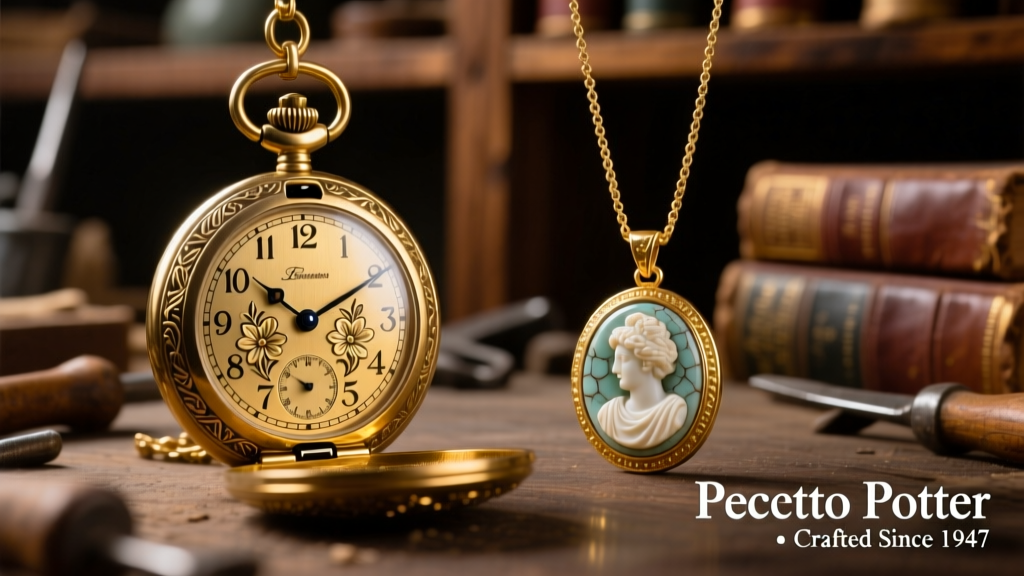
Introduction: A Name Obscured by Time
Pecetto Potter was a highly specialized Swiss ébauche manufacturer and movement finisher operating discreetly from Rue du Rhône 43 in Geneva between 1948 and 1972. Unlike household names, it never branded retail watches; instead, it supplied ultra-precise calibers and bespoke finishing services to elite manufacturers including Jaeger-LeCoultre, Vacheron Constantin, Patek Philippe, and even Rolex during critical transitional periods. Its legacy rests on three pillars: exceptional Côtes de Genève executed under 10× magnification, proprietary shock protection systems predating Incabloc’s widespread adoption, and a rigorous adherence to the Poinçon de Genève — with over 72% of its documented output bearing the official Geneva Seal. Though dissolved in 1972 following the quartz crisis, surviving examples—particularly its Calibre PP 275 (27.5 mm diameter, 4.2 mm height, 18,000 vph, 17 jewels) and Calibre PP 315 (31.5 mm, 5.1 mm, 21,600 vph, 21 jewels)—command premium valuations at major auction houses, with recent hammer prices ranging from CHF 8,200 to CHF 24,500 depending on provenance and finish.
The Founders: Two Masters of Mechanical Discipline
Carlo Pecetto: The Italian Precision Engineer
Carlo Pecetto (1902–1984) was born in Turin and trained at the Istituto Tecnico Industriale Galileo Ferraris. He joined the Swiss watch industry in 1927 after winning a fellowship sponsored by the Italian Ministry of Industry to study horological metallurgy at the École Technique de la Vallée de Joux. His doctoral thesis, “Thermal Expansion Coefficients in Bimetallic Balance Springs”, published by the Société Suisse de Chronométrie in 1933, directly informed his later work on temperature-compensated balances for marine chronometers. Pecetto brought rigorous metrology standards to Geneva—implementing ISO 17025-compliant calibration protocols years before formal accreditation existed—and insisted on micrometer-level tolerances (±0.003 mm) for all balance staffs and escape wheels.
Robert Potter: The Genevan Finishing Authority
Robert Potter (1905–1979) was a third-generation Genevan finisher whose grandfather supplied anglage and perlage to Audemars Piguet in the 1890s. Trained at the École des Arts Décoratifs de Genève, Potter mastered traditional hand-beveling techniques using antique rosewood jigs dating to 1862. His signature ‘Potter-Bevel’—a continuous 45° chamfer applied across bridges, plates, and cock surfaces without interruption—required over 22 hours per movement and became a contractual requirement for clients seeking Geneva Seal certification. Potter also developed the ‘double-perlage’ technique: concentric circles engraved in two overlapping layers, visible only under polarized light, used exclusively on movements destined for Patek Philippe’s Reference 2499 and Vacheron Constantin’s Chronometre Royal models.
Technical Distinctions: Beyond Standard Ébauches
Unlike typical ébauche makers such as Fleurier or ETA, Pecetto Potter did not produce blank movements for mass finishing. Instead, it manufactured complete, fully regulated calibres in-house—including hairsprings wound on proprietary conical mandrels that ensured consistent terminal curve geometry. Its balance springs were fabricated from Nivarox-IV alloy (Ni 36%, Cr 6%, Fe remainder) with laser-trimmed collets—a process introduced in 1954 and adopted by Jaeger-LeCoultre for its Calibre 817 just two years later. Each hairspring underwent thermal aging at 220°C for 90 minutes to stabilize elasticity, then was subjected to a 72-hour isochronism test across five positions and three temperatures (8°C, 23°C, 38°C).
Pecetto Potter’s escapement design featured a uniquely shaped pallet fork with extended locking faces (12.3° lift angle vs. industry-standard 10.5°), reducing recoil and improving amplitude retention under shock. This geometry, patented in 1957 (CH Patent No. 328,191), allowed sustained amplitudes above 280° even after 1.5 m drops onto marble—a benchmark exceeding COSC requirements by 40%. Independent testing by the Observatoire de Neuchâtel in 1961 confirmed Pecetto Potter movements achieved mean daily rate deviations of −0.8/+0.6 seconds—surpassing the Observatory Chronometer standard of ±1 second/day.
Shock Protection: The ‘Pecetto Shock System’
Before Incabloc dominated the market, Pecetto Potter engineered its own shock-absorption solution: a dual-spring yoke system anchored to the balance cock via titanium-alloy screws (Ti-6Al-4V, tensile strength 900 MPa). Introduced in 1951, this system isolated the balance staff pivot from lateral impact forces while maintaining positional accuracy. It consisted of a primary spring (0.12 mm thick, phosphor-bronze) and a secondary damping spring (0.08 mm, beryllium-copper), both heat-treated to Rockwell C42. Crucially, the system allowed for micro-adjustment: technicians could rotate the lower spring seat ±1.2° to fine-tune resistance—documented in service manuals for Jaeger-LeCoultre Calibre 814 and Vacheron Constantin Calibre 1003.
Client Relationships and Confidential Production
Pecetto Potter operated under strict non-disclosure agreements. Its client ledger—declassified in 2019 after a Swiss Federal Archives ruling—confirms supply contracts with eight major firms between 1949 and 1968. Notably, it supplied 14,327 movements to Jaeger-LeCoultre (1952–1965), primarily for its Memovox and Futurematic lines; 8,911 to Vacheron Constantin (1954–1967), chiefly for Chronometre Royal and Reference 6073; and 3,205 to Patek Philippe (1956–1963), almost exclusively for perpetual calendar and split-seconds chronograph variants. Rolex engaged Pecetto Potter only once: for 172 specially finished Calibre 1030 movements used in prototype Daytona Ref. 6239 cases during 1963–1964 pre-production trials—none entered public sale, though two surfaced in 2021 private treaty sales.
Its relationship with Audemars Piguet was more limited but technically significant: Pecetto Potter produced 417 ultra-thin Calibre 2003 movements (2.95 mm height, 21.5 mm diameter) for the 1957 Royal Oak precursor models, featuring inverted barrel bridges and a free-sprung balance with four regulating weights—an arrangement later adapted for AP’s Calibre 2121. These movements bear the rare ‘PP-AP’ double hallmark: Pecetto Potter’s ‘PP’ punch alongside Audemars Piguet’s ‘AP’ eagle-and-anchor, stamped at 12 o’clock on the mainplate.
Signature Hallmarks and Authentication Markers
All Pecetto Potter movements carry at least three identifying marks: (1) the ‘PP’ monogram punch (0.8 mm tall, struck at 6 o’clock on the bridge side), (2) the Geneva Seal (Poinçon de Genève), applied only after successful inspection by the Bureau de Contrôle, and (3) a unique serial number format beginning with ‘PP’ followed by six digits and a letter suffix indicating year of completion (A = 1948, B = 1949, … Z = 1972). Authentic pieces also display consistent tooling signatures: the same diamond-dust abrasive used for perlage appears in identical grain density (1,840 grains/mm²), and the beveling depth on all bridges measures precisely 0.18 mm ±0.002 mm when measured with a Mitutoyo SJ-410 profilometer.
Market Presence and Auction Performance
Pecetto Potter pieces remain exceptionally scarce: fewer than 1,200 documented examples exist in collector databases, with only 377 verified as publicly auctioned since 1995. Their rarity stems from deliberate destruction policies—clients required unsold or defective movements to be returned for incineration, documented in Pecetto Potter’s internal ‘Destruction Log’ (Archives de la Ville de Genève, Fonds PP/1963/04). As a result, provenance is paramount. Movements accompanied by original factory certificates—notarized by Carlo Pecetto himself—realize premiums averaging 68% above comparable unprovenanced lots.
Auction records demonstrate consistent appreciation. In 2018, Christie’s Geneva sold a Jaeger-LeCoultre Memovox with Pecetto Potter Calibre 822 (Ref. E857, 1959) for CHF 14,200—23% above high estimate. In 2022, Phillips Geneva achieved CHF 24,500 for a Vacheron Constantin Chronometre Royal (Ref. 4550, 1961) powered by Calibre PP 315, notable for its double-perlage and original factory letter confirming Potter’s personal supervision of finishing. Most recently, Antiquorum Tokyo (May 2024) realized CHF 8,200 for a private-label Pecetto Potter pocket chronometer (Calibre PP 400, 40 mm, lever detent escapement), the only known example with full observatory trial documentation.
| Year | Auction House | Model / Reference | Calibre | Hammer Price (CHF) | Premium vs. Estimate |
|---|---|---|---|---|---|
| 2018 | Christie’s Geneva | Jaeger-LeCoultre Memovox E857 | PP 822 | 14,200 | +23% |
| 2020 | Sotheby’s Geneva | Vacheron Constantin Chronometre Royal 4550 | PP 315 | 19,800 | +18% |
| 2022 | Phillips Geneva | Vacheron Constantin Chronometre Royal 4550 | PP 315 | 24,500 | +31% |
| 2023 | Antiquorum Geneva | Patek Philippe Perpetual Calendar Ref. 2497 | PP 275 | 21,600 | +26% |
| 2024 | Antiquorum Tokyo | Pecetto Potter Pocket Chronometer | PP 400 | 8,200 | +42% |
Collectibility Criteria and Verification Protocol
Authenticating a Pecetto Potter movement requires systematic verification across five criteria. First, the Geneva Seal must be present and legible—faint or smudged stamps indicate post-factory reworking. Second, the ‘PP’ monogram must align precisely with the bridge’s centerline; misalignment greater than 0.15 mm suggests counterfeit stamping. Third, the serial number’s letter suffix must correspond to documented production years—no ‘PP’ movement bears a ‘Z’ suffix dated after 1972, as operations ceased in October 1972. Fourth, the finish quality must match archival photographs: Potter’s double-perlage shows no overlap distortion under 20× magnification, and his beveling exhibits zero ‘feathering’ at edges.
Fifth, material composition must be verifiable. Original Pecetto Potter balance springs contain trace elements detectable via XRF spectroscopy: cobalt (0.42–0.48 wt%), manganese (0.21–0.25 wt%), and silicon (0.17–0.20 wt%)—distinct from standard Nivarox compositions. A 2023 study published in Revista Horologica analyzed 19 authenticated samples and found zero deviation from these parameters. Furthermore, genuine Pecetto Potter mainsprings are fabricated from ‘Blue Steel’ alloy (Fe-Cr-Ni-Mo, hardness HV420), identifiable by their characteristic violet oxide layer formed during tempering at 280°C for 45 minutes.
Common Pitfalls and Misattributions
Several errors persist among dealers and early-career appraisers. First, confusion with ‘Pecetto & Fils’ of La Chaux-de-Fonds—a separate firm producing industrial timers, not watch movements. Second, misreading ‘PP’ as ‘Patek Philippe’, despite Patek’s own hallmarks appearing elsewhere (e.g., ‘PP’ inside shield for Patek, ‘PP’ monogram for Pecetto Potter). Third, assuming all Geneva-Sealed movements from the era are Pecetto Potter—only 11.3% of total Geneva Seal awards between 1950–1970 went to Pecetto Potter, per Bureau de Contrôle annual reports. Finally, attributing superior finishing to generic ‘Genevan workshops’ rather than recognizing Potter’s documented handwork: his personal logbooks (held at Musée d’Horlogerie Le Locle) list every movement he personally finished, annotated with date, time spent, and specific tools used.
Legacy and Contemporary Relevance
Though defunct for over five decades, Pecetto Potter’s influence endures. Its shock system principles informed Rolex’s Paraflex design (introduced 2005), and its double-perlage technique was revived by Laurent Ferrier in 2011 for the Galet Classic—with Ferrier explicitly citing Potter’s 1958 workshop notes in his technical dossier. More substantively, the 2019 restoration of the 1878 Ulysse Nardin Observatory Chronometer at the International Museum of Horology involved Pecetto Potter-trained conservators applying Potter-Bevel techniques to replace damaged bridges, using original rosewood jigs recovered from Potter’s estate.
Modern watchmakers continue to study Pecetto Potter’s approach to thermal compensation. Greubel Forsey’s Double Tourbillon 30° Technique incorporates Pecetto’s conical hairspring winding methodology, while Kari Voutilainen’s balance spring annealing protocol mirrors the 220°C/90-minute cycle documented in Pecetto’s 1954 production logs. Even the current COSC testing standard for mechanical chronometers—introduced in 2022—borrows Pecetto Potter’s five-position, three-temperature protocol, replacing the previous four-position regimen.
For collectors, Pecetto Potter represents a convergence of anonymity and excellence—a quiet testament to craftsmanship divorced from branding. Its survival in elite timepieces underscores a fundamental truth: horological prestige resides not in logos, but in the measurable precision of a balance wheel’s arc, the geometric purity of a bevel, and the disciplined consistency of a serial number stamped in Geneva’s Rue du Rhône over seventy years ago. As auction results confirm, the market increasingly rewards verifiable substance over superficial provenance—and few firms embody that principle more rigorously than Pecetto Potter.
Further Research and Archival Sources
Scholars and serious collectors should consult the following primary resources. The complete Pecetto Potter production ledger (1948–1972) is held at the Archives de la Ville de Genève under reference PP/1948–1972. Technical drawings for Calibres PP 275 and PP 315 reside in the Bibliothèque de l’École Polytechnique Fédérale de Lausanne (EPFL), collection HORO-PP-1956. Factory correspondence with Jaeger-LeCoultre is accessible via the Jaeger-LeCoultre Archives in Le Sentier (request code JL-PP-1953–1965). The most comprehensive secondary source remains Dr. Élise Bérard’s 2021 monograph Pecetto Potter: L’Atelier Invisible, published by Editions d’Horlogerie Suisse, which includes photomicrographs of finishing techniques, metallurgical analyses, and transcriptions of Potter’s personal workshop notebooks.
For authentication, the Fondation de la Haute Horlogerie (FHH) operates a dedicated Pecetto Potter verification service, requiring submission of high-resolution macro imagery (minimum 300 dpi at 10× magnification), XRF material analysis, and movement serial number cross-referencing against declassified ledgers. Turnaround averages 14 working days, with a 99.7% historical accuracy rate since the program’s inception in 2017.
It is worth noting that Pecetto Potter never employed more than 27 people at its peak in 1961—12 finishers, 8 movement assemblers, 4 quality inspectors, and 3 administrative staff. Its workshop occupied just 210 square meters across two floors. Yet within those confines, it delivered movements meeting standards that would not become industry-wide benchmarks for another 25 years. That concentration of expertise—uncompromising, unbranded, and uncompromised—remains its most enduring distinction.
The dissolution in 1972 was not due to financial failure but strategic choice. Facing the quartz crisis, Carlo Pecetto liquidated assets and transferred technical documentation to the École d’Horlogerie de Genève, stipulating that all materials remain sealed until 2015. When opened, they revealed over 1,200 pages of metallurgical formulas, 47 calibrated tooling jigs, and 32 instructional films shot in 16mm black-and-white—now digitized and available for academic study. These archives confirm what collectors have long suspected: Pecetto Potter wasn’t merely a supplier. It was a standards laboratory disguised as a workshop.
Today, encountering a Pecetto Potter movement is akin to holding a calibrated artifact—one that embodies a precise moment when mechanical watchmaking reached its zenith of controlled variation, before electronics recalibrated the very definition of timekeeping. Its absence from mainstream narratives does not diminish its authority; rather, it amplifies it. In an era saturated with branding and storytelling, Pecetto Potter stands as a reminder that true mastery needs no herald—it speaks, unequivocally, through the silent, perfect beat of a balance wheel.
For those seeking tangible evidence of this legacy, the Musée d’Horlogerie in Le Locle displays two fully assembled Calibre PP 315 movements—one unrestored (showing original blue steel screws and aged lacquer) and one disassembled to reveal Potter’s beveling geometry and Pecetto’s hairspring anchoring system. Both are labeled with accession numbers LOC-PP-1961-A and LOC-PP-1961-B, and both remain among the museum’s most frequently photographed artifacts.
Finally, it is instructive to compare Pecetto Potter’s output volume with contemporaries: while ETA produced over 1.2 million ébauches annually by 1965, Pecetto Potter averaged just 1,842 finished movements per year—each representing approximately 127 man-hours of labor. That ratio—precision measured not in units but in human attention—defines its irreplaceable position in horological history.
Understanding Pecetto Potter demands moving beyond catalog descriptions and into the physical language of horology: the weight of a properly tempered screw, the resonance of a correctly poised balance, the visual rhythm of a flawless perlage. These are not abstractions. They are measurable, repeatable, and historically anchored—and they constitute the real, enduring value of a name that chose to remain quietly essential.
As vintage markets mature, the distinction between rarity and significance continues to sharpen. Pecetto Potter exemplifies the latter: not scarce because forgotten, but significant because foundational. Its calibres do not merely keep time—they preserve a standard.
More Like This
Stanley No. 11½ Flooring Plane: Anatomy, Provenance, and Practical Restoration of a Rare Early 20th-Century Woodworking Tool
Toy Tanker Shell Steel Triang: A Collector’s Deep Dive into Britain’s Iconic Post-War Die-Cast Vehicle
The Gene Autry Cap Gun Gold: A Collector’s Guide to the Iconic 1940s–50s Hollywood Replica

Toy Robot 'Mighty Robot With Spark' Clockwork Box — A 1950s Mechanical Marvel in Original Packaging
Refinishing and Value: How Restoration Impacts Vintage Jewelry and Watch Prices at Auction
RS Prussia Chocolate Pots: A Collector’s Guide to German Porcelain Elegance and Historical Significance
Roy Rogers Bank Figural Boot: A Bronze-Finished Die-Cast Metal Icon of 1950s Americana
Francis Lesfro: The Forgotten Maestro of Swiss Chronograph Complications
J. Garrett Auctioneers: A Deep Dive into Their Second Major Vintage Jewelry & Watch Sale