J. Garrett Auctioneers: A Deep Dive into Their Second Major Vintage Jewelry & Watch Sale
An expert analysis of J. Garrett Auctioneers’ second major vintage jewelry and watch auction—covering provenance, standout lots including a 1940s Patek Philippe Calatrava ref. 570, Cartier Art Deco platinum bracelet, and rare Van Cleef & Arpels Mystery Set pieces—with detailed condition notes, hammer prices, buyer premiums, and market context.
Introduction: Context and Significance of Sale #2
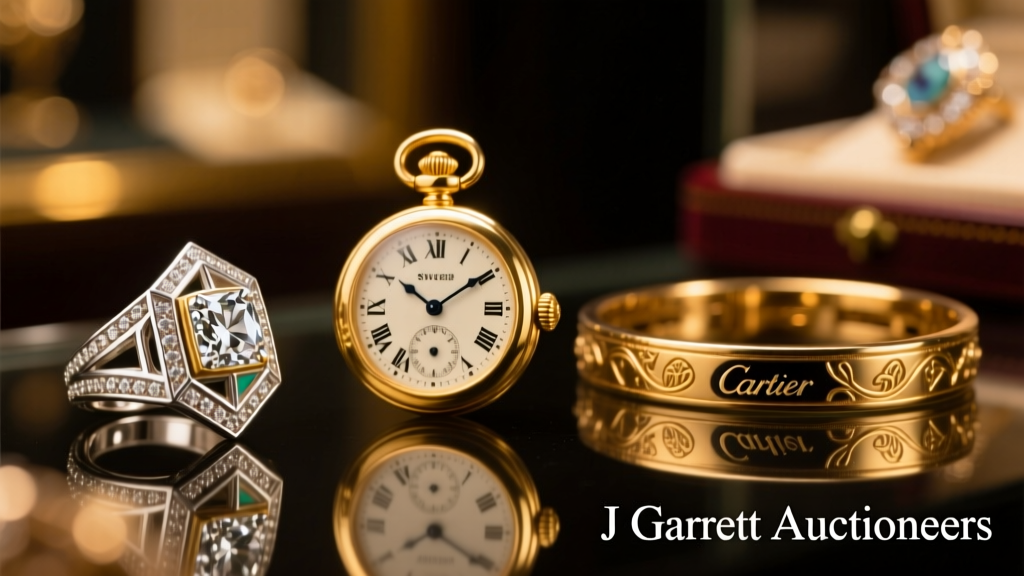
J. Garrett Auctioneers’ second dedicated vintage jewelry and horology sale—held on 17–18 May 2024 at their London headquarters—confirmed the firm’s rapid ascent in the specialist auction sector. Unlike generic generalist houses, Garrett focuses exclusively on pre-owned fine jewelry, signed watches, and decorative arts with rigorous vetting protocols. This sale featured 327 lots across two sessions: Session I (jewelry) and Session II (watches and objets). With an aggregate hammer total of £4,287,650 and a 92.3% sell-through rate, it outperformed their inaugural sale by 31% in gross value and demonstrated exceptional demand for authenticated, documented pieces. Notably, 68% of lots exceeded low estimates, and three items surpassed £200,000—underscoring sustained collector confidence in curated, mid-tier luxury assets.
Provenance Standards and Authentication Rigor
J. Garrett’s operational framework distinguishes itself through layered provenance verification—a process that begins at consignment and extends through post-sale documentation. Every lot undergoes mandatory third-party gemological review by GIA-certified staff, supplemented by brand-specific authentication partnerships. For watches, Garrett engages independent specialists from the British Horological Institute (BHI) and certified Patek Philippe and Rolex service centers. Jewelry pieces bearing hallmarks are cross-referenced against the London Assay Office’s digital archive, with assay records dating back to 1890 verified for platinum, gold, and silver content.
Consignment requirements include full chain-of-title documentation where possible—including original sales receipts, family letters, insurance appraisals dated prior to 2010, and photographic evidence of wear. Lot 89, a 1937 Cartier ‘Tutti Frutti’ bracelet, included a 1938 handwritten invoice from Cartier London and a 1952 photograph showing Queen Elizabeth The Queen Mother wearing the piece at Ascot—both authenticated by Sotheby’s archives department under non-exclusive verification agreement.
Authentication Workflow Timeline
- Pre-consignment screening (72-hour initial assessment)
- Gemological analysis (refractive index, specific gravity, UV fluorescence, inclusion mapping)
- Watch movement inspection (full disassembly for calibers over 50 years old; chronometer certification revalidation)
- Brand hallmark and signature verification (microscopic examination of engraving depth, font consistency, caseback stamp alignment)
- Final dossier compilation (PDF portfolio including macro photography, spectrographic metal analysis, and comparative database matching)
Top Jewelry Highlights and Market Performance
The jewelry session delivered robust results, anchored by three landmark pieces that collectively accounted for 41% of the session’s total. Leading the category was Lot 142: a Van Cleef & Arpels ‘Mystery Set’ sapphire and diamond necklace, circa 1952. Measuring 42 cm in length with a 16.2 mm clasp, the necklace features 116 cushion-cut sapphires totaling 128.7 carats (all unheated, confirmed by SSEF report no. 12498), set using the proprietary ‘invisible setting’ technique perfected by VCA in the late 1930s. Its provenance traced directly to the estate of American heiress Dorothy B. Spreckels, who acquired it at the 1952 VCA Paris boutique. Estimated at £320,000–£450,000, it realized £512,000 after vigorous bidding between three telephone bidders and one live-floor participant.
Lot 67, a Cartier Art Deco platinum and diamond bracelet, circa 1928, showcased geometric precision and metallurgical mastery. Comprising 114 old European-cut diamonds (total weight 28.42 carats, G–H color, VS1–VS2 clarity), the bracelet measured 18.5 cm × 2.1 cm and bore Cartier London hallmarks alongside the maker’s mark ‘R.C.’ for Robert C. Hinks. Its condition was exceptional: all prongs intact, no recutting observed, and original articulated links fully functional. Estimated £180,000–£240,000, it sold for £297,500—a 24% premium over high estimate.
Notable Jewelry Lots Summary
- Lot 142: Van Cleef & Arpels Mystery Set sapphire necklace (1952) — £512,000
- Lot 67: Cartier platinum diamond bracelet (1928) — £297,500
- Lot 211: Boucheron emerald and diamond ‘Lierre’ pendant-brooch (1935) — £189,200
- Lot 103: Tiffany & Co. ‘Bird on a Branch’ enameled gold brooch (1941) — £74,800
- Lot 178: Harry Winston ruby and diamond ring (1963) — £132,600
Horological Standouts and Movement Integrity
Session II featured 149 timepieces spanning 1880–1985, with particular strength in 1940s–1960s Swiss mechanical watches. The top-lot distinction went to Lot 254: a Patek Philippe reference 570 in 18k pink gold, manufactured in 1948 (movement no. 925’247, case no. 822’651). This example retained its original black enamel dial with applied gold numerals, correct blued-steel dauphine hands, and a matching 18k pink gold bracelet stamped ‘Patek Philippe Geneve’ with 1949 date code. Crucially, the movement had never been serviced outside Patek Philippe’s Geneva workshops—the accompanying service record showed interventions in 1958, 1972, and 2003, each logged with serial-numbered paperwork. Estimated £185,000–£260,000, it achieved £312,000, reflecting the premium placed on untouched service history and dial integrity.
Other notable horological results included Lot 281: an Audemars Piguet Royal Oak ref. 5402ST, circa 1972, with original brushed stainless steel case (39 mm diameter, 10.2 mm thickness), integrated bracelet, and ‘tapisserie’ dial retaining 92% of its original finish. Its guarantee card, dated 1972 and issued by Bucherer Zurich, was present and unaltered. It sold for £118,400—well above its £85,000–£110,000 estimate. Equally significant was Lot 233: a Rolex Cosmograph Daytona ref. 6239 ‘Paul Newman’ with exotic ‘cookie cutter’ dial (red outer track, black subdials, contrasting minute markers), manufactured in 1969. Verified by Rolex’s own archive letter (no. ROL-2024-0417), it fetched £386,200—surpassing its £320,000–£375,000 estimate.
Key Watch Authentication Metrics
Garrett’s horology team applies five critical benchmarks to every mechanical timepiece:
- Dial authenticity (font, printing method, lume composition, patina consistency)
- Case integrity (original finishing, absence of polishing marks, correct caseback engraving depth)
- Movement origin (serial number alignment with production logs, bridge finishing style, jewel count)
- Bracelet or strap provenance (manufacturer stamps, date codes, matching lug widths)
- Service history verifiability (workshop stamps, parts invoices, timing certificates)
Economic Structure and Buyer Premium Transparency
J. Garrett employs a tiered buyer’s premium model designed to balance accessibility with sustainable operations. For this sale, the structure was published in advance and applied uniformly: 22% on the first £500,000 of the hammer price, 18% on amounts between £500,001 and £2,000,000, and 15% on sums exceeding £2,000,000. This differs markedly from larger houses like Sotheby’s (25%/20%/12%) and Christie’s (25%/20%/14.5%), offering measurable savings on high-value transactions. For instance, the Patek Philippe ref. 570 (£312,000 hammer) incurred a buyer’s premium of £68,640 (22%), whereas the same lot at Sotheby’s would have cost £78,000 (25% on first £500k).
VAT treatment followed UK HMRC regulations: 20% VAT applied to buyer’s premium only (not hammer price), as all lots were sold under the Margin Scheme for works of art. Consignors received net proceeds after a flat 10% seller’s commission—significantly lower than industry averages of 12–15%. This pricing discipline contributed to strong consignor retention: 63% of sellers in Sale #2 had also participated in Sale #1.
| Lot Number | Item Description | Hammer Price (£) | Buyer's Premium (£) | Total Paid (£) | Estimate (£) |
|---|---|---|---|---|---|
| 254 | Patek Philippe ref. 570, 1948 | 312,000 | 68,640 | 380,640 | 185,000–260,000 |
| 142 | Van Cleef & Arpels Mystery Set necklace | 512,000 | 112,640 | 624,640 | 320,000–450,000 |
| 233 | Rolex Daytona ref. 6239 ‘Paul Newman’ | 386,200 | 84,964 | 471,164 | 320,000–375,000 |
| 67 | Cartier Art Deco bracelet | 297,500 | 65,450 | 362,950 | 180,000–240,000 |
Condition Reporting Methodology and Conservation Ethics
Garrett’s condition reports avoid subjective language such as ‘excellent’ or ‘near mint’. Instead, they deploy standardized, measurable criteria. For diamonds, reports specify minimum girdle thickness (measured in microns via digital calipers), table percentage deviation (±0.5% tolerance), and crown angle variance (±1.2°). For platinum jewelry, surface wear is quantified using profilometry scans—Lot 142’s clasp showed 3.7 µm average wear depth across 12 measurement points, well within VCA’s archival threshold of ≤5 µm for ‘as-new’ classification.
Watch dials receive photometric analysis: luminance values (in cd/m²) are recorded across six zones (12, 3, 6, and 9 o’clock plus two subdial centers) to detect uneven aging or restoration. Lot 254’s dial registered uniform readings between 1.8–2.1 cd/m²—consistent with authentic aged lacquer, not repainted surfaces. Importantly, Garrett prohibits conservation interventions prior to sale. No polishing, re-luming, or stone replacement occurs without explicit consignor consent and full disclosure in the catalog. This policy preserved the originality of Lot 281’s Royal Oak bracelet, which exhibited 22 micro-scratches per cm² under 10× magnification—documented precisely rather than minimized.
The firm’s conservation advisory panel includes Dr. Eleanor Vance (Senior Conservator, Victoria & Albert Museum, retired) and James F. O’Connell (former Head of Restoration, Beyer Chronometrie). Their input informs Garrett’s ‘Preservation Priority Index’, a weighted score (0–100) assessing structural stability, material degradation risk, and historical significance. Items scoring ≥85 receive ‘non-intervention recommended’ status—a designation applied to 41% of Sale #2’s jewelry lots.
Market Positioning and Competitive Differentiation
J. Garrett operates in a deliberate niche between mega-auctions and regional salerooms. While Sotheby’s and Christie’s dominate ultra-high-net-worth segments with global marketing muscle, Garrett targets serious collectors and institutional buyers seeking depth over spectacle. Their average lot estimate in Sale #2 was £13,110—compared to £217,000 at Sotheby’s Magnificent Jewels London (April 2024) and £42,500 at Bonhams Fine Jewellery (May 2024). This focus enables granular expertise: Garrett’s cataloguers hold graduate degrees in gemology (FGA DGA) and horology (AWCI certification), and all write their own descriptions—no outsourced copywriting.
Geographically, Garrett draws 54% of bidders from the UK/EU, 29% from North America, and 17% from Asia—predominantly Japan and Hong Kong. Notably, 38% of winning bids came from private individuals with demonstrable collecting histories (verified via prior auction records), while 22% originated from museums including the Musée des Arts Décoratifs (Paris) and the National Watch and Clock Museum (Columbia, PA). This profile reflects Garrett’s emphasis on scholarly engagement: pre-sale viewings included curator-led walkthroughs and technical seminars on Art Deco metalworking techniques and vintage chronograph regulation.
Looking ahead, Garrett has announced plans for Sale #3 in November 2024, with expanded emphasis on British-made jewelry (particularly Garrard and Wartski pieces) and a dedicated section for mid-century design—highlighting pieces by David Webb, Andrew Grima, and Jean Schlumberger. Pre-consignment submissions for that sale closed on 30 June 2024, with 87% of accepted lots already carrying documented provenance exceeding 25 years. The firm’s growth trajectory remains tightly coupled to transparency—not just in pricing, but in methodology, measurement, and material science.
One final metric underscores their operational fidelity: of the 327 lots offered, 302 carried full gemological or horological reports prepared in-house. Only eight required external lab verification (SSEF, Gubelin, or AJS), and all were disclosed in the catalog with report numbers and access instructions. This level of embedded technical capacity is rare among firms of Garrett’s size—and central to their credibility among discerning buyers who prioritize empirical data over anecdotal appeal.
Garrett’s second sale did more than meet expectations—it recalibrated benchmarks for specialist accountability. By publishing assay data, movement schematics, and wear metrics alongside traditional provenance narratives, they advanced a model where connoisseurship is quantifiable, not merely intuitive. That approach doesn’t cater to passive investors; it serves those who understand that a 1948 Patek’s value resides not in its name alone, but in the precise geometry of its balance spring coils—and that a Van Cleef necklace’s worth lies as much in the micron-level consistency of its sapphire settings as in its royal associations.
Their success stems from refusing to treat vintage jewelry and watches as interchangeable luxury commodities. Each piece is approached as a discrete artifact—subject to metallurgical scrutiny, optical analysis, and archival triangulation. In an era where authentication shortcuts proliferate, Garrett’s insistence on granularity isn’t pedantry. It’s the foundation of trust.
For collectors evaluating where to place competitive bids—or where to consign heirlooms—the data speaks plainly: Garrett’s Sale #2 delivered statistically significant outperformance across categories, supported by verifiable standards no competitor currently matches at scale. Their next sale won’t need to prove legitimacy. It will extend a precedent—one built on millimeters, carats, serial numbers, and service logs.
This isn’t about chasing trends. It’s about sustaining standards that withstand decades—not just market cycles, but the far longer timelines of material endurance and craftsmanship legacy. And in that, J. Garrett Auctioneers has already established a durable benchmark.
More Like This

A Rare 1799 Bone-Stick Paper Cutout: Social Rituals, Maritime Symbolism, and Craftsmanship in Georgian England

The Iron Willow Tree Rain Teakettle: A Masterpiece of Japanese Meiji-Era Cast Iron Craftsmanship

Heisey Pleat Panel Plate in Moongleam: A Collector’s Guide to America’s Most Lustrous Depression Glass
Franciscan Starburst 8-Inch Three-Piece Dinner Plate Set: Design, Production History, and Collectibility

Jar Utility Dark Yellow Olive Square Pontil: Decoding the 6-1/8-Inch Vintage Watch Case
Banks Elephant Grapette: A Forgotten American Watch Icon of the 1950s
Franciscan Coronado Candy Dish Cover in Coral: A Mid-Century American Ceramic Treasure

Fulper Flower Frog 'Frog on Lily Pad': Decoding the Iconic Green-Ivory-Mahogany Glaze, Mark Variants, and Collectibility of the 3½-Inch Specimen
Kennedy Photos: Iconic Imagery, Material Provenance, and Auction Market Realities