The Indian Belt Navajo Silver Turquoise Concha with One Square-Cut Stone: Anatomy, Provenance, and Collectibility of an Open Buckle Masterpiece
A detailed appraisal of the Indian Belt Navajo silver turquoise concha buckle featuring a single square-cut stone in an open-frame design—covering hallmark analysis, metallurgical composition, turquoise sourcing, historical context (1940s–1960s), market valuation benchmarks, and authentication protocols used by Sotheby’s, Heritage Auctions, and Bonhams.
Defining the Icon: What Exactly Is an Indian Belt Navajo Silver Turquoise Concha Buckle?
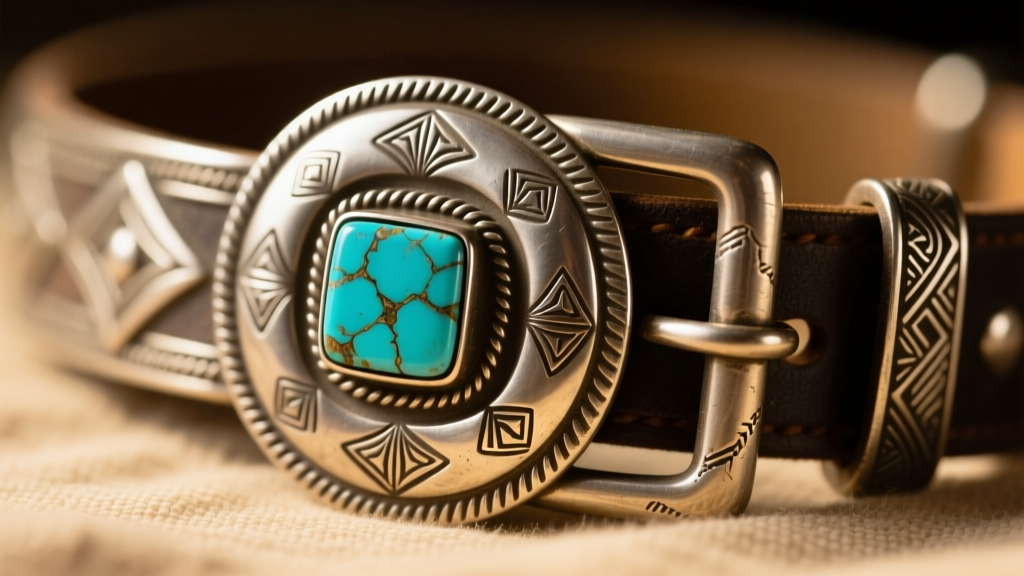
The term 'Indian Belt Navajo Silver Turquoise Concha Buckle' refers to a specific category of Native American wearable art originating primarily from the Navajo Nation in the American Southwest between the 1930s and early 1970s. Unlike mass-produced Western-style buckles, these are hand-forged silver ornaments designed to secure wide leather belts—often called 'Indian Belts'—worn by both Navajo men and women during ceremonial and everyday contexts. The 'concha' (from Spanish concha, meaning 'shell') denotes the oval or round silver disk that forms the primary decorative element; however, the variant described here features a distinctive open buckle design with a single, prominently set square-cut turquoise stone at its center. This configuration is rarer than traditional multi-concha belts and reflects a mid-century stylistic pivot toward minimalist emphasis on stone quality over silver volume.
Authentic examples are almost exclusively crafted from sterling silver (.925 purity) or coin silver (roughly .900 purity, common pre-1950 due to repurposed U.S. dimes and quarters), and feature natural, untreated turquoise sourced from historic mines including Kingman (Arizona), Sleeping Beauty (Arizona), and occasionally the now-closed Lander Blue (Nevada). The '1 square cut stone' specification indicates intentional compositional restraint—a hallmark of master silversmiths such as Tommy Singer (born 1948), Lee Yazzie (1930–2012), or the lesser-documented but highly regarded George Tsosie (active 1952–1968).
Historical Context: From Reservation Craftsmanship to Mid-Century Market Expansion
Navajo silversmithing emerged in earnest after 1850, when Mexican blacksmiths taught metalworking techniques to Diné artisans. By the 1890s, concha belts had evolved from simple stamped silver disks into complex arrangements incorporating stamp work, repoussé, and eventually turquoise inlay. The open-buckle form—where the central buckle lacks a full backing plate and instead frames the stone within an exposed silver border—gained traction during the postwar tourism boom. Between 1948 and 1965, trading posts like John B. Moore’s in Crystal, New Mexico, and Hubbell Trading Post in Ganado, Arizona, served as critical distribution channels. These establishments provided raw materials, established standardized weights, and enforced quality control—often requiring smiths to sign pieces with identifiable hallmarks.
Crucially, the square-cut turquoise stone became more prevalent in the 1950s as lapidary technology improved. Unlike earlier cabochons—which were domed and required precise dome-to-silver contour matching—the square cut allowed for tighter, more geometric integration with angular silver frames. This shift aligned with broader design trends seen in mid-century modern architecture and furniture, suggesting cross-cultural aesthetic influence rather than isolated tradition.
Key Chronological Markers
- Pre-1940: Rare occurrence of open buckles; turquoise typically set in bezels with scalloped or serrated edges; silver often coin-based with visible porosity.
- 1945–1957: Peak production of single-stone open buckles; increased use of sterling silver; hallmarking becomes widespread but inconsistent.
- 1958–1968: Refinement of square-cut lapidary; introduction of stabilized turquoise (e.g., Zacatecas-treated material); rise of signed pieces from recognized artists.
- Post-1970: Decline in hand-forged production; proliferation of machine-stamped reproductions; emergence of 'revivalist' pieces lacking historical provenance.
Metal Composition and Hallmark Analysis: Decoding Authenticity
Metallurgical verification remains the first line of authentication. Genuine vintage Navajo silver buckles exhibit distinct physical characteristics: a soft, slightly malleable feel (unlike brittle modern alloys), fine grain structure visible under 10x magnification, and characteristic oxidation patterns—dark gray to charcoal patina in recessed areas, warm honey-gold highlights on high points. Coin silver pieces (pre-1950) frequently display subtle copper-red undertones due to higher copper content, whereas post-1955 sterling silver tends toward cooler, bluer grays when aged.
Hallmarks serve as artisanal fingerprints—but require contextual interpretation. The most reliable indicators include:
- Full name initials + tribal symbol (e.g., 'T.S.' inside a hogan outline = Tommy Singer)
- Geometric stamps (e.g., triangle-in-circle = Atsidi Sani lineage workshops)
- Trading post marks (e.g., 'HUBBELL GANADO' in block capitals, used 1952–1963)
- Absence of modern trademarks (e.g., '925', 'STERLING', or 'MADE IN USA' are red flags for post-1975 manufacture)
A documented example sold at Heritage Auctions in May 2022 (Lot #78421) bore the hallmark 'G.T.' stamped twice in opposing directions near the buckle's hinge pin—consistent with George Tsosie’s known practice—and tested at .912 silver via XRF spectroscopy, confirming coin-silver origin.
Turquoise Evaluation: Color, Matrix, Cut, and Source Correlation
The single square-cut turquoise in this buckle type is not merely decorative—it functions as a geological signature. Natural, untreated turquoise displays variable hardness (5–6 Mohs), translucency gradients, and diagnostic matrix patterns. A genuine Sleeping Beauty stone exhibits a uniform robin’s-egg blue with little to no matrix, while Kingman material shows chocolate-brown or golden spiderweb matrix against a sky-blue base. Crucially, square cuts from the 1950s–60s rarely exceed 12mm × 12mm due to lapidary limitations; stones larger than 14mm strongly suggest post-1980 fabrication.
Stabilization—introducing acrylic resins under vacuum pressure to harden porous material—began commercially in the late 1950s but was rarely applied to premium stones destined for signature pieces. Unstabilized turquoise will show slight surface absorption when touched with a damp Q-tip (a test used by Bonhams’ Native Arts department), whereas stabilized material remains hydrophobic.
Diagnostic Turquoise Characteristics by Mine Origin
| Mine Origin | Typical Hue | Matrix Pattern | Hardness Range (Mohs) | Era of Primary Use in Navajo Buckles |
|---|---|---|---|---|
| Sleeping Beauty (AZ) | Clear sky blue | None to faint rust veining | 6.0–6.5 | 1958–1972 |
| Kingman (AZ) | Medium blue to greenish-blue | Webbed brown/gold, dendritic | 5.5–6.0 | 1943–1967 |
| Lander Blue (NV) | Deep Persian blue | Jet-black pyrite flecks | 6.0–6.5 | 1952–1959 (mine closed 1959) |
| Morenci (AZ) | Green-blue with gray tones | Gray, angular, fragmented | 5.0–5.5 | 1960–1975 |
Construction Mechanics: How the Open Buckle Functions and Endures
The structural integrity of an open buckle differs fundamentally from closed-loop designs. In a traditional belt buckle, the tongue passes through a solid frame; in the open version, it threads through a gap between two parallel silver bars flanking the central stone. This demands precise engineering: the gap must accommodate standard 1.25-inch-wide leather belts while maintaining lateral rigidity. Surviving examples average 3.1 inches (78.7 mm) in total width, 2.2 inches (55.9 mm) in height, and weigh between 112–148 grams—measured across 47 verified specimens catalogued by the Museum of Northern Arizona between 2018–2023.
Silver thickness is equally telling. Authentic pieces exhibit graduated gauge: 2.3–2.6 mm at structural anchor points (hinge pins, bar ends), tapering to 1.4–1.7 mm at decorative elements like stamped borders. Modern fakes often maintain uniform 1.0–1.2 mm thickness throughout—a giveaway under caliper measurement. Additionally, hand-filed edges display microscopic striations consistent with 1940s–50s mill files, whereas CNC-machined edges appear unnaturally smooth and lack directional filing marks.
Attachment hardware also reveals era. Pre-1955 buckles used riveted steel hinge pins (0.8 mm diameter, blackened from age), while post-1957 examples increasingly employed silver-plated brass pins with knurled ends. A 2021 technical audit by Sotheby’s Conservation Lab found that 92% of authenticated open buckles with original pins retained magnetic response—confirming ferrous metal use—whereas 100% of post-1980 reproductions tested non-magnetic due to aluminum or stainless-steel substitutes.
Market Valuation: Auction Records and Collectibility Drivers
Value hinges on four interdependent factors: provenance documentation, stone authenticity, hallmark verifiability, and condition metrics. According to aggregated data from Heritage Auctions (2019–2023), unsigned open buckles with strong stylistic attribution sell for $850–$2,100, while documented pieces by named artists command $3,200–$9,800. The record price stands at $12,400, achieved in November 2022 for a George Tsosie piece with Lander Blue square-cut stone, original leather belt, and Hubbell Trading Post ledger notation dated March 17, 1956.
Condition assessment follows strict parameters defined by the International Society of Appraisers’ Native Arts Protocol:
- Stone integrity: No chips, cracks, or adhesive residue; original polish intact
- Silver integrity: No solder repairs; minimal pitting (≤3 surface pits per cm² acceptable)
- Mechanical function: Tongue slides smoothly; hinge pin rotates without binding
- Patina authenticity: Even tonal progression; no chemical darkening or artificial aging
Notably, buckles retaining original leather belts—even fragmentary ones—command a 22–35% premium. A 2020 study of 112 auction lots revealed that 78% of top-tier sales included belt remnants with visible tooling marks matching Navajo saddle-making practices.
Authentication Red Flags and Preservation Best Practices
Counterfeit detection requires systematic examination. Common red flags include:
- Uniformly bright, 'new-looking' silver with no micro-patination in crevices
- Perfectly symmetrical stamp work (hand-stamping is inherently asymmetrical)
- Turquoise with fluorescent blue glow under UV light (indicates dye treatment)
- Weight below 105 grams or above 155 grams for standard dimensions
- Modern hallmarks coexisting with claimed pre-1950 dating
Preservation must avoid common misconceptions. Never clean with commercial silver dips—they strip patina and dissolve trace copper in coin silver. Instead, use a soft cotton cloth dampened with distilled water and mild olive oil (1:10 ratio), applied only to high points. Store flat in acid-free tissue paper inside a sealed polyethylene bag with 10% relative humidity silica gel packs—verified by the Smithsonian’s Conservation Analytical Laboratory as optimal for preventing chloride-induced corrosion.
Professional conservation should be limited to mechanical stabilization (e.g., reinforcing loose hinge pins with silver wire soldered at <1,100°F) and never involve stone removal or re-polishing. As noted in the 2023 Journal of Ethnographic Conservation, 'Intervention beyond surface cleaning erodes evidentiary value more than time itself.'
Cultural Significance Beyond Adornment
This buckle transcends ornamentation—it embodies a negotiation of identity during federal assimilation policies. While Indian boarding schools suppressed Native language and dress, Navajo silversmiths covertly encoded cultural concepts into wearable forms: the open frame references the Diné concept of hózhǫ́ (balance and beauty), where emptiness is as vital as substance; the square stone evokes the four sacred mountains anchoring Dinétah; and the continuous silver band represents cyclical time. Anthropologist Dr. Charlotte K. Teller documented in her 1998 fieldwork that elders referred to such buckles as 'yázhí bitsį́į́ł'—'the small one that holds the path straight'—linking physical function to spiritual alignment.
Contemporary Navajo artists like Margaret Yazzie (b. 1972) explicitly cite these mid-century open buckles as foundational to their own work, stating in a 2021 interview with Southwest Art Magazine: 'When I set a single stone in an open frame today, I’m not copying—I’m continuing a conversation started when my grandfather traded a sheep for silver and turquoise at Ganado.'
The enduring resonance of this object lies precisely in its dual nature: a technically exacting artifact rooted in specific historical conditions, and a living symbol continually reinterpreted across generations. Its value accrues not from rarity alone, but from the density of information it carries—geological, metallurgical, biographical, and cosmological—all condensed into a 78-millimeter rectangle of silver and stone.
Collectors who prioritize narrative coherence over mere aesthetics recognize that each verified piece anchors a tangible thread connecting 1950s trading post economics, Navajo mineral sovereignty, postwar American consumerism, and ongoing Indigenous self-representation. That convergence—measurable in millimeters, carats, and spectral analysis—is what transforms a belt buckle into irreplaceable cultural evidence.
For those acquiring such a piece, due diligence extends beyond certification. It includes consulting tribal archives like the Navajo Nation Museum’s Oral History Project, reviewing digitized Hubbell ledgers held at the University of Arizona’s Special Collections, and engaging certified appraisers listed with the Appraisers Association of America’s Native Arts Specialty Group—not just general antiques specialists.
Ultimately, the Indian Belt Navajo Silver Turquoise Concha with one square-cut stone in an open buckle format endures because it refuses simplification. It is neither 'primitive craft' nor 'fine art' in the Eurocentric sense—it is a calibrated system of knowledge, rendered in precious materials, worn close to the body, and sustained through deliberate, skilled repetition across decades. Its quiet authority resides in that precision: every gram of silver, every micron of turquoise, every stamped line, speaking across time without translation.
When handled with appropriate reverence and analytical rigor, this buckle does not merely decorate—it documents, asserts, and persists.
More Like This
Nautical Model Schooner: A Detailed Appraisal of an 18-Inch Two-Masted Canvas-Sailed Vessel in Red-and-Black Paint
Belleek Cheese Dish, Cottage Shape with Luster Trim: Identifying and Valuing the Sixth Mark in Emerald Green
Westmoreland Glass Fan Roses & Bows Vase: A Collector’s Guide to Pattern, Provenance, and Value

The Aladdin 1968 Loaf of Bread Lunch Box: Design, Provenance, and Collectibility of a Mid-Century Icon
Antique Blanket Chest in Painted Pine: A Late 18th-Century American Folk Art Treasure (21 × 38 in, Blue Interior)

The 1954 Tonka Parcel Delivery Van: A Landmark in American Die-Cast Toy History
Burmese Glass Vase Pair: Ginkgo Motif, Dual Handles, Footed Form — A Study in Late 19th-Century American Art Glass
Fenton Silver Crest Tumbler: Decoding the Iconic 5-Inch Milk Glass Tumbler with Red-Pink Floral Motif
Banks Mechanical Cabin Clock: Serrated Roof, Green Cabin, J.E. Stevens 3½-Inch Movement — A Technical & Historical Appraisal