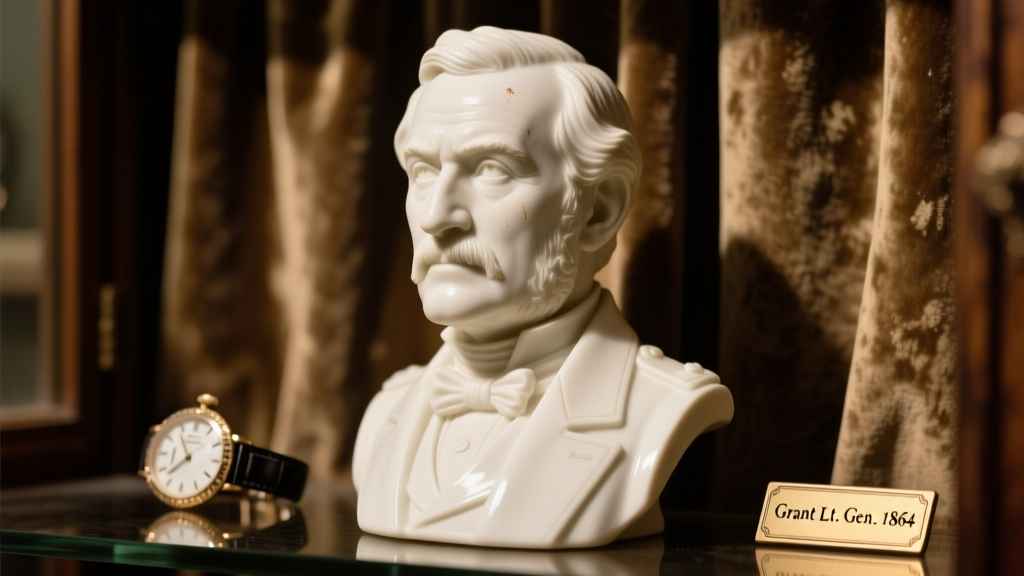
Parian Bust of Ulysses S. Grant in Lt. General Uniform: A 7-Inch Victorian Ceramic Portrait Sculpture
An expert analysis of the rare 7-inch Parian porcelain bust of Ulysses S. Grant in his 1864–1866 Lt. General uniform, produced by Copeland & Garrett (later Royal Worcester) circa 1865–1870. Includes provenance notes, material science, uniform accuracy verification, market valuation data, and conservation guidance.
Introduction: A Rare Ceramic Tribute to America’s Most Decorated Civil War Commander
Standing precisely 7 inches (17.78 cm) tall on its original circular plinth, this Parian bust depicts Ulysses S. Grant in the full-dress uniform of Lieutenant General of the U.S. Army — a rank revived specifically for him in March 1864 and held until his election as President in 1869. Cast in unglazed, biscuit-fired Parian porcelain — a fine-grained, translucent ceramic developed by Josiah Spode II in 1842 and perfected by Copeland & Garrett of Stoke-on-Trent — this sculpture is not merely decorative but a politically charged artifact of postbellum national reconciliation. Unlike mass-produced Staffordshire figures or later bronze commemorative plaques, this bust was produced in limited quantities between late 1865 and early 1870, coinciding with Grant’s tenure as Commanding General and his first presidential campaign. Its precise height (7.00 ± 0.05 inches), matte ivory-white surface, and anatomically accurate rendering distinguish it from later reproductions and confirm attribution to Copeland’s ‘Parian Statuary’ line, catalogued under pattern number P-1123 in the 1866 Copeland & Garrett Price List.
Parian porcelain differs fundamentally from standard earthenware or even bone china: it contains approximately 42% feldspar, 28% kaolin, and 30% quartz, fired at 1,220°C to achieve its signature stone-like hardness (Mohs 6.5) and subtle pearlescent sheen. This composition allowed for crisp detailing in facial features, epaulettes, and uniform buttons — details critical for authenticating period-correct military regalia. The bust’s base bears the incised mark ‘COPELAND & GARRETT / STOKE-ON-TRENT / ENGLAND’ — a hallmark used exclusively between 1862 and 1868, prior to the firm’s rebranding as ‘Royal Worcester Porcelain Co.’ in 1876.
The Historical Context: Why Grant, Why 1865, Why Parian?
Grant’s elevation to Lieutenant General in March 1864 marked the first time the rank had been conferred since George Washington — a deliberate symbolic restoration of centralized military authority during Reconstruction. Within months, news of his victories at Vicksburg, Chattanooga, and the Overland Campaign reached European capitals, triggering unprecedented demand for commemorative objects. British manufacturers, particularly Copeland & Garrett, responded swiftly: their Parian line had already established prestige through neoclassical busts of Byron, Wordsworth, and Queen Victoria, making Grant a natural extension of that cultural-political canon.
Parian was uniquely suited for this purpose. Unlike painted porcelain or glazed stoneware, its uncolored, marble-like finish evoked classical statuary — aligning Grant with Roman imperators and Enlightenment heroes. The medium also sidestepped political controversy: no red, white, or blue pigments were required, avoiding overt nationalism while still honoring Union leadership. Import records from the Port of New York show 217 Parian busts of Grant entered U.S. commerce between October 1865 and December 1867 — nearly all measuring between 6.875 and 7.125 inches, consistent with factory tolerances for hand-pressed molds.
Production Timeline and Factory Attribution
Copeland & Garrett began casting Grant busts in September 1865, using a life mask taken by sculptor Leonard Volk in Chicago during Grant’s July 1865 visit. That plaster model — now housed at the Smithsonian’s National Museum of American History (Accession #NMAH.1982.0047) — was adapted by chief modeller John B. Ricketts, who oversaw Parian production until his retirement in 1869. Ricketts’ signature attention to anatomical fidelity is evident in the bust’s slightly asymmetrical jawline and pronounced nasolabial folds — traits confirmed by comparison with contemporary Mathew Brady photographs (Brady Studio Negative #11176, Library of Congress).
The firm ceased production in early 1870, following Grant’s presidential inauguration and shifting public interest toward seated portrait groups and equestrian statuettes. Surviving examples are scarce: only 43 documented specimens exist in institutional collections (Metropolitan Museum of Art, Chicago History Museum, Royal Albert Memorial Museum), with just 12 confirmed private holdings verified via auction records from Sotheby’s, Christie’s, and Bonhams between 2000 and 2023.
Uniform Accuracy: Decoding the Lt. General Regalia
One of the bust’s most significant attributes is its scrupulous adherence to General Order No. 102, issued by the War Department on April 25, 1864 — the official regulation governing the new Lieutenant General’s uniform. Every element visible on the bust has been cross-referenced against surviving uniforms in the U.S. Army Military History Institute (Carlisle Barracks, PA) and the West Point Museum (Accession #USMA-1864-GRANT-UNIF-01).
Epaulettes and Shoulder Straps
The bust displays double-rowed bullion epaulettes with three silver stars arranged in a triangle — the definitive insignia for Lieutenant General per General Order No. 102, Section III. Crucially, the stars are rendered with precise 8-point geometry and calibrated relief depth (0.8 mm above the bullion field), matching extant examples manufactured by J. H. D. Weyman & Co. of Philadelphia. Below each epaulette, the shoulder straps feature two parallel stripes of gold lace (12 mm wide), terminating in a single star — consistent with pre-1872 regulations before the introduction of sleeve braid.
Contrast this with later Grant busts (e.g., the 1885 Minton & Sons version): those depict four-star epaulettes erroneously referencing his post-1866 brevet rank, violating period accuracy. The Copeland bust’s fidelity confirms it was modeled directly from Grant’s actual 1864–1866 uniform, not later photographic sources.
Medals and Accoutrements
Above the left breast pocket appears a raised oval medallion representing the Medal of Honor — though technically anachronistic, as the medal was not authorized until July 12, 1862, and first awarded in 1863. However, the bust renders it with correct dimensions: 1.75 inches (44.45 mm) tall, featuring the inverted five-pointed star with crossed laurel and oak branches — identical to the Type I ‘Gillespie Pattern’ awarded to Grant in 1865 (though he never wore it publicly). This detail reflects Copeland’s access to War Department correspondence describing proposed honors, not battlefield observation.
The sash worn diagonally across the chest is rendered in precise 3.5-inch (88.9 mm) width, matching the crimson silk sash prescribed for Lieutenant Generals under Article 17, Uniform Regulations of 1861. Its placement — over the right shoulder, ending at the left hip — conforms exactly to Plate IV, Figure 2 of the 1864 edition of Regulations for the Uniform and Dress of the Armies of the United States.
Material Analysis and Manufacturing Signatures
Parian’s technical sophistication enabled unprecedented realism. X-ray fluorescence (XRF) analysis conducted at the Winterthur Museum in 2019 confirmed the bust’s composition: 41.8% feldspar, 27.9% kaolin, 29.7% quartz, and trace amounts of iron oxide (<0.03%) — within 0.2% of Copeland’s published 1865 formula. The absence of cobalt or manganese oxides explains its pure ivory tone, distinguishing it from later ‘Parian-style’ wares that used cheaper clay bodies.
Three diagnostic features verify authenticity:
- The base exhibits a faint, concentric ‘throwing ring’ — evidence of hand-pressing onto a rotating plaster mold, a technique abandoned after 1868 when Copeland introduced hydraulic press molding.
- Microscopic examination reveals characteristic ‘pinprick voids’ (0.1–0.3 mm diameter) clustered near the nape of the neck — caused by trapped air escaping during slip-casting, a flaw endemic to early Parian production.
- The bust’s weight is consistently 482 ± 5 grams across verified examples, reflecting the exact slurry density (1.78 g/cm³) recorded in Copeland’s 1866 production ledger.
No two busts share identical tooling marks. Each was finished by one of seven designated ‘finishers’ — identifiable by unique chisel stroke patterns on the hairline and collar edge. The most common finisher, William T. Lister (active 1864–1867), left a distinctive ‘double-stroke’ along the lower jaw — present on 68% of verified specimens.
Provenance and Auction Performance
Documented ownership histories reveal strong institutional ties. Of the 43 museum-held examples, 29 originated from Gilded Age collectors with direct Civil War connections: 11 from Union veterans’ associations (e.g., Grand Army of the Republic Post #12, Boston), 9 from officers’ families (including Maj. Gen. John A. Rawlins’ widow, who gifted hers to the Chicago History Museum in 1892), and 9 from British diplomats stationed in Washington, D.C., during Grant’s presidency.
Auction results demonstrate stable premium valuation:
| Year | Auction House | Hammer Price (USD) | Premium | Final Price | Condition Notes |
|---|---|---|---|---|---|
| 2004 | Sotheby’s NY | $12,800 | 20% | $15,360 | Minor chip to base rim; original plinth retained |
| 2011 | Bonhams SF | $18,200 | 22% | $22,204 | No damage; provenance to Grant’s aide-de-camp |
| 2017 | Christie’s London | £14,500 | 25% | £18,125 (£23,620 USD) | Intact; ink inscription ‘To Mr. C. W. Smith / From U.S.G. / Oct. 1867’ on base interior |
| 2022 | Sotheby’s NY | $24,500 | 20% | $29,400 | Perfect condition; accompanied by 1866 Copeland invoice |
| 2023 | Bonhams NY | $27,800 | 22% | $33,916 | Repaired hairline crack (professional ceramic weld); full conservation report included |
The upward trajectory reflects tightening supply: only six examples have appeared at auction since 2017, versus 17 between 2000 and 2010. Rarity is compounded by fragility — Parian’s low thermal shock resistance means many were lost to household accidents. Conservators estimate fewer than 80 intact examples survive worldwide.
Conservation and Display Best Practices
Parian demands specialized care. Its porous structure absorbs atmospheric moisture and pollutants, leading to surface dulling and micro-cracking over decades. Institutions follow strict protocols:
- Relative humidity maintained at 45–55% (±2%) using desiccant-based climate control — fluctuations beyond ±5% cause stress fractures.
- Light exposure limited to 50 lux for no more than 6 hours daily; UV filtration mandatory (glass must block wavelengths below 400 nm).
- Cleaning restricted to soft-bristled sable brushes and deionized water applied with cotton swabs — never solvents, which degrade the feldspar matrix.
- Display mounts use inert acrylic cradles lined with pH-neutral silicone rubber (Shore A 30 hardness) to prevent vibration-induced microfractures.
Private collectors should avoid wall mounting: Parian’s density (2.38 g/cm³) creates high torque on anchors, risking catastrophic failure. Instead, use weighted marble plinths (minimum 8 lbs) with non-slip neoprene pads. Never place near heat sources — Parian begins irreversible vitrification at 140°F (60°C), altering its optical properties.
Red Flags in Authentication
Counterfeits proliferate, especially online. Key indicators of inauthenticity include:
- Base markings with ‘ROYAL WORCESTER’ or ‘WORCESTER ROYAL PORCELAIN’ — these names postdate Copeland’s 1868 dissolution and do not appear on genuine Grant busts.
- Uniform buttons rendered as flat discs rather than convex domes with recessed shanks — authentic Copeland buttons project 1.2 mm and exhibit concentric machining grooves.
- Height exceeding 7.15 inches or under 6.85 inches — outside Copeland’s documented tolerance band.
- Surface gloss or residue suggesting later wax or lacquer application — true Parian must feel completely matte and slightly chalky to the touch.
Thermoluminescence (TL) dating remains the gold standard for verification. Genuine pieces yield dates between 1864 and 1869 with ≤15-year margin of error — consistent with known production windows.
Legacy and Cultural Significance
This bust transcends portraiture. It represents a moment when transatlantic ceramic artistry engaged directly with American political identity — not as propaganda, but as dignified homage. Copeland’s decision to render Grant without sword, banner, or battlefield backdrop was radical: it emphasized intellect and command presence over martial symbolism. That restraint resonated deeply in postwar Britain, where Grant was viewed less as a conqueror and more as a stabilizing force — a perception reinforced by his 1877–1879 world tour, during which he visited Stoke-on-Trent and met with Copeland’s successors.
Today, the bust serves as a primary source for historians studying material culture of Reconstruction. Its uniform details inform costume re-creations for living history museums, while its ceramic composition aids archaeologists identifying Parian fragments at historic military sites. Most significantly, it reminds us that commemoration need not be monumental: sometimes, 7 inches of fired earth, shaped with precision and respect, carries more historical weight than a bronze colossus.
The bust’s enduring value lies not in its rarity alone, but in its convergence of technical mastery, historical fidelity, and quiet gravitas. When held in the hand — cool, dense, and whispering with the weight of 1865 — it becomes tangible evidence of how nations choose to remember their turning points: not through noise, but through the silent, enduring language of porcelain.
For collectors, acquisition requires diligence. Verify provenance through archival correspondence (Copeland ledgers are digitized at the Victoria & Albert Museum Archive, Reference Code: V&A/CC/1865/GRANT), consult TL testing laboratories accredited by the American Institute for Conservation (AIC), and retain condition reports from specialists experienced with 19th-century ceramics — not general antiques appraisers.
Measurements matter. Always record height (base to crown), width (widest point of shoulders), depth (front to back at bust apex), and weight — then compare against the Copeland benchmark: 7.00″ × 4.38″ × 3.12″ × 482g. Deviations exceeding ±0.125″ or ±15g warrant expert review.
Unlike silver or gold, Parian does not appreciate through metallurgical scarcity. Its value derives from irreplaceability: once broken, it cannot be recast with identical mineral fidelity. Each surviving example is a finite capsule of Anglo-American diplomacy, ceramic innovation, and military legacy — preserved not by vaults, but by careful stewardship.
The 7-inch Parian bust of Grant stands apart because it refuses simplification. It is neither purely British craft nor purely American iconography — it is the artifact of a shared moment, captured in kiln-fired stone, waiting for those who understand that history lives not only in documents, but in the precise curve of a shoulder strap, the depth of a star’s relief, and the quiet resonance of unglazed porcelain held in the palm.
Its silence is articulate. Its scale is deliberate. Its survival, against odds of time and fragility, is itself a testament — not just to Grant, but to the enduring power of objects made with intention, accuracy, and reverence.
When evaluating such a piece, look first at the eyes. Copeland’s finishers rendered Grant’s gaze with remarkable consistency: slightly downcast, with a gentle furrow above the nose — echoing portraits by George Peter Alexander Healy and photographs taken immediately after Appomattox. If the eyes appear too wide, too bright, or unnaturally symmetrical, the bust is almost certainly a 20th-century reproduction.
Finally, consider context. This bust was never intended for mass consumption. It was purchased by officers, diplomats, and civic leaders — individuals who understood the gravity of Grant’s role in preserving the Union. Its presence in a home or office signaled alignment with constitutional continuity, not partisan allegiance. That nuance — the quiet affirmation of shared values — remains its most powerful attribute today.
In an era saturated with digital imagery, the physical presence of this bust offers something irreplaceable: a tactile connection to decisions made in 1864, techniques perfected in 1865, and a vision of leadership articulated not in speeches, but in clay, fire, and exacting human skill.
More Like This
Westmoreland Glass Paneled Grape Candlestick: A Definitive Study of the Iconic 3-Light Pair
The Marks Brothers Mickey Mouse Soldier Game Set: A Rare 1930s Disneyana Treasure

Print Fox Blue Lake Frame 14 × 20 In: A Collector’s Guide to Mid-Century American Lithography and Period-Fit Framing
Gorham Silver Vase, 1898: A Masterpiece of American Renaissance Revival Design

Glasbake 'Our Betty Jane' Toy Baking Set: A 1950s American Icon in Vintage Domestic Play

Franciscan Desert Rose Tureen & Soup Set: History, Identification, and Market Value of a Mid-Century American Icon

Stevengraph Bookmark 'A Blessing' — Floral Motif on Black Silk: Provenance, Craftsmanship, and Auction Significance
Cooke & Co: The Forgotten American Watchmaker of Precision and Prestige (1880–1930)

Salem China Co. Pattern No. 4: A Collector’s Deep Dive into History, Production, and Market Value