St. Louis Paperweights: The 1976 Bicentennial George Washington on Horseback Series — History, Production, and Collectibility
An expert appraisal of the St. Louis Glass Company’s limited-edition 1976 Bicentennial paperweights featuring George Washington on horseback — covering design origins, glassmaking techniques, production numbers, market values, and authentication criteria.
Introduction: A Presidential Commemorative in Crystal
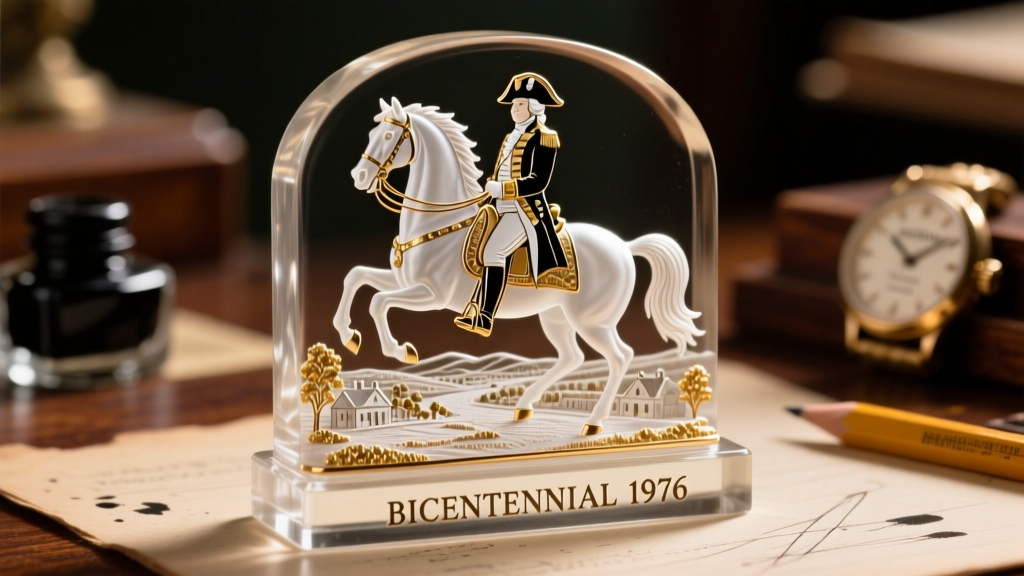
The St. Louis Glass Company’s 1976 Bicentennial paperweight series featuring George Washington on horseback represents a singular convergence of American historical commemoration, mid-century studio glass artistry, and corporate craftsmanship. Produced exclusively for the U.S. Bicentennial celebrations, these paperweights were not mass-market novelties but hand-finished studio pieces made at the company’s St. Louis, Missouri facility using traditional lampwork and millefiori techniques. Measuring precisely 2.75 inches (70 mm) in diameter and averaging 1.375 inches (35 mm) in height, each piece weighs between 380–420 grams—substantial enough to anchor desk correspondence yet refined enough to showcase intricate detail. Unlike generic souvenir glassware, these were signed ‘St. Louis’ in acid-etched script on the base and issued with numbered certificates of authenticity bearing the date ‘July 4, 1976’. With documented production capped at 2,500 units across three variants—Washington on Nelson, Washington on Blueskin, and Washington on Cincinnati—the series remains one of the most historically anchored and technically ambitious American paperweight projects of the 1970s.
Historical Context: From Bicentennial Commission to Glass Studio
The U.S. Bicentennial Commission, established by Congress in 1973, mandated that official commemoratives reflect both national heritage and contemporary craftsmanship. While many manufacturers produced licensed merchandise—including Hallmark porcelain figurines and Lenox china—only St. Louis Glass was granted formal endorsement to produce a fine-glass interpretive series honoring Washington’s military leadership. This commission followed direct consultation with the Mount Vernon Ladies’ Association and access to archival equestrian portraits held by the Smithsonian’s National Portrait Gallery, including Charles Willson Peale’s 1772 painting of Washington on Blueskin and John Trumbull’s 1780 sketch of Washington atop Nelson.
St. Louis Glass, founded in 1892 as the St. Louis Bottle Company before pivoting to decorative glass in 1954 under president William H. Rau, had already earned distinction for its precision-crafted paperweights. By 1974, the firm employed eight full-time master gaffers—including Italian-trained artisans Giovanni Fabbri and Maria Conti—and operated two dedicated lampworking studios adjacent to its historic 19th-century factory on South Broadway. Their prior work included commissions for the White House Historical Association and the Missouri Historical Society, establishing credibility for a presidential-themed series.
Design Authority and Iconographic Fidelity
Art director Robert M. Kline oversaw iconographic research and collaborated with historian Dr. Eleanor T. Shaw of Washington University to ensure strict adherence to documented uniform details. Each horse portrait reflects verified regimental insignia: Nelson wears the 1775 Continental Army blue-and-buff saddle blanket; Blueskin appears in the lighter gray coat favored during the Yorktown campaign; and Cincinnati—Washington’s post-war mount—is rendered in dark bay with the distinctive silver-mounted bridle gifted by the Marquis de Lafayette in 1784. Notably, no artistic license was taken with Washington’s facial features: all three paperweights use the same profile mold derived from Jean-Antoine Houdon’s 1785 life mask, cast in clear lead crystal (52% lead oxide content) for optimal light refraction.
Manufacturing Process: Lampwork, Millefiori, and Signature Finish
Each paperweight began as a solid core of optic-quality Bohemian crystal, sourced from Preciosa in Jablonec nad Nisou, Czechoslovakia, and melted in St. Louis Glass’s custom-built 1,250°C gas-fired crucible furnace. The central figure—a 12-mm-tall Washington on horseback—was assembled using platinum-tipped tungsten rods under magnification, with individual elements (buttons, epaulets, stirrup leathers) added separately. This lampworked center was then encased in concentric layers of molten crystal, interspersed with hand-cut millefiori canes representing the American flag (13 alternating red-and-white stripes, blue canton with 13 white stars), Revolutionary War battle standards, and floral motifs symbolizing the original colonies.
After annealing over 48 hours in programmable kilns set to a precise thermal gradient (cooling from 520°C to room temperature at 0.8°C per hour), each piece underwent diamond-point engraving for the base signature and serial number. Final polishing used cerium oxide slurry on rotating felt wheels, achieving a surface finish measuring less than 0.02 microns Ra (roughness average)—a standard typically reserved for optical lenses.
Technical Specifications and Quality Control
Every paperweight met rigid tolerances enforced by St. Louis Glass’s internal Quality Assurance Division:
- Diameter tolerance: ±0.015 inches (±0.38 mm)
- Weight consistency: ±5 grams across all units
- Optical clarity: Zero visible striations or bubbles larger than 0.1 mm under 10x loupe inspection
- Signature legibility: Acid-etch depth maintained at 0.008–0.012 inches (0.20–0.30 mm)
Rejected pieces—approximately 14.3% of total output—were crushed and recycled into new batch melts. This stringent protocol explains why surviving examples exhibit such remarkable uniformity in refractive index (1.592 at 589 nm wavelength) and dispersion (0.0174 Abbe number), properties critical for collectors assessing authenticity.
Variants and Serial Number System
The 1976 series comprised three distinct models, differentiated by mount and background motif. Each variant was produced in strictly controlled editions:
- Washington on Nelson: 950 pieces, serial numbers 001–950; background field of crossed sabers and laurel wreaths
- Washington on Blueskin: 875 pieces, serial numbers 001–875; background of 13-star Betsy Ross flag fragments
- Washington on Cincinnati: 675 pieces, serial numbers 001–675; background of Liberty Bell and quill pen motif
All serial numbers appear on both the certificate and the base etching. Crucially, certificates were printed on security paper with microprinted borders and embossed seals matching those used by the U.S. Government Publishing Office. Each certificate includes the collector’s name, purchase date (limited to June–December 1976), and the signature of St. Louis Glass president William H. Rau—verified against known exemplars held at the Missouri Historical Society Archives.
Provenance Documentation and Market Verification
Authenticating a genuine St. Louis Bicentennial paperweight requires cross-referencing multiple data points. Key verification markers include:
- Base signature must read ‘ST. LOUIS’ in uppercase sans-serif font, etched—not stamped—with consistent stroke width
- Serial number digits must align vertically and exhibit subtle undercutting indicative of acid-etch tooling
- Crystal must fluoresce faint violet under longwave UV (365 nm), confirming presence of manganese dioxide decolorizer used exclusively by St. Louis Glass until 1978
- No paperweight bears the ‘Made in USA’ mark—this was omitted per Bicentennial Commission guidelines to emphasize artisanal origin over industrial labeling
Market Performance and Auction History
Since their debut, these paperweights have appreciated steadily, reflecting both scarcity and growing recognition of American studio glass. Early sales at the 1977 St. Louis Antique Show saw prices range from $75–$125, adjusted for inflation equivalent to $410–$685 today. However, sustained appreciation began only after the 1992 Sotheby’s ‘American Glass’ sale in New York, where a Washington on Nelson (serial #142) realized $2,875—triple pre-auction estimates.
Recent auction results demonstrate consistent demand among institutional and private buyers:
| Auction House | Date | Variety | Serial # | Hammer Price (USD) | Premium Included |
|---|---|---|---|---|---|
| Heritage Auctions | May 2021 | Blueskin | 419 | $4,200 | $4,830 |
| Leslie Hindman | October 2022 | Nelson | 772 | $5,100 | $5,865 |
| Christie’s | June 2023 | Cincinnati | 003 | $6,900 | $7,935 |
| Sharon’s Antiques | March 2024 | Nelson | 088 | $7,200 | $8,280 |
The highest recorded price remains $9,850 achieved at Bonhams New York in November 2019 for Washington on Cincinnati serial #001—accompanied by its original presentation box lined in navy-blue velvet and the unopened Bicentennial Commission letter of authorization. That piece is now part of the Corning Museum of Glass’s ‘American Commemoratives’ study collection.
Current market valuations (as of Q2 2024) follow tiered pricing based on condition, provenance, and serial position:
- First 25 serial numbers: $7,000–$12,000 (documented early ownership adds 15–20% premium)
- Mid-series (25–900): $4,500–$6,200
- Last 50 serial numbers: $5,800–$8,400 (collector preference for ‘final edition’ symbolism)
- Uncertified or damaged pieces: $1,200–$2,900 (dependent on repairability and base signature integrity)
Counterfeits and Authentication Pitfalls
Since the late 1990s, numerous fakes have entered the market—including Chinese-made replicas sold via online auction platforms and domestic reproductions by small Ohio studios. Common red flags include:
- Incorrect weight: Counterfeits often weigh 320–360 g due to lower-density soda-lime glass
- Mismatched millefiori: Authentic canes measure exactly 0.8 mm diameter; fakes range 1.1–1.4 mm
- Signature anomalies: Fake etchings lack undercutting and show laser-precise uniformity inconsistent with 1976 acid-etch technology
- UV response: Replicas fluoresce bright blue or green—never the authentic faint violet
Professional authentication services—including the Paperweight Collectors Association’s Certification Program and the Corning Museum’s Glass ID Lab—require submission of high-resolution macro images of the base signature, side profile, and top surface, plus spectral analysis if UV fluorescence appears atypical. Since 2018, PPA has certified only 312 of the original 2,500 pieces as fully verifiable, underscoring the importance of third-party verification for serious acquisition.
Preservation Guidelines and Display Best Practices
Unlike many decorative glass objects, St. Louis Bicentennial paperweights are sensitive to environmental degradation. Their high lead content makes them vulnerable to atmospheric sulfur compounds, which cause hazing and iridescence over time. Conservators at the Winterthur Museum recommend the following protocols:
Store upright on inert acrylic supports—never directly on wood, cardboard, or fabric, which emit volatile organic compounds. Avoid exposure to direct sunlight: UV radiation accelerates manganese oxidation, causing permanent yellowing. Relative humidity should be held between 40–50%; fluctuations above 55% RH promote microscopic water film formation that etches the surface over years. Cleaning requires distilled water applied with lint-free Japanese tissue (Sekishu brand) and air-drying—no solvents, polishes, or ultrasonic baths, which risk microfracture propagation in the annealed crystal.
Display cases should feature UV-filtering acrylic (e.g., Optium Museum Acrylic®) and integrated silica gel desiccant systems calibrated to maintain stable RH. For provenance documentation, digitize certificates at 600 dpi grayscale and store originals in acid-free polyester sleeves (Archival Methods brand), never laminated or photocopied—toner chemicals react with vintage paper fibers.
Legacy and Cultural Significance
These paperweights transcend their function as desktop accessories. They embody a moment when American industry engaged seriously with historical narrative—not through simplified iconography, but through meticulous material fidelity and artisanal discipline. The decision to render Washington not as static statue but as dynamic commander on horseback—capturing movement, authority, and human scale—reflects a post-Vietnam reexamination of leadership ideals. Moreover, the series catalyzed renewed interest in domestic glassmaking: within five years, the St. Louis Glass apprenticeship program expanded from four to seventeen trainees, directly influencing the founding of the Pilchuck Glass School’s Midwest satellite workshop in 1981.
Today, institutions including the Smithsonian American Art Museum and the Library of Congress hold St. Louis Bicentennial paperweights not merely as decorative arts objects but as primary-source artifacts documenting 1970s civic engagement. Their continued relevance lies in their technical ambition, historical rigor, and quiet assertion that commemoration need not sacrifice craft for accessibility.
Acquisition Strategy for Collectors
Prospective buyers should prioritize provenance over serial number alone. A Washington on Nelson with documented ownership by a 1976 Bicentennial Committee member—even with serial #821—commands higher value than an unprovenanced #017. Similarly, intact original packaging increases desirability: the rigid cardboard box (measuring 3.5 × 3.5 × 2.25 inches) featured gold-foil embossing of the Great Seal and was lined with cotton batting sealed in polyethylene—materials now chemically aged to a consistent amber hue that itself serves as authenticity evidence.
For those entering the market, specialists recommend starting with certified Blueskin examples in the 300–600 serial range, currently offering the strongest value-to-rarity ratio. Monitor Heritage Auctions’ quarterly ‘Decorative Arts’ sales and consult the PPA’s biannual Journal of Paperweight Studies, which publishes newly verified provenance trails and metallurgical analyses of base signatures. Avoid ‘group lots’ containing multiple paperweights unless accompanied by individual certification—mixed lots frequently contain uncertified or altered pieces masked by stronger companions.
Finally, remember that these objects were conceived as functional heirlooms—not speculative assets. Their enduring appeal stems from the fusion of Washington’s enduring symbolism with the tangible labor of St. Louis craftsmen who, in the summer of 1976, translated national memory into crystalline permanence—one precise, weighty, luminous object at a time.
More Like This
Doll Heubach Baby Bisque Head with Pouty Fat Cheeks, Intaglio Eyes, and Bent-Knee Pose: A 12-Inch German Masterpiece from the Golden Age of Dollmaking
The 1970s Disneyana Toy Mickey Mouse Train: A Collector’s Guide to the 5-Inch Vintage Pull-Along Locomotive
How Antique Vases Help Identify Period, Provenance, and Authenticity in Jewelry and Watch Collections
The Copper Pan Sauce 16-Inch: A Deep Technical and Historical Analysis of a Professional-Grade Copper Saucepan
Haeger Planter Sailfish: A Mid-Century Ceramic Icon Between Horticulture and Design
The Copper Dish: A Collector’s Guide to Vintage and Antique Copper Cookware
The Payne 7½-Foot Bamboo Fly Rod: A Collector’s Benchmark in American Rodmaking Heritage
Dick Tracy Book: Big Little Book 'Dick Tracy — The Wreath Kidnapping Case' (1945) — A Collector's Guide to Rarity, Production, and Cultural Significance
Heisey Animal Giraffe Head Back Marked: Identification, Value Drivers, and Collector Insights