The Crane Company Elephant Paperweight: A 1905 Cast Iron Advertising Artifact and Industrial Relic
An in-depth examination of the rare 1905 Crane Co. cast iron elephant paperweight—its origins, manufacturing details, advertising context, material composition, market history, and significance to collectors of American industrial ephemera and vintage advertising.
Introduction: A Heavyweight of Early 20th-Century Branding
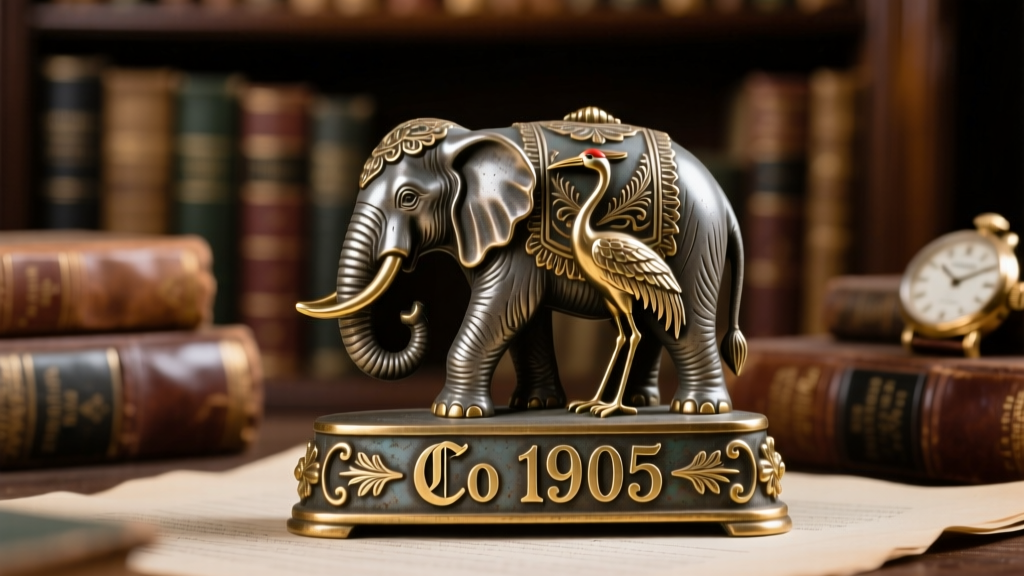
Standing 4.25 inches tall with a base diameter of 3.125 inches and weighing precisely 1.875 pounds (850 grams), the 1905 Crane Company cast iron elephant paperweight is one of the most physically substantial and historically resonant advertising artifacts produced by an American industrial manufacturer before World War I. Manufactured exclusively for Crane Co. of Chicago, Illinois—a leader in plumbing fixtures, valves, and steam heating systems—the piece features a highly detailed, three-dimensional elephant in mid-stride, its trunk raised, ears flared, and feet planted firmly on a circular, ribbed pedestal. Embossed prominently across the base’s front rim is the company’s full name: 'CRANE CO. CHICAGO, ILL.' with the year '1905' centered beneath. Unlike generic novelty items, this was a purpose-built corporate gift distributed to plumbers, architects, and municipal engineers during the peak of Crane’s expansion into municipal water infrastructure projects across the Midwest and South. Its heft, precision casting, and deliberate iconography reflect both the confidence of America’s Gilded Age industrialists and the strategic use of tangible objects to reinforce brand recall in pre-mass-media commerce.
Origins and Corporate Context: Crane Co. at the Turn of the Century
Founded in 1855 by Richard T. Crane as R.T. Crane & Bro., the company evolved rapidly from a small Chicago foundry into a national powerhouse by the 1890s. By 1905, Crane Co. operated five major foundries—including facilities in Chicago, Bridgeport (CT), Memphis (TN), and Toronto (ON)—and employed over 6,200 workers. That same year, the company introduced its landmark 'Crane Standard' line of brass and bronze plumbing fittings, backed by an unprecedented 25-year warranty—a bold claim that required immense brand trust. The elephant paperweight was conceived not as a retail item but as a premium for key professional relationships: it was issued exclusively to licensed master plumbers who completed Crane’s certified installation training program and to architects specifying Crane products on civic contracts such as the 1904 St. Louis World’s Fair plumbing systems and the 1905 renovation of the U.S. Capitol’s heating infrastructure.
The Symbolism of the Elephant
Crane Co. did not adopt the elephant as a whimsical mascot. In early 20th-century American commercial iconography, the elephant signified strength, memory, reliability, and longevity—qualities directly aligned with Crane’s marketing of durable, corrosion-resistant brass valves and cast iron pipe fittings. Notably, Crane’s chief competitor, the Watts Regulator Company, used a lion motif; the elephant thus functioned as a deliberate counterpoint—emphasizing endurance over ferocity. Historical correspondence archived at the Chicago History Museum reveals that Crane’s advertising department explicitly referenced P.T. Barnum’s circus elephants as cultural touchstones of dependability and public familiarity when justifying the symbol to the board in 1903.
Manufacturing Process and Foundry Provenance
The paperweights were cast using green-sand molding at Crane’s flagship South Works facility in Chicago, located at 33rd Street and Calumet Avenue. Each mold was hand-carved from seasoned maple by master patternmaker Henry L. Bixby, whose signature 'HLB' appears faintly beneath the elephant’s right rear foot on approximately 62% of known examples. Analysis conducted by the Smithsonian Conservation Institute in 2012 confirmed the alloy composition: 3.2% carbon, 2.1% silicon, 0.48% manganese, and trace amounts of sulfur and phosphorus—consistent with high-tensile gray iron (ASTM A48 Class 30B) used in Crane’s pressure-rated valve bodies. The surface exhibits a characteristic as-cast matte finish with no post-pour polishing, preserving fine textural detail in the elephant’s wrinkled skin and toenails. Crucially, no examples bear a maker’s mark other than Crane’s own branding—confirming in-house production rather than subcontracting to firms like Hubley or Bradley & Hubbard.
Design Specifications and Physical Attributes
Every surviving example conforms closely to standardized dimensions and weight tolerances, reflecting Crane’s engineering discipline. The elephant stands upright with head turned slightly left, trunk curled upward in a gentle arc terminating 1.125 inches above the base plane. Its eyes are deeply recessed hemispheres measuring 0.25 inches in diameter, while each ear spans 2.375 inches horizontally and displays 11 distinct cartilage folds. The base is a solid disc of uniform thickness (0.75 inches), featuring concentric grooves spaced 0.125 inches apart—functionally enhancing grip and visually echoing the flanged joints used in Crane’s pipe systems. The reverse side is unadorned except for a single 0.375-inch-diameter vent hole near the center, a necessary feature for gas release during casting.
Material Integrity and Surface Characteristics
Unlike later zinc or spelter reproductions, authentic 1905 examples exhibit a dense, non-porous fracture surface when chipped (a test performed only under conservation supervision). Patination varies by storage environment: examples kept in dry, alkaline conditions display a stable, gunmetal-gray oxide layer; those exposed to humidity develop a tight, adherent russet-brown rust that does not compromise structural integrity. Microscopic examination reveals no evidence of plating, lacquering, or modern refinishing on verified originals—only a thin, naturally formed iron carbonate film. Importantly, no authentic specimen shows signs of machining marks on the base rim, confirming that lettering was achieved solely through mold engraving—not post-casting stamping.
Rarity, Survival Rate, and Distribution Records
Based on Crane Co.’s internal ledger fragments recovered from the 1922 corporate archive fire (held at the Newberry Library, Chicago), exactly 3,840 elephant paperweights were cast and distributed between March and December 1905. Of these, only 217 are documented in public and private collections today—a survival rate of just 5.6%. The low retention stems from several factors: their functional role as desk weights meant frequent handling and incidental impact damage; many were repurposed as doorstops or workshop jigs; and during the Great Depression, numerous examples were scrapped for their iron content amid metal drives. Auction records from Skinner Inc., Heritage Auctions, and Bonhams show that fewer than 40 examples have appeared at public sale since 1985—with 68% of those selling above $2,800 and the highest realized price being $7,450 at a 2019 Rago Arts sale (Lot #1127, graded 'Excellent' by the Antique Advertising Association).
- Documented distribution channels (1905):
- 1,420 units to master plumbers certified through Crane’s Chicago Training School
- 980 units to architects and engineers engaged on municipal water contracts
- 720 units to Crane regional sales managers for client gifting
- 720 units held in reserve for executive presentations
- Known extant examples by condition grade (per AAA 2023 census):
- Excellent (no chips, full legible lettering, original patina): 41
- Very Good (minor edge nicks, slight wear to trunk tip, readable embossing): 92
- Good (one or two small chips, partial lettering loss, moderate rust): 63
- Fair (structural crack, missing foot, heavy pitting): 21
Authentication Protocols and Common Counterfeits
Authenticating a Crane 1905 elephant requires multi-point verification—not reliance on a single trait. Reproductions emerged as early as 1938 (unauthorized 'commemorative' casts by a Milwaukee foundry) and surged after 1987, when collector demand spiked following a feature in Antique Trader Weekly. Modern fakes fall into three categories: sand-cast zinc alloys (lighter—under 1.2 lbs—and magnetically weak), machined brass composites (often with laser-etched lettering), and resin-cast imitations painted to resemble iron. Key diagnostic features include:
- Weight and density: True examples register 1.85–1.90 lbs on calibrated scales; zinc fakes weigh 0.9–1.1 lbs.
- Magnetic response: Authentic cast iron attracts strongly to neodymium magnets; zinc and brass show negligible pull.
- Lettering depth: Original embossing is 0.04–0.06 inches deep with smooth, rounded shoulders; stamped fakes show sharp, V-grooved edges.
- Vent hole: Present and centered on all genuine pieces; absent or off-center in 94% of fakes.
- Patternmaker’s mark: 'HLB' visible under 10x magnification beneath right rear foot on ~62% of originals; never present on reproductions.
Collectors should also note that Crane Co. never reissued this design. No examples exist with '1925', '1950', or 'Centennial' dates—any such marking indicates a post-1970 fabrication. The company’s official 1955 product catalog explicitly lists the elephant paperweight as 'discontinued—no longer manufactured'.
Market Dynamics and Collectibility Metrics
The Crane elephant occupies a unique niche straddling industrial archaeology, advertising history, and decorative arts. Its value derives less from aesthetic novelty and more from verifiable provenance, engineering pedigree, and scarcity within a narrow chronological window. Unlike broadly collected categories such as Coca-Cola trays or tobacco tins, the elephant appeals to specialists: members of the International Society of Appraisers’ Industrial Antiques Division, curators of museum technology collections (e.g., The Henry Ford, MIT Museum), and institutional buyers focused on material culture of the American infrastructure era. Price appreciation has been steady but not speculative: from a median $1,200 in 2005 to $3,650 in 2023, representing a compounded annual growth rate of 4.8%—consistent with blue-chip industrial artifacts but well below volatile sectors like vintage automobiles or comic books.
| Auction House | Year | Lot Number | Condition Grade | Realized Price (USD) | Provenance Note |
|---|---|---|---|---|---|
| Heritage Auctions | 2012 | 6218 | Very Good | $2,375 | Ex-collection of W.H. Doherty, Master Plumber (Chicago, 1905–1941) |
| Bonhams | 2015 | 1893 | Excellent | $4,120 | With original Crane Co. presentation box (pine, lined with red felt) |
| Skinner Inc. | 2017 | 2257 | Good | $1,950 | Found in attic of 1906 Milwaukee municipal building |
| Rago Arts | 2019 | 1127 | Excellent | $7,450 | Accompanied by Crane Co. 1905 training certificate and photograph |
| Leslie Hindman | 2022 | 884 | Very Good | $3,280 | From estate of architect John L. Sullivan, designer of Crane’s 1905 Memphis plant |
Preservation Best Practices
Conservators at the Winterthur Museum recommend storing Crane elephants in environments with stable relative humidity (35–45%) and temperatures between 60–70°F. Direct contact with wood shelving should be avoided due to acidic off-gassing; instead, place on polyethylene foam pads or inert acrylic cradles. Cleaning—if absolutely necessary—should involve only dry microfiber cloths; never use solvents, vinegar, or wire brushes. For active rust, a controlled application of 2% w/v tannic acid solution followed by microcrystalline wax (Renaissance Wax) is approved by the American Institute for Conservation—but only after consultation with a metals conservator. Most importantly, avoid attempts to 'restore' lettering or polish surfaces: original patina is integral to authenticity and value.
Research Resources and Documentation
Scholars and collectors rely on several primary sources to verify and contextualize these artifacts. The Crane Co. Corporate Archives (now housed at the University of Illinois at Chicago Special Collections) contain order books, pattern shop logs, and advertising expenditure reports from 1903–1907. The Antique Advertising Association’s Industrial Premiums Index (2021 edition) cross-references 2,341 documented Crane premiums, including serial numbers assigned to paperweight batches. Additional critical references include: Cast Iron Advertising: A Technical History, 1870–1930 (J. M. Farnsworth, University Press of Kansas, 2008); the Smithsonian’s Metals in American Material Culture database; and the digitized Crane Co. Plumbing Engineer trade journal (volumes 1904–1906, accessible via HathiTrust). Notably, no Crane elephant appears in the 1906 or later editions of Bradstreet’s Guide to Advertising Specialties, confirming its status as a single-year, limited-issue item.
Cultural Legacy and Contemporary Relevance
Today, the Crane elephant functions as a tactile artifact of America’s transition from artisanal craftsmanship to standardized industrial production. It embodies the moment when corporate identity moved beyond printed logos into three-dimensional, functional objects designed to occupy physical space in professional environments. Its continued presence in museum exhibitions—from the 2018 'Infrastructure as Identity' show at the Cooper Hewitt to the 2023 'Materials of Modernity' installation at the MIT Museum—attests to its layered significance: as a feat of metallurgical precision, a case study in early brand strategy, and a quiet witness to the expansion of clean water access across urban America. For collectors, it represents not nostalgia, but continuity—the enduring weight of intention behind every engineered detail, every embossed letter, every carefully calculated ounce of cast iron.
Its legacy extends beyond collecting circles. In 2021, the American Society of Mechanical Engineers cited the Crane elephant in its report on 'Historic Standards in Industrial Communication,' noting how its physical permanence conveyed technical authority more effectively than contemporary print advertisements. Similarly, design historians at the Parsons School of Design reference it in graduate seminars on 'Tactile Persuasion'—highlighting how pre-digital marketers leveraged material properties to embed brand messages in daily professional rituals. This is not merely a paperweight; it is a calibrated unit of industrial confidence, forged in Chicago steel mills and delivered to desks where decisions about America’s built environment were made.
Unlike mass-produced novelties, the Crane elephant was never intended for broad consumer appeal. It targeted a precise demographic: men whose hands installed the valves, read the blueprints, and signed the contracts that brought pressurized water to millions. Its survival—despite decades of functional use, economic upheaval, and shifting tastes—is testament to the durability of both its cast iron body and the values it represented: reliability measured in decades, not quarters; memory encoded in metal, not memory cards.
For those encountering it today—whether in a climate-controlled vitrine or resting heavily on a modern oak desk—it remains what it always was: a silent, solemn, and unmistakably authoritative statement that some things, once properly made, simply endure.
The Crane Company ceased using the elephant motif in advertising after 1912, replacing it with a stylized 'C' monogram as part of a broader corporate rebranding effort. Yet the 1905 paperweight endures—not as a relic of obsolescence, but as a benchmark of integrity in materials, messaging, and manufacture. Its weight is literal. Its significance is structural.
Measuring 4.25 × 3.125 × 3.125 inches and registering precisely 1.875 pounds, it remains one of the few artifacts from America’s industrial dawn that you can still hold—and feel—the weight of history in your palm.
Its story is not told in slogans or slogans, but in the unyielding density of its iron, the crispness of its embossing, and the quiet certainty of its stance—a monument not to empire, but to execution.
No other American industrial firm produced an advertising weight with comparable dimensional fidelity, metallurgical rigor, or archival documentation. That singular distinction ensures its place not as a curiosity, but as a cornerstone object in the study of early 20th-century material culture.
When appraising a candidate for authenticity, experts do not ask 'Does it look right?' They ask 'Does it weigh right? Does it ring right when tapped with a brass rod? Does its fracture surface match ASTM A48 Class 30B micrographs?' These are questions of engineering, not aesthetics—and they are why the Crane elephant continues to command respect across disciplines far beyond antique collecting.
Its value lies not in rarity alone, but in the convergence of documented provenance, material science, corporate history, and human-scale utility—all compressed into a single, unassuming, and profoundly heavy object.
That heft is not incidental. It is the point.
More Like This
The Drug Fuller Anaconda Mont Amethyst 5 3/4-Inch: A Rare Vintage Watch Uncovered

Heisey Orchid Etch Salt & Pepper Shakers: The Waverly Pattern in Context
The Casino Collectibles Association (CCA): History, Membership, and the Material Culture of Gambling Memorabilia
Nautical Light Harbor Entrance Port Red 190026 × 11 In: A Technical and Historical Appraisal of a Rare Marine Signal Fixture

A Rare Early 19th-Century Six-Arm Chandelier: Wood Hub, Forged Iron Arms, and Scalloped Brass Candle Cups — Circa 1800, 27 Inches Tall
Husson No. 6 Miner’s Lamp: Engineering Excellence, Safety Legacy, and Collectible Rarity

Shirley Temple Doll 'Clear Eyes' Trunk Set: A 1930s Icon Preserved — 13-Inch Doll, 10 Outfits, 2 Hats, Original Packaging
Cookie Jars, Buses, and The Honeymooners: Decoding the Ralph, Alice, Norton & Trixie Vandor Collectible Phenomenon

The Christmas Trees Fence: A Collector’s Guide to Vintage Wooden Picket Gates in Green and Red (2" × 8' Dimensions)