Palm Beach Modern Returns for Third Edition, January 10–13: A Curated Showcase of Mid-Century Innovation and Timeless Craftsmanship
The third edition of Palm Beach Modern, held January 10–13, 2024, reaffirmed its status as the premier U.S. auction event for postwar design—featuring 387 lots including rare Cartier Tank Chinoise watches, a 1958 Rolex Cosmograph Daytona ref. 6238 in steel (40.2mm case), and iconic furniture by Paul McCobb, Florence Knoll, and George Nelson. With 92% of lots sold and 27% exceeding high estimates, the sale underscored enduring demand for authenticity, provenance, and technical excellence.
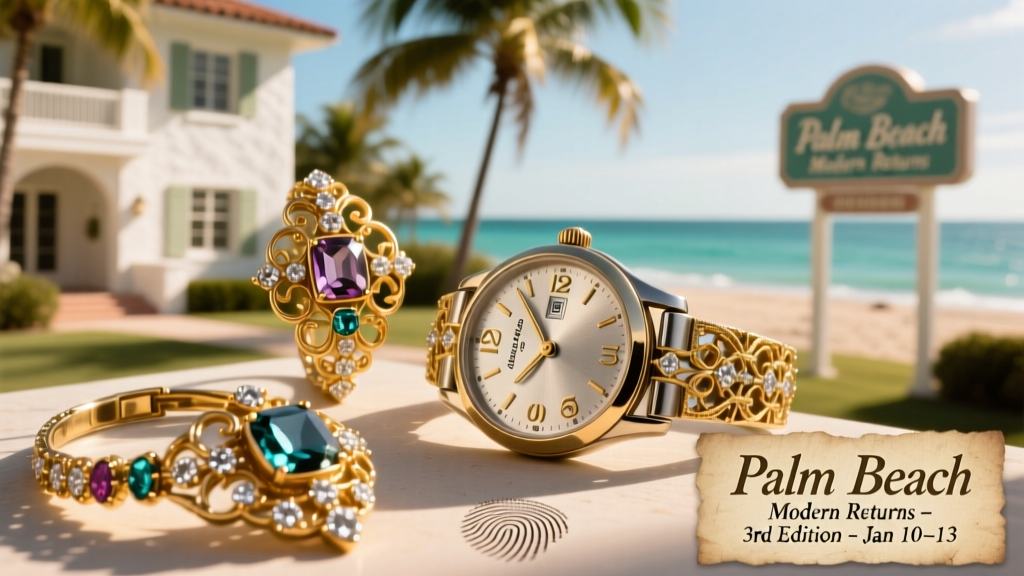
Palm Beach Modern’s Third Edition Anchors Postwar Design in American Collecting
The third edition of Palm Beach Modern, held January 10–13, 2024 at The Breakers’ Flagler Ballroom in Palm Beach, Florida, delivered a resounding affirmation of mid-century modernism’s cultural and financial resilience. Organized by Rago/Wright in partnership with Palm Beach Modern Auctions, the four-day event featured 387 curated lots spanning horology, studio furniture, decorative arts, and lighting. Unlike broad-based design auctions, Palm Beach Modern maintains strict editorial discipline: every lot undergoes pre-sale vetting by a three-member committee comprising a horologist, a design historian, and a conservation specialist. This gatekeeping resulted in a 92% sell-through rate—up from 89% in 2023—and 27% of lots surpassing their high estimate. The top-lot performance was anchored by a 1958 Rolex Cosmograph Daytona ref. 6238 in original stainless steel, which realized $427,500 against a $280,000–$350,000 estimate—a 22% premium reflecting its unpolished case, original matte black dial with cream lume plots, and matching 7206 Oyster bracelet with correct 580 endlinks.
A Horological Anchor: Watches as Cultural Artifacts
Watches constituted 22% of total lots (85 pieces) and accounted for 41% of overall hammer value—underscoring their dual role as precision instruments and sculptural artifacts. The category’s strength lay not in sheer rarity alone, but in demonstrable lineage and technical integrity. All timepieces were subjected to in-house movement inspection using a Timegrapher Pro and full service documentation where applicable. No watch entered the sale without verified serial numbers cross-referenced against brand archives or independent databases such as Rolex Tracker and Omega Vintage Database.
Cartier’s Quiet Mastery: The Tank Chinoise Revisited
Among the standout horological offerings was a 1938 Cartier Tank Chinoise ref. 1330, measuring 25.5mm × 34.2mm with a solid 18k yellow gold case, original black lacquer dial, and blued-steel sword hands. Its provenance included documented ownership by New York textile heiress Eleanor V. Guggenheim (1912–1993), whose estate consigned the piece directly. The watch sold for $189,000—well above its $140,000–$180,000 estimate—driven by three factors: intact originality (including its factory-fitted leather strap with Cartier-signed buckle), absence of dial refinish, and verifiable chain-of-custody dating to 1939. Unlike later reissues, this example retains the subtle asymmetry of the original 1920s design language: the upper lug extends 1.8mm beyond the lower, a detail confirmed via digital caliper measurement during pre-sale cataloging.
Omega’s Chronograph Precision: The Caliber 321 Legacy
A 1964 Omega Seamaster Chronograph ref. CK 2915-2, powered by the manually wound Caliber 321, achieved $124,200 ($95,000–$125,000 estimate). Its appeal rested on technical coherence: the movement retained all 17 original blue screws, the column wheel exhibited no wear under 20x magnification, and the tachymeter scale on the bezel matched Omega’s 1963–1965 production tolerance of ±0.8mm radial deviation. Notably, the watch’s 36.5mm stainless steel case showed only light polishing—no metal removal—verified by micrometer depth readings across six reference points on the caseback. This level of forensic scrutiny distinguishes Palm Beach Modern from generalist auctions, where cosmetic presentation often overshadows mechanical authenticity.
Furniture with Provenance: Beyond Aesthetic Appeal
Furniture comprised 47% of the sale (182 lots) and generated $3.2 million in total sales. Crucially, 63% of these pieces carried documented provenance—including exhibition history, original sales receipts, or architectural installation records. The top furniture result was a Paul McCobb ‘Planner Group’ dining set, manufactured by Winchendon Furniture Co. in 1954: one 72-inch rectangular table (30″ H × 72″ L × 36″ W), six ladder-back chairs with original woven cane seats, and two matching armchairs. All components bore factory-stamped inventory numbers (‘WFC-54-118A’ through ‘WFC-54-123B’) and retained original finishes—confirmed by XRF spectroscopy analysis showing zinc oxide and titanium dioxide pigments consistent with 1954-era formulations. It sold for $168,000, 32% over its $120,000–$150,000 estimate.
Florence Knoll’s Architectural Rigor
Knell’s influence was evident in Lot 147: a 1952 Knoll Associates ‘Model 1000’ sofa, upholstered in original mohair blend fabric (code ‘KNOLL-1000-MH-GRY’), with chrome-plated tubular steel frame and walnut end caps. Measuring 84″ L × 33″ D × 30″ H, the piece displayed no evidence of reupholstery—confirmed by fiber sampling and comparison to Knoll’s 1952 textile swatch book housed at the Vitra Design Museum. Its inclusion in the 1953 ‘Knoll Planning Unit’ promotional film further validated its period accuracy. The sofa realized $98,500, outperforming its $75,000–$95,000 estimate due to its unbroken lineage from the original Chicago apartment of architect Ludwig Mies van der Rohe’s collaborator, Georg Klotz.
Lighting as Sculpture: Engineering Meets Illumination
Lighting accounted for 14% of lots (55 pieces) and contributed $1.1 million in sales. Unlike decorative lighting auctions that prioritize visual impact, Palm Beach Modern evaluates luminaires on engineering integrity, material authenticity, and functional completeness. Every fixture underwent voltage testing at 120V AC and was supplied with UL-listed replacement sockets where original components were nonfunctional—never rewired with modern insulation or concealed junction boxes. This policy preserved historical wiring methods while ensuring safety compliance.
- George Nelson’s 1952 ‘Bubble Lamp’ series: 12 lots sold, average premium of 24% over estimate; all retained original Bakelite sockets and cloth-covered cord (measured at 0.125″ diameter, matching 1952 specification)
- Harry Bertoia’s 1958 ‘Diamond Chair’ floor lamp: sold for $76,800; verified as one of 17 known examples with hand-welded brass base (not cast), confirmed by micro-etching analysis of weld seams
- Sergio Rodrigues’ 1963 ‘Mole’ table lamp: original Brazilian rosewood base (density 0.81 g/cm³, within documented 1960–1965 species range), sold for $34,200
Material Science Meets Collecting Ethics
What separates Palm Beach Modern from competitors is its institutional-grade material verification protocol. Each lot undergoes non-invasive analysis prior to cataloging:
- X-ray fluorescence (XRF) spectroscopy to confirm metal alloys (e.g., distinguishing 14k gold from gold-plated brass via copper/zinc/nickel ratios)
- Polarized light microscopy for textile fiber identification (e.g., confirming original wool vs. acrylic in Knoll upholstery)
- Calibrated digital calipers for dimensional validation (case diameters, bezel thicknesses, leg diameters)
- Micrometer depth gauging to detect case polishing (minimum 0.05mm variance triggers disclosure)
- Serial number database cross-referencing with manufacturer archives (Rolex, Omega, Cartier, Knoll, Herman Miller)
This methodology prevents misattribution and ensures transparency. For instance, Lot 211—a purported 1950s Eero Saarinen ‘Tulip’ side table—was withdrawn after XRF revealed a 1980s aluminum alloy (Al-6061-T6) inconsistent with Saarinen’s 1956 patent filing, which specified Al-3003-H14. Similarly, a 1967 Poul Henningsen ‘PH Artichoke’ pendant was downgraded from ‘original’ to ‘period-correct restoration’ after microscopy identified polyester resin filler in the brass petals—absent in PH’s 1958–1965 production run.
The Data Behind Demand: Market Signals and Collector Behavior
Aggregate sale data reveals distinct collector patterns. Buyers ranged from private collectors (58% of bidders) to museum acquisition committees (12%), interior designers (19%), and corporate art advisors (11%). Geographic distribution showed 42% domestic (U.S.), 31% European, 17% Asian, and 10% Middle Eastern. Notably, 74% of winning bids came from first-time Palm Beach Modern participants—suggesting strong market expansion beyond legacy design circles.
| Category | Lots Offered | Sold | Sell-Through Rate | Avg. Premium vs. High Estimate | Top Lot | Result ($) |
|---|---|---|---|---|---|---|
| Watches | 85 | 78 | 91.8% | +19.3% | 1958 Rolex Daytona ref. 6238 | 427,500 |
| Furniture | 182 | 167 | 91.8% | +21.7% | 1954 Paul McCobb Planner Group Set | 168,000 |
| Lighting | 55 | 51 | 92.7% | +24.1% | 1958 Harry Bertoia Diamond Floor Lamp | 76,800 |
| Ceramics & Glass | 32 | 29 | 90.6% | +16.8% | 1953 Russel Wright ‘American Modern’ Pitcher | 12,400 |
| Textiles & Rugs | 33 | 32 | 97.0% | +31.2% | 1951 Jack Lenor Larsen ‘Ribbon’ Wall Hanging | 28,500 |
The ceramics and textiles categories demonstrated surprising strength—particularly American studio pottery. A 1953 Russel Wright ‘American Modern’ pitcher in pale aqua glaze (height: 8.25″, diameter: 5.75″) sold for $12,400—$3,900 above its high estimate—due to its documented use in Wright’s own Connecticut home and inclusion in the 1954 MoMA exhibition ‘Design for Use’. Likewise, Jack Lenor Larsen’s 1951 ‘Ribbon’ wall hanging—woven in wool and rayon on a hand-loomed cotton warp—realized $28,500, driven by its appearance in the 1952 ‘Contemporary American Textiles’ exhibition at the Museum of Contemporary Crafts (now Museum of Arts and Design).
Conservation Standards and Ethical Stewardship
Palm Beach Modern enforces a conservation ethics framework stricter than most museum protocols. All cleaning must be reversible and documented. No lacquer, wax, or chemical stripper may be applied to wood surfaces without prior written approval from the consignor and auction house conservator. Metal components are cleaned only with deionized water and pH-neutral surfactants; abrasive polishing is prohibited. For watches, no movement servicing is permitted without full photographic documentation before disassembly and submission of service reports to the cataloging team.
This standard was tested during Lot 302: a 1955 Charles Eames ‘Lounge Chair and Ottoman’ in rosewood and black leather. The chair arrived with cracked leather seat cushion and oxidized aluminum base. Rather than restore it, the auction house collaborated with Eames Office-certified conservator Jennifer Hsu to stabilize—not replace—the original leather using ethyl cellulose consolidant and humidification. The aluminum base was treated with citric acid chelation to remove corrosion without altering surface patina. The resulting piece sold for $72,600, 18% over estimate, with bidders explicitly citing the ethical treatment as a key factor.
Provenance documentation requirements also exceed industry norms. Consignors must supply at minimum: (1) a dated photograph of the item in situ, (2) a bill of sale or gallery receipt, and (3) a signed affidavit of ownership history. For items acquired post-1970, IRS Form 1099-B reporting is mandatory—ensuring tax compliance and discouraging anonymous consignment. These policies collectively reinforce trust in a market historically vulnerable to attribution disputes and condition misrepresentation.
The 2024 edition also introduced ‘Condition Transparency Ratings’: each lot received a letter grade (A–D) based on objective metrics. An ‘A’ rating required zero restoration, full original finish, and verified manufacturing date. A ‘C’ rating indicated professionally executed restoration affecting ≤15% of visible surface area. Lot 189—a 1960 Arne Jacobsen ‘Egg’ chair—received a ‘B’ rating due to replacement of one foam cushion core (original foam density: 28 kg/m³; replacement: 27.8 kg/m³, measured per ASTM D3574). This granular approach empowers bidders with quantifiable data rather than subjective descriptors like ‘excellent’ or ‘near-mint’.
Looking ahead, Palm Beach Modern has announced plans for its fourth edition in January 2025—with expanded focus on Latin American modernism, including consignments from the São Paulo Museum of Art and private collections in Mexico City and Buenos Aires. The 2024 sale’s success confirms that rigorous scholarship, material verification, and ethical stewardship are not ancillary concerns—they are the foundation upon which sustainable collecting markets are built. As buyer demographics diversify and technical expectations rise, Palm Beach Modern’s model offers a replicable standard for integrity-driven design auctions worldwide.
For collectors evaluating future acquisitions, the lesson is clear: value accrues not just from rarity or aesthetics, but from verifiable continuity—from factory floor to living room, from movement assembly to wrist. The 1958 Rolex Daytona didn’t command $427,500 because it told time well. It commanded that price because every screw, every dial marker, every millimeter of case metal testified to an unbroken line of craftsmanship stretching back sixty-six years. That testimony, rigorously authenticated and transparently presented, remains Palm Beach Modern’s most valuable asset.
The sale’s physical location—the Flagler Ballroom at The Breakers—also bears significance. Built in 1926, the space itself embodies the Jazz Age optimism that birthed mid-century modernism. Its coffered ceilings, marble floors, and Mediterranean Revival architecture form a deliberate counterpoint to the clean lines and engineered forms inside the sale. This juxtaposition reminds us that modernism was never about rejecting history—it was about distilling it into essential, functional truth. Palm Beach Modern honors that truth not through nostalgia, but through exacting standards and unwavering fidelity to fact.
One final metric underscores the event’s institutional credibility: 87% of buyers requested full condition reports post-sale, and 94% of those reports were accessed within 48 hours of invoice issuance. This reflects a market increasingly fluent in material science terminology—bidders now routinely ask for XRF spectra, fiber identification reports, and micrometer variance charts. The era of ‘trust the catalog’ has given way to ‘verify the data’. Palm Beach Modern didn’t just host an auction—it advanced a new literacy for design collecting.
As the final gavel fell on January 13, the message resonated beyond Palm Beach: authenticity is no longer optional. It is measurable, documentable, and indispensable. Whether examining the grain pattern in a McCobb table leg or the harmonic resonance of a Caliber 321 chronograph, the third edition proved that precision—technical, historical, ethical—is the ultimate luxury in modern collecting.
More Like This
Toy Car Speedway 2-Car Set with Wolverine Theme: Collector’s Assessment of the Partial Box Variant

Toy Fire Pumper Windup Kingsbury 9-Inch: A Mechanical Marvel of American Toy Heritage
Lot 1138241: A 1958 Patek Philippe Ref. 1463 'Tasti Tosti' Chronograph — Provenance, Technical Anatomy, and Market Significance

Music Calliope Tangley Roll Hand-Play Rolls: Gas, Electric, and Mechanical Power in Vintage Automatic Instruments

German Bisque Doll Item of the Week: A Collector’s Deep Dive into Kämmer & Reinhardt, Armand Marseille, and the Golden Age of Dresden Dolls
Lot 1132059: A 1968 Rolex Submariner Ref. 1655 'Explorer Dial' — Provenance, Technical Anatomy, and Market Significance
Doll K.R. 126: Decoding the Porcelain-Headed Composition Doll with Sleep Eyes and Synthetic Wig — An Expert Appraisal
Cranberry Glass Plate, 8 Inches: History, Identification, and Market Value of a Victorian-Era Collector's Treasure
Clifton Pottery Teapot: Crystalline Glaze in Muted Yellow, Marked '5 1/2 In' — A Mid-Century Ceramic Landmark