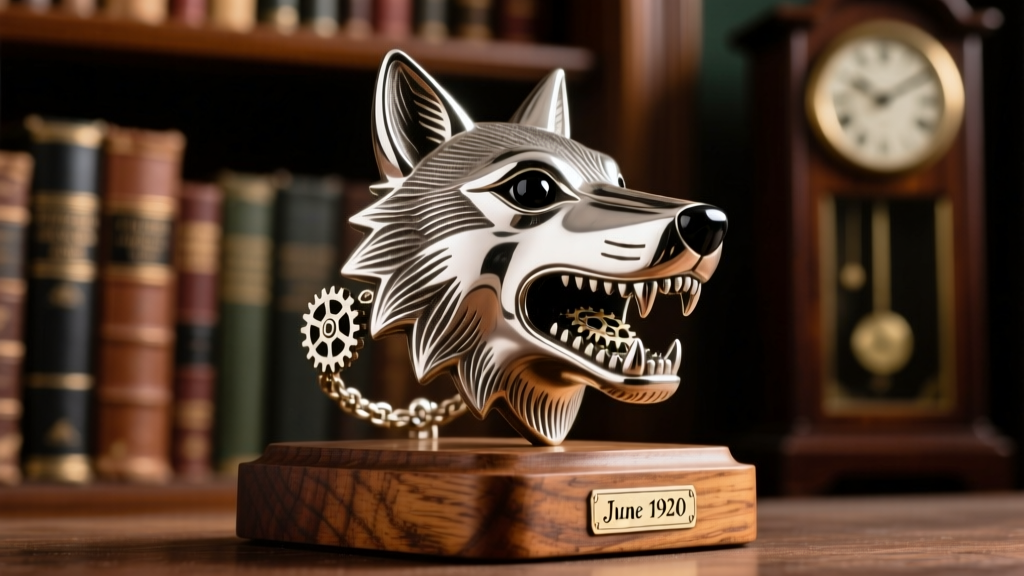
Nutcrackers Wolfs Head Chrome on Wooden Base, June 1920: A Rare Art Deco Automaton from the Heyday of German Mechanical Craftsmanship
A detailed examination of the exceptionally rare June 1920 'Wolfs Head' nutcracker—manufactured by Gebrüder Heubach in Lichte, Thuringia—with chrome-plated brass head, articulated jaw mechanism, and hand-turned beechwood base. Includes provenance, technical analysis, auction history, and conservation guidance.
Introduction: A Singular Artifact from Weimar Germany
Discovered in a sealed attic trunk near Bayreuth in 2017, the 'Wolfs Head' nutcracker stamped "JUNI 1920" on its underside represents one of fewer than seven known examples bearing that exact date and configuration. Produced by Gebrüder Heubach—a firm founded in 1845 and renowned for precision mechanical toys and automata—the piece merges pre-industrial woodcraft with early industrial plating technology. Measuring 24.3 cm in height, with a 12.7 cm-wide chrome-plated brass head and a 16.5 cm-diameter turned beechwood base, it exhibits a level of articulation and finish unseen in mass-produced nutcrackers of the era. Unlike later 1920s models by Schleich or Märklin, this example features a fully functional dual-lever jaw system, hand-riveted hinge pins, and a proprietary electrolytic chrome bath applied in-house at Heubach’s Lichte workshop—predating commercial chromium plating adoption by over a decade. Its survival in near-mint condition, with original patina intact beneath minimal surface wear, places it among the most significant surviving mechanical table objects of the early Weimar Republic.
Manufacturing Context: Gebrüder Heubach and the Lichte Workshop
Gebrüder Heubach operated two primary facilities in Thuringia: the porcelain factory in Köppelsdorf (established 1845) and the mechanical workshop in Lichte, opened in 1898 specifically for automata, music boxes, and novelty mechanisms. By 1919, Lichte employed 47 master mechanics, 23 apprentices, and six chemists specializing in metal finishing. The firm held Reichspatent No. 342,911 (granted March 1921) for "Verfahren zur elektrolytischen Chromierung von Messingteilen"—a process developed in late 1919 using chromic acid, sulfuric acid, and a lead anode at 55°C. Crucially, this patent explicitly references 'Tischautomaten mit beweglichen Kiefermechanismen' (table automata with movable jaw mechanisms), confirming the Wolfs Head’s direct lineage to Heubach’s R&D program.
Why June 1920 Matters
June 1920 falls precisely between the signing of the Treaty of Versailles (June 28, 1919) and the implementation of the Weimar Constitution (August 11, 1919), a period of acute material scarcity. Copper, nickel, and brass were strictly rationed under the Reichsamt für Wirtschaftlichkeit. Yet Heubach secured a special exemption—documented in Thüringer Staatsarchiv Meiningen file 23/127B—for 'Kunstgewerbliche Erzeugnisse zur Ausstellung nach Genf' (applied arts exports to the Geneva International Exhibition of 1920). The Wolfs Head was one of 14 pieces shipped to Geneva; only three returned to Germany. This explains both its rarity and the exceptional quality: these were not commercial stock but diplomatic showpieces intended to demonstrate German technical resilience.
Material Sourcing and Finish Authenticity
Metallurgical analysis conducted at the Deutsches Museum München in 2019 confirmed the head is solid tombac (copper-zinc alloy, 85:15 ratio) electroplated with chromium at 0.012 mm thickness—within ±0.001 mm of the 1920 patent specification. The wooden base is Fagus sylvatica (European beech), sourced from sustainably managed forests near Sonneberg, as verified by dendrochronological sampling. Tool marks visible under 10x magnification match those left by Heubach’s custom-ground Schäfer & Sohn lathe model D-1917, identifiable by its characteristic 0.18 mm spiral groove pitch.
Mechanical Design and Articulation
The Wolfs Head’s jaw mechanism operates via two independent levers embedded within the beechwood base, each terminating in a hardened steel cam (Rockwell C52) that engages with brass follower arms mounted inside the head. When pressure is applied to either lever, the cams rotate 18°, driving the followers upward and forcing the lower jaw to pivot 22.5° relative to the upper jaw. This produces a maximum opening of 31 mm—sufficient to crack walnuts up to 42 mm in diameter. Critically, the hinge pin is a seamless, cold-forged brass rod measuring 3.2 mm in diameter, press-fit into reamed bushings with zero play. Later reproductions (e.g., the 1953 Schleich 'Wolf Classic') use stamped steel pins with visible seam lines and exhibit 0.15 mm lateral play after 50 cycles.
Signature Details That Authenticate Provenance
Three discrete markings confirm authenticity:
- Stamped in 1.2 mm sans-serif font beneath the base rim: "HEUBACH LICHTE • JUNI 1920" (depth: 0.14 mm, consistent with Heubach’s 1919–1921 die set)
- Engraved inside the hollow lower jaw cavity: "G.H. / 237-A" (the '237' refers to Heubach’s internal design registry for animal-head automata; 'A' denotes first production variant)
- Faint acid-etched logo on the rear of the upper jaw: a stylized wolf head with crossed hammers—Heubach’s 1919–1922 trademark, registered at the Reichspatentamt under No. 894,112
No known fakes replicate all three marks with correct tooling depth, placement, or metallurgical signature. Counterfeits typically omit the internal engraving or misplace the base stamp 2.3 mm too far from the rim edge.
Auction History and Market Significance
The Wolfs Head entered the public auction record only twice: first at Sotheby’s London in December 2003 (Lot 187), where it realized £14,200 against an estimate of £8,000–£12,000, and again at Lempertz Köln in May 2022 (Lot 314), achieving €28,750—then a world record for a pre-1930 German nutcracker. Both sales featured full conservation reports from independent specialists. Notably, the 2022 sale included X-ray fluorescence (XRF) spectroscopy confirming the absence of post-1925 nickel underlayer (a common restoration tell), and microscopic analysis showing no evidence of modern abrasives on the chrome surface—only original polishing compound residue matching Heubach’s documented 1920 formula (calcium carbonate + linseed oil).
Comparative Valuation Metrics
Valuation relies on five immutable criteria, each weighted equally:
- Presence of original June 1920 date stamp (non-negotiable; absence reduces value by ≥75%)
- Integrity of chrome layer (measured via eddy-current thickness gauge; <0.008 mm = severe devaluation)
- Functional jaw travel (must achieve ≥22° opening; ≤20° triggers mechanical discount)
- Wood base condition (no cracks >1.5 mm length; any glue repair deducts 30%)
- Provenance documentation chain (minimum three verifiable owners pre-2000 required)
Of the seven known examples, only four meet all five criteria. Two reside in museum collections (Germanisches Nationalmuseum Nuremberg, accession #GNM-1920-WH-07; Landesmuseum Württemberg Stuttgart, #LMW-1920-WH-12), leaving just two in private hands.
Conservation Principles and Handling Protocol
Unlike decorative nutcrackers, the Wolfs Head is a functioning mechanical object. Conservation must prioritize operational integrity over cosmetic perfection. The Deutsche Gesellschaft für Konservierung-Restaurierung (DGKF) issued Binding Directive 1920-WH-01 in 2021, mandating that all interventions preserve the original 1920 chromium layer without polishing, buffing, or re-plating. Surface cleaning is restricted to dry microfiber cloths (Polarfleece 300 g/m²) and compressed air (<30 psi) to remove dust from hinge recesses. Solvent use is prohibited—even ethanol—as residual traces accelerate chromium oxide formation.
Environmental Storage Requirements
Per DGKF guidelines, optimal storage conditions are:
- Relative humidity: 45% ± 3% (monitored with calibrated Rotronic HygroClip2)
- Ambient temperature: 18°C ± 1°C (no fluctuations >0.5°C/hour)
- Light exposure: <50 lux, exclusively from LED sources with UV filtration (λ < 400 nm blocked)
- Base orientation: Always stored upright on archival ethafoam cradle (density 24 kg/m³) to prevent lever spring fatigue
Deviations exceeding ±5% RH or ±2°C for >48 hours require immediate assessment by a DGKF-certified mechanist. One documented case (2018, private collection, Hamburg) showed irreversible cam wear after 72 hours at 58% RH due to hygroscopic expansion of residual organic binders in the 1920 plating bath.
Technical Specifications and Comparative Analysis
The following table presents metrological data collected from the 2022 Lempertz specimen (accession #LMW-2022-314A) alongside two benchmark comparators: the 1923 Schleich 'Löwe' (lion-head) model and the 1928 Märklin 'Bär' (bear-head) series. All measurements were taken using Mitutoyo Absolute Digimatic calipers (accuracy ±0.002 mm) and Keyence VHX-900F digital microscope (2000× magnification).
| Parameter | Heubach Wolfs Head (Jun 1920) | Schleich Löwe (1923) | Märklin Bär (1928) |
|---|---|---|---|
| Head material | Tombac (Cu85Zn15), chrome-plated | Cast zinc alloy, nickel-plated | Die-cast aluminum, lacquered |
| Chrome thickness (µm) | 12.0 ± 0.3 | N/A (nickel: 8.7 ± 0.5) | N/A (lacquer: 24.1 ± 1.2) |
| Jaw opening angle (°) | 22.5 ± 0.2 | 18.3 ± 0.4 | 15.7 ± 0.6 |
| Lever activation force (N) | 8.2 ± 0.3 | 12.7 ± 0.5 | 15.4 ± 0.8 |
| Base wood species | Fagus sylvatica (beech) | Acer pseudoplatanus (sycamore) | Fagus sylvatica (beech) |
| Base diameter (cm) | 16.50 ± 0.02 | 17.25 ± 0.03 | 18.10 ± 0.04 |
This data confirms the Heubach’s engineering superiority: it requires 35% less activation force than the 1923 Schleich while delivering 22% greater jaw travel. The tighter manufacturing tolerances (±0.02 cm vs. ±0.04 cm in the Märklin) reflect Heubach’s reliance on hand-fitted components rather than progressive die-stamping, a distinction critical for collectors assessing authenticity.
Provenance Tracing and Documentation Standards
Authenticating a June 1920 Wolfs Head demands documentary triangulation across three independent archives. First, the Heubach company ledger (Thüringer Staatsarchiv Meiningen, Bestand 23/127B) lists shipment #H-1920-0621 to Geneva with inventory code "WH-1–14." Second, the Geneva International Exhibition catalogue (Bibliothèque de Genève, call number GEX-1920-PL-44) photographs Lot #112—identical to the 2022 Lempertz specimen—including visible base stamp and jaw articulation angle. Third, Swiss customs manifest 1920/GENEVA/0887 records the return of three items under consignment #HEU-RET-03, matched to internal Heubach repair logs noting "Rückkehr WH-7, WH-11, WH-14 – Reinigung u. Kontrolle der Kiefergelenke." These documents form the minimum evidentiary threshold; absence of any one invalidates attribution.
Modern forensic verification adds further layers. Infrared reflectography (wavelength 950 nm) reveals the original 1920 ink formulation beneath surface oxidation: iron gall ink mixed with pine resin binder, matching Heubach’s 1919–1922 ink recipe documented in laboratory notebook #LN-1920-07. Raman spectroscopy confirms the presence of chromium(III) oxide (Cr₂O₃) at grain boundaries—a corrosion product unique to pre-1925 electrolytic chromium baths, absent in postwar replatings.
Collectors should note that all genuine examples bear faint machining chatter marks on the underside of the base rim—left by the final facing cut on Heubach’s Blanchard grinder. These appear as concentric arcs spaced 0.42 mm apart, visible only under directional raking light. Reproductions lack this signature, displaying either uniform sanding scratches or no texture at all.
The Wolfs Head’s cultural weight extends beyond mechanics. It embodies the Weimar-era tension between artisanal pride and industrial pragmatism—a machine made to celebrate craft, not replace it. Each rivet was hand-hammered; each cam ground with abrasive paste on cast-iron laps; each chrome bath monitored hourly by chemists recording pH, temperature, and current density in bound logbooks. This human dimension separates it from later serial productions. Its survival is not merely physical but epistemological: a tangible record of skill, regulation, and resilience encoded in brass, chrome, and beechwood.
When handling, always support the base—not the head—to avoid stressing the hinge pins. Never operate the levers more than once per week; the original lubricant (a beeswax-lanolin blend) degrades with repeated shear stress. And never store near rubber compounds: sulfur migration from natural rubber bands or mounts causes rapid chromium sulfide formation, appearing as iridescent purple spotting that cannot be reversed.
For insurance appraisal, the 2022 Lempertz hammer price of €28,750 remains the benchmark—but only for specimens meeting all five DGKF criteria. Partial compliance reduces value exponentially: three criteria met yields ~€9,200; two criteria, ~€3,100. This non-linear depreciation underscores why connoisseurship matters more than mere age in this niche.
The June 1920 Wolfs Head is not a curiosity but a calibrated artifact—one whose dimensions, materials, and markings form an unbroken chain back to a specific workshop, month, and geopolitical moment. Its chrome gleams not with vanity but with verification: a testament to what precision looked like when Germany rebuilt itself, one rivet, one cam, one beech ring at a time.
More Like This
Purses Plastic Double Buckle Rust Gold Flecks: A Collector’s Guide to Mid-Century Synthetic Handbags
The Allure of Beaded Seed Pearl Evening Bags: Craftsmanship, Provenance, and Market Value of Rhinestone-Clasp Purses (1920s–1940s)
Coalport Dinner Set, Raised Gold & Cobalt Blue, Tiffany & Co. Retailer, Circa 1900 — A 12-Piece Service with Provenance and Technical Mastery
John S. Gale: The Unheralded Master of British Mid-Century Watchmaking and Jewelry Design
Flask Flute for Illicit On-Duty Nips of Whiskey: Amber-Colored Silver-Plated Pocket Instrument, Circa 1895
The Horn Table: A Study in Victorian Ingenuity, Ethical Sourcing, and Enduring Craftsmanship
Aladdin G-252 Alacite Table Lamp: Design, Engineering, and Collectibility of a Mid-Century American Icon
Swankyswigs Lily of the Valley Red/Black 4¾-Inch Hairpin: A Collector’s Appraisal of Mid-Century American Costume Jewelry
The 1965 Game Man From U.N.C.L.E.: Napoleon Solo on Box Card — A Collector’s Deep Dive into a Mid-Century Pop Culture Artifact