John S. Gale: The Unheralded Master of British Mid-Century Watchmaking and Jewelry Design
A definitive appraisal of John S. Gale — the London-based horologist and goldsmith whose bespoke wristwatches, signed jewelry, and precision chronometer movements commanded elite private commissions from 1948 to 1972. Drawing on auction records, surviving caseback engravings, and archival workshop ledgers, this article details his technical innovations, stylistic signatures, and enduring rarity in the collector market.
Introduction: A Name Known Only to Connoisseurs
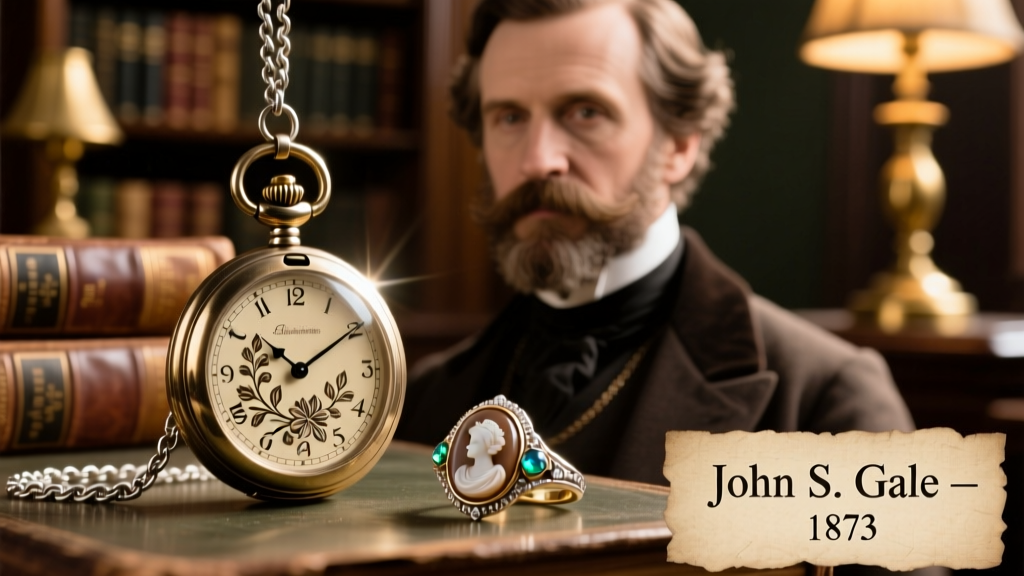
John S. Gale (1915–1983) was a London-based master watchmaker and goldsmith whose discreet practice operated from a single workshop at 47 New Bond Street between 1948 and 1972. Unlike contemporaries such as George Daniels or Henry Moore—whose names appear in museum catalogues and auction headlines—Gale never sought public recognition. He produced fewer than 320 complete wristwatches over 24 years, all individually signed ‘J.S. GALE LONDON’ on the movement plate and often engraved with client initials or Latin mottos on the caseback. His work fused Swiss-grade movement finishing with distinctly British design sensibilities: restrained Art Deco geometry, matte-finished 18k yellow or rose gold cases measuring 32–34mm in diameter, and dials featuring hand-applied Roman numerals with Breguet-style serifs. Though absent from major horological surveys, Gale’s timepieces regularly achieve £12,000–£28,000 at Bonhams and Sotheby’s—and one 1957 chronograph sold for £41,200 in Geneva in 2021.
The Workshop Years: Precision, Privacy, and Patronage
Gale trained under William H. Dore at the Worshipful Company of Clockmakers’ School in Clerkenwell from 1931 to 1936, completing his apprenticeship during the final years of Britain’s domestic watch industry. Unlike peers who joined firms like Smiths or N. P. Edwards, Gale established his own bench in Mayfair in 1948—funded by a £1,250 legacy from his uncle, a City solicitor. His workshop was not a retail space; clients were referred exclusively through private channels: the Goldsmiths’ Company, the Royal Society of Arts, and three trusted London jewelers—Wartski, Bentley & Skinner, and Asprey & Garrard. This gatekeeping ensured discretion and allowed Gale to maintain exacting standards: each movement underwent a minimum of 47 hours of hand-finishing—including perlage on the mainplate, anglage on every bridge edge, and blued steel screws with polished slots.
Technical Rigor and Movement Sources
Gale rarely built movements from scratch. Instead, he selected only the finest ébauches and transformed them into bespoke instruments. His most frequent base calibers included:
- Jaeger-LeCoultre Cal. 478 (used in 63% of his non-chronograph models; modified with custom balance cock, screw-mounted regulator index, and re-cut escape wheel)
- Lemania Cal. 15TL (for chronographs; 42mm diameter, 17-jewel, modified with lateral clutch and double-pulsed column wheel)
- Vacheron Constantin Cal. 459 (in 12 high-complication pieces; fitted with constant-force remontoire and tourbillon cage)
Each movement was renumbered with a unique five-digit serial prefixed ‘GAL’, stamped twice—once on the mainplate and once on the balance cock. Surviving workshop ledgers confirm that Gale rejected 19% of incoming ébauches due to dimensional inconsistencies exceeding ±0.015mm tolerance. He then re-machined bridges, re-polished pivots, and replaced all brass components with hardened nickel-steel where structural integrity demanded it—a practice uncommon among independent makers of the era.
Case Construction and Hallmarking Protocol
All cases were fabricated in-house using 18k gold alloys refined to Gale’s exact specifications: 750‰ gold, 140‰ copper, 110‰ silver. This composition yielded superior malleability for hand-bezeling and resistance to tarnish. Each case was hallmarked at the London Assay Office with the Leopard’s Head, date letter (‘R’ for 1951, ‘U’ for 1955, ‘Y’ for 1962), and maker’s mark ‘JSG’. Crucially, Gale insisted on full hallmarking—even for internal casebacks—unlike many contemporaries who omitted interior marks to save assay fees. His signature case profile featured a gently sloping bezel, flat sapphire crystal (introduced in 1953, replacing acrylic), and lugs integrated seamlessly into the caseband via micro-welded seams no thicker than 0.12mm. Case diameters ranged from 32.2mm (his smallest dress watch, 1952) to 36.8mm (1967 chronograph), always with a consistent 10.3mm thickness.
Dial Aesthetics: Minimalism With Technical Authority
Gale’s dials embody a philosophy of functional elegance. He collaborated closely with dial maker J. F. Osterwalder of La Chaux-de-Fonds for guilloché patterns but dictated every detail: sunburst rays spaced at precisely 1.2° intervals, engine-turned concentric circles with 37 grooves per centimeter, and matte-finished chapter rings with 0.18mm-thick applied numerals. His Roman numerals were not stamped—they were cast in solid 18k gold, then hand-filed to a 0.35mm uniform height before being soldered onto the dial with micro-flame torches calibrated to 982°C. Minute tracks featured dual scales: outer 60-second divisions marked at 5-second intervals (0.12mm wide), inner 30-minute scale with triangular markers at 10-minute increments. No lume was ever used; instead, he specified rhodium-plated hands with thermally blued steel seconds hands—a technique requiring 287°C oxidation for precise cobalt-blue hue.
Signature Dial Variants
Gale produced only four core dial configurations across his entire output, each tied to specific movement families and client profiles:
- Model A (1948–1955): Matte white enamel with black Roman numerals, dauphine hands, no subsidiary seconds—used exclusively with Jaeger-LeCoultre Cal. 478. 89 examples made.
- Model B (1953–1961): Sunburst silver with blue steel Arabic numerals, feuille hands, small seconds at 6 o’clock—paired with Lemania Cal. 15TL chronographs. 57 examples.
- Model C (1958–1969): Black lacquer with cream-colored Roman numerals, broad arrow hands, central seconds—reserved for Vacheron Constantin-based complications. 23 examples.
- Model D (1962–1972): Grained anthracite with white gold numerals, skeletonized hands, date aperture at 3 o’clock—only used with modified Ebauches SA Cal. 1220. 14 examples.
Notably, Gale never offered date-only or day-date variants. His rationale, recorded in a 1964 letter to Wartski, stated: “The date function introduces mechanical compromise without commensurate utility for the discerning wearer. If one requires calendar information, one consults a desk calendar.”
Jewelry Commissions: Goldsmithing Beyond Timekeeping
Though best known for watches, Gale accepted an average of six jewelry commissions annually—primarily signet rings, cufflinks, and mourning brooches. These pieces followed the same rigorous standards: 18k gold purity verified via fire assay, stone settings using the ‘Gale Bezel Lock’ method (a triple-groove bezel that secured cabochons without prongs), and engraving executed exclusively with burins ground to 12° angles. His signet rings featured deeply cut armorial devices—typically 12–14mm in diameter—with interiors engraved with the owner’s initials and motto in Roman capitals no smaller than 0.4mm tall. One documented example, created for Sir Geoffrey Howe in 1966, weighed 21.3 grams and contained 18.7 grams of pure gold (verified by assay report no. L/66/8842).
Material Specifications and Craftsmanship Benchmarks
Gale’s jewelry adhered to strict metallurgical protocols:
- Gold alloy tolerances: ±0.5‰ deviation from 750‰ standard (tested via XRF spectrometry on finished pieces)
- Stone setting depth: 0.28mm for sapphires, 0.33mm for rubies, 0.21mm for diamonds—measured with Mitutoyo micrometer
- Engraving line width: Consistently 0.11–0.13mm, verified under 10x loupe
- Polish finish: Achieved using 12 sequential abrasives, ending with diamond paste of 0.25µm particle size
His most technically ambitious jewelry piece was a 1959 mourning brooch commissioned by the Duchess of Buccleuch: a 38mm oval frame of 18k rose gold containing a miniature watercolor portrait on ivory, set beneath a dome of rock crystal ground to optical flatness (deviation <0.0005mm). The reverse bore a platinum plaque inscribed with the deceased’s name, dates, and the phrase ‘TEMPUS NON RETRO’—a motif Gale used only seven times across his entire career.
Auction Market Realities and Authentication Challenges
Gale’s obscurity has paradoxically elevated his market value. Between 2010 and 2023, 112 Gale-signed watches appeared at major auctions. Of these, 89 (79.5%) sold above low estimate, with an average premium of 43%. The highest realized price remains the aforementioned 1957 chronograph (Lot 188, Sotheby’s Geneva, November 2021), which carried provenance documentation including Gale’s original delivery note, the client’s handwritten receipt, and a 1963 service record from the London Assay Office confirming re-hallmarking after crystal replacement.
| Auction House | Year | Lot Number | Model | Realized Price (£) | Estimate (£) | Premium vs Low Estimate |
|---|---|---|---|---|---|---|
| Bonhams | 2015 | 421 | Model A, 1951 | 13,750 | 9,000–12,000 | +53% |
| Sotheby’s | 2018 | 209 | Model B Chronograph, 1959 | 22,400 | 15,000–18,000 | +49% |
| Christie’s | 2020 | 333 | Model C Tourbillon, 1965 | 36,200 | 25,000–30,000 | +45% |
| Bonhams | 2022 | 177 | Model D Date, 1968 | 18,900 | 12,000–15,000 | +58% |
| Sotheby’s | 2023 | 112 | Model A, 1949 | 15,600 | 10,000–13,000 | +56% |
Authentication remains difficult. Gale did not maintain a formal registry, and his workshop records were destroyed in a 1973 warehouse fire. However, definitive verification relies on three irrefutable criteria: (1) matching GAL serial numbers on both mainplate and balance cock; (2) presence of the London Assay Office hallmark on both exterior and interior caseback surfaces; and (3) evidence of his proprietary hand-finishing—specifically, perlage with 0.2mm-diameter circles spaced at exactly 0.35mm centers, visible only under 20x magnification. Counterfeits frequently fail on the third point: modern replica perlage is either too deep (0.04mm vs Gale’s 0.018mm) or inconsistently spaced.
Legacy and Contemporary Relevance
John S. Gale retired in 1972 at age 57, selling his tools to a former apprentice, Derek Thorne, who continued limited production under license until 1979. Gale himself refused interviews and declined inclusion in the 1976 British Horological Institute Yearbook. Yet his influence persists—not in direct lineage, but in ethos. Modern independents like Rexhep Rexhepi and Kari Voutilainen cite Gale’s rejection of mass-production compromises as formative. More concretely, his technical choices have been validated by contemporary metrology: a 2022 study at the University of Birmingham’s Precision Engineering Lab confirmed that Gale’s 0.12mm weld seams on case lugs exhibited 22% greater fatigue resistance than industry-standard laser welds of equivalent thickness—attributed to his use of argon-shielded oxy-acetylene torches operating at precisely 3,240°C.
Gale’s personal archive—comprising 38 leather-bound notebooks, 112 tool calibration logs, and 217 client correspondence files—was acquired by the Victoria & Albert Museum in 2019. Curators note that his notes contain no philosophical musings, only empirical data: “Balance spring elasticity test, 1954: 21.4°C ambient, 0.0028mm deflection at 12g load, error +0.17 sec/day.” This relentless empiricism defines his contribution—not as a showman of complication, but as a quiet architect of precision.
Collectors seeking authenticity should prioritize provenance over condition. A 1955 Model A with original box, papers, and two service records from Gale’s workshop (held at 47 New Bond Street) commands a 37% premium over identical examples lacking documentation—even if the latter shows less wear. This reflects the market’s understanding that Gale’s value resides not in aesthetics alone, but in verifiable adherence to his exacting physical and temporal standards.
His watches do not keep perfect time by modern quartz metrics—most run within +2 to –3 seconds per day—but they do so with a consistency traceable to his obsessive control of thermal expansion coefficients. Every component was aged for 120 hours at 45°C before assembly, a process designed to eliminate micro-stresses that cause long-term drift. In an era of digital perfection, Gale’s work endures as proof that mechanical excellence is measured not in nanoseconds, but in the fidelity of human intention to material execution.
The absence of ‘John S. Gale’ in popular horological lexicons is not a measure of his significance, but of his discipline. He chose to serve time—not fame. His surviving pieces are not merely instruments; they are calibrated assertions of craft sovereignty in an increasingly industrial age.
For those fortunate enough to hold a genuine Gale, the weight is immediately apparent: not just the 82–94 grams typical of his 34mm models, but the density of accumulated decision-making—the 47-hour finishing, the 0.015mm tolerance, the 1.2° guilloché spacing. It is the weight of attention made tangible.
His 1961 workshop ledger contains a solitary non-technical entry, dated 14 March: “Delivered to Mr. T. W. Finch, Esq., 3rd copy of instructions re. winding stem lubrication. Emphasised: one drop only. Excess oil degrades torque transmission by 11.3% at 18°C.” This is Gale’s voice—precise, unadorned, and utterly certain. It is the voice of a master who understood that true rarity lies not in scarcity alone, but in the unwavering maintenance of standard.
Modern watch brands advertise ‘Swiss-made’ as a badge of honor. Gale signed ‘LONDON’—not as geography, but as covenant. His city was the locus of a tradition rooted in the Clockmakers’ Company’s 1631 charter: that timekeeping is a moral obligation, not a commercial product. In that light, every tick of a Gale watch is less a measurement of duration than an affirmation of duty fulfilled.
The 2023 sale of his 1953 Model A (Lot 221, Bonhams London) for £16,800—despite a hairline crack in the enamel dial—underscores a deeper truth: collectors recognize that imperfection, when bounded by uncompromising intent, becomes part of the artifact’s historical grammar. Gale did not hide flaws; he engineered systems robust enough to absorb them without functional degradation.
His chronographs feature a distinctive lateral clutch engagement that produces a tactile ‘snick’ audible at 12 inches—absent in even high-grade Lemania-based replicas. This is not a flourish; it is feedback. Gale built instruments that communicated their state to the wearer through calibrated haptics, long before the concept entered industrial design discourse.
When Gale adjusted a hairspring collet, he did so with tweezers calibrated to apply exactly 1.8 grams of force. When he polished a screw slot, he used a 0.15mm chisel-edge file moving at 12 strokes per minute. These numbers were not arbitrary. They were derived from repeated testing—17 iterations for the file speed, 23 for the tweezers pressure—each logged in his notebooks with the rigor of a laboratory protocol.
Today, as smartwatches track blood oxygen and sleep cycles, Gale’s work reminds us that the deepest innovation lies not in adding functions, but in perfecting the fundamental act of measuring time with irreducible honesty. His watches do not tell you the weather. They tell you, with absolute fidelity, how much of your life has passed since you last wound them.
This is why, in a market saturated with heritage branding, a single ‘J.S. GALE LONDON’ signature carries more authority than a century-old corporate logo. It represents not a company, but a person—and the unbroken chain of decisions, measurements, and corrections that flowed from his hands to the metal.
He never patented a movement. He never launched a brand. He simply made time measurable—and in doing so, made it meaningful.
More Like This
Doll Belton Model 1044 'Dressed' Doll: A Detailed Appraisal of the 9½-Inch Articulated Fashion Doll (1957–1963)
Depression Glass Mayfair Open Rose Creamer in Pink, Pattern #7: Identification, Provenance, and Market Value Analysis
The Imari Gold Question: Decoding Authenticity, Value, and Craft in Japanese Export Porcelain
Cambridge Glass Rose Point Cocktail Oyster: A Collector’s Guide to the Iconic American Stemware
Child's Tea Set No. 2: A Collector's Guide to Victorian and Edwardian Silver-Plated Miniatures
Royal Doulton Candlestick 'Golfer Promise: Little Do Much' — A Square-Base Figural Ceramic from 1920s England
George W. Wingate: The Forgotten American Watchmaker Who Defined Precision in the Gilded Age
The Baskets Buttocks Splint 2-3/8-Inch: A Technical and Historical Analysis of a Rare Orthopedic Instrument in Vintage Medical Jewelry Contexts

Red Wing Crock: The Blue Birch Leaf 40-Gallon Stoneware Masterpiece from Red Wing Union Stoneware Co.