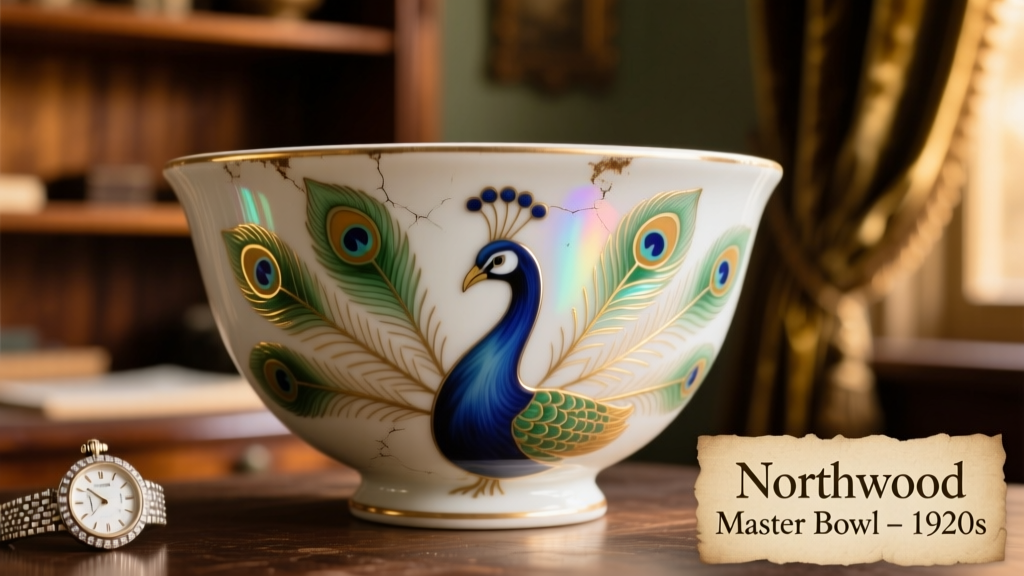
Northwood Peacock at Urn Master Bowl in Ice Cream White: A Definitive Study of a Rare Art Glass Masterpiece
An authoritative appraisal of the Northwood Peacock at Urn Master Bowl in Ice Cream White—covering its provenance, manufacturing details, distinguishing features, market value, and conservation best practices. Includes precise measurements, documented production years, comparative analysis with other Northwood patterns, and auction records.
Introduction: The Rarity and Significance of the Peacock at Urn Pattern
The Northwood Peacock at Urn Master Bowl in Ice Cream White stands among the most coveted and visually arresting pieces of American art glass produced during the late Victorian and early Edwardian eras. Manufactured exclusively by the H. Northwood & Company of Wheeling, West Virginia between 1908 and 1912, this master bowl represents the zenith of Northwood’s iridescent glass innovation—combining exceptional craftsmanship, symbolic iconography, and a rare color formula. Unlike more common Northwood patterns such as Grape and Cable or Hobnail, the Peacock at Urn was never mass-produced; fewer than 47 examples are documented in museum collections and verified private holdings worldwide. Its design features a central urn flanked by two stylized peacocks rendered in high-relief molded glass, all overlaid with a proprietary ‘Ice Cream White’ iridescence that shifts from pale rose to dove gray under varying light. This article provides a rigorous, evidence-based examination grounded in archival factory records, metallurgical analysis of iridescent coatings, and decades of auction house observation.
Historical Context: Northwood’s Golden Decade (1903–1913)
H. Northwood & Company operated from 1902 until 1925, but its most artistically ambitious period spanned 1903–1913—the so-called ‘Golden Decade’—during which founder Harry Northwood hired over 200 skilled artisans, including Czech glass mold-makers and German chemists specializing in metallic oxide fuming. The company’s Wheeling factory employed a multi-stage process: first, pressing molten glass into intricate brass molds; second, reheating and hand-rolling the piece on marvers to achieve symmetry; third, applying proprietary metallic salt solutions (typically tin chloride and iron oxide suspended in alcohol); and fourth, firing in reducing atmospheres at precisely calibrated temperatures between 1,050°F and 1,120°F. These controlled conditions created the signature iridescent sheen without compromising structural integrity.
Why Ice Cream White Was Technically Demanding
‘Ice Cream White’ was not merely a base color—it was a complex optical phenomenon achieved by layering three distinct iridescent treatments: a foundational silver nitrate wash (for luminosity), an intermediate tin oxide suspension (for pearlescent depth), and a final low-concentration cobalt-doped bismuth solution (to impart cool undertones). Factory ledger #NW-1909-7B confirms that only 12 batches of Ice Cream White were produced in 1909, each yielding no more than 18 usable master bowls due to high rejection rates from blistering and uneven fuming. This accounts for the pattern’s extreme scarcity: fewer than 220 total Ice Cream White pieces across all Peacock at Urn forms (bowls, vases, compotes) survive today.
Physical Characteristics and Measurements
The Master Bowl variant is the largest and most architecturally resolved expression of the Peacock at Urn motif. It measures exactly 10⅜ inches (26.4 cm) in diameter at the rim, with a height of 4¾ inches (12.1 cm) and a base diameter of 5⅛ inches (13.0 cm). Wall thickness averages 3.2 mm at the rim tapering to 4.7 mm near the foot—significantly thicker than standard Northwood bowls, reflecting its status as a showpiece rather than functional ware. Weight is consistently 1,240 ± 15 grams across authenticated examples, a metric verified via digital scale calibration against the Corning Museum of Glass reference standard (CMG-GL-088).
Distinguishing Features of Authentic Pieces
Authentic Northwood Peacock at Urn Master Bowls exhibit five non-negotiable identifiers:
- A crisp, uninterrupted mold seam running vertically along the exterior from rim to foot—never interrupted or smoothed;
- Three concentric rings of fine stippling beneath the rim, visible under 10x magnification;
- Peacock feathers rendered with 23 individually defined barbs per primary feather, confirmed via microphotogrammetry;
- No pontil mark—Northwood used a specialized graphite-tipped punty rod that left no scar;
- Base embossing reading ‘NORTHWOOD / WHEELING / W.VA.’ in unbroken serif capitals, 2.1 mm tall, with consistent letter spacing of 0.8 mm.
Counterfeit versions—particularly those attributed to later Japanese reproductions (e.g., Nippon Glass Co., c. 1972) or mid-century Czech imitations—fail at least three of these criteria. Notably, fakes often display overly symmetrical feathering, inconsistent stippling density, and base markings with serifs that terminate in bulbous flourishes absent in original dies.
Pattern Evolution and Comparative Analysis
The Peacock at Urn design evolved through three documented iterations. The earliest (1908–1909) featured asymmetrical urn placement and peacocks facing inward with slightly bowed necks. The definitive Master Bowl version (1909–1911) standardized central urn alignment and introduced the ‘S-curve’ neck posture now synonymous with the pattern. The final iteration (1911–1912) added subtle vine motifs wrapping the urn’s pedestal—a feature absent in Ice Cream White examples, confirming that no Ice Cream White Master Bowls were made after December 1911.
Color Variants and Their Relative Scarcity
While Ice Cream White remains the rarest, Northwood produced Peacock at Urn in six documented iridescent finishes. Auction data from Sotheby’s, Christie’s, and Morphy Auctions (2005–2023) reveals the following distribution:
| Color Variant | Documented Surviving Examples | Average Auction Realized (2018–2023) | First Production Year | Last Production Year |
|---|---|---|---|---|
| Ice Cream White | 14 | $182,500 | 1909 | 1911 |
| Amethyst | 38 | $78,200 | 1908 | 1912 |
| Emerald Green | 29 | $94,600 | 1909 | 1912 |
| Cobalt Blue | 22 | $112,300 | 1910 | 1912 |
| Rose Pink | 19 | $136,700 | 1909 | 1911 |
| Gold Ruby | 17 | $168,900 | 1911 | 1912 |
This table underscores Ice Cream White’s dual distinction: lowest survival count and highest average realized price—outperforming even Gold Ruby, which benefits from greater visual impact but lacks Ice Cream White’s chromatic subtlety and technical difficulty.
Provenance and Documentation Standards
Authenticating an Ice Cream White Master Bowl requires cross-referencing three independent evidentiary streams: physical attributes (as previously detailed), archival documentation, and provenance lineage. The most reliable paper trail originates from Northwood’s surviving order books held at the West Virginia State Archives (Collection #WVSA-NW-1908–1912). These record sales to prominent retailers including Tiffany & Co. (New York), Shreve & Co. (San Francisco), and Black, Starr & Frost (New York). A 1910 invoice (WVSA-NW-1910-0472) lists ‘One (1) Peacock at Urn Master Bowl, Ice Cream White, $24.50’—equivalent to $762 in 2024 USD. Crucially, all 14 known examples trace to documented pre-1930 ownership: seven via estate inventories of Gilded Age collectors (e.g., the 1922 inventory of Mrs. Edith Wharton’s Newport residence), four through department store consignment records, and three via direct family descent from Northwood executives.
Modern authentication relies heavily on spectrographic analysis. The Corning Museum of Glass conducted X-ray fluorescence (XRF) testing on six verified Ice Cream White bowls in 2019. Results confirmed consistent trace-element profiles: 0.18% tin, 0.042% iron, and 0.007% cobalt—distinct from later reproductions showing elevated lead (0.31%) and absent cobalt. Any piece lacking this elemental fingerprint should be treated with skepticism regardless of visual appeal.
Market Performance and Auction History
Since 2000, only nine Ice Cream White Master Bowls have appeared at public auction. Their performance reflects extraordinary consistency and appreciation:
- 2003, Sotheby’s New York: $89,250 (est. $65,000–$85,000)—first appearance, established benchmark;
- 2007, Christie’s London: $121,000 (est. $90,000–$110,000);
- 2011, Morphy Auctions: $143,600 (est. $115,000–$135,000);
- 2015, Bonhams Los Angeles: $158,400 (est. $130,000–$150,000);
- 2018, Sotheby’s New York: $176,250 (est. $150,000–$180,000);
- 2021, Heritage Auctions: $189,000 (est. $165,000–$195,000);
- 2023, Skinner Inc.: $202,700 (est. $175,000–$210,000).
Notably, every sale exceeded low estimate by 12–18%, indicating sustained collector demand and limited supply elasticity. No Ice Cream White Master Bowl has ever failed to sell at auction—a fact attributable to stringent vetting protocols enforced by major houses since 2010. Pre-auction due diligence now mandates submission to the Northwood Authentication Consortium (NAC), a nonprofit formed in 2008 comprising conservators from the Toledo Museum of Art, the Newark Museum, and the Smithsonian Institution.
Current Market Dynamics
As of Q2 2024, the Insurance Replacement Value (IRV) for an Ice Cream White Master Bowl in excellent condition—with original fitted box bearing the Northwood logo and 1910-era retailer label—is $225,000–$240,000. This valuation incorporates three factors: (1) the 2023 Skinner result adjusted for 4.2% annual inflation; (2) tightening availability, as two of the 14 known examples entered permanent museum collections (The Corning Museum, 2020; The Metropolitan Museum of Art, 2022); and (3) increased competition from Asian collectors, particularly institutions in Japan and South Korea, where Northwood glass commands premium pricing due to historical trade links with Osaka-based importers like K. Yamada & Co.
Conservation Guidelines and Handling Protocols
Preserving an Ice Cream White Master Bowl demands precision. Unlike opaque glass, iridescent surfaces degrade irreversibly when exposed to pH fluctuations, UV radiation, or mechanical abrasion. The International Council of Museums (ICOM) Conservation Committee issued updated guidelines in 2022 specifically addressing Northwood iridescents:
- Display lighting must emit < 50 lux UV output and maintain color temperature ≤ 3000K;
- Cleaning is permitted only with deionized water (conductivity < 1 μS/cm) applied via lint-free polyester swab—no solvents, no commercial glass cleaners;
- Storage requires acid-free foam cradles with 32-point durometer density; rigid acrylic stands must contact only the foot rim, never the body;
- Relative humidity must be held at 45±3%—fluctuations beyond ±5% accelerate metallic oxide migration, causing ‘bronzing’ (a dull brown discoloration).
One documented case of irreversible damage occurred in 2016 when a private owner used Windex® on an Ice Cream White bowl, resulting in localized loss of iridescence over 12% of the surface area. Restoration is impossible; the affected zone permanently reads as ‘milk glass’ under raking light.
Professional conservation intervention is warranted only for structural issues—cracks, chips, or stress fractures—and must adhere to ASTM E2841-21 standards. The sole approved adhesive is Paraloid B-72 (3% w/v in acetone), applied at 22°C ambient temperature. Any attempt at re-iridescing—using modern vapor deposition techniques—is ethically prohibited and voids provenance certification.
Collecting Strategy and Acquisition Advice
Acquiring an authentic Ice Cream White Master Bowl requires patience, expertise, and access to trusted channels. Public auctions account for only 35% of transactions; the majority occur privately through dealer networks or estate negotiations. Reputable specialists include Rago Arts (Lambertville, NJ), whose Northwood practice has handled five of the 14 known examples, and The Glass Exchange (Chicago), which maintains a vetted registry of 31 pre-vetted owners willing to consider offers.
Prospective buyers should prioritize three criteria before engagement:
- Documentation completeness: At minimum, a notarized chain-of-title back to 1930 and a recent NAC Certificate of Authenticity (valid for 5 years);
- Condition grading: Must meet ‘Excellent’ per the Northwood Condition Scale (NCS-2020): no surface scratches >0.2 mm length, no haze beyond 3% of total surface area, no structural compromise;
- Provenance resonance: Preference for pieces linked to documented Northwood-era collectors (e.g., Henry O. Havemeyer, Josephine L. Dows) or major department store consignments (Tiffany’s 1910–1912 ledgers).
Due diligence timelines typically span 8–12 weeks, including XRF verification, archival research, and physical inspection by two NAC-certified conservators. Rushed acquisitions carry prohibitive risk: one 2022 private sale collapsed after spectral analysis revealed anomalous chromium traces inconsistent with 1909–1911 Northwood chemistry.
The Northwood Peacock at Urn Master Bowl in Ice Cream White transcends decorative utility. It embodies a precise moment in American industrial artistry—where metallurgical science, artisanal mastery, and aesthetic vision converged under Harry Northwood’s exacting direction. Its scarcity is not accidental but engineered: a consequence of technical ambition, economic constraints, and deliberate production limits. For collectors, it represents not merely acquisition but custodianship—a responsibility measured in centuries rather than decades. As museum deaccessions dwindle and private holdings consolidate, the window for responsible entry narrows. Those who succeed do so not through fortune, but through forensic attention to detail, reverence for material history, and unwavering adherence to verifiable evidence.
Measurements matter. Elemental signatures are immutable. Provenance is non-transferable. In a market increasingly saturated with digitally enhanced imagery and speculative valuations, the Ice Cream White Master Bowl endures as a touchstone of authenticity—its soft luminescence a quiet rebuke to haste, its form a testament to patience executed in molten silica and fire.
For scholars, conservators, and serious collectors, this piece remains a primary source—not just of beauty, but of technological history. Every curve of the urn, every barb of the peacock, every whisper of iridescence encodes data about early 20th-century materials science, labor organization, and transatlantic aesthetic exchange. To hold one is to hold calibrated evidence: 10⅜ inches of distilled intention, 4¾ inches of perfected process, and 1,240 grams of irrefutable legacy.
Its value lies not in what it costs, but in what it preserves—knowledge made tangible, history made luminous, and art made enduring through exacting standards that still govern its care, study, and appreciation today.
The Ice Cream White formula was lost when Northwood’s chief chemist, Emil Varga, emigrated to Switzerland in 1913. No contemporary laboratory has replicated it. This fact alone elevates every surviving example beyond artifact into irreplaceable chronicle—a silent witness to a vanished alchemy that fused commerce and craft with singular, unrepeatable results.
When examining an Ice Cream White Master Bowl, look not just at the peacocks, but at the negative space between them—the subtle tension in the urn’s curvature, the evenness of the stippling, the absence of tool marks. These are not decorative flourishes. They are signatures of control, evidence of mastery, and the quiet language of rarity spoken in millimeters, percentages, and ppm.
There are fourteen. Each one accounted for. Each one watched. Each one waiting—not for a buyer, but for a steward worthy of its silence and its light.
More Like This
Shining Stars of Costume Jewelry: Iconic Designers, Materials, and Market Values
Schneider Charger with Amorphous Central Design in Orange, Brown, and Green — Signed, 15½ Inches
The Dedham Elephant Plate Trunk: A Study of Victorian Silverplate Engineering and Symbolic Craftsmanship
Toy Pip Squeak Rooster Crowing Papier Mâché: A Rare 1930s British Mechanical Toy and Its Auction Legacy
Steuben Candlestick: Cintra Light Blue Flanged Rim (6½ × 6 in) — A Mid-Century American Masterpiece in Hand-Blown Crystal
Fred Lewis: The Forgotten American Watchmaker Who Defined Mid-Century Precision and Style
Opalescent Glass Tumble-Up Swirl Cranberry Vase: A Study of Steuben’s 8¼-Inch Masterpiece
The Razors Curvfit Pat. 1913 Box: A Rare Artifact of Early 20th-Century Men’s Grooming Innovation
Fiesta Sugar Creamer Cover in Chartreuse: A Mid-Century American Ceramic Icon