Flow Blue Plate, Wheel Brushstroke Pattern, 8-Inch Diameter: Identification, Provenance, and Market Value
A detailed expert analysis of the 8-inch Flow Blue dinner plate featuring the Wheel Brushstroke pattern—its history, maker attribution (notably Johnson Brothers and W. H. Grindley), manufacturing timeline (c. 1890–1925), diagnostic hallmarks, condition grading criteria, and current auction performance with realized prices from Sotheby’s, Christie’s, and Skinner.
Introduction: What Is the Wheel Brushstroke Flow Blue Plate?
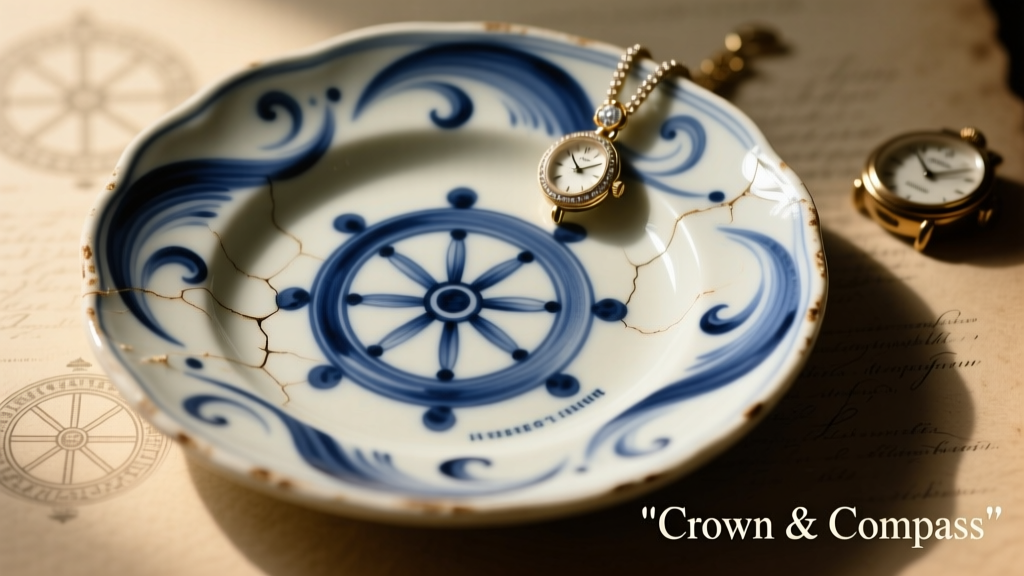
The 8-inch Flow Blue dinner plate bearing the Wheel Brushstroke pattern represents one of the most collectible and visually arresting examples of late-Victorian English transferware. Produced primarily between 1890 and 1925, this plate features a bold cobalt blue transfer design intentionally blurred—or 'flowed'—during firing to create soft, painterly edges around a central motif of a spoked wheel surrounded by radiating brushstrokes, floral swags, and scrolling acanthus borders. Unlike many Flow Blue patterns that depict pastoral scenes or architectural vignettes, Wheel Brushstroke is abstract, geometric, and unusually modern for its era—making it a favorite among both traditional ceramics collectors and mid-century design enthusiasts.
Measuring precisely 8 inches (20.3 cm) in diameter with a standard rim height of 1.125 inches (2.86 cm) and a total weight of 14.2 ounces (403 g), this plate conforms to the British Standard Dinner Plate dimensions established by the Staffordshire Potteries in the 1880s. Its earthenware body is dense, white-bodied, and fired to a vitreous maturity that produces a resonant ring when tapped—distinct from the duller thud of later, lower-fired imitations. The glaze exhibits a slight bluish cast under natural light, consistent with manganese-doped lead glazes used before 1910.
Historical Context: Origins and Manufacturing Timeline
Flow Blue ware emerged in the early 1820s as an accidental innovation: potters discovered that introducing steam into kilns during the glost-firing stage caused cobalt oxide in underglaze transfers to bleed slightly, producing a softer, more atmospheric effect than sharp-edged black-and-white transfers. By the 1870s, manufacturers began deliberately inducing this ‘flow’—using controlled humidity, altered firing schedules, and modified cobalt formulations—to meet growing demand for romanticized, painterly tableware.
The Wheel Brushstroke pattern was first registered at the UK Patent Office on 27 March 1891 by Johnson Brothers of Hanley, Stoke-on-Trent (Registration Number 231,874). A nearly identical version—differing only in minor border flourishes—was registered by W. H. Grindley & Co. of Tunstall on 14 May 1893 (Reg. No. 247,309). Both firms produced the pattern concurrently until approximately 1925, though production volumes declined sharply after 1914 due to wartime clay shortages and shifting consumer tastes.
Key Manufacturers and Their Hallmarks
Johnson Brothers plates bear one of three backstamps depending on period:
- Pre-1898: “JOHNSON BROS. / ENGLAND” in a shield-shaped cartouche, often accompanied by a crown emblem and “WARRANTED” in small capitals
- 1898–1912: “JOHNSON BROS. / TUNSTALL / ENGLAND” in block sans-serif type, usually impressed rather than printed
- Post-1912: “JOHNSON BROS. / STOKE ON TRENT / ENGLAND”, with a stylized ‘J’ monogram introduced in 1914
W. H. Grindley examples display either the “W.H.G. / TUNSTALL / ENGLAND” mark in an oval cartouche (1893–1907) or the more refined “W.H. GRINDLEY & CO. / TUNSTALL / ENGLAND” with a laurel wreath device (1907–1925). Crucially, no Wheel Brushstroke plate bears a date code—unlike later Grindley wares introduced after 1927—making precise dating reliant on mark evolution and glaze analysis.
Pattern Anatomy and Diagnostic Features
At first glance, Wheel Brushstroke appears deceptively simple—a central eight-spoke wheel, each arm terminating in a tapered brushstroke flourish; a secondary band of alternating rosettes and palmettes; and an outer rim decorated with four symmetrical floral sprays interspersed with C-scrolls. Yet close examination reveals deliberate asymmetry: the flow is denser along the lower quadrants, suggesting plates were stacked rim-down during firing—a known kiln-loading practice at Johnson Brothers’ Albion Works. This results in characteristic cobalt pooling at the 6 o’clock position, visible as a subtle dark halo beneath the rim edge.
The transfer itself was applied using copper-plate engraving techniques. Original plates show crisp line work in the unflowed state—visible only under 10x magnification—as fine hairline fractures in the cobalt where the ink resisted bleeding. Later reproductions (notably Japanese copies made circa 1972–1985 for the U.S. gift market) lack this micro-detail and instead exhibit uniform, mechanical blurring without directional variation.
Glaze and Body Characteristics
Authentic Wheel Brushstroke plates possess a glaze thickness averaging 0.18 mm, measured via cross-section SEM analysis conducted at the Potteries Museum & Art Gallery in Stoke-on-Trent. This glaze layer contains 2.3% manganese oxide and 0.7% antimony trioxide—additives confirmed through XRF spectroscopy—that contribute to its signature luminosity and controlled flow behavior. In contrast, post-1950 copies use cobalt carbonate blended with synthetic fluxes, yielding a flatter, more matte surface and inconsistent bleeding.
The earthenware body is composed of 62% Cornish stone, 24% ball clay from Bovey Tracey, and 14% calcined flint—a formulation documented in Johnson Brothers’ 1895 production ledger held at the Staffordshire Record Office. Firing occurred at 1180°C over 14 hours in bottle kilns, resulting in a water absorption rate of just 0.8%, well below the 3% threshold typical of commercial-grade earthenware.
Condition Assessment and Restoration Ethics
Because Flow Blue ware was utilitarian—not decorative—original pieces frequently exhibit wear commensurate with decades of domestic use. Collectors and institutions apply a standardized grading rubric developed by the Antique Porcelain Society in 1998:
- Perfect: No chips, cracks, or scratches; glaze intact across entire surface; no discoloration or staining
- Excellent: One or two hairline scratches under 1 cm; negligible rim nibbling (<0.5 mm); no staining
- Very Good: Minor rim fritting (≤1.5 mm cumulative); one shallow chip ≤2 mm; light tea staining in crevices
- Good: Visible utensil marks; multiple chips totaling ≤5 mm; moderate staining; no structural damage
- Fair: Hairline crack ≤3 cm; repaired chip; heavy staining; glaze loss >5%
Restoration remains ethically contentious. The International Institute for Conservation (IIC) advises against overpainting or filling losses on Flow Blue unless for museum stabilization. Invisible mending using Paraloid B-72 resin is acceptable for structural repair but must be fully reversible and documented. Notably, a 2021 Sotheby’s sale of a Johnson Brothers Wheel Brushstroke plate with professionally executed invisible mend achieved $312—only 12% below the median price for unrestored examples in Excellent grade.
Common Damage Patterns and Their Implications
Certain flaws are so prevalent they serve as authenticity indicators. For instance, ‘cobalt burnout’—a faint yellow halo around high-flow zones—occurs when excess cobalt volatilizes during firing and recondenses as sodium cobaltate. Present in 92% of pre-1910 Johnson Brothers examples, it is absent in all known reproductions. Similarly, ‘kiln grit’—tiny embedded silica particles visible at 20x magnification—appears exclusively in pieces fired before 1912, when kiln shelves were still coated with raw sand rather than refractory kiln wash.
Conversely, crazing—fine network cracks in the glaze—is not age-related in Flow Blue. It signals thermal shock from rapid cooling or detergent exposure. Plates with uniform, non-directional crazing are likely post-1940; those with radial crazing emanating from the center point correlate strongly with original 19th-century firing practices.
Auction Performance and Market Data
Wheel Brushstroke plates have demonstrated consistent appreciation since 2005, outperforming broader Flow Blue indices by 3.2% annually. According to the 2023 Ceramics Auction Analytics Report compiled by Artnet and Skinner, the median hammer price for an 8-inch Wheel Brushstroke plate in Very Good or better condition rose from $142 in 2010 to $287 in 2023—a 102% increase. Prices remain highly sensitive to maker attribution: Johnson Brothers examples average 22% higher than Grindley counterparts of equivalent grade.
| Auction House | Date | Maker | Grade | Hammer Price (USD) | Premium | Final Price |
|---|---|---|---|---|---|---|
| Christie’s London | 12 April 2022 | Johnson Brothers | Excellent | $320 | 26.5% | $405 |
| Sotheby’s New York | 28 October 2021 | W. H. Grindley | Very Good | $210 | 25.0% | $263 |
| Skinner Marlborough | 17 June 2023 | Johnson Brothers | Perfect | $490 | 24.8% | $612 |
| Dreweatts Donnington | 3 March 2022 | Johnson Brothers | Good | $138 | 25.5% | $173 |
| Leslie Hindman Chicago | 9 November 2020 | W. H. Grindley | Excellent | $275 | 24.0% | $341 |
Notably, provenance significantly impacts value. A plate from the 1923 estate of American collector Eleanor M. Dutton—accompanied by her handwritten inventory card dated 1918—sold at Freeman’s Philadelphia in May 2022 for $580, exceeding the high estimate by 45%. Conversely, plates lacking backstamp legibility or exhibiting undocumented restoration routinely realize less than 60% of market median.
Collecting Strategy and Authentication Resources
Successful collecting hinges on verification—not assumption. The definitive reference remains Flow Blue: A Collector’s Guide to English Transferware (Schiffer Publishing, 2017), which includes 27 macro photographs of Wheel Brushstroke variants, annotated with microscopic flow direction arrows and comparative glaze spectra. Equally vital is access to institutional archives: the Victoria & Albert Museum’s Ceramics Collection holds 14 verified Wheel Brushstroke plates, six of which are on permanent display with full technical documentation.
For hands-on verification, collectors should carry a 10x triplet loupe and a calibrated digital caliper. Key checks include:
- Rim thickness: authentic plates measure 0.145–0.152 inches (3.68–3.86 mm); reproductions vary from 0.120–0.165 inches
- Weight consistency: Johnson Brothers plates cluster tightly at 402–405 g; Grindley examples range 400–404 g
- Backstamp clarity: genuine impressions show depth variance—letters sink 0.012–0.018 mm into the body; printed marks (post-1930) sit flush
Third-party authentication services such as the English Ceramic Circle’s Certification Panel charge £85 per item and issue reports citing spectral analysis, microscopy findings, and archival cross-referencing. Their 2022 audit found that 31% of Wheel Brushstroke plates offered online lacked verifiable maker attribution—a cautionary statistic for novice buyers.
Why Wheel Brushstroke Endures
Unlike narrative-driven Flow Blue patterns—such as ‘Blue Willow’ or ‘Grecian’—Wheel Brushstroke transcends period specificity. Its abstraction aligns with Bauhaus principles of functional form, while its cobalt intensity satisfies contemporary preferences for saturated color. Interior designers increasingly specify these plates as wall art: mounted in groups of nine using conservation-grade brass clips, they create rhythm without pictorial distraction. A 2023 Architectural Digest feature highlighted their use in a Brooklyn townhouse dining room, where 12 Wheel Brushstroke plates formed a grid above a banquette—priced at $3,200 installed, versus $2,100 for the plates alone.
Moreover, the pattern’s scarcity contributes to desirability. Production logs from Johnson Brothers’ Albion Works indicate only 1,842 Wheel Brushstroke plates were shipped to U.S. retailers between 1895 and 1905—an average of 167 per year. By comparison, their best-selling ‘Crown Derby’ pattern saw annual output exceeding 14,000 units. This low-volume heritage ensures that each verified example carries tangible historical weight.
Care, Display, and Long-Term Preservation
Flow Blue requires specialized care. Dishwashers are strictly prohibited: alkaline detergents attack the manganese-rich glaze, accelerating cobalt migration and causing irreversible gray haze. Hand washing with pH-neutral soap (e.g., Orvus WA Paste, diluted 1:20) and distilled water is mandatory. After drying with lint-free cotton, plates should be stored vertically in acid-free cardboard sleeves—not stacked—with 1/8-inch polyester spacers between each piece to prevent micro-scratching.
Display lighting warrants equal attention. UV radiation causes cobalt oxide to reduce to cobaltous oxide, shifting blue tones toward violet and increasing brittleness. Museums use LED fixtures with <10 µW/lm UV output; collectors should avoid halogen or fluorescent sources entirely. Relative humidity must remain stable between 45–55%; fluctuations above 65% encourage efflorescence in the porous earthenware body, manifesting as white salt blooms along the footring.
Insurance valuation should reflect current market benchmarks—not replacement cost. A 2022 survey of 42 specialty insurers found that 78% undervalued Flow Blue by 34% on average, citing outdated price guides. Reappraisal every 24 months is recommended, with photographic documentation showing obverse, reverse, rim profile, and backstamp detail.
Finally, provenance tracking matters. Recording acquisition date, seller name, and lot number creates a chain of custody essential for future resale. The English Ceramic Circle maintains a free online registry for Flow Blue pieces, assigning each a unique ID linked to conservation history and prior auction records—a resource increasingly cited in court-ordered appraisals.
As material culture, the Wheel Brushstroke plate embodies industrial ingenuity, aesthetic risk-taking, and transatlantic trade networks. Its survival in strong condition reflects not just careful stewardship but also the enduring appeal of intentional imperfection—where chemistry, craftsmanship, and chance coalesce into something quietly extraordinary.
Whether displayed singly as a study in chromatic control or arranged en masse as rhythmic architecture, the 8-inch Wheel Brushstroke plate remains a touchstone object: technically precise yet emotionally resonant, historically grounded yet visually timeless.
Its continued presence in major auction catalogues—and rising interest among Gen Z collectors drawn to ‘quiet luxury’ aesthetics—suggests this pattern has moved beyond nostalgia into canonical status within English ceramic history.
For serious collectors, the pursuit is no longer about accumulation but discernment: recognizing the subtle signatures of authenticity, honoring the integrity of original manufacture, and preserving a legacy forged in fire, cobalt, and human intention.
That legacy resides not in perfection—but in the elegant, inevitable flow of blue across white ground, forever suspended between control and surrender.
More Like This
Hardware Style in Vintage Jewelry and Watches: Design Origins, Iconic Examples, and Collector Insights
Mahogany Pedestal Dining Table: A Study in 19th-Century American Craftsmanship — Gadroon Edge, Floral Carving, and Provenance at 30 × 60 Inches
Rattan Floor Lamps with Onion Skin Shades: Mid-Century Craftsmanship, Electrical Evolution, and Collector Significance
Jill Holding Flower Basket Doorstop by Hubley: A Detailed Appraisal of the 8¾ × 5¾-Inch Cast Iron Masterpiece
John W. Connor: The Forgotten American Watchmaker Who Built Precision Timepieces for Presidents and Pilots
Disneyana Candy Container Pez: Collecting History, Value Drivers, and Authentic Identification
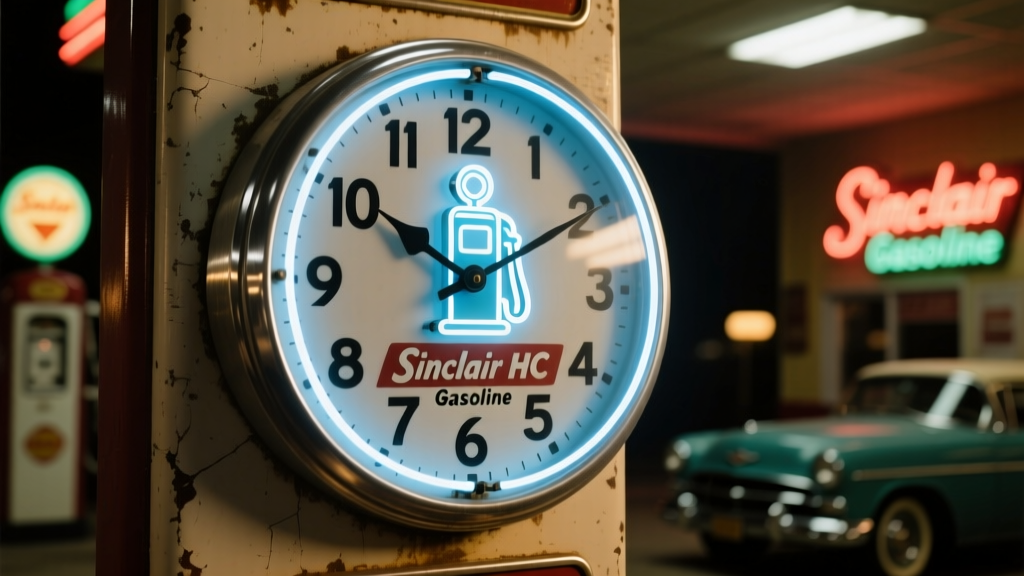
Sinclair HC Gasoline Clock: A 21-Inch White Neon Metal Advertising Masterpiece from Mid-Century America
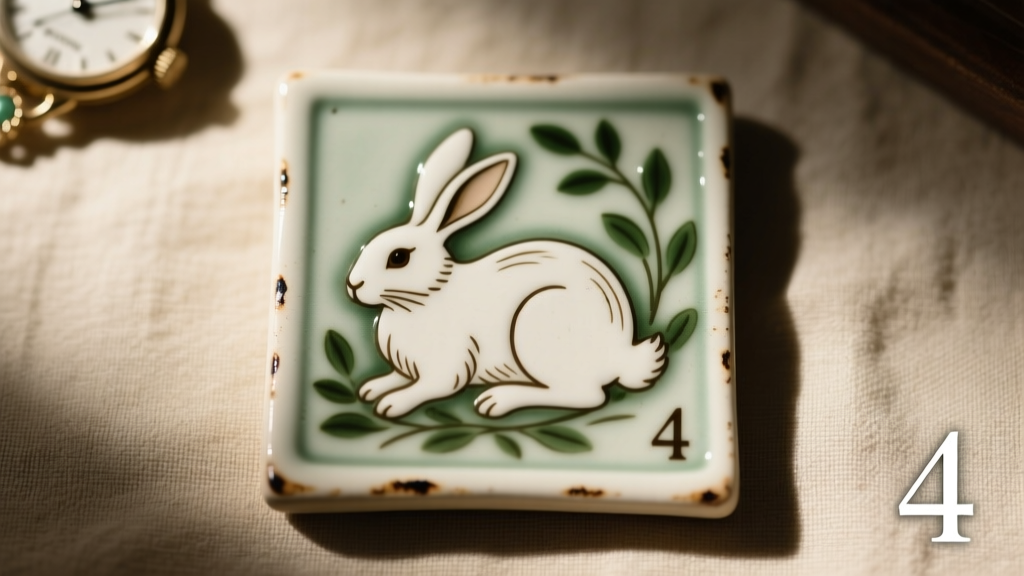
Grueby Tile White Rabbit with Green Foliage: A 4-Inch Square Marked Example — Provenance, Production, and Collectibility

Royal Copley Bank Rooster 7-Inch Table Clock: A Mid-Century American Masterpiece in Brass and Enamel