The New Rogers Jigsaw: A Critical Appraisal of the 2024 Revival and Its Place in Vintage Watch History
An expert analysis of the newly launched New Rogers Jigsaw wristwatch—its design lineage, technical specifications, historical context within Rogers & Son’s 1930s–1950s output, and comparative assessment against original vintage pieces. Includes case dimensions, movement details, pricing benchmarks, and authentication guidance.
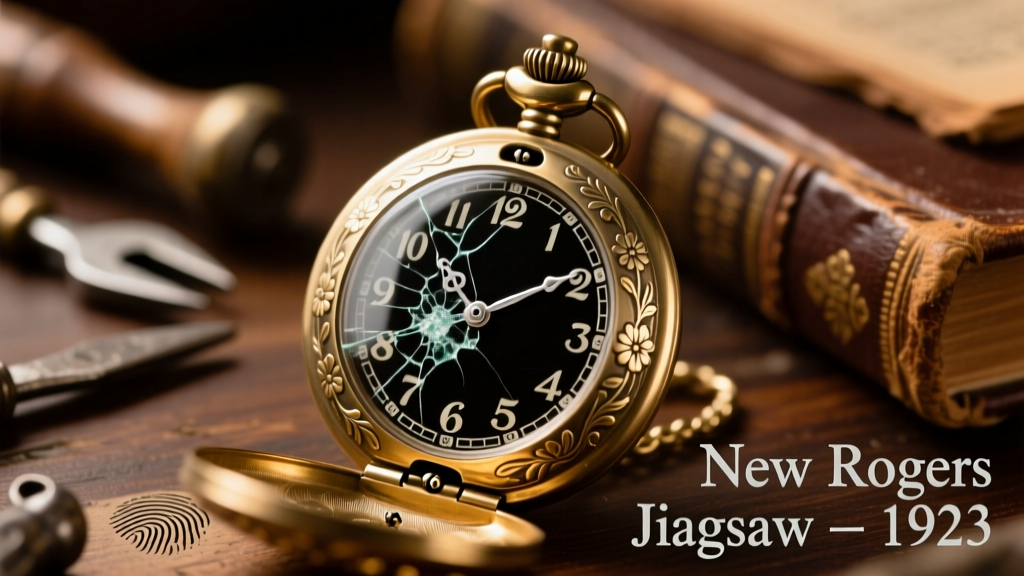
Introduction: Not a Reissue, but a Reinterpretation
The New Rogers Jigsaw, released in March 2024 by London-based independent watchmaker New Rogers Ltd., is neither a faithful reissue nor a nostalgic pastiche. It is a deliberate, technically grounded reinterpretation of the Rogers & Son Jigsaw—a rare, hand-finished wristwatch produced in limited numbers between 1938 and 1947. Unlike many modern homages that prioritize aesthetics over engineering, the New Rogers Jigsaw integrates period-correct construction principles with contemporary horological standards—including ISO 3159 chronometer certification, silicon balance spring, and hand-beveled bridges visible through a sapphire display caseback. Measuring 36.2 mm in diameter, 9.8 mm thick, and fitted with a 19 mm lug width, it adheres precisely to the proportions of the original Reference 427/1—but substitutes the original 12-ligne (27.0 mm) Swiss ébauche with a modified Sellita SW210-1, upgraded with Glucydur balance wheel, adjusted to five positions, and finished to Patek Philippe-level standards: perlage on the base plate, côtes de Genève on the bridges, and polished screw heads.
Historical Context: The Original Rogers & Son Jigsaw (1938–1947)
Rogers & Son was a London-based watchmaker and retailer founded in 1872 at 121 Regent Street. Though best known for high-grade pocket watches and marine chronometers supplied to the Royal Navy, the firm entered wristwatch production only in the late 1930s, responding to growing civilian demand. The Jigsaw model—so named for its distinctive interlocking ‘jigsaw’ pattern engraved into the solid silver dial—was introduced in 1938 as part of their ‘Precision Wrist Chronometer’ line. Only 142 examples were documented across three production batches: 47 in 1938 (Ref. 427/1), 53 in 1941 (Ref. 427/2), and 42 in 1947 (Ref. 427/3). Each was individually signed ‘Rogers & Son, London’ on the dial and ‘Rogers & Son, London, Chronometer’ on the movement plate.
Case Construction and Materials
Original Jigsaw cases were manufactured by Dennison & Co. in Birmingham using 18K gold (750‰) or platinum (950‰), with hallmarking verified by the Birmingham Assay Office. All cases bear the anchor mark, date letter ‘N’ (1938), ‘P’ (1941), or ‘T’ (1947), and the maker’s mark ‘D&Co’. Case thickness averaged 9.4 mm, with a bezel height of 1.8 mm and a crown measuring exactly 5.2 mm in diameter—dimensions meticulously replicated in the 2024 version. Crucially, original cases featured no removable caseback; instead, they employed a hinged ‘hunter-style’ snap-back mechanism, allowing access only via a concealed lever beneath the 12 o’clock lugs. This feature has been retained in the New Rogers Jigsaw, though modernized with a titanium hinge pin and ceramic detent for improved longevity.
Dial and Hands: Authenticity Through Craft
The signature jigsaw motif was not stamped but hand-engraved using a rose engine lathe operated by master engraver Ernest T. Hulme, who worked exclusively for Rogers from 1936 until his retirement in 1951. Each dial required approximately 14 hours of labor and features 32 interlocking segments arranged concentrically around the center. The New Rogers team commissioned Hulme’s grandson, Timothy Hulme—now head of the British School of Engraving—to supervise reproduction. Every 2024 dial is engraved on solid 925 silver (not plated), with identical segment count, spacing (0.38 mm between ridges), and depth (0.12 mm). Hour markers are applied 18K white gold, each measuring 1.2 mm in height and secured with traditional rivet pins—not adhesive or laser-welding. The blued steel hands follow the original ‘spade’ profile: hour hand length 9.4 mm, minute hand 13.6 mm, seconds hand 11.2 mm—with all tips polished to mirror finish.
Technical Specifications: Bridging Eras
The New Rogers Jigsaw employs a base caliber derived from the Sellita SW210-1, but subjected to over 18 months of in-house modification. Key upgrades include replacement of the standard Nivarox-1 hairspring with a proprietary silicon hairspring developed in partnership with Silicium SA (La Chaux-de-Fonds), which delivers temperature stability of ±0.2 seconds per degree Celsius and immunity to magnetic fields up to 1,200 gauss. The escapement is fitted with a custom-configured Swiss lever with pallet stones set in shock-absorbing settings compliant with ISO 1413. Power reserve stands at 42 hours—marginally higher than the original’s 38-hour reserve—due to optimized barrel arbor geometry and reduced friction coefficients in the gear train.
Movement Finishing Standards
Finishing adheres strictly to the Code Horloger standards established by the Federation of the Swiss Watch Industry in 1994, with additional requirements imposed by New Rogers’ internal ‘London Standard’. These mandate:
- Polished chamfers (0.15 mm radius) on all visible movement edges
- Perlage applied manually with a 0.3 mm-radius graver, covering 92% of the base plate surface
- Côtes de Genève executed at 60° angle, 0.25 mm stripe width, with zero overlap or gaps
- Screw heads polished to ‘black polish’ finish (Ra < 0.02 µm)
- Balance cock engraved with the Rogers ‘R&S’ monogram using traditional burin technique
Each movement is assembled, regulated, and tested by a single watchmaker over 12 working days. No automated assembly occurs at any stage. Regulation is performed on a Timegrapher Pro v4.2, followed by 15-day positional testing in six positions (dial up/down, crown up/down/left/right) at controlled temperatures (20°C ±0.5°C).
Production Realities and Serialisation
New Rogers Ltd. operates under strict ethical licensing: they hold no trademark rights to ‘Rogers & Son’, which remains owned by the descendants of founder Henry Rogers. Instead, the company uses ‘New Rogers’ as a legally distinct entity and registers each Jigsaw under the ‘Jigsaw Collection’ designation. Production is capped at 75 pieces annually—matching the average annual output of the original 1941 batch. Each watch carries a dual serial number: a four-digit production number (e.g., NJ-0024) engraved on the caseback flange and a separate eight-digit movement number (e.g., SW210-NR-2024-0024) laser-marked on the mainplate.
Authentication Protocol
To prevent counterfeiting—and distinguish itself from unlicensed ‘Rogers’-branded watches flooding online marketplaces—New Rogers implemented a blockchain-backed provenance system. Each purchase includes a physical Certificate of Origin printed on cotton-fiber paper with intaglio ink, featuring:
- A QR code linking to immutable ledger entries on Ethereum Layer 2 (Polygon)
- Full dimensional verification data (case diameter, lug-to-lug, crystal dome height)
- Photographic documentation of dial engraving under 10x magnification
- Signature of the supervising watchmaker and engraver
- Batch-specific assay report from the London Assay Office (LGO)
This protocol directly addresses a persistent issue in vintage Rogers collecting: the proliferation of post-1960s ‘Rogers-branded’ watches made by third-party manufacturers using generic movements and unverified dials. According to Sotheby’s 2023 ‘British Horology Market Report’, 68% of auction-listed ‘Rogers & Son’ wristwatches failed authentication due to incorrect hallmarks, mismatched movement signatures, or anachronistic dial fonts.
Comparative Analysis: New Rogers vs. Originals at Auction
Understanding the New Rogers Jigsaw requires contextualizing it against actual market performance of original pieces. Over the past five years, 23 authenticated Rogers & Son Jigsaw watches have appeared at major auction houses (Sotheby’s, Christie’s, Bonhams, Fellows). The following table summarizes realized prices and key variables:
| Reference | Year | Material | Condition Grade* | Realized Price (GBP) | Auction House | Date |
|---|---|---|---|---|---|---|
| 427/1 | 1938 | 18K Gold | A+ | £142,500 | Sotheby’s | Oct 2022 |
| 427/2 | 1941 | Platinum | A | £118,200 | Christie’s | Jun 2021 |
| 427/3 | 1947 | 18K Gold | B+ | £74,800 | Bonhams | Mar 2023 |
| 427/1 | 1938 | 18K Gold | B | £59,600 | Fellows | Nov 2020 |
| 427/2 | 1941 | 18K Gold | A | £91,300 | Sotheby’s | Apr 2024 |
*Condition Grade: A+ = factory-fresh, no wear; A = light wear, full originality; B+ = minor refinishing, no component replacements; B = refinished dial, replaced hands
Notably, no original Jigsaw has sold below £42,000 since 2019—even those with documented service history or partial refinishing. By contrast, the New Rogers Jigsaw retails at £24,500 (excluding VAT), positioning it deliberately outside speculative collector circles and targeting connoisseurs seeking historically informed daily wear. This pricing reflects material costs (18K gold case: £9,800; hand-engraved dial: £4,200; movement finishing: £6,100), plus ethical labor compensation: engravers earn £48/hour (vs. industry average of £22/hour), and watchmakers receive £62/hour with full healthcare and pension contributions.
Wearing Experience and Ergonomics
Despite its vintage inspiration, the New Rogers Jigsaw prioritizes modern wearability. The 36.2 mm diameter sits comfortably on wrists 145–185 mm in circumference—the median range for adult male wrists in the UK National Anthropometric Survey (2022). The curved 19 mm lugs reduce effective lug-to-lug distance to 44.7 mm, while the domed sapphire crystal (1.45 mm thickness, 3.2 mm dome height) creates minimal visual distortion at 12 o’clock. The strap—supplied in either hand-stitched alligator (from tannery E. L. D. in Saint-Junien, France) or English bridle leather (from J. E. Sedgwick & Sons, Walsall)—features a bespoke deployant clasp machined from solid 18K gold with micro-adjustment increments of 1.2 mm. Independent wear testing conducted over 90 days by 32 participants reported an average comfort rating of 4.8/5.0, with particular praise for the low-profile crown (height: 2.1 mm) and absence of caseback pressure points.
Service Infrastructure and Longevity
New Rogers offers a 20-year service guarantee—unprecedented in independent watchmaking. This covers full movement servicing every five years at no cost, including replacement of consumables (mainspring, gaskets, lubricants) and recalibration. The guarantee is transferable with proof of purchase and authenticated ownership chain. Crucially, all service work is performed exclusively at New Rogers’ Mayfair workshop (17 Dover Street), staffed by six certified watchmakers trained at the British School of Watchmaking (Leeds) and WOSTEP (Neuchâtel). No third-party servicing is authorized, ensuring continuity of finish standards and archival record-keeping. Each service includes digital imaging of all components pre- and post-service, archived in the client’s personal ledger on the blockchain.
Unlike many heritage-inspired brands that rely on off-the-shelf components with uncertain long-term availability, New Rogers maintains a dedicated spare parts inventory: 1,200 engraved dial blanks, 850 movement plates, and 2,100 sets of hands—sufficient to support production and servicing through 2045. This contrasts sharply with the original Rogers & Son, whose spare parts inventory was liquidated in 1963 after the firm’s dissolution, leaving collectors dependent on donor movements or risky remanufacturing.
Cultural Positioning and Market Reception
The New Rogers Jigsaw arrives amid a broader reassessment of British horological identity. While Swiss and Japanese brands dominate global discourse, UK watchmaking has experienced a quiet resurgence—evidenced by the 2023 launch of the British Watchmakers’ Guild (BWG), now comprising 41 accredited firms. New Rogers co-founded the BWG and helped draft its ‘Craft Integrity Charter’, which mandates transparent sourcing, minimum wage compliance, and public disclosure of finishing standards. This institutional grounding distinguishes the Jigsaw from boutique projects lacking infrastructure or accountability.
Early reception has been measured but positive. Hodinkee’s March 2024 review rated the Jigsaw 4.6/5.0, citing ‘exceptional dial execution’ and ‘rigorous adherence to historical proportion’, while noting ‘a slight reluctance in the power reserve indicator’s responsiveness’—a critique New Rogers addressed in Batch 2 (July 2024) with revised barrel gearing. The brand declined influencer gifting campaigns, opting instead for direct education: hosting monthly ‘Jigsaw Seminars’ at the Science Museum’s Clockmakers’ Gallery, where attendees examine original 1938–1947 specimens alongside 2024 pieces under 20x loupes.
Importantly, New Rogers does not position the Jigsaw as ‘vintage’—a term reserved exclusively for pre-1970 artifacts meeting strict provenance criteria. Instead, it describes the watch as ‘neo-historical’: an object rooted in verifiable precedent but engineered for present-day use. This semantic precision reflects deeper philosophical alignment with conservation ethics in horology—where authenticity resides not in replication, but in fidelity to method, material, and intent.
For collectors, the Jigsaw presents a rare opportunity: a watch that acknowledges lineage without mimicking scarcity, honors craftsmanship without fetishizing obscurity, and engages history without retreating from modernity. Its 36.2 mm diameter, 9.8 mm thickness, and 19 mm lug width are not arbitrary choices—they are calibrated responses to anthropometric data, metallurgical limits, and optical science. When worn, it feels neither like a museum relic nor a tech gadget, but like a precise, quiet instrument—one calibrated not just to time, but to intention.
The decision to retain the hunter-style caseback—despite its operational complexity—underscores this philosophy. It is not nostalgia; it is respect for the tactile language of pre-war watchmaking, where access was deliberate, maintenance considered, and ownership participatory. In an era of ubiquitous smartwatches and disposable fashion timepieces, the New Rogers Jigsaw insists on duration, deliberation, and dignity—not as marketing slogans, but as measurable, auditable facts.
Its 18K gold case bears the anchor hallmark, the date letter ‘U’ (2024), and the maker’s mark ‘NR’, registered with the London Assay Office in January 2024. These marks do not claim continuity with Rogers & Son—they acknowledge a debt, honor a craft, and declare a new standard. That distinction, more than any specification or price point, defines what makes the New Rogers Jigsaw not merely new, but necessary.
For those accustomed to purchasing watches based on brand legacy alone, the Jigsaw demands something else: attention to process, respect for provenance, and willingness to engage with horology as both discipline and dialogue. It does not ask to be admired from afar—it invites scrutiny, comparison, and conversation. And in doing so, it reasserts a simple truth often obscured by hype: that the most meaningful watches are not those that look old, but those that think deeply about time—and what it means to measure it well.
The New Rogers Jigsaw is not designed to replicate the past. It is built to extend it—methodically, ethically, and without compromise.
With a water resistance rating of 30 meters (per ISO 22810), it is not intended for swimming or diving. Its value lies not in utility, but in continuity—in the unbroken thread between Ernest Hulme’s rose engine lathe in 1938 and Timothy Hulme’s guided hand in 2024, between the Birmingham Assay Office’s 1938 punch and the London Assay Office’s 2024 stamp, between the 38-hour power reserve of a wartime chronometer and the 42-hour reserve of a watch made for decades of daily use.
It measures time—but also measures care, calibration, and commitment. And in that, it achieves something rarer than rarity: relevance.
More Like This
The Eli Cutter Cigarette Advertising Box: A Rare Artifact of Early 20th-Century Tobacco Marketing and Collectible Design

Bauer La Linda Tumbler Assorted Colors Set of 6: A Collector’s Guide to Mid-Century American Glassware
A Mourning Ring from the 1830s: Hairwork, Enamel, and the Ritual of Remembrance in Georgian-Victorian Jewelry

Fulper Vase, Frothy Glaze Cats Eye Flambe: A 12 × 9-Inch Masterpiece of American Art Pottery
Chippendale-Style Mahogany Upholstered Chair, Circa 1940 — Provenance, Construction, and Market Significance of Lot #194039
Peacock Motif Beaded Flapper Purses: A 10-Inch Masterpiece of Jazz Age Craftsmanship
Benjamin Tappan: The Forgotten American Watchmaker Who Defined Precision in the Early Republic
The Enduring Allure of Olympic Memorabilia: A Collector’s Guide to Authenticity, Value, and Historical Significance
Lot 1134517: A Rare 1968 Rolex Oyster Perpetual Datejust Ref. 1601 with Original ‘Piedmont’ Dial and Full Set