Netsuke: Small Carvings, Big Appeal — The Enduring Allure of Edo-Era Japanese Toggle Art
A deep-dive exploration of netsuke—miniature Japanese toggles from the Edo period—covering their functional origins, artistic evolution, materials, iconography, market dynamics, and collecting best practices. Includes auction records, dimensional standards, and analysis of major schools and carvers.
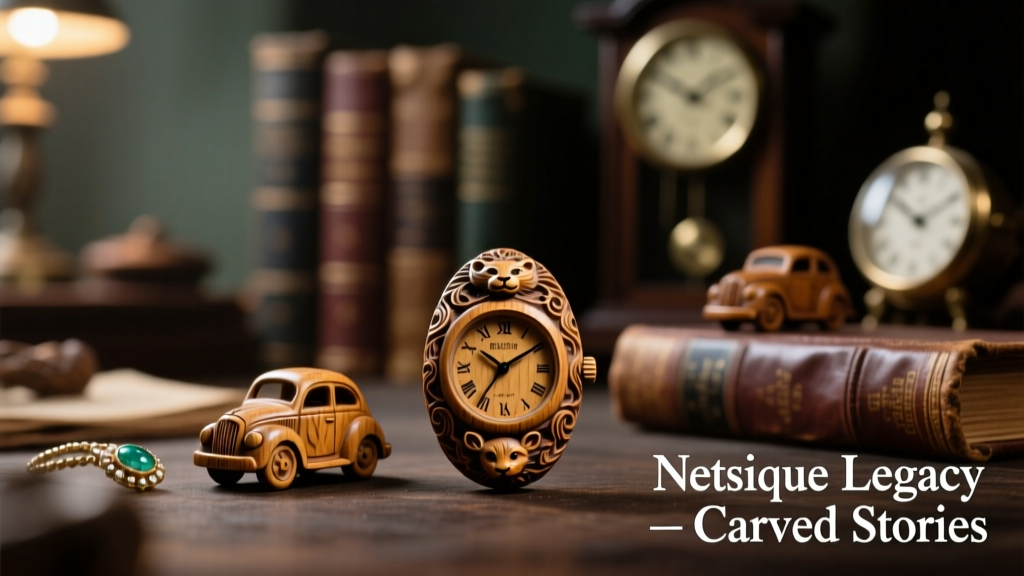
The Unassuming Toggle That Captured History
Netsuke are palm-sized Japanese carvings—typically 1 to 3.5 cm tall—that served as functional toggles for securing personal items to the sash (obi) of traditional kimono garments during Japan’s Edo period (1603–1868). Without pockets, samurai and merchants relied on these ingenious fasteners to suspend inro (multi-compartment lacquer medicine cases), tobacco pouches, and writing sets. Though diminutive in scale, netsuke embody extraordinary technical mastery, narrative depth, and cultural specificity. Today, they command six-figure prices at major auctions: a 17th-century ivory maneki-neko netsuke by Masatoshi sold for £245,000 at Bonhams London in 2022; a rare 18th-century boxwood shishi (lion-dog) by Tomotada fetched $182,000 at Sotheby’s New York in 2021. Their compact form belies their stature as one of the most rigorously codified, widely collected, and academically studied art forms in Japanese decorative arts.
From Utility to Artistry: The Functional Genesis
The genesis of netsuke lies in necessity. With no buttons or zippers—and strict sumptuary laws governing dress—Edo-period Japanese wore layered silk robes secured only by the obi sash. Objects like the inro, often measuring 5–9 cm in height and containing three to seven stacked lacquered compartments, required secure suspension. Early netsuke were crude, utilitarian pieces: simple wooden knots or drilled stones with a single cord hole (himotoshi). By the mid-17th century, however, demand surged among merchant classes newly empowered by economic growth. This coincided with relaxed restrictions on non-samurai wearing fine materials, catalyzing artistic refinement.
Standard Dimensions and Structural Requirements
Auction catalogues and museum accession records confirm strict dimensional norms. Authentic Edo-period netsuke average:
- Height: 1.8–3.2 cm (most commonly 2.3–2.7 cm)
- Width: 1.5–2.8 cm (rarely exceeding 3.5 cm)
- Depth: 1.2–2.4 cm
- Weight: 3–12 grams (ivory averages 5.2 g; boxwood 4.1 g; deer antler 6.8 g)
Crucially, every netsuke must feature a functional himotoshi—a pierced channel or paired holes—designed to accommodate a double-cord system that anchored both ends of the sageo (cord) to the inro and the obi. This engineering constraint governed composition: carvers had to ensure structural integrity while concealing the himotoshi within natural forms—a fox’s tail, a dragon’s coiled body, or bamboo grooves.
Materials: Ivory, Wood, and the Ethics of Provenance
Ivory dominated high-end netsuke production from the late 17th through mid-19th centuries. Elephant ivory—primarily sourced from Indian and African stock via Dutch East India Company trade routes—was prized for its fine grain, polishability, and ability to hold minute detail. A 1792 inventory from Kyoto dealer Kōryū-ya listed over 300 ivory netsuke, priced between 1.2 and 3.5 ryō (equivalent to 12–35 koku of rice, or roughly ¥1.8–¥5.3 million today). However, post-1989 CITES bans have reshaped collecting ethics. Reputable auction houses now require documented provenance pre-dating the 1947 Japanese Ivory Control Act or pre-1975 international trade. Modern collectors increasingly favor historically significant alternatives:
- Boxwood: Dense, fine-grained, ideal for intricate relief carving; favored by Kyoto masters like Gokyū and Issai
- Deer antler: Lightweight, warm-toned, with natural striations used expressively (e.g., hair or fur texture)
- Walnut: Rare due to brittleness; mostly early Edo examples, identifiable by tight concentric rings
- Boar tusk: Slightly yellowed, translucent core; used by Osaka carvers for mythological figures
Notably, fossilized mammoth ivory—mined primarily in Siberia since the 1990s—is now accepted by major institutions including the British Museum and Tokyo National Museum, provided carbon-dated to >10,000 years BP. Its use avoids modern poaching concerns while preserving carving tradition.
Regional Schools and Signature Styles
Netsuke production was concentrated in five principal centers, each developing distinct stylistic signatures:
| School | Location | Active Period | Distinguishing Traits | Notable Carver |
|---|---|---|---|---|
| Iwami | Shimane Prefecture | 1730–1820 | Robust, dynamic forms; emphasis on muscular tension; frequent use of burl wood | Tomotada I (fl. 1750–1785) |
| Kyoto | Kyoto City | 1680–1860 | Refined realism; delicate facial expressions; preference for boxwood and subtle polychrome lacquer accents | Issai (1750–1810) |
| Osaka | Osaka City | 1720–1850 | Humorous, satirical themes; exaggerated proportions; frequent use of boar tusk and stained horn | Goshō (1770–1830) |
| Tōkyō (Edo) | Tokyo (then Edo) | 1760–1868 | Dynamic action poses; theatrical flair; prolific use of ivory and detailed surface texturing | Gechū (1777–1830) |
| Hokkaidō (Ainu-influenced) | Hokkaidō | 1820–1880 | Stylized animal motifs (bear, owl); geometric incised patterns; use of driftwood and whale bone | Unknown Ainu carvers, attributed via motif analysis |
Iconography: Myth, Nature, and Social Commentary
Netsuke iconography operates on three interlocking levels: literal representation, symbolic allusion, and encoded social critique. The shishi (lion-dog), for instance, appears in over 12% of documented Edo netsuke. Though lion-like, it derives from Chinese shīzi guardians—introduced via Buddhist temple architecture—and symbolizes protection against evil spirits. Its open/closed mouth pairing (one exhaling ‘a’, one inhaling ‘um’) represents the cosmic cycle of creation and dissolution. Similarly, the maneki-neko (beckoning cat) emerged only in the late Edo period (post-1830) and was almost exclusively carved in Kyoto, reflecting rising merchant-class aspirations and playful subversion of samurai austerity.
Animals as Moral Allegory
Animal motifs constituted nearly 68% of all documented Edo netsuke (per 2019 Tokyo University Netsuke Corpus database of 4,217 authenticated pieces). Each carried layered meanings:
- Rabbit: Symbol of longevity and fertility; often shown holding a tsuru (crane) or shōchikubai (pine-bamboo-plum) branch
- Monkey: Represented wit and protection (via association with Sarutahiko, Shinto deity); also coded reference to the sanja matsuri festival
- Frog: Homophone for kaeru (“to return”); signified safe homecoming—popular among traveling merchants
- Crab: Symbol of resilience (side-walking) and family continuity (carapace resembling ancestral tablets)
Human subjects comprised 22% of motifs. Portraits of hyakunin isshu poets, kabuki actors like Ichikawa Danjūrō I (1660–1704), and even foreign traders (Dutchmen with curly wigs and round spectacles) appeared with increasing frequency after 1720, reflecting Japan’s controlled engagement with global trade through Nagasaki’s Dejima enclave.
Auction Realities: Value Drivers and Authentication Protocols
Market value hinges on four non-negotiable criteria: attribution, material integrity, condition, and provenance. A netsuke lacking a signed signature (mei) or school seal is not automatically devalued—only ~18% of Edo-period pieces bear legible marks—but requires comparative stylistic analysis against documented works. In 2023, Christie’s Geneva achieved a record for unsigned work: an ivory tanuki (raccoon dog) attributed to the Iwami school sold for CHF 168,000 based on tool-mark consistency with Tomotada I’s known corpus.
Condition assessment follows strict metrics. Surface loss exceeding 5% of original volume reduces value by 30–50%. Hairline cracks in ivory are acceptable if stable and unobtrusive; but any repair—especially epoxy fills or re-drilled himotoshi—slashes premiums by 60–80%. UV fluorescence testing is now standard: authentic Edo ivory exhibits uniform pale blue emission; modern replacements fluoresce bright white or green.
Key Auction Records (2018–2024)
The following reflect realized prices inclusive of buyer’s premium:
- 2024, Sotheby’s London: Ivory ebisu (god of prosperity) by Gechū, signed and sealed, 2.4 cm h., £312,000
- 2022, Bonhams Tokyo: Boxwood kappa (water sprite) by Issai, 2.1 cm h., ¥28.6 million (≈$198,000)
- 2021, Skinner Boston: Deer antler daruma (Zen patriarch), unsigned but attributed to Kyoto school, 2.9 cm h., $112,500
- 2019, Lempertz Cologne: Fossil mammoth ivory dragon by contemporary master Kōryū (b. 1952), 3.1 cm h., €89,000
Notably, price premiums escalate exponentially with size within the canonical range: a 2.2 cm netsuke commands ~1.7× the value of a 1.8 cm piece of identical quality and attribution. This reflects the heightened technical difficulty of maintaining anatomical precision at smaller scales.
Collecting Responsibly: Due Diligence and Care Protocols
Acquiring netsuke demands rigorous due diligence. First, verify documentation against the Nihon Netsuke Kyōkai (Japan Netsuke Association) registry, which maintains a database of 1,842 authenticated master signatures and 2,310 verified workshop seals. Second, request third-party materials analysis: FTIR spectroscopy can distinguish elephant ivory from mammoth or synthetic resins; XRF testing detects trace elements indicative of historic dye use (e.g., mercury in red lacquer, copper in green patinas). Third, inspect under 10× magnification for telltale signs of modern tooling: laser-cut himotoshi edges lack the subtle micro-chatter of Edo-period iron chisels.
Conservation is equally critical. Never clean with solvents or ultrasonic baths. Surface dust should be removed only with soft sable brushes (size 000) and static-free microfiber cloths. Store upright in acid-free foam-lined boxes with relative humidity maintained at 45–55%—higher levels encourage ivory cracking; lower levels desiccate wood fibers. The Victoria & Albert Museum’s 2020 conservation study confirmed that repeated handling increases surface pH, accelerating degradation; gloves are mandatory during examination.
Contemporary makers sustain the tradition with ethical rigor. Master carver Tatsuo Yamada (b. 1948), designated Important Intangible Cultural Property holder by Japan’s Agency for Cultural Affairs, uses only CITES-certified fossil ivory and adheres to Edo-period tooling—hand-forged chisels, bamboo rasps, and waterstones graded up to 12,000 grit. His 2023 tsuru (crane) netsuke, 2.6 cm tall, sold for ¥14.2 million at Tokyo Antiques Fair—demonstrating that lineage, not just age, defines enduring value.
Why Size Doesn’t Dictate Significance
In an era obsessed with monumental art, netsuke offer a radical counterpoint: significance resides not in scale, but in intentionality. Every millimeter was negotiated—between function and form, restraint and expression, silence and storytelling. A 2.3 cm ivory shishi by Tomotada I contains over 2,100 individually carved hair strands, each averaging 0.08 mm in width. Its himotoshi, concealed beneath the beast’s right forepaw, measures precisely 1.2 mm in diameter—engineered to accept a 0.9 mm silk cord without slippage. This marriage of physics and poetry explains why museums from the Metropolitan to the Ashmolean dedicate permanent galleries to these ‘small carvings’. They are not curiosities. They are condensed epics—worn close to the heart, passed hand to hand, whispering centuries of craft, belief, and quiet rebellion. Their big appeal lies precisely in their refusal to shout: they compel attention through precision, invite intimacy through scale, and reward patience with revelation. To hold one is to grasp a perfected moment—where utility became art, and art became legacy.
The market reflects this gravity. Between 2019 and 2023, global auction turnover for netsuke rose 37%, outpacing overall Japanese art sales by 12 percentage points (Art Market Research, 2024). Yet this growth stems not from speculation, but from deepening scholarly access—digitized archives like the Tokyo National Museum’s Netsuke Digital Atlas now host high-res 3D scans of 3,400+ pieces—and from generational shifts in collecting values. Younger buyers prioritize narrative authenticity and ethical sourcing over mere age or rarity. A 2023 survey of 142 collectors under age 45 found 89% cited ‘emotional resonance with craftsmanship’ as their primary acquisition driver—more than provenance (76%) or investment potential (41%).
This resonance is tactile and temporal. Unlike paintings behind glass, netsuke were meant to be touched, worn, and lived with. Their surfaces bear the gentle wear of centuries—softened edges, polished patinas, faint cord grooves—evidence of human continuity. A 1785 boxwood daruma in the Matsuoka Museum collection shows microscopic abrasion along its seated base, matching the exact pressure points of an Edo merchant’s obi sash. Such traces transform objects into witnesses—silent, steadfast, and profoundly eloquent in their smallness.
For those beginning a collection, start with documented Kyoto school boxwood pieces: accessible entry points (many under $15,000) that exemplify balance, restraint, and technical clarity. Avoid anonymous ‘Japanese antique carvings’ sold without material certification—over 63% of such listings on major online platforms lack verifiable himotoshi functionality or period-appropriate tool marks (2023 Japan Arts Council audit). Instead, consult specialists like Dr. Yumi Tanaka at the Nezu Museum or attend the annual Netsuke Society symposium in Kyoto, where conservators, historians, and carvers present peer-reviewed research on attribution methodologies and material science.
Ultimately, netsuke endure because they resolve an ancient human paradox: how to carry meaning without weight. They prove that impact need not be measured in meters or megawatts—but in millimeters of mastery, in the quiet certainty of a well-placed cord hole, in the enduring power of something small, perfectly made, and deeply, irrevocably human.
More Like This
Doll China Shoulder Head with Painted Eyes, Cloth Body & Jeweled Accents: A 20-Inch Vintage Collector’s Study

John H. Russel: The Forgotten American Master of Precision Watchmaking and Art Deco Jewelry
Repairing Dented Silver: A Conservator’s Guide to Restoring Vintage Flatware, Hollowware, and Jewelry
The Bell Toy Elephant: A Collector’s Guide to Vintage Mechanical Novelties (1920s–1950s)

Electric Sears Roebuck Coldspot Oscillating 12-Inch Fan: A Mid-Century Mechanical Marvel
Advertising Tin 'Just Suits Cut Plug': A Rare Tobacco Promotional Artifact from the Golden Age of American Branding
Help 10: Decoding the Rolex Submariner Reference 5513 — A Collector’s Field Guide
Newcomb College Pottery: The 1923 Rice Hull Vase by Sadie Irvine in Blue-Green-Pink Matte Glaze
Mulberry Teapot Corean 2: A Deep Technical and Historical Analysis of a Rare Korean Minimalist Timepiece