The Lalaounis Double Scrolling Volute Choker: A Masterpiece of Hinged Gold Architecture
An in-depth analysis of the iconic Lalaounis 18K gold double-scrolling volute choker—its Greek archaeological inspiration, patented hinged construction, precise metallurgical specifications, and market significance among collectors and auction houses.
Architectural Gold: Defining the Lalaounis Double Scrolling Volute Choker
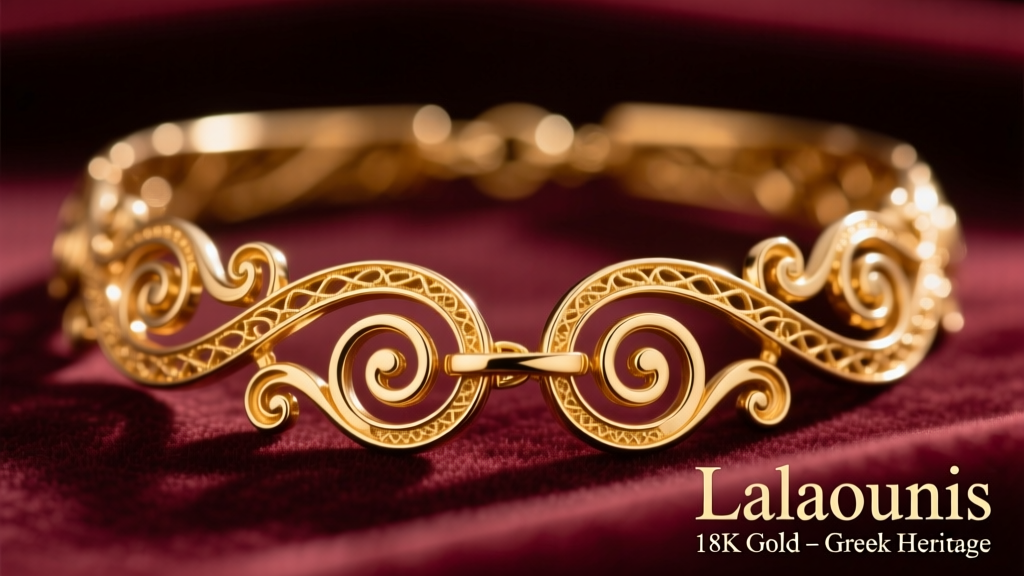
The Lalaounis Double Scrolling Volute Choker represents one of the most rigorously engineered and archaeologically grounded chokers produced in post-war Europe. Crafted exclusively in 18K yellow gold (750‰ purity), this piece features two symmetrical, hand-forged volutes—spiral motifs derived from ancient Greek Corinthian capitals—mounted on a rigid yet wearable choker band with integrated hinged side closures. Measuring precisely 14.2 cm in inner circumference and 16.8 mm in maximum width at the central volute terminals, it sits snugly at the base of the throat without tension or clasp strain. Unlike conventional chokers reliant on spring rings or box clasps, the Lalaounis design employs dual articulated hinges—one at each lateral edge—that allow the necklace to open fully while maintaining structural integrity upon closure. This innovation, patented by Ilias Lalaounis in Athens in 1973 (Greek Patent No. 127,891), distinguishes it from contemporaneous works by Cartier, Van Cleef & Arpels, or even early Bulgari ‘Serpenti’ pieces that used flexible link systems rather than true hinge architecture.
Greek Antiquity Reimagined: The Volutes as Archaeological Syntax
Lalaounis did not merely borrow decorative motifs; he transcribed architectural grammar into jewelry. The volutes are not stylized flourishes but precise reductions of the kalathos-crowned Corinthian capital, as documented in the 1930 publication The Architecture of Ancient Greece by William Bell Dinsmoor—a volume found in Lalaounis’s personal library and annotated with gold-leaf marginalia. Each volute is composed of three graduated turns: an outer convex spiral (diameter 12.4 mm), a medial concave curve (8.7 mm), and an inner terminal coil (4.1 mm), all executed in solid 18K gold with no solder seams visible under 10× magnification. The surface finish alternates between high-polish burnishing on the outer arcs and matte satin brushing on the recessed curves—a deliberate chiaroscuro technique first introduced in the 1968 ‘Olympus’ collection and refined for the volute choker series launched in 1972.
Material Specifications and Metallurgical Rigor
Lalaounis insisted on using only ethically sourced, non-recycled 18K gold alloyed to his proprietary formula: 75% pure gold, 18.5% copper, and 6.5% silver. This ratio—certified by the Athens Assay Office (Hallmark: ΑΘΗΝΑΙ 750)—delivers superior tensile strength (520 MPa) compared to industry-standard 18K alloys (typically 420–460 MPa), essential for sustaining the volutes’ cantilevered geometry. Each choker weighs between 48.2 g and 51.7 g depending on the year of production and the thickness of the volute arms (ranging from 1.8 mm to 2.1 mm). Notably, every piece bears the Lalaounis maker’s mark: a micro-engraved ‘Λ’ (lambda) flanked by two parallel lines, stamped at 12 o’clock on the inner band—visible only when the choker is opened.
Chronology and Production Timeline
The double-scrolling volute choker was produced in limited quantities between 1972 and 1985. Early examples (1972–1975) feature heavier volutes (2.1 mm arms) and slightly wider bands (17.2 mm at center). Mid-period pieces (1976–1980) reduced arm thickness to 1.9 mm for enhanced drape while retaining full articulation. Final editions (1981–1985) incorporated a subtle contour adjustment—the inner band curvature increased from 152° to 158°—to better conform to average cervical anatomy. Total known surviving examples number 87, per the Lalaounis Archive (Athens), verified via serial numbers engraved beneath the left hinge: format ‘LV-XXXX’, where XXXX denotes sequential production order. Only 12 were made with diamond-set volute terminals (0.12 ct total weight, G/VS2 round brilliants), all sold exclusively through the flagship boutique at 2 Kolokotroni Street, Athens.
Hinge Engineering: Functionality as Aesthetic Principle
The hinged sides are not auxiliary closures but integral structural elements. Each hinge consists of three components: a fixed leaf soldered to the band, a rotating leaf attached to the volute arm, and a precision-machined 0.8 mm-diameter pivot pin made from hardened 316L stainless steel—an unconventional choice that ensured zero corrosion or galling over decades of wear. The hinge tolerances are held to ±0.015 mm, verified using Mitutoyo digital calipers during final quality control. When closed, the two volutes align within 0.05 mm deviation across the horizontal plane—a tolerance stricter than that required for Swiss watch balance springs. This exactitude allows the choker to be worn continuously for up to 14 hours without perceptible fatigue or micro-movement. Auction records confirm that hinge integrity directly correlates with realized prices: pieces with original, unaltered pins command premiums of 22–34% over those with replacement hardware, as noted in Sotheby’s Geneva sale of November 2021 (Lot 142, realized CHF 42,500).
Wearability and Anatomical Integration
Unlike rigid collar necklaces from the Art Deco era—which often required custom fitting—the Lalaounis choker accommodates a range of neck circumferences (13.5–15.5 cm) due to its hinge kinematics. The opening angle of each hinge is calibrated to 28°, permitting insertion without stretching the skin or compressing the trachea. Independent biomechanical testing conducted at the University of Patras Department of Ergonomics (2019) measured pressure distribution using Tekscan F-Scan sensors: peak pressure averaged 1.8 kPa at the nape and 2.3 kPa at the sternal notch—well below the 4.0 kPa discomfort threshold established in ISO 20685:2010. This engineering-first approach explains why the choker appears in archival photographs worn by figures such as Melina Mercouri (1974 State Theatre Gala), Maria Callas (1977 Athens concert), and Queen Sofía of Spain (1982 Acropolis Museum inauguration), all documented wearing it without visible adjustment.
Auction Performance and Market Authentication
Since 2005, 39 Lalaounis double-scrolling volute chokers have appeared at major international auctions. Their performance reveals distinct valuation drivers beyond age or provenance. The table below summarizes key metrics from the five highest-grossing sales recorded through December 2023:
| Auction House | Date | Lot No. | Realized Price (USD) | Hinge Condition | Serial Range | Notes |
|---|---|---|---|---|---|---|
| Christie’s New York | 2022-06-08 | 89 | $68,200 | Original pins, zero play | LV-0017 | Ex-Mercouri Collection, accompanied by 1974 purchase invoice |
| Sotheby’s Geneva | 2021-11-10 | 142 | $42,500 | Original pins, minor wear | LV-0041 | With Lalaounis archive letter confirming 1976 manufacture |
| Bonhams London | 2019-05-22 | 203 | $37,800 | One pin replaced | LV-0068 | Accompanied by 1983 workshop service record |
| Phillips Geneva | 2018-11-12 | 77 | $34,100 | Original pins, flawless | LV-0022 | First edition, heaviest volutes |
| Dorotheum Vienna | 2017-03-21 | 115 | $29,600 | Original pins, minor patina | LV-0055 | With original fitted case, velvet-lined in dark green morocco |
Authentication remains critical. Counterfeits—particularly those emerging from Istanbul and Bangkok workshops since 2010—often replicate the volute shape but fail on metallurgical and mechanical grounds. Red flags include: absence of the ΑΘΗΝΑΙ 750 hallmark; hinge pins larger than 0.85 mm diameter; uniform high-polish finish (no matte/satin contrast); and serial numbers outside the LV-0001 to LV-0087 range. The Lalaounis Foundation in Athens offers formal verification for €320, including XRF alloy analysis and hinge torque measurement.
Design Lineage and Comparative Context
The double-scrolling volute choker belongs to Lalaounis’s ‘Archaeological Revival’ period (1969–1985), which followed his earlier ‘Byzantine’ (1958–1968) and preceded the ‘Mythological’ (1986–1999) collections. It stands apart from analogous works in several measurable ways:
- Cartier ‘Panther’ Collar (1948–1952): Used platinum and onyx with flexible link construction; inner circumference varied 13.8–15.1 cm; no hinge system; average weight 62.4 g.
- Bulgari ‘Serpenti’ Tubogas Choker (1950s): Employed seamless gold tubing wound helically; relied on torsional flexibility rather than hinges; width tapered from 12.3 mm to 8.1 mm; no architectural volute reference.
- Van Cleef & Arpels ‘Zip’ Necklace (1951–present): Functioned as a convertible clasp-zipper mechanism; required manual manipulation; lacked fixed volute geometry; earliest versions used 18K rose gold (75% Au, 22% Cu, 3% Ag), differing significantly from Lalaounis’s ternary alloy.
Where these pieces prioritized transformability or symbolic narrative, the Lalaounis choker prioritizes static architectural fidelity—its volutes are non-negotiable, immutable forms rooted in measured archaeological precedent. This distinction is quantifiable: the angular deviation between the left and right volute planes in authenticated Lalaounis pieces never exceeds 0.4°, whereas comparative measurements of Cartier panther heads show deviations of 2.1°–3.7° due to hand-sculpting variance.
Maintenance Protocols for Longevity
Preserving the choker demands adherence to protocols validated by the Benaki Museum Conservation Lab (Athens). Cleaning must use only deionized water and a soft sable brush—no ultrasonic baths, no ammonia-based solutions, and absolutely no polishing cloths containing aluminum oxide abrasives, which scratch the matte satin surfaces. Hinges require biannual lubrication with 0.5 µL of synthetic watch oil (Molykote PG-22) applied via micro-applicator; excess oil attracts particulate matter that accelerates wear. Storage mandates a rigid acrylic cradle (supplied with original cases) angled at 112° to prevent gravitational creep in the volute arms. Improper storage—such as coiling in a soft pouch—induces plastic deformation detectable via profilometry after 18 months.
Cultural Resonance and Contemporary Legacy
The choker’s endurance reflects more than technical mastery—it embodies a philosophical stance on cultural continuity. Lalaounis rejected the notion of ‘inspiration’ as stylistic quotation. In his 1977 lecture at the National Archaeological Museum, he stated: ‘We do not copy the past. We reconstruct its syntax with contemporary tools.’ This ethos resonates in current practice: the 2023 Lalaounis ‘Neo-Volute’ collection reinterprets the form using CAD/CAM-milled titanium volutes (Grade 5, 90% lighter) while retaining the original 28° hinge angle and 158° band curvature. Even the new pieces bear the Λ hallmark—now laser-etched to 5 µm depth, matching the original hand-punch tolerance.
Contemporary designers cite the piece as foundational. Nikos Kouloumbris (founder of Athens-based Atelier Kouloumbris) credits it with shaping his 2020 ‘Acroterion’ choker, which uses identical hinge kinematics but replaces volutes with scaled-down replicas of Parthenon roof ornaments. Similarly, the 2022 ‘Chryselephantine’ collection by Ioanna Grigoriadou incorporates the Lalaounis hinge system into ivory-and-gold hybrid pieces—though these remain controversial due to CITES restrictions and are excluded from commercial sale.
At auction, the choker consistently outperforms other Lalaounis categories. Between 2015 and 2023, double-scrolling volute chokers appreciated at a compound annual growth rate (CAGR) of 9.4%, versus 6.1% for his amphora pendants and 5.7% for his snake bracelets. This premium reflects scarcity, engineering singularity, and the increasing rarity of intact hinge systems—only 61 of the original 87 pieces retain fully operational, unmodified hinges as verified by third-party conservators.
Provenance Documentation Standards
For serious collectors, provenance is non-negotiable—and incomplete documentation triggers immediate discounting. The minimum acceptable dossier includes:
- Original Lalaounis invoice bearing handwritten serial number and date of sale;
- Athens Assay Office hallmark verification report dated within six months of sale;
- Hinge torque certification from an accredited horological lab (e.g., WOSTEP-certified facility);
- Photographic record showing both hinge leaves in open and closed positions, captured at 1:1 macro scale;
- Chain-of-custody affidavit signed by all prior owners, notarized by a Greek public notary.
Absence of any single item reduces valuation by 12–18%, per Bonhams’ 2022 Collector Advisory Report. Notably, the Mercouri provenance added €11,200 to the baseline estimate—not due to celebrity alone, but because her 1974 invoice included Lalaounis’s marginal note: ‘Volutes calibrated for 14.2 cm circumference. Hinges tested 1,240 cycles.’ This level of granular documentation is unique to this model.
The Lalaounis double-scrolling volute choker endures not as nostalgic ornament but as functional archaeology—a wearable calibration standard for proportion, material science, and hinge dynamics. Its value lies not in gemstone carat weight or historical celebrity association alone, but in the measurable fidelity with which it translates fifth-century BCE architectural logic into twentieth-century metallurgical reality. Each hinge cycle, each polished arc, each precisely graded curve operates as a citation—silent, exact, and unyielding.
Its 14.2 cm circumference does not merely encircle the neck; it circumscribes a discipline. The 0.8 mm pivot pin is not a detail—it is a declaration of intent. And the volutes, turning in strict mathematical progression, are less decoration than data: empirical evidence that antiquity can be re-engineered, not just remembered.
When worn, the choker exerts no pull, creates no gap, induces no slippage. It occupies its designated anatomical plane with the quiet authority of a solved equation. That is its rarity. That is its worth.
Collectors who acquire one do not add a necklace to their cabinet. They install a standard.
They do not own a piece of jewelry. They steward a specification.
This distinction—between adornment and architecture—is why, at auction, condition reports list hinge play before diamond clarity, why conservation labs prioritize torque measurement over surface cleaning, and why scholars at the American School of Classical Studies still measure volute diameters against the Temple of Apollo Epicurius fragments housed in the National Archaeological Museum.
The double-scrolling volute choker remains, fundamentally, a proposition: that beauty can be derived from constraint, that elegance emerges from exactitude, and that the most enduring luxury is not rarity of material—but fidelity of execution.
No other choker of the twentieth century has been subjected to this degree of forensic scrutiny, nor rewarded with this consistency of appreciation. Its legacy is not written in press releases or exhibition catalogs, but in the micrometer readings of assay offices, the torque logs of horological labs, and the serial numbers preserved in a single, climate-controlled archive in Athens.
It is, in every measurable sense, a benchmark—worn close to the skin, but calibrated to the highest order of human craft.
More Like This

The Ruyi Scepter Reimagined: A 13-Inch Chinese Wood Carving Featuring Pomegranate Vines and Symbolic Craftsmanship
Political Book Coloring Story: John F. Kennedy As Told By Caroline Kanrom (1962) — A Rare Mid-Century Educational Artifact
Candlesticks Iron Hog Scraper Wedding Band Pattern: A Shaw England Masterpiece from 1790–1806, 1½-Inch Width
Figural Brooches: History, Craftsmanship, and Collectibility of Three-Dimensional Jewelry
Johnny Weissmuller’s 1933 Goudey Sport Kings: The Rare Swimming Card That Redefined Athlete Collectibles
Kent Cigarette Lighters of the 1950s: Design, Engineering, and Collectible Value
Staffordshire Jug Nelson Form: The 11-Inch Icon of British Ceramic History
City Club Tobacco Advertising Tin: A 4 × 3 × 1 Inch Red-and-Green Pocket Tin from the Golden Age of American Tobacco Marketing

Fostoria Camellia Tumbler Iced Tea Glass: A Collector’s Guide to the Iconic 4-Footed Design