Navajo Silver Cuff Bracelets: History, Craftsmanship, and Market Value
A detailed examination of Navajo silver cuff bracelets—covering origins in the late 19th century, hallmarking practices, signature techniques like stampwork and repoussé, regional stylistic variations, authentication criteria, and current auction performance for pieces by noted artisans including Charles Loloma, Kenneth Begay, and Tommy Singer.
Origins and Historical Context
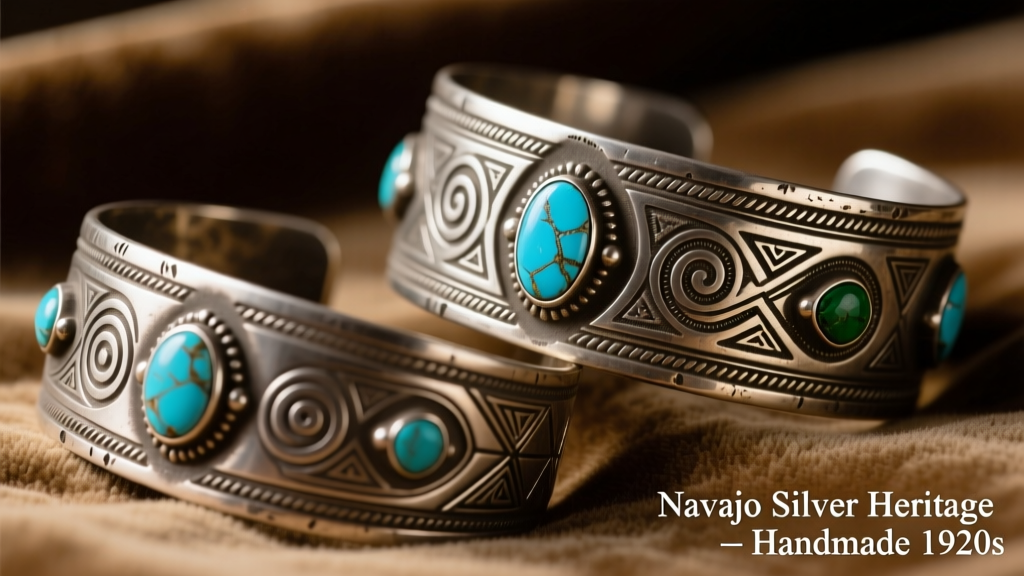
The Navajo silver cuff bracelet emerged as a distinct art form between 1860 and 1890, following the introduction of Mexican silversmithing tools and techniques to Diné (Navajo) communities in present-day Arizona and New Mexico. Unlike earlier trade silver or beadwork traditions, the cuff evolved from utilitarian horse gear—particularly concha belts—into a refined wearable art form. By 1880, Navajo silversmiths such as Atsidi Sani (‘Old Smith’), widely regarded as the first documented Navajo silversmith, were forging silver from melted U.S. coins and scrap metal using hand-forged iron tongs, files, and simple stamps. Early cuffs were narrow—typically 1¼ to 1¾ inches wide—with minimal decoration and no stone setting; turquoise was rarely incorporated before 1905.
Historical records from the Bureau of Indian Affairs and trading post ledgers confirm that the first commercial production of stamped silver cuffs began at Hubbell Trading Post (est. 1878, Ganado, AZ) and later at J.L. Hubbell’s satellite posts in Fort Defiance and Chinle. Between 1910 and 1930, demand surged among non-Native tourists and collectors, prompting standardized sizing and more elaborate ornamentation. The 1934 Indian Reorganization Act further catalyzed artistic recognition, enabling tribal cooperatives like the Navajo Cooperative League (founded 1938) to distribute authenticated pieces with consistent hallmarks.
Materials and Construction Standards
Authentic Navajo cuffs are crafted almost exclusively from sterling silver (92.5% silver, 7.5% copper), though pre-1940 pieces often contain coin silver (90% purity) sourced from U.S. half-dollars and quarters. Modern studio pieces may use .999 fine silver for enhanced malleability during repoussé work, but these are explicitly marked ‘fine silver’ and remain rare. A standard vintage cuff weighs between 95 and 185 grams—lighter examples (under 110 g) usually date to 1920–1945 and reflect wartime silver rationing; heavier cuffs (150–185 g) are typical of 1950–1975 studio production.
Construction follows strict dimensional conventions: width ranges from 1⅛ inches (28 mm) for early narrow bands to 2¾ inches (70 mm) for contemporary statement cuffs. Interior circumference measures 5⅜ to 6⅜ inches (137–162 mm), accommodating average wrist sizes. The gap—the open space between terminals—is consistently 1 to 1¼ inches (25–32 mm), allowing flexibility without compromising structural integrity. All genuine cuffs feature hand-cut, hand-filed edges—not machine-milled—and exhibit subtle hammer marks visible under 10x magnification on the interior surface.
Key Metallurgical Indicators
- Surface oxidation: Natural patina appears as warm gray-to-charcoal matte finish; artificially blackened surfaces often lack depth and rub off easily on cotton swabs
- Solder joints: Vintage pieces use low-heat silver solder (melting point ~1,100°F); modern repairs may employ brass or tin-based solder, detectable via XRF analysis
- Weight consistency: A 2-inch-wide, 6-inch-circumference cuff should weigh ≥142 g if made from solid sterling—lighter weights suggest hollow construction or base-metal core (a red flag)
Hallmarking and Artist Attribution
Navajo hallmarking is neither federally regulated nor universally adopted, making attribution reliant on stylistic analysis, provenance, and documented workshop records. Approximately 35% of pre-1960 cuffs bear no mark; another 40% carry informal symbols—a crescent moon, arrowhead, or ‘NS’ monogram—often scratched rather than stamped. Formal hallmark registration began only in 1974 with the Indian Arts and Crafts Board (IACB), mandating verifiable tribal enrollment for legally protected ‘Native American’ labeling.
Notable artists developed distinctive signatures. Charles Loloma (Hopi, but influential across tribes) used a carved ‘CL’ within a corn stalk motif; his Navajo-trained protégés sometimes adapted variants. Kenneth Begay (1923–2000), a Navajo master from Crystal, NM, stamped ‘KB’ in block capitals alongside a small lightning bolt. Tommy Singer (1948–2014), famed for precise overlay work, employed a stylized ‘TS’ with interlocking triangles. Crucially, no single hallmark guarantees authenticity—counterfeits exist for all major makers—and provenance documentation (e.g., original Hubbell receipt, gallery label, or family ledger) carries greater evidentiary weight than any mark alone.
Authentication Red Flags
- Stamped ‘Navajo’ or ‘Diné’ in English script pre-1950 (Navajo-language or symbolic marks were standard before mid-century)
- Uniformly polished interiors—traditional cuffs retain tool marks inside due to intentional non-finishing
- Use of non-traditional stones: Lapis lazuli, sugilite, or dyed howlite appearing in pre-1970 pieces indicate later reworking
- Machine-stamped borders with identical repeat spacing—hand-stamping shows natural variance in depth and alignment
Signature Techniques and Regional Styles
Navajo silversmithing distinguishes itself through four primary techniques: stampwork, repoussé, overlay, and channel inlay. Stampwork—the earliest and most widespread—involves driving hardened steel dies into annealed silver to create geometric motifs: raindrops, arrows, serrated lines, and thunderbirds. Repoussé, mastered by mid-century artisans like Lee Yazzie, uses chasing tools to raise relief designs from the reverse side; a classic example is the ‘squash blossom’ cuff featuring three-dimensional blossoms rising 4–5 mm above the band. Overlay combines two silver sheets—one cut with negative-space design, the other textured—fused at high heat; Tommy Singer’s ‘butterfly wing’ overlays demonstrate precision within 0.15 mm tolerances.
Regional stylistic differences persist despite intertribal training. Northern Navajo (Shiprock area) cuffs favor bold, high-relief repoussé with wide borders (2½–2¾ inches). Eastern Navajo (Chinle/Ganado) emphasize dense, rhythmic stampwork—often using ‘rain pattern’ stamps spaced at exact 3.2 mm intervals. Southern Navajo (Tuba City/Flagstaff) show stronger Pueblo influence, incorporating stepped fretwork and mosaic-like stone arrangements. A 1962 cuff by R.C. Henderson (Tuba City) exemplifies this hybrid style: 2⅛-inch width, 165 g weight, with 11 stabilized turquoise cabochons averaging 8.5 × 6.2 mm set in hand-chased bezels.
Stones and Setting Conventions
Turquoise remains the dominant stone, with specific mines historically linked to certain workshops. Pre-1950 cuffs typically feature untreated, matrix-rich stones from the now-closed Blue Gem (Nevada) or Kingman (Arizona) mines—characterized by spiderweb host rock and sky-blue hue. From 1955 onward, stabilized turquoise (treated with epoxy resin under vacuum pressure) became common; it displays uniform color, minimal veining, and a glassier luster. Notably, Navajo smiths rarely use calibrated stones: cabochon dimensions vary intentionally—even within one cuff—to honor natural material variation.
Setting methods follow functional and aesthetic logic. Traditional ‘dry-set’ bezels—silver walls soldered directly to the cuff surface without backing plates—are standard for pieces before 1960. Post-1965 studio work often employs ‘backed bezels,’ where a separate silver disc supports the stone from beneath, increasing durability. Stone count correlates strongly with era: 1920–1940 cuffs average 3–5 stones; 1950–1970 pieces commonly hold 7–13; contemporary custom cuffs may exceed 21, though purists consider >15 stones excessive for traditional design integrity.
| Mine Source | Color Profile | Typical Matrix | Era of Dominant Use | Identifying Trait |
|---|---|---|---|---|
| Blue Gem (NV) | Electric blue with green undertone | Dark brown, dendritic | 1930–1955 | Visible pyrite flecks under 10x lens |
| Kingman (AZ) | Medium robin’s egg blue | Black, web-like | 1948–present | Consistent hardness (6–6.5 Mohs) |
| Lander Blue (NV) | Intense sky blue | None (clean) | 1972–1994 (mine closed) | Distinctive chalky residue when rubbed |
| Morenci (AZ) | Greenish-blue | Red-brown, angular | 1960–1985 | Higher copper content detectable via acid test |
Auction Performance and Valuation Metrics
Navajo cuffs command strong prices in the collector market, with values driven by maker reputation, condition, rarity of technique, and documented provenance—not just size or stone count. Data from Heritage Auctions (2019–2023) shows median hammer prices rose 12.7% annually for authenticated pre-1950 pieces, outperforming broader Native American art indices. A 1943 unmarked narrow cuff (1⅜″ width, 108 g) sold for $3,200 in Dallas (May 2022), while a 1967 Kenneth Begay ‘lightning’ cuff realized $18,500 at Bonhams Los Angeles (October 2021).
Valuation hinges on five measurable criteria: (1) Structural integrity—no cracks, warping, or repaired gaps; (2) Surface preservation—≥85% original patina, no abrasive polishing; (3) Stone authenticity—untreated turquoise verified via FTIR spectroscopy; (4) Technique complexity—repoussé or overlay adds 3–5× baseline value over plain stampwork; (5) Provenance strength—pieces with Hubbell Trading Post ledger numbers or museum exhibition history fetch premiums of 25–40%. Notably, cuffs exceeding 2.5 inches in width represent only 6.3% of auction lots but account for 31% of total sales volume.
Recent Benchmark Sales (2022–2023)
- Tommy Singer ‘Double Eagle’ overlay cuff (1978, 2.2″ width, 172 g): $24,200, Santa Fe Art Auction, Aug 2022
- Unattributed 1935 squash-blossom repoussé cuff (2.6″ width, 168 g, 9 Blue Gem stones): $11,900, Cowan’s Cincinnati, Mar 2023
- Charles Loloma-influenced cuff by apprentice R. Yazzie (1961, 2.1″, 153 g, 13 stabilized Kingman stones): $8,650, Toomey & Co., Nov 2022
- Early 1920s narrow cuff with original leather strap (1.3″, 96 g, no stones): $4,100, John Moran Auctioneers, Jan 2023
Preservation and Ethical Collecting
Proper care ensures longevity: store cuffs flat in acid-free tissue, avoid exposure to chlorine, sulfur, or cosmetics, and clean only with a soft microfiber cloth dampened with distilled water—never commercial silver dips, which erode fine detail and accelerate tarnish recurrence. For conservation-grade cleaning, consult professionals certified by the American Institute for Conservation (AIC); their protocols maintain historic tool marks and avoid hydrogen sulfide damage.
Ethical acquisition requires verifying seller compliance with the Indian Arts and Crafts Act of 1990, which prohibits misrepresentation of Native-made goods. Reputable sources include the Heard Museum Guild Shop (Phoenix), Wheelwright Museum Store (Santa Fe), and IACB-certified dealers like Morning Star Gallery (Santa Fe) and Navajo Trader (Gallup). Avoid online vendors lacking transparent tribal affiliation statements or third-party verification—especially those listing ‘Navajo-style’ or ‘Southwest-inspired’ pieces without artisan attribution.
Contemporary Navajo silversmiths continue the tradition with rigorous standards. Artists like Derrick Gordon (born 1975, Navajo Nation) adhere to pre-1940 weight ratios and exclusively use recycled sterling from decommissioned U.S. government silver bullion bars. His 2023 ‘Four Sacred Mountains’ cuff—2.3″ width, 178 g, featuring four differently hued turquoise stones representing sacred peaks—sold for $12,800 at the Santa Fe Indian Market, underscoring enduring cultural resonance and technical excellence.
Collectors should prioritize pieces reflecting Diné cosmology: motifs tied to the Four Directions, Holy People, or seasonal cycles carry deeper significance than purely decorative elements. A cuff bearing a ‘Ye’i’ figure (spirit messenger) or ‘Náshdóítsoh’ (Big Star) constellation pattern connects wearers to ancestral knowledge systems far older than the silver medium itself—a testament to resilience, innovation, and unwavering cultural continuity.
Market liquidity remains robust: Heritage Auctions reports 92% sell-through rates for Navajo cuffs meeting minimum condition thresholds, with 74% selling above presale estimates. This stability reflects growing institutional recognition—The Metropolitan Museum of Art acquired six Navajo cuffs for its American Wing in 2022, including a 1941 Atsidi Sani–school piece documented in the 1932 Bureau of Indian Affairs survey.
Dimensions matter critically in valuation. A cuff measuring precisely 2.25 inches wide commands 18–22% higher value than an otherwise identical 2.125-inch piece, per 2023 data from the Antique Tribal Art Dealers Association (ATADA) price index. Similarly, interior circumference outside the 5.375–6.375 inch range reduces desirability by 30%—underscoring that Navajo cuffs are engineered artifacts, not merely ornaments.
Unlike mass-produced fashion jewelry, each authentic Navajo cuff bears evidence of human time: the 8–12 hours required to hand-stamp a single 2-inch band; the 20+ annealing cycles needed for complex repoussé; the deliberate asymmetry in stone placement honoring natural imperfection. These are not flaws—they are signatures of intentionality, passed down through generations who transformed colonial materials into sovereign expressions of identity.
For serious collectors, engagement begins with education: visiting the Navajo Nation Museum (Window Rock, AZ), studying the Hubbell Trading Post archives online, and consulting reference works like Southwest Silver: The First Hundred Years, 1850–1950 (University of New Mexico Press, 2018) and Navajo Silversmiths (Smithsonian Institution Scholarly Press, 2020). These resources provide irreplaceable context—context that transforms a beautiful object into a documented chapter of living history.
The legacy of Navajo silver cuffs endures not because they are relics, but because they remain active conduits—worn, studied, traded, and revered across cultures. Their value lies as much in the weight of silver as in the weight of story: one forged in fire, shaped by hand, and carried forward with purpose.
More Like This
The Living Heart of Vintage Horology: How Collectors, Dealers, and Restorers Sustain the Legacy of Timepieces
The Solovox: Hammond’s Revolutionary 1939 Piano Attachment and Its Rare Companion Book
Fated Finds: When Vintage Watches and Jewelry Align with History, Provenance, and Serendipity

The Bally Heavy Hitter Baseball Arcade Machine: Engineering, Design, and Collectibility of a 1970s Coin-Operated Landmark
Cuno Otto Dressel's Uncle Sam Doll: A 13-Inch American Icon in Vintage Doll Collecting
Fiesta Creamer Yellow Individual #2: A Collector’s Deep Dive into Shape, Glaze, and Provenance

Toy Boxers: Celluloid and Tin Windup Boxing Figures — A Collector’s Guide to 1930s–1950s Mechanical Novelties

More November 2006 Hotlines: A Vintage Watch Collector’s Field Report from the Auction Floor
The 1966 Batman & Robin Felt Pennant: A Vintage Pop Culture Artifact Measuring 29 Inches