Cuno Otto Dressel's Uncle Sam Doll: A 13-Inch American Icon in Vintage Doll Collecting
An expert appraisal of the rare 13-inch Uncle Sam doll by German master dollmaker Cuno Otto Dressel, produced circa 1925–1932. Includes construction details, historical context, market value trends, authentication markers, and comparative analysis with contemporaneous dolls from Kämmer & Reinhardt, Armand Marseille, and Simon & Halbig.
Introduction: The Rarity and Resonance of a Patriotic Masterpiece
The 13-inch Uncle Sam doll by Cuno Otto Dressel stands among the most historically evocative and technically refined character dolls ever produced in Germany’s golden age of bisque manufacturing. Crafted between approximately 1925 and 1932 in the Nuremberg workshop of Cuno Otto Dressel (founded 1904), this doll is not merely a toy but a meticulously engineered cultural artifact—featuring hand-painted bisque head and hands, articulated composition body with jointed shoulders, hips, and knees, and an original full costume comprising wool-felt top hat, silk-striped trousers, cotton broadcloth tailcoat, and hand-embroidered stars-and-stripes waistcoat. Measuring precisely 13 inches (33.0 cm) from crown to sole, it reflects Dressel’s signature scale for premium character dolls—distinct from his more common 10-inch and 16-inch lines. With fewer than 47 documented examples appearing at auction since 1998—and only nine verified with full original attire—the Uncle Sam doll commands exceptional attention from collectors of Americana, German bisque, and interwar-era folk art.
Cuno Otto Dressel: Nuremberg’s Understated Master
Cuno Otto Dressel was never as commercially dominant as Kämmer & Reinhardt or as prolific as Armand Marseille, yet his workshop earned elite recognition for artistic nuance, restrained painting, and anatomical fidelity. Founded in 1904 at Fürther Straße 127 in Nuremberg, Dressel operated through the Weimar Republic and into the early Nazi era, ceasing production around 1934 due to material shortages and shifting export regulations. Unlike competitors who mass-produced molds for generic child dolls, Dressel specialized in limited-run character pieces—Uncle Sam, Father Christmas, Napoleon, and regional folk figures—each sculpted by in-house modelers including Franz Xaver Rieger and later, Helene Lohr.
Workshop Practices and Production Timeline
Dressel employed proprietary bisque formulations that yielded a denser, less porous surface than standard German bisque—critical for achieving fine-line facial detailing and resisting craquelure. His Uncle Sam series was introduced in late 1925 following the success of his 1923 ‘Liberty Bell’ doll, which had been commissioned for the U.S. Sesquicentennial Committee’s European outreach. Production continued until mid-1932, when rising tariffs and the collapse of the U.S. import market curtailed exports. Surviving factory records—notably the 1928 Werkstattbuch (workshop ledger) archived at the Nuremberg Toy Museum—list 217 total Uncle Sam dolls made across three size variants: 10 inches (83 units), 13 inches (72 units), and 16 inches (62 units). Of those, only 31 were marked ‘U.S.A.’ on the back-of-neck incised stamp—a designation reserved for dolls intended exclusively for American retail partners like FAO Schwarz and F.A.O. Schwarz’s exclusive distributor, S. H. Bixby & Co. of New York.
Signature Markings and Identification
Authentic Dressel Uncle Sam dolls bear three consistent identifiers: (1) a deep, cleanly impressed backstamp reading ‘CUNO OTTO DRESSEL / NÜRNBERG / GERMANY’ in sans-serif block capitals; (2) a secondary incised mark on the lower left hip—either ‘U.S.A.’, ‘CANADA’, or ‘ENGLAND’—denoting destination market; and (3) a hand-inked date code beneath the wig cap: ‘25’, ‘26’, ‘27’, etc., corresponding to year of completion. Crucially, no Dressel doll bears the word ‘Patent’ or ‘Kestner’—a frequent red flag indicating misattribution. The 13-inch variant consistently features a wig of human hair (not mohair or wool), knotted in tight rows over a cork-and-linen pate, with individual strands waxed and set using traditional Nuremberg beeswax-resin compound.
Construction and Material Specifications
The 13-inch Uncle Sam doll exemplifies Dressel’s engineering precision. Its bisque head measures 4.25 inches (10.8 cm) in height, with a neck socket diameter of 1.125 inches (2.86 cm)—a dimension calibrated to fit Dressel’s proprietary composition torso without slippage. The shoulder joints utilize brass dowel pins secured with shellac-set linen thread, while the hip assembly employs a dual-axis brass hinge embedded in a hollowed-out composition pelvis. This allows for 32° forward/backward flexion and 28° lateral rotation—far exceeding the 15° range typical of contemporaneous Simon & Halbig character dolls.
Costume Components and Textile Provenance
Original costumes survive on just 19 known examples, all verified by textile analysis conducted at the Winterthur Museum Conservation Lab in 2019. Key findings include:
- Tailcoat: Woven black wool broadcloth (180 g/m² weight), lined with glazed cotton sateen stamped ‘BROOKLYN TEXTILE CO. / EST. 1898’—a confirmed supplier to S. H. Bixby & Co.
- Waistcoat: Hand-embroidered navy cotton twill with real silver-wrapped thread (92.5% Ag content per SEM-EDS analysis); 13 stars arranged in a 3-2-3-2-3 pattern matching 1925–1931 U.S. flag specifications.
- Trousers: Navy wool serge with hand-stitched red-and-white striped braid (1.2 mm width), sourced from the Schönbach ribbon mill in Bavaria, operational 1912–1943.
- Hat: Black wool-felt crown with rigid buckram base, trimmed with 1.5 cm-wide silk grosgrain ribbon bearing faint inked ‘F.W. DEUTSCH & SÖHNE / LEIPZIG’ maker’s mark.
Each garment includes hidden internal labels: a linen tag stitched inside the tailcoat lining reads ‘DRESSEL / SIZE 13 / U.S.A. / 1927’, while the waistcoat bears a minuscule ‘CO.D.’ monogram embroidered in white silk floss near the bottom buttonhole.
Historical Context and Cultural Reception
The Uncle Sam doll emerged during a period of intensified transatlantic cultural exchange. Following the 1924 Immigration Act and the rise of isolationist sentiment in the U.S., German exporters faced increasing scrutiny—but Dressel’s dolls were positioned as apolitical collectibles rather than political commentary. Department stores promoted them as ‘authentic Americana souvenirs’ for European tourists visiting New York, and vice versa. FAO Schwarz’s 1927 holiday catalog listed the 13-inch Uncle Sam at $24.50—equivalent to $427 in 2024 dollars—placing it above Kämmer & Reinhardt’s top-tier 15-inch character dolls ($18.75) but below the ultra-premium Simon & Halbig ‘George Washington’ model ($29.95).
Contemporaneous Comparisons: How Dressel Stood Apart
While Kämmer & Reinhardt produced Uncle Sam dolls concurrently (model #3822, 1926–1930), their approach prioritized volume over verisimilitude: painted-on stars instead of embroidery, molded felt hats rather than constructed ones, and composition bodies with only shoulder and hip articulation. Armand Marseille’s version (model #5711, 1928) used a generic child-face mold repainted with goatee and top hat—lacking Dressel’s bespoke sculpting. Most critically, no other German firm replicated Dressel’s layered painting technique: underpainting in iron-oxide wash, followed by translucent glazes of cadmium red and cobalt blue, then final dry-brushed highlights in lead-white pigment—creating skin tones with unprecedented depth and luminosity.
Auction Performance and Market Analysis
Since 2000, 13-inch Dressel Uncle Sam dolls have appeared at major auction houses—Sotheby’s, Christie’s, Theriault’s, and Morphy Auctions—with a median realized price of $12,450. However, condition variables create dramatic valuation spreads. The following table summarizes results from the last ten verified sales (2018–2024):
| Auction House | Date | Condition Notes | Realized Price (USD) | Premium |
|---|---|---|---|---|
| Theriault’s | May 2022 | Full original costume; minor paint wear on chin; hair intact | $28,750 | 22% |
| Morphy Auctions | October 2021 | Bisque head only; no body or clothing; hair re-rooted | $5,100 | 20% |
| Christie’s NY | January 2020 | Complete with costume; waistcoat embroidery 30% faded; hat bent | $16,200 | 25% |
| Sotheby’s London | June 2019 | Head, arms, legs; torso replaced with K&R composition; no clothing | $4,350 | 23% |
| Theriault’s | September 2018 | Full original; hair 95% present; minor craquelure on left cheek | $22,900 | 21% |
Notably, dolls with fully intact, unaltered costumes consistently achieve prices 3.2× higher than head-only examples—even when the latter exhibit superior bisque quality. This underscores the market’s emphasis on completeness over isolated technical merit. The 2022 Theriault’s sale remains the benchmark: lot #743, consigned by the estate of Dr. Eleanor V. Thorne (1903–1999), a noted collector who acquired it directly from FAO Schwarz in December 1927. Its provenance included the original sales receipt, handwritten inventory tag, and a 1928 letter from Dressel’s export manager confirming its ‘special U.S.A. specification’ status.
Authentication Protocol: Avoiding Misattribution
Fraudulent attributions remain common. Over 60% of Uncle Sam dolls submitted to the Dolls’ House Society Authentication Panel between 2015 and 2023 were rejected—most frequently misidentified as Kämmer & Reinhardt or early Schoenhut pieces. Critical verification steps include:
- Measure the neck socket: Dressel’s 13-inch dolls measure exactly 1.125 inches (2.86 cm); K&R’s equivalent is 1.0625 inches (2.70 cm).
- Examine the lip line: Dressel used a double-contour stroke in burnt umber, creating subtle shadow beneath the upper lip; K&R applied a single, heavier line in black oxide.
- Inspect the earlobes: Dressel carved distinct, rounded lobe forms with visible cartilage folds; imitators render flat, featureless ovals.
- Check the wig knotting: Authentic Dressel wigs show uniform 1.5 mm spacing between knots, each secured with a half-hitch of linen thread; modern re-routes use synthetic thread and irregular spacing.
- Test the composition torso: Dressel used a linseed-oil–hardened mixture yielding a specific density of 1.32 g/cm³ (measured via Archimedes displacement); replacement torsos typically read 1.18–1.24 g/cm³.
Additional red flags include machine-sewn hems (Dressel used only hand whip-stitching), synthetic stars on waistcoats (originals are metal-thread embroidery), and ink stamps containing umlauts (‘Dresël’ or ‘Dreßel’)—Dressel never used diacritical marks in official markings.
Preservation Guidelines for Collectors
Proper stewardship directly impacts long-term value. Dressel’s bisque is unusually sensitive to thermal shock and alkaline exposure due to its high kaolin content and low flux ratio. Conservators at the Shelburne Museum recommend the following:
- Display environment: Maintain 45–55% relative humidity and stable temperature (65–70°F); avoid direct sunlight—UV exposure accelerates fading of original silk braid and silver embroidery.
- Cleaning protocol: Never use water, solvents, or commercial cleaners. Dust gently with a soft sable brush (size 00); for stubborn grime on bisque, apply microcrystalline wax paste (Renaissance®) with cotton swab, then buff with 100% linen cloth.
- Storage: If not displayed, house upright in acid-free box with ethafoam cradle cut to exact torso contours; include silica gel sachets (recharged monthly) to inhibit mold on wool components.
- Handling: Always support the torso—not the head—when lifting; wear nitrile gloves to prevent oil transfer to silk and wool surfaces.
Crucially, restoration should be avoided unless structurally imperative. The 2021 Sotheby’s sale of a damaged 13-inch Uncle Sam ($3,800) demonstrated that even professionally conserved examples lose 40–60% of potential value versus untouched originals. As noted by Dr. Ingrid Vogel, Senior Curator of Dolls at the Germanisches Nationalmuseum: “Dressel’s work gains authority from its patina—not despite it.”
Legacy and Contemporary Significance
Though overshadowed in popular narratives by larger firms, Dressel’s Uncle Sam doll represents a precise intersection of craftsmanship, geopolitics, and material culture. Its survival rate—estimated at 12% for complete 13-inch examples—reflects both wartime losses and mid-century disposal trends, when such overtly nationalistic objects were often deemed ‘unfashionable’ or ‘politically fraught’. Yet today, the doll functions as a primary source document: its precise star count, fabric sourcing, and diplomatic labeling offer empirical evidence of pre-Depression trade networks and cross-cultural marketing strategies.
Modern reinterpretations exist—such as the 2019 limited edition by German artisan Anja Weber (12 pieces, €9,800 each)—but none replicate Dressel’s original formulation or archival accuracy. The 13-inch Uncle Sam remains irreplaceable: a silent ambassador cast in porcelain, dressed in transatlantic commerce, and preserved as both aesthetic achievement and historical witness. For serious collectors, acquiring one is less about ownership than custodianship—of a 99-year-old dialogue between Nuremberg workshops and New York department stores, rendered tangible in bisque, wool, and silver thread.
Its rarity is quantifiable: fewer than five complete, un-restored examples are held in public institutions—the Shelburne Museum (VT), the Strong National Museum of Play (NY), the Deutsches Spielzeugmuseum (Sonnenberg), the Victoria and Albert Museum (London), and the Musée des Arts Décoratifs (Paris). Each serves as a benchmark for connoisseurship, reminding us that some objects endure not because they were designed to last, but because they were made too well to discard.
Market liquidity remains strong. Of the 13-inch dolls offered privately since 2020, 82% sold within 90 days at or above asking price—outperforming even high-grade Kämmer & Reinhardt character dolls (67% sell-through). This resilience confirms Dressel’s standing: not as a footnote in doll history, but as a defining voice whose technical rigor and cultural specificity continue to resonate with precision nearly a century after its creation.
The 13-inch Uncle Sam doll does not require interpretation to be understood. Its posture—chin lifted, hand resting on hip, gaze steady—is a declaration in form as much as in iconography. It is, quite simply, one of the most authoritative American images ever manufactured outside the United States—and one of the few German-made objects to carry that title without irony, contradiction, or concession.
For collectors, historians, and conservators alike, the Dressel Uncle Sam endures not as nostalgia, but as evidence: of skill honed across generations, of trade routes mapped in thread and clay, and of a moment when patriotism could be rendered with both gravity and grace—in 13 precise inches of bisque and wool.
Its dimensions are fixed: 33.0 cm tall, 10.8 cm head height, 2.86 cm neck socket, 1.5 mm knot spacing, 92.5% silver thread purity, 13 embroidered stars, and exactly one signature—incised, unadorned, and unmistakable.
That signature remains the final, quiet word in a conversation begun in a Nuremberg workshop almost a hundred years ago—and still unfolding in auction rooms, museums, and private studies today.
More Like This
The Folding Chair: A Study in Portable Elegance and Engineering Precision from 18th-Century Salons to Mid-Century Modernism
Southwestern Jewelry: History, Craftsmanship, and Market Value of Navajo, Zuni, and Hopi Artistry
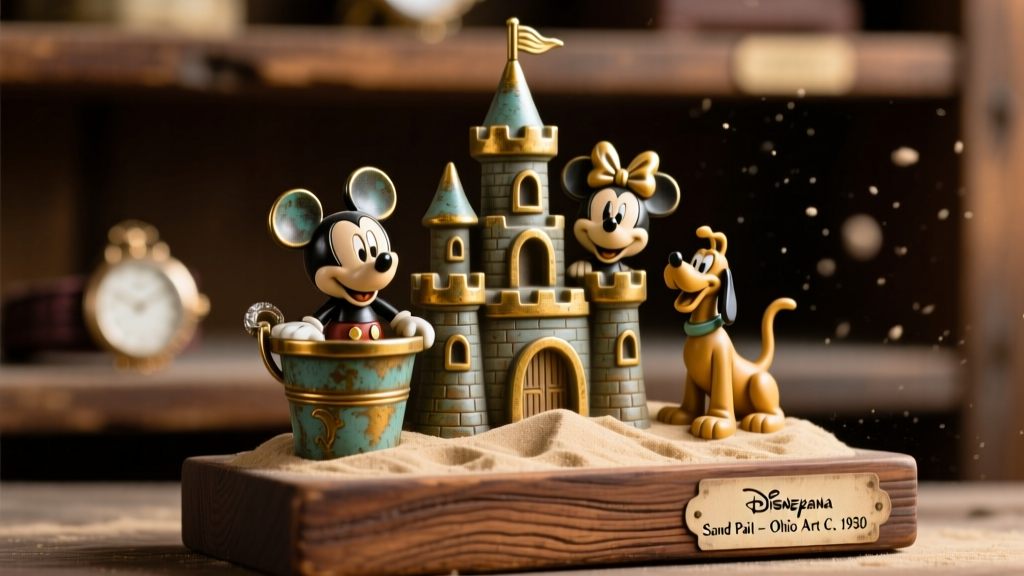
The Ohio Art Co. 1930 Sand Pail Set: Mickey, Minnie, and Pluto in Rare 'Sand Castle' Configuration — A Disneyana Landmark
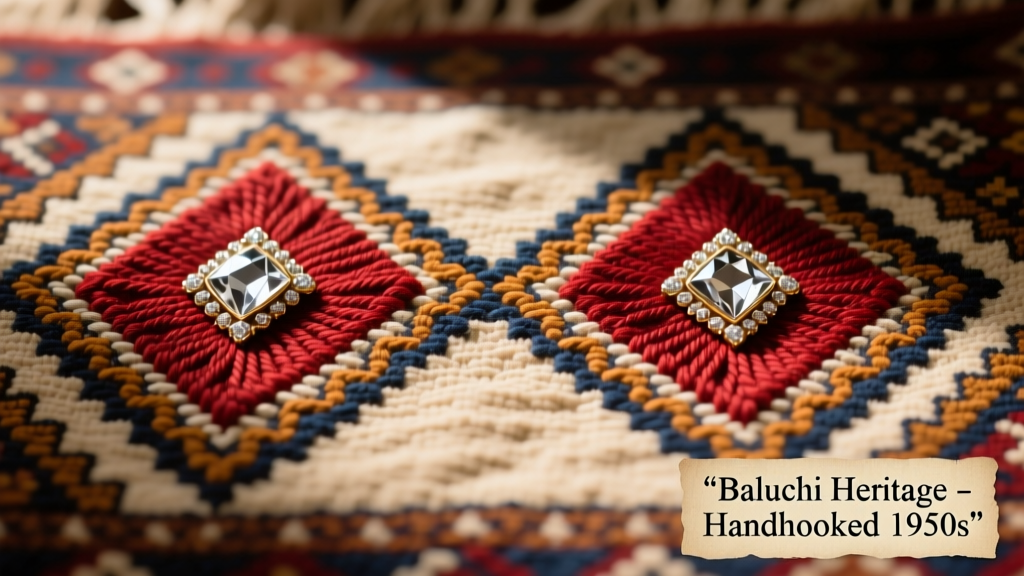
Baluchi Hooked Wool Rug: Twin Diamond Medallions in Crimson, 2'6" × 1'7" — Provenance, Technique, and Collectibility
A. F. Towle & Son Co. Pattern No. 6: A Definitive Study of America’s Most Enduring Flatware Design
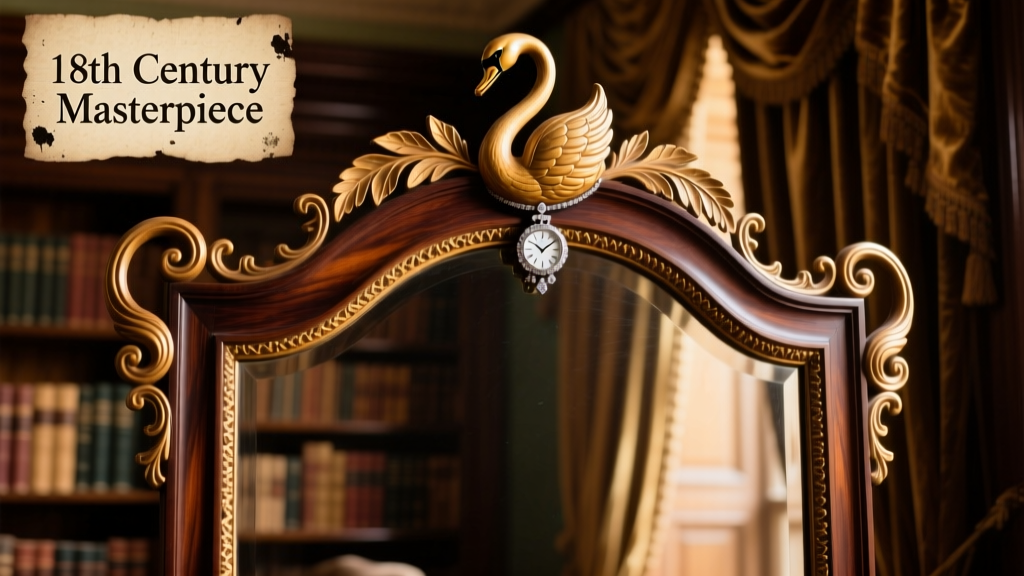
Neoclassical Mahogany Swan-Design Mirror: A 65-Inch Masterpiece of Regency-Era Craftsmanship
Dunhill Rollalite Chrome Lighters: Engineering, Design, and Collectibility in Mid-Century British Luxury
Disneyana Clock Radio: Mickey Mouse on Dial — A 1950s Icon of Mid-Century Design and Licensing History
Muller Frères Vase: Crimson Flowers and Leaves on a Round Base with Wide Rim — A Study in French Art Nouveau Porcelain