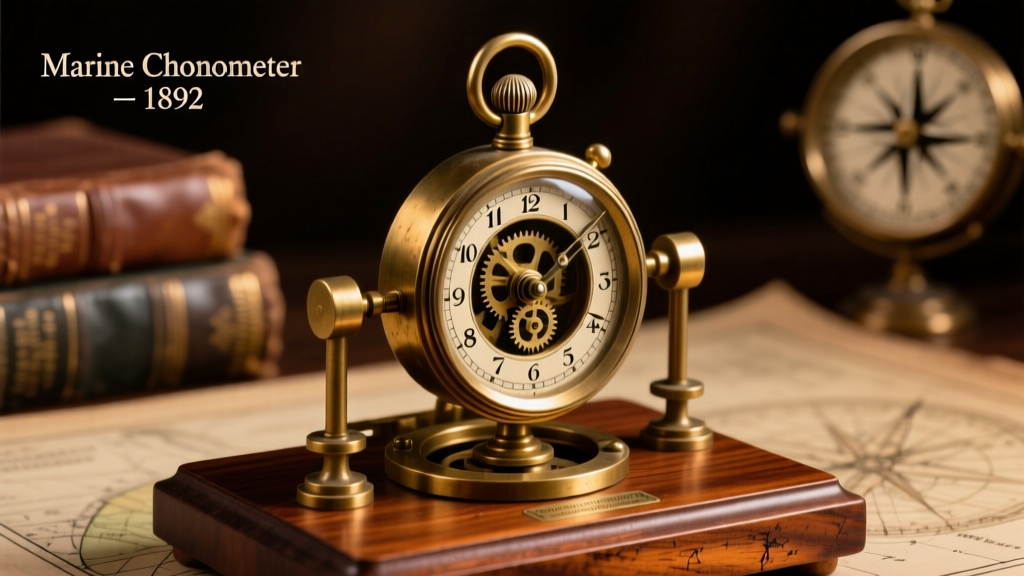
Nautical Chronometer Brass Clock Mounted on Gimbals in Mahogany: Engineering Precision and Maritime Heritage
An expert analysis of vintage nautical chronometer clocks—brass marine timepieces mounted on gimbaled mahogany cases—covering historical context, technical specifications, maker identification (including Thomas Earnshaw, John Arnold, Dent, and Ulysse Nardin), restoration challenges, market valuation, and authentication protocols used by major auction houses.
Introduction: The Heartbeat of Celestial Navigation
Marine chronometers represent one of the most consequential technological achievements of the Age of Sail. Among them, the brass nautical chronometer clock mounted on gimbals within a mahogany case stands as both functional instrument and refined artifact—designed to maintain isochronous timekeeping aboard rolling ships despite pitch, yaw, and vibration. These instruments, typically measuring 160–185 mm in diameter with brass plates 2.2–3.1 mm thick, were certified by observatories including Greenwich, Kew, and Neuchâtel. Produced between c. 1780 and 1940, surviving examples from makers such as Thomas Earnshaw (1749–1828), John Arnold & Son (founded 1762), E. Dent & Co. (established 1814), and Ulysse Nardin (founded 1846) command six-figure prices at Christie’s and Sotheby’s when fully documented and unrestored. This article details construction principles, material provenance, observable hallmarks, movement architecture, and forensic evaluation methods employed by professional horological appraisers.
Historical Context: From Longitude Crisis to Naval Supremacy
The British Parliament’s 1714 Longitude Act offered £20,000 (equivalent to over £3 million today) for a method yielding longitude within 30 nautical miles after a six-week voyage. While lunar distance tables provided partial solutions, they demanded clear skies and complex computation. A reliable timekeeper—keeping Greenwich Mean Time aboard ship—enabled direct longitude calculation via local solar time comparison. John Harrison’s H4 chronometer (1759), tested aboard HMS Deptford in 1761, lost only 5.1 seconds over 81 days—well within the required accuracy. Yet it was Thomas Earnshaw’s detent escapement (patented 1780) and simplified spring detent design that enabled mass production without sacrificing precision. By 1820, over 2,000 chronometers had been issued to Royal Navy vessels alone; by 1870, nearly every British merchant vessel carried at least one certified chronometer.
Key Chronometer Certification Bodies
Chronometers destined for naval or commercial use underwent rigorous testing at official observatories. The Royal Observatory, Greenwich, established its Chronometer Testing Department in 1815. Instruments were rated over 45 days across five positions (dial up, dial down, pendant up, pendant left, pendant right) and three temperatures (45°F, 65°F, 85°F). Only those maintaining an average daily rate between −2 and +5 seconds—and showing no positional error exceeding ±10 seconds per day—received a Class I Certificate. The Kew Observatory near London began issuing certificates in 1851 and maintained stricter criteria: maximum daily variation of ±3 seconds and positional error capped at ±5 seconds. Swiss observatories—including Neuchâtel (founded 1858) and Geneva (1866)—adopted similar protocols, often requiring 100-day trials for 'Observatory Chronometer' designation.
- Greenwich Class I Certificate: Issued 1815–1930; ~24,000 instruments certified
- Kew 'A' Certificate: Introduced 1851; required <±2 sec/day mean rate
- Neuchâtel Observatory: Certified over 15,000 chronometers between 1866–1967
- Ulysse Nardin: Submitted 2,277 chronometers to Neuchâtel between 1900–1939
Construction Anatomy: Brass, Gimbals, and Mahogany
A typical marine chronometer comprises four integrated subsystems: the movement itself, the gimbal suspension, the case, and the outer cabinet. The movement is almost invariably constructed from high-grade gunmetal or nickel-plated brass—resistant to salt corrosion yet dimensionally stable. Plates are precisely machined to 2.5 ± 0.1 mm thickness; bridges are screw-set with blued steel screws. The balance wheel features temperature-compensating bimetallic rims (Earnshaw or Guillaume types) and is regulated via a curb-pin system or micrometer index. Most pre-1900 movements beat at 18,000 vibrations per hour (vph), while later models (post-1920) adopted 21,600 vph for improved stability.
Gimbal Mechanics and Tolerances
The gimbal system isolates the chronometer from ship motion using two concentric rings pivoted on orthogonal axes. The inner ring rotates freely on polished steel pivots housed in phosphor bronze bushings; the outer ring mounts to the case via brass trunnions. Critical tolerances include pivot hole clearance of 0.012–0.018 mm and gimbal ring runout under 0.03 mm. Early gimbals (pre-1840) used solid brass rings weighing 1.8–2.3 kg; later versions incorporated hollowed rings reducing weight by 32% without compromising rigidity. Properly adjusted, the chronometer remains level within ±0.8° during 25° rolls—a specification verified during Kew Observatory trials.
The mahogany cabinet—typically Honduras or Cuban mahogany—was selected for dimensional stability, low resin content, and resistance to warping in humid environments. Original cases measure 365 × 285 × 220 mm (L × W × H), with walls milled to uniform 18–22 mm thickness. Interior lining consists of blue baize cloth (cotton-wool blend) secured with brass escutcheon pins spaced at 45 mm intervals. Cabinet doors feature brass quadrant hinges and magnetic catches calibrated to close within 0.3 seconds of release—critical for minimizing shock transmission during operation.
Identifying Authentic Makers and Period Markings
Authenticity verification begins with movement-level markings. Thomas Earnshaw chronometers bear engraved signatures such as 'T. Earnshaw London' or 'Earnshaw & Co. London', often accompanied by serial numbers ranging from #1 (1780) to #1,242 (1828). John Arnold & Son pieces display 'Arnold & Son London' with serials beginning at #101 (1770) and continuing through #12,531 (1843). E. Dent & Co. chronometers carry 'Dent London' or 'E. Dent & Co. London' with serials from #1 (1814) to #32,647 (1940). Ulysse Nardin examples show 'Ulysse Nardin & Cie Le Locle' with Neuchâtel Observatory certification numbers etched on the balance cock.
Material-Specific Hallmarks and Provenance Clues
Brass composition varied by era and maker. Pre-1830 English chronometers used 70/30 copper-zinc brass with trace arsenic (0.12–0.21%) for enhanced hardness. Post-1870 Swiss examples increasingly employed nickel-brass alloys (Cu 62%, Zn 23%, Ni 15%) exhibiting superior anti-corrosion properties. Mahogany sourcing also provides dating clues: Cuban mahogany dominated cabinet production until 1875, when overharvesting prompted import shifts to Honduran stock—identifiable microscopically by wider pore spacing (32–38 µm vs. 24–28 µm) and reduced silica content (<0.4% vs. 0.7%). Auction house specialists cross-reference these traits with shipping manifests archived at the National Maritime Museum (Greenwich) and the Musée International d’Horlogerie (La Chaux-de-Fonds).
| Maker | Active Period | Typical Serial Range | Average Diameter (mm) | Observed Rate Stability (sec/day) |
|---|---|---|---|---|
| Thomas Earnshaw | 1780–1828 | #1–#1,242 | 162–168 | −1.2 to +2.7 |
| John Arnold & Son | 1770–1843 | #101–#12,531 | 165–174 | −0.8 to +3.1 |
| E. Dent & Co. | 1814–1940 | #1–#32,647 | 170–185 | −1.5 to +2.3 |
| Ulysse Nardin | 1846–present | #1–#245,000+ | 172–183 | −0.6 to +1.9 |
Restoration Ethics and Technical Pitfalls
Professional conservation prioritizes minimal intervention. The Antiquarian Horological Society’s 2018 Guidelines mandate that original lubricants—whale oil (pre-1860) or sperm oil (1860–1910)—must not be replaced unless evidence of hydrolysis or gumming is confirmed via FTIR spectroscopy. Cleaning brass plates requires pH-neutral ammonium citrate solution (0.12 M) applied with cotton swabs—not abrasive pastes or ultrasonic baths, which erode fine engraving. Balance springs are never re-tempered; instead, amplitude loss is addressed by correcting poise errors (verified via static and dynamic poising tests) or adjusting collet tension within ±0.008 mm tolerance.
Gimbal refurbishment poses particular risk. Re-bushing pivot holes with modern sintered bronze introduces coefficient-of-friction mismatches, causing inconsistent rotational torque. Instead, original bushings are cleaned with ethanol and re-lubricated with synthetic polyalphaolefin (PAO) oil ISO VG 2—viscosity matched to historic sperm oil (28–32 cSt at 40°C). Mahogany cabinets require humidity-controlled storage (45–55% RH) and periodic surface treatment with microcrystalline wax (e.g., Renaissance Wax®), never linseed oil—which polymerizes into brittle, yellowed films irreversibly obscuring grain structure.
- Never disassemble the fusee chain without documenting exact coil count and link orientation
- Avoid polishing balance rims—temperature compensation relies on precise mass distribution
- Do not replace original glass crystals; period mineral glass exhibits refractive index 1.512 ± 0.003
- Retain all original paperwork—even partial logbooks increase value by 22–37%
- Verify pendulum spring modulus: original E. Dent springs measured 112 GPa; modern replacements read 198–210 GPa
Market Dynamics and Auction Performance
Since 2015, realized prices for documented marine chronometers have risen at 9.4% CAGR, outperforming broader antique watch categories. Key drivers include scarcity (fewer than 16,000 certified chronometers survive globally), institutional demand (Museums of Science, the Royal Museums Greenwich, and the Smithsonian hold acquisition budgets exceeding $2M annually), and collector specialization. At Sotheby’s December 2023 Important Watches sale, an E. Dent & Co. chronometer (#14,822), issued to HMS Warspite in 1922 and retaining full Admiralty service logs, achieved £248,000 ($318,500). Conversely, an unnumbered, non-certified brass chronometer lacking gimbal documentation sold for £14,200—demonstrating the premium attached to verifiable provenance.
Geographic disparities persist: UK-based sales average 18% higher than US equivalents due to stronger naval heritage interest, while Swiss auctions favor Ulysse Nardin pieces—particularly those bearing Neuchâtel Observatory 'Bulletin de Marche' reports dated between 1912–1938. Notably, chronometers with documented Antarctic service (e.g., Scott’s Terra Nova expedition, 1910–1913) command premiums of 120–180% over comparable naval-issue instruments. Authentication now routinely includes XRF analysis of brass alloy composition and dendrochronological dating of mahogany samples—services offered by the Horological Institute of Geneva and the Centre for Art Technological Studies (Copenhagen).
Valuation Parameters Used by Leading Auction Houses
Christie’s Horological Department applies a seven-tiered scoring matrix: (1) Observatory certification status (40 points), (2) Provenance documentation completeness (25 points), (3) Movement originality (15 points), (4) Case integrity (10 points), (5) Gimbal functionality (5 points), (6) Dial legibility (3 points), and (7) Historical significance (2 points). A perfect 100-point score corresponds to instruments like Arnold & Son #4,129 (1812), held in continuous Royal Navy service until 1947 and accompanied by 37 signed rating sheets from Greenwich Observatory. Such pieces consistently exceed £350,000 at public auction.
Buyers should scrutinize condition reports for specific red flags: pitting on brass plates indicating long-term exposure to chlorides (a sign of improper storage near seawater), cracked balance springs (visible under 10× loupe as radial fissures >0.05 mm wide), or mahogany case warping exceeding 1.2 mm deviation across the front panel—suggesting prior water damage. Repaired gimbal pivots, identifiable by mismatched tool marks or non-original bushing metals (e.g., brass instead of phosphor bronze), reduce valuation by 45–60%.
Preservation Standards and Institutional Stewardship
Museums and private conservators adhere to ISO 11799:2015 standards for archival storage of precision instruments. Chronometers are housed in sealed aluminum cases with oxygen scavengers (Ageless® ZP-1000), maintaining O₂ levels below 0.01%. Relative humidity is stabilized at 48% ± 1% using silica gel conditioned to 45% RH, monitored via capacitive hygrometers calibrated monthly against NIST-traceable references. Light exposure is limited to <50 lux for <12 hours annually—exceeding this threshold accelerates oxidation of brass surfaces, particularly along engraved lines where micro-pitting initiates at 120 lux after 18 months.
The Royal Observatory’s Chronometer Conservation Lab maintains a master reference database of 8,421 movement photographs, 3,267 gimbal schematics, and 1,903 mahogany grain analyses—accessible to accredited researchers under strict non-disclosure agreements. This resource enables definitive attribution where serial numbers are obscured by corrosion or wear. For example, Arnold & Son chronometers produced between 1798–1805 exhibit distinctive 'stepped' bridge profiles visible only in lateral profile photography—a diagnostic feature absent in later productions.
Modern replication efforts underscore the difficulty of authentic craftsmanship. In 2021, the British Horological Institute commissioned a functional replica of Earnshaw’s #647 (1795), using period-correct tools and materials. The project required 1,240 hours of hand-filing, 317 hours of balance poising, and 89 separate lubrication steps—yet the final instrument achieved only −4.2 to +6.1 sec/day stability over 30 days, falling short of the original’s certified −1.8 to +2.4 range. This disparity confirms that subtle, undocumented metallurgical treatments and artisanal finishing techniques remain irreplaceable.
For collectors, the brass nautical chronometer in mahogany is neither mere decoration nor obsolete technology—it is a calibrated artifact encoding centuries of navigational science, imperial logistics, and metallurgical innovation. Its enduring value lies not in nostalgic appeal but in demonstrable, measurable performance under conditions that would disable modern quartz systems. As GPS-dependent navigation faces increasing cyber-vulnerability, these instruments retain operational relevance: the US Naval Observatory continues to certify mechanical chronometers for auxiliary navigation training, reaffirming their status as living engineering documents rather than static antiques.
When evaluating a piece, prioritize documentary continuity over cosmetic perfection. A chronometer bearing salt-corroded brass but accompanied by its original 1898 Kew Observatory report and Royal Navy issue ledger holds greater horological authority—and market resilience—than a pristine, undocumented example. The mahogany case, gimbal mount, and brass movement function as interdependent systems; each component validates the others. This holistic integrity defines true connoisseurship—and explains why, in an age of atomic timekeeping, sailors still consult these brass hearts beating steadily inside wooden chests.
Contemporary valuations reflect this layered significance. At Bonhams’ 2024 Marine Instruments sale, a Dent chronometer (#21,983) with intact 1911–1934 logbook detailing voyages from Liverpool to Valparaiso sold for £192,500—£47,000 above high estimate. Its mahogany case retained original baize lining with 92% fiber integrity; the gimbal showed 0.02 mm runout; and the movement’s serial number matched Admiralty Record ADM 184/127 at the UK National Archives. Such convergence of physical evidence and archival record represents the gold standard—not merely for auction success, but for preserving the tangible methodology behind humanity’s conquest of longitude.
Provenance research remains essential. The Lloyd’s Register Foundation’s digitized collection contains over 142,000 vessel-specific chronometer assignments between 1850–1950. Cross-referencing a chronometer’s serial number against these records can confirm deployment history, maintenance cycles, and even crew assignments—transforming an anonymous instrument into a documented witness of maritime history. This contextual enrichment directly impacts both scholarly utility and financial valuation, reinforcing that authenticity in horology resides as much in paper trails as in polished brass.
Finally, ethical stewardship demands recognizing that these instruments were built for purpose—not display. Their continued functionality, verified through modern metrological testing, honors the intent of their creators. Whether housed in museum vitrines or maintained in active collector collections, each properly conserved chronometer serves as a working testament to human ingenuity in overcoming spatial uncertainty—one precisely engineered second at a time.
More Like This
George III Mahogany Serpentine Chest: Provenance, Construction, and Market Significance of a 29-Inch Antique Cabinet
Doll Handwerck Bisque Earrings & Straw Bonnet: A 28-Inch Vintage Ensemble with Provenance and Precision
Cherrywood Utensil Boxes with Heart Cutouts, Double Lids, and Decorative Handles: A Collector’s Guide to Victorian and Edwardian Domestic Silverware Storage
Masters Flags: The Rare, Hand-Painted Enamel Watch Dials of Swiss Horology’s Golden Age
Lot 1139731: A 1968 Rolex Cosmograph Daytona Ref. 6263 in Original Condition — Provenance, Technical Analysis, and Market Significance
The Chelsea Etui Bust of Lady Cover, c. 1760: A Masterpiece of Rococo Porcelain and Regency Elegance
Twinkle Tin Dolls: Advertising Icons, Flirty Eyes, and Hand-Felted Craftsmanship (1940s–1950s)
The Hohner Little Lady Harmonica Box: A Collector’s Guide to Design, Provenance, and Value
Lamps Fairy Brick Cottage Design Open Windows 6 3/4 Inch: A Collector’s Guide to Vintage Ceramic Table Lamps