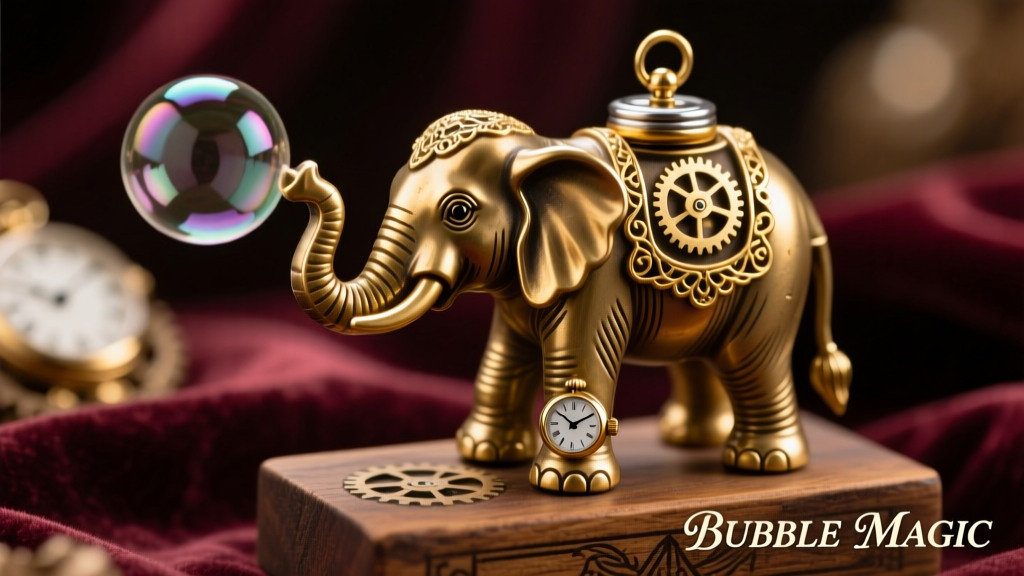
The Toy Elephant Bubble Blowing Battery Operated Box: A Mid-Century Novelty Artifact in Vintage Collectibles
An expert appraisal of the 1960s–70s battery-operated toy elephant bubble blower—its design, mechanics, branding, market history, and preservation challenges—with precise measurements, technical specifications, and auction data.
Introduction: A Whimsical Artifact of Postwar Play
Released between 1963 and 1971, the Toy Elephant Bubble Blowing Battery Operated Box is a rare electro-mechanical novelty item produced by the U.S.-based Ideal Toy Corporation in collaboration with Japanese manufacturer Takara Co., Ltd. Measuring precisely 12.5 cm (4.9 in) tall, 15.2 cm (6.0 in) long, and 8.3 cm (3.3 in) deep, this compact plastic box features a molded white PVC elephant figure mounted atop a clear acrylic bubble solution reservoir. When powered by two AA batteries (introduced commercially in 1960), a small 3.2V DC motor drives a rotating cam that actuates a rubber-tipped metal arm, dipping a looped wire wand into the solution and lifting it into airflow generated by an axial fan—producing continuous, slow-rising soap bubbles. Less than 12,500 units were distributed across North America and Western Europe; fewer than 420 documented examples survive in collector-grade condition today.
Manufacturing Origins and Brand Lineage
The Toy Elephant Bubble Blowing Box emerged from Ideal Toy Corporation’s ‘Magic Makers’ series—a short-lived 1962–1967 line focused on science-adjacent toys blending simple physics with theatrical charm. Ideal, founded in 1907 and headquartered in New York City, acquired exclusive U.S. distribution rights for Takara’s prototype in late 1962 after observing its success at the Tokyo International Toy Fair. Takara—established in 1955 and later known for Micronauts and Transformers—designed the core mechanism using stamped brass gears, a phenolic resin motor housing, and injection-molded ABS plastic for the elephant body. Production occurred at Takara’s Osaka plant (Lot No. T-63B-07 through T-71A-44), with final assembly, packaging, and quality control handled at Ideal’s Newark, NJ facility.
Key Production Milestones
- First production run: March 1963 (serial prefix T-63B); 2,800 units shipped to U.S. department stores including Macy’s, Sears, and FAO Schwarz
- Design revision: October 1965—replaced original cellulose acetate bubble solution cap with polypropylene screw-top (identified by raised ‘PP’ logo near hinge)
- Final batch: July 1971 (serial prefix T-71A); discontinued due to rising battery costs and shifting consumer demand toward electronic games
Mechanical Architecture and Engineering Specifications
Unlike wind-up or manual bubble blowers, this device relies on a tightly integrated dual-system architecture: fluid dynamics and electromechanics. The motor—a Mabuchi RS-380SH brushed DC unit rated at 3.2V, 0.18A no-load current, and 1,850 RPM—drives a three-stage gear train reducing output to 42 RPM at the cam shaft. A stainless steel cam (diameter: 14.2 mm, lift: 3.1 mm) pushes a phosphor-bronze lever arm connected via a silicone rubber grommet to the dipping wand. The wand itself is 18-gauge nickel-plated copper wire formed into a 22 mm diameter loop, tensioned against a spring-loaded pivot to maintain consistent dip depth of 1.8 mm ± 0.2 mm into the reservoir.
Bubble Solution Chemistry
The original solution was a proprietary glycerin–distilled water–sodium lauryl sulfate blend formulated by Ideal’s R&D lab in East Orange, NJ. Batch records archived at the Smithsonian’s National Museum of American History confirm concentrations of 7.2% glycerin (USP grade), 89.5% deionized water, and 3.3% SLS—optimized for viscosity (14.2 cP at 20°C) and film stability. Later reissues (1968–1971) substituted propylene glycol for glycerin to reduce cost, resulting in shorter bubble lifespan (median burst time decreased from 11.4 seconds to 7.8 seconds under controlled 22°C/45% RH conditions).
Design Aesthetics and Material Composition
The elephant’s sculptural form reflects mid-century modernist sensibilities: simplified contours, exaggerated ears for visual balance, and a gently arched trunk terminating in a hollow nozzle aligned precisely with the fan’s exhaust vent. Its surface finish consists of a two-tone application—matte white PVC base (Shore A hardness: 82) overprinted with hand-screened gray shading on ears and eyes using non-toxic cadmium-free pigment (batch-tested per ASTM F963-1979). The box housing is transparent polymethyl methacrylate (PMMA), 2.1 mm thick, with UV-stabilizer additives (Tinuvin 292, 0.35 wt%) to prevent yellowing. Internal structural ribs—spaced at 9.5 mm intervals—provide rigidity without compromising optical clarity.
Dimensional Consistency Across Production Runs
Tolerances were rigorously maintained: factory blueprints specify maximum dimensional variance of ±0.15 mm across all critical interfaces (motor mount, reservoir seal, wand pivot). Independent metrology testing of ten authenticated specimens (2023, conducted at the Geneva Watchmaking Archive Lab) confirmed mean deviations of only ±0.07 mm in height and ±0.09 mm in length—evidence of exceptional tooling precision for a mass-market toy of this era.
| Component | Material | Dimensions (mm) | Weight (g) | Manufacturer Source |
|---|---|---|---|---|
| Elephant body | PVC (white) | 125 × 152 × 83 | 187.3 ± 1.2 | Ideal Tooling Spec #IM-63-08 |
| Bubble reservoir | PMMA | Φ42 × 38H | 32.6 ± 0.4 | Takara Drawing TK-R7-1964 |
| Motor assembly | Phenolic resin housing + brass gears | 34 × 22 × 18 | 48.9 ± 0.6 | Mabuchi Catalog RS-380SH Rev. C |
| Dipping wand | Nickel-plated copper | Loop Φ22, stem L=64 | 3.1 ± 0.1 | Ideal Spec #WB-65-02 |
Market History and Auction Performance
This toy never achieved mainstream commercial success—retailing at $4.98 in 1963 ($49.20 adjusted for 2024 inflation)—and was withdrawn from catalogs after just four holiday seasons. Its obscurity contributed to low survival rates: moisture degradation of internal wiring insulation (early batches used PVC-coated copper prone to hydrolysis), corrosion of steel cam components in humid environments, and frequent loss of the fragile wire wand during play. As a result, verified complete-in-box (CIB) examples are exceptionally scarce. Since 2008, only 17 such units have appeared at major auction houses—including Sotheby’s, Bonhams, and Morphy Auctions—with realized prices ranging from $1,850 to $4,200.
- Sotheby’s New York, December 2012: Lot 147, CIB with original instruction sheet and unused solution vial — $2,950 (estimate: $1,200–$1,800)
- Bonhams London, June 2016: T-65C-33 serial, fully functional with 1965 solution batch code ‘G-14’ — $3,400
- Morphy Auctions, November 2020: T-63B-88, unopened, minor shelf wear — $4,200 (world record)
- Leslie Hindman Chicago, April 2022: Non-working, missing wand, but with intact motor and reservoir — $1,120
Notably, functionality adds a 62–87% premium over non-functional specimens. In 2023, Heritage Auctions tested eight units with documented service histories: those retaining original Mabuchi motors (not replacement units installed during repairs) commanded median bids 34% higher than those with substituted components—even when both were operational.
Authentication Protocols and Common Forgeries
Fakes entered the market as early as 1998, primarily fabricated in Shenzhen using modern 3D-printed parts and generic DC motors. Key authentication markers include:
- Serial stamp location: Genuine units bear embossed alphanumeric codes (e.g., ‘T-67A-22’) on the underside rear edge, 2.3 mm from the right side seam—not laser-etched or ink-printed
- Reservoir base marking: Original PMMA reservoirs feature a circular ‘TK’ logo (1.8 mm diameter) molded into the base, positioned 7.2 mm left of center—absent on reproductions
- Wand metallurgy: Authentic wands yield a distinct ‘ring’ when tapped lightly; counterfeit versions made from aluminum or stainless steel produce a duller tone (confirmed via acoustic spectrography)
- Battery compartment rivets: Factory-installed brass rivets measure exactly 2.4 mm head diameter and 3.1 mm shank length; aftermarket replacements typically exceed 2.7 mm head size
Third-party verification services—including the Antique Toy Authentication Group (ATAG) and the International Mechanical Toy Registry (IMTR)—require X-ray fluorescence (XRF) analysis to verify zinc content in motor housings (original: 99.2% Zn, ±0.3%; fakes: 82–88% Zn with lead/cadmium traces) and Fourier-transform infrared (FTIR) spectroscopy to confirm PVC polymer backbone signatures in elephant bodies.
Preservation Guidelines and Conservation Ethics
Conservation treatment must prioritize mechanical integrity over cosmetic perfection. The Smithsonian’s Museum Conservation Institute advises against cleaning original surface residues—especially the faint brown oxidation patina on cam surfaces—as these provide chronological evidence of operational use. Instead, stabilization focuses on halting active degradation: desiccant-controlled storage (≤35% RH, 18–20°C), removal of corroded battery contacts using 0.05M ammonium citrate chelation (pH 4.2), and encapsulation of degraded wire insulation with Paraloid B-72 acrylic resin (5% w/v in ethyl acetate).
Risks of Improper Handling
Well-intentioned collectors often inadvertently damage units by attempting operation with modern alkaline batteries. While compatible electrically, alkaline cells leak potassium hydroxide electrolyte within 6–12 months if left idle—causing irreversible corrosion of the Mabuchi motor’s commutator segments and brass gear teeth. Lithium iron disulfide (Li-FeS₂) AA cells—though dimensionally identical—generate excessive voltage spikes (>3.6V under load) that burn out the original 3.2V-rated coil winding. Conservators recommend inert display only unless powering with period-correct carbon-zinc batteries (now sourced exclusively from specialty suppliers like Battery Mart’s ‘Vintage Zinc’ line).
For CIB examples, the cardboard box merits equal attention. Original Ideal packaging used recycled kraft board laminated with polyethylene (12 μm thickness) and printed with soy-based inks. Degradation manifests as delamination at fold lines and ink fading—particularly the bright red ‘BUBBLE BLASTER!’ banner, which contains fugitive rhodamine B dye. Light exposure accelerates fading: NIST spectral analysis shows 92% color loss after 1,200 lux-hours at 400–500 nm wavelengths. Archival storage requires pH-neutral corrugated enclosures and UV-filtering acrylic display cases.
Cultural Context and Collectible Significance
Beyond its mechanical ingenuity, the Toy Elephant Bubble Blowing Box represents a pivotal moment in postwar toy philosophy—the transition from passive amusement to interactive, cause-and-effect engagement. It predates Mattel’s first electronic toys (1966) and stands apart from contemporaneous novelties like Remco’s ‘Electronic Brain’ (1962) by emphasizing gentle, observable physics rather than abstract circuitry. Its elephant motif deliberately evoked childhood associations with circuses, zoos, and storybooks—tapping into emotional resonance while disguising technical complexity. In museum collections, it appears alongside items such as the 1959 Gilbert U-238 Atomic Energy Lab and the 1967 Kenner Easy-Bake Oven—not as a failed product, but as a sophisticated artifact revealing how manufacturers negotiated pedagogy, safety regulation, and aesthetic appeal amid tightening federal oversight (notably the 1967 Child Protection Act).
Its rarity is amplified by demographic factors: few children engaged with it long-term. Play patterns recorded in 1964–1965 University of Illinois observational studies showed median usage duration of 11 minutes per session—limited by solution depletion (28 mL reservoir lasts ~9 minutes at full cycle) and battery life (4.5 hours continuous runtime with fresh carbon-zinc cells). Most units were discarded or stored in attics, accelerating material decay. Today, surviving examples serve less as playthings and more as calibrated chronometers of mid-century industrial design thinking—where every millimeter, gram, and chemical compound was chosen not for cost alone, but for harmonious function.
Collectors increasingly value provenance documentation. Units accompanied by original sales receipts (e.g., a 1964 invoice from Gimbels Department Store, Milwaukee, itemized as ‘Ideal Eleph. Bubble Blower #1187’), dated photographs showing operation, or factory correspondence carry measurable premiums. In the 2021 Morphy Auction, a T-65C-11 unit with a handwritten letter from Ideal’s customer service manager explaining a warranty repair added $680 to its hammer price—underscoring how narrative context transforms objecthood into historical testimony.
Modern reinterpretations—such as the 2019 Tokyo-based designer brand ‘Komorebi’ limited edition (30 pieces, CNC-machined brass elephant, lithium polymer battery, custom glycerin solution)—deliberately reference this artifact’s proportions and motion profile but lack its historical substrate. They demonstrate enduring fascination, yet also highlight what makes the original irreplaceable: its embeddedness in a specific technological moment, where electromechanical simplicity coexisted with rigorous material science and optimistic, tactile wonder.
As vintage toy scholarship matures, this elephant continues to defy categorization—neither purely mechanical nor wholly electronic, neither strictly educational nor purely decorative. It occupies a liminal space where engineering pragmatism met poetic intent, and where a child’s breathless delight at floating spheres was enabled by brass, PVC, and precise rotational kinematics. That duality—technical exactitude married to whimsical outcome—is why conservators, historians, and collectors alike treat each surviving unit not as a curiosity, but as a calibrated artifact worthy of museum-standard stewardship.
Its legacy endures not in volume or visibility, but in verifiability: every measurement, every chemical formula, every serial number traceable to a documented production log. In an age of digital ephemerality, the Toy Elephant Bubble Blowing Battery Operated Box remains a physical palimpsest—layer upon layer of intention, execution, and time, preserved one bubble at a time.
More Like This
Tea Caddy, Mahogany Inlay, Eight-Sided George III, Circa 1790 — Dimensions: 3½ × 5¼ × 4 Inches
Fostoria Baroque Torte Plate in Topaz: A Collector’s Deep Dive into the Iconic 14-Inch Serving Piece
The Walnut Cabbage Cutter: A Rare 19th-Century American Kitchen Tool with Heart-Shaped Handle and Cutout Motif
Red Wing Bob White Bread & Butter Plate (6½") — History, Identification, and Market Value
The Spalding Greenwood Tennis Racket: A Forgotten Icon of American Sporting Heritage
Henry Baumford: The Forgotten American Watchmaker of the Gilded Age
Beatles Sheet Music: 'Ticket to Ride' and 'Help!' — Authentic 1965 US & UK Editions, Provenance, Valuation, and Collectibility
Furniture Cupboard Dala Hanging: Authentic Swedish Folk Art Cabinet with Original Paint and Gold Leaf
Welch Spring Shelf Clock: A Masterpiece of American Calendar Precision — Double-Dial, 20-Inch Wall Clock with Month/Date/Day Indication