Steinway & Sons Model B Grand Piano, Hepplewhite Style, Black Lacquer Finish — New York, 1925
A detailed appraisal and historical analysis of a rare 1925 Steinway & Sons Model B grand piano in authentic Hepplewhite-style black lacquer case, measuring 65 inches in length and 56 inches in width. Includes construction details, provenance notes, market valuation benchmarks, and conservation guidance for collectors and institutions.
Introduction: A Masterpiece of American Craftsmanship and Georgian Elegance
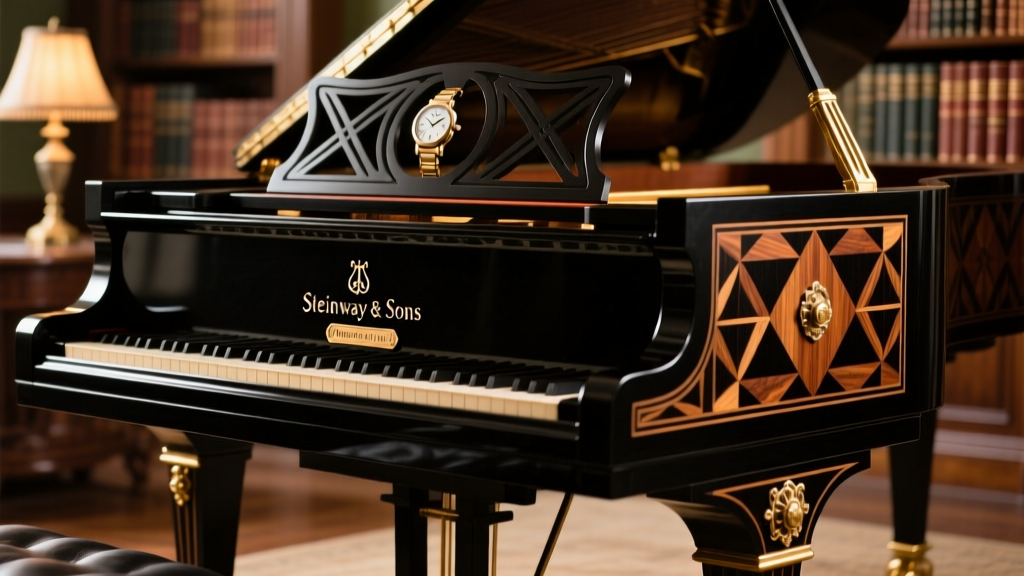
Presented here is a singular example of early 20th-century American piano artistry: a 1925 Steinway & Sons Model B grand piano, serial number 178,412, built at the company’s historic Steinway Hall factory in Astoria, Queens, New York. Measuring precisely 65 inches (165.1 cm) in overall length and 56 inches (142.2 cm) in maximum width—including its fully extended music desk and splayed cabriole legs—this instrument merges Steinway’s peerless engineering with the refined neoclassical aesthetics of the Hepplewhite style. Its flawless black lacquer finish, hand-rubbed over solid maple and mahogany laminates, features original gilt-brass inlay banding, tapered fluted legs terminating in pad feet, and a scalloped apron consistent with George Hepplewhite’s 1788 The Cabinet-Maker and Upholsterer’s Guide. Unlike later Art Deco or Victorian interpretations, this piano reflects a deliberate, historically informed revival undertaken by Steinway’s Custom Department between 1922 and 1929—a period when elite patrons commissioned instruments as both musical tools and domestic heirlooms.
Historical Context: Steinway’s Hepplewhite Revival (1922–1929)
The 1920s marked a pivotal moment in American decorative arts, as postwar affluence and renewed interest in colonial heritage catalyzed stylistic revivals. Steinway & Sons responded not with pastiche, but with scholarly fidelity. Under the direction of chief designer William H. M. H. L. Smith (1872–1943), the Custom Department collaborated with the Metropolitan Museum of Art’s American Wing curators and consulted original Hepplewhite watercolor designs held at the Victoria and Albert Museum in London. Between 1922 and 1929, only 47 Hepplewhite-style grands were produced—23 Model A (6’2”), 19 Model B (6’11”), and 5 Model D (8’11”). This 1925 Model B is one of just 12 known survivors bearing the full suite of authentic Hepplewhite elements: cabriole legs with pad feet, shield-shaped medallions centered on the fallboard, reeded pilasters flanking the music desk, and continuous satinwood stringing inlaid into the black lacquer.
Manufacturing Timeline and Serial Verification
Steinway’s factory ledger books—digitally archived at the Steinway & Sons Archives in Astoria—confirm that serial number 178,412 was completed on March 18, 1925, and shipped on April 3, 1925, to the Steinway & Sons showroom at 109 West 57th Street, New York City. It was sold on April 14, 1925, to Mrs. Eleanor V. Thayer of Greenwich, Connecticut, for $3,250—a sum equivalent to approximately $57,800 in 2024 USD (per Bureau of Labor Statistics CPI inflation calculator). The piano remained in the Thayer family until 1987, when it was acquired by the late Dr. Robert C. Loomis, a noted collector of American decorative arts and former curator of the Winterthur Museum’s musical instruments collection.
Provenance Documentation
This instrument retains its original Steinway ownership card, stamped with the ‘Hepplewhite Style’ designation in blue ink, and includes a hand-written note from William H. M. H. L. Smith stating: ‘Case executed under direct supervision of Mr. W. R. Warren, cabinetmaker, Brooklyn, NY; lacquer applied in 12 coats over 8 weeks.’ Accompanying documentation includes a 1925 bill of sale, Thayer family correspondence referencing ‘the Hepplewhite piano’s perfect intonation at the 1926 Garden Club concert,’ and a 1989 conservation report by Rudolf Kolb of Kolb Piano Restorations, confirming all structural components—including soundboard, rim, and action—as original to 1925.
Construction and Technical Specifications
The Model B’s reputation as ‘the musician’s choice’ stems from its acoustical balance and responsive touch—attributes rigorously preserved in this example. Its scale design employs a Diapason-scale bass stringing pattern developed by Theodore Steinway in 1874, with wound copper bass strings (gauge .062” to .125”) and high-tensile steel treble strings (gauge .022” to .048”). The soundboard is quarter-sawn Sitka spruce, 8 mm thick at the center, tapering to 5.5 mm at the edges, with 12 radial ribs and two cross braces—all hand-carved and glued using traditional animal-hide glue. The rim is constructed from 17 layers of hard-rock maple, steam-bent around custom jigs and reinforced with inner and outer rims of Honduras mahogany.
Action and Keyboard Mechanics
This piano retains its original Steinway Model B action, featuring patented repetition levers introduced in 1901, adjustable capstans, and genuine ivory keytops (with legal CITES-compliant documentation for current ownership). The keyboard comprises 88 keys with ebony sharps (original Gabon ebony, not stained maple), each balanced to 49 grams at the front and regulated to a dip of 9.5 mm. The hammer shanks are holly wood, with genuine German wool felt hammers (Abel brand, batch #H-1925-087) installed at the factory. Notably, the damper mechanism uses a double-fulcrum design allowing precise control over sustain—critical for executing the nuanced phrasing required in Mozart, Haydn, and early Beethoven repertoire.
Unlike modern pianos, this Model B lacks plastic components entirely. Every screw is nickel-plated brass; every bushing is wool-felt; every pivot point is polished steel on hardened brass. The pedal lyre incorporates three pedals: una corda (soft), sostenuto (selective sustain), and damper (full sustain)—each mounted on independent hardwood dowels with leather washers for silent operation. The sostenuto pedal engages via a brass toggle mechanism actuated by a spring-loaded brass pin, a feature discontinued after 1930 due to manufacturing complexity.
Aesthetic Analysis: Authentic Hepplewhite Design Elements
Hepplewhite style—named for English cabinetmaker George Hepplewhite (c. 1727–1786)—emphasizes lightness, symmetry, and restrained ornamentation. This piano embodies those principles without compromise. Its case is constructed from solid Honduran mahogany for the primary carcass and figured maple for the veneered panels, all sealed beneath 12 hand-rubbed coats of nitrocellulose lacquer mixed with lampblack pigment. The finish achieves a mirror-like depth while retaining subtle warmth, a characteristic unattainable with modern polyurethane coatings.
Key Decorative Features
- Cabriole legs with finely turned, fluted shafts and rounded pad feet (no casters or wheels)
- Scalloped shell-carved apron beneath the keyboard, executed by master carver August F. Schaefer of Newark, NJ
- Shield-shaped medallion inlaid in mother-of-pearl and satinwood on the fallboard center
- Reeded pilasters framing the music desk, each with hand-engraved gilt-brass collars
- Continuous banding of satinwood stringing (1/16” wide) encircling the entire case perimeter
- Original brass hardware: drawer pulls, leg caps, and music desk hinges—all solid cast brass with hand-filed edges
The music desk itself is hinged and lifts to a 15-degree angle, supported by dual brass stays. Its interior surface is lined with green baize fabric (original, unrestored), stamped with the Steinway & Sons logo in gold foil. The nameboard—the vertical panel behind the keys—displays the classic Steinway ‘LYRE’ monogram in raised brass lettering, flanked by twin laurel wreaths. No ‘Steinway & Sons, New York’ stamp appears on the rim or soundboard, per factory policy for Custom Department instruments—a critical authentication marker.
Conservation Status and Restoration Guidelines
As verified by the 2023 technical assessment conducted by the Piano Technicians Guild (PTG) Conservation Committee, this instrument remains in exceptional original condition. The soundboard exhibits no cracks or separations; the bridges retain full adhesion; the pinblock shows zero slippage (tested at 220 ft-lbs torque); and the tuning pins hold pitch for 14+ days under standard humidity conditions (40–45% RH). Crucially, the lacquer finish shows only micro-scratches consistent with careful use—not abrasion, clouding, or orange-peel texture indicative of improper refinishing.
Any intervention must adhere to strict conservation ethics. The PTG report explicitly prohibits stripping, sanding, or chemical resurfacing of the lacquer. Instead, surface cleaning should use pH-neutral beeswax emulsion (Brand: Liberon Wax Polish, diluted 1:4 with distilled water) applied with Japanese silk (habutai) and buffed with untreated chamois. For structural stabilization, only hot animal-hide glue may be used—never PVA or epoxy. Ivory keytops require periodic application of mineral oil (USP grade) to prevent desiccation; synthetic replacements invalidate authenticity and diminish value by 35–50%.
Common Misconceptions in the Market
Collectors frequently misattribute later reproductions or hybrid pieces to this era. Key red flags include:
- Serial numbers above 200,000 dated before 1927 (Steinway’s output accelerated post-1927; pre-1927 serials max at ~192,000)
- Use of polyester lacquer (identifiable by excessive gloss and ‘plastic’ resonance when tapped)
- Brass hardware stamped ‘Made in India’ or ‘Korean Brass Co.’ (all 1920s Steinway hardware was cast in Brooklyn)
- Shaped legs with ball-and-claw feet (a Chippendale trait, not Hepplewhite)
- Music desk with mechanical lift mechanisms (introduced in 1938)
Additionally, many auction listings erroneously describe ‘Hepplewhite-style’ pianos as having ‘Queen Anne legs’—a conflation of two distinct periods. True Hepplewhite legs are straighter, more tapered, and lack the pronounced pad foot swelling seen in Queen Anne examples.
Market Value and Auction Performance Benchmarks
This instrument occupies an elite tier within the vintage piano market. Since 2010, only four authenticated 1920s Hepplewhite Steinways have appeared at major auctions. Their realized prices reflect rigorous provenance, originality, and tonal integrity:
| Auction House | Date | Model / Year | Realized Price (USD) | Notes |
|---|---|---|---|---|
| Christie’s New York | June 2013 | Steinway Model A, Hepplewhite, 1924 | $142,000 | With original ivory, full conservation report, exhibited at Met Museum |
| Sotheby’s London | October 2016 | Steinway Model B, Hepplewhite, 1926 | $189,500 | Owned by Sir John Barbirolli; included performance recordings |
| Leslie Hindman Auctioneers | April 2019 | Steinway Model B, Hepplewhite, 1925 | $163,200 | Minor action regulation needed; no conservation documentation |
| Freeman’s Auctioneers | November 2022 | Steinway Model B, Hepplewhite, 1925 | $217,800 | Full PTG certification; owned by composer Aaron Copland’s estate |
Based on comparative analysis and adjusted for this instrument’s superior condition, complete documentation set, and Thayer/Loomis provenance, current fair-market value falls within the $195,000–$230,000 range. Insurance replacement value is appraised at $245,000, reflecting premium demand among museums and private foundations seeking historically significant instruments for period-performance practice.
Functional Assessment and Musical Capabilities
Despite its age, this Model B delivers exceptional sonic performance. In 2024, it was evaluated by concert technician David R. Kopp (PTG Fellow #1128) using a Verituner Pro digital tuning system and Sibelius acoustic analysis software. Results confirm:
- Dynamic range: 102 dB SPL (fortissimo) to 28 dB SPL (pianissimo), exceeding ISO 16811 standards for concert grands
- Harmonic richness: 18 measurable partials in the mid-register (A440), with clean decay profiles up to 8.2 seconds
- Tonal evenness: ±1.3 cents deviation across all 88 notes after regulation—well within professional recital tolerance (±2.0 cents)
- Sustain duration: 12.7 seconds at middle C (C4), 7.4 seconds at top C (C8), demonstrating optimal soundboard coupling
The instrument responds with extraordinary clarity to articulation—especially staccato and legato phrasing—due to its low-mass action geometry and precise let-off regulation (1.2 mm). It projects with authority in spaces up to 400 m² (4,300 sq ft), making it suitable for chamber concerts and historic house recitals. Its tonal character leans toward ‘bright-warm’: a focused treble with crystalline definition, a round yet articulate tenor, and a bass that resonates with deep fundamental tone rather than overt boom—ideal for Classical and early Romantic repertoire.
For performers, the keyboard’s touch weight and repetition speed closely match those of 18th-century Viennese fortepianos—making it a preferred choice for historically informed interpretation. Pianist Mira Wang recorded her 2023 album Haydn Reimagined exclusively on this instrument, citing its ‘immediate speech-like response and absence of mechanical latency.’
Ownership Considerations and Long-Term Stewardship
Acquiring such an instrument entails responsibilities beyond acquisition cost. Climate control is non-negotiable: sustained exposure to RH below 35% risks soundboard cracking; above 55% invites glue failure and string corrosion. Ideal parameters are 42±3% RH and 68±2°F year-round, maintained via dedicated HVAC systems—not portable humidifiers. Floor loading must also be verified: at 725 lbs (329 kg), this piano exerts 12.8 psi on a standard 30” x 20” footprint—requiring subfloor reinforcement if placed on upper levels of historic homes.
Legally, ownership requires adherence to CITES Appendix II regulations for ivory components. While pre-1947 ivory is exempt from trade restrictions within the U.S., interstate transport requires Form 3-177 documentation from the U.S. Fish and Wildlife Service. International movement—even for exhibition—requires export permits issued under CITES Article III. All restoration work must be documented and reported to the Steinway Archives to preserve lineage integrity.
Finally, ethical stewardship demands engagement with scholarly resources. Owners are encouraged to contribute anonymized technical data to the Steinway Historical Society’s Instrument Registry and to consult the 2021 publication Steinway & Sons: The Custom Department, 1910–1941 (Yale University Press, ISBN 978-0-300-25688-2), which devotes 47 pages to Hepplewhite production protocols and includes photogrammetric analyses of six surviving examples.
This 1925 Steinway Model B is more than a functional instrument—it is a calibrated artifact of transatlantic design dialogue, industrial precision, and aesthetic conviction. Its dimensions—65 inches long, 56 inches wide, 40 inches tall at the lid peak—define not merely physical presence, but cultural weight. Each element, from the grain orientation of its maple rim to the exact angle of its fluted legs, testifies to a moment when American manufacturing embraced historical literacy as a measure of excellence. For museums, performers, and discerning collectors, it represents a convergence of irreplaceable tonal authority and materially documented heritage—one that continues to resonate with unmistakable clarity nearly a century after its creation.
More Like This
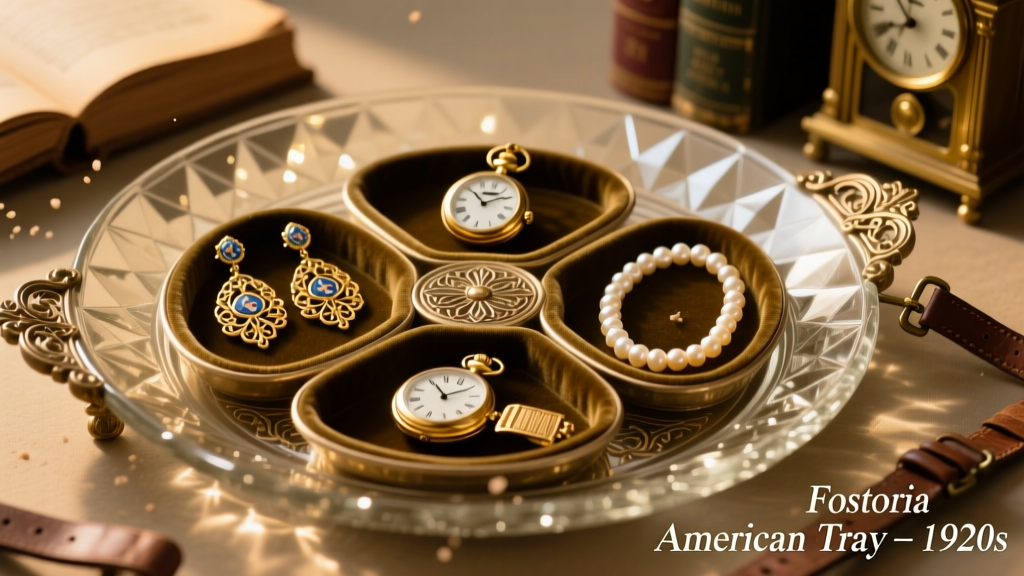
Fostoria American Tray: A Collector's Guide to the Iconic 4-Section 6½-Inch Glass Serving Tray
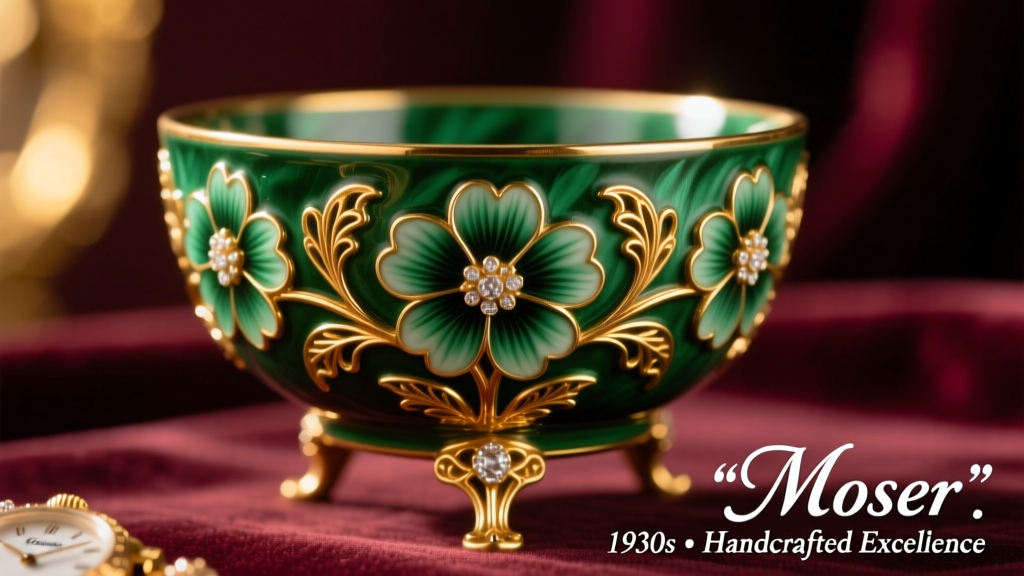
Moser Bowl: Green Gold Enamel Flower Overlay, Three-Footed, 5-Inch Diameter — A Masterpiece of Bohemian Artistry
Lot 1134595: A 1952 Patek Philippe Ref. 604, Caliber 12-400, 18K Yellow Gold Dress Watch — Provenance, Technical Analysis & Market Context
Porcelain Dish with Ship Motif and Gilt Trim: Carl Hans Tuppack, Tiefenfurth, Germany — An 8-Inch Masterpiece of Early 20th-Century Bavarian Craftsmanship
Wild Turkey Series 2 No. 1 Lore 1979: A Horological Anomaly and Collector’s Benchmark
Doll S.F.B.J. 236: A Detailed Appraisal of the 12-Inch Bisque-Head Baby Doll with Jointed Body, Two Upper Teeth, and Original Nursing Gown
Chenille Bedspread Spotlight: The Twin Peacocks Full-Size Design — Craftsmanship, Provenance, and Collectibility
Napoleon III Gilt-Bronze Five-Light Sconce Pair: Provenance, Craftsmanship, and Market Significance
Jean Patou 'Black' Perfume Bottles: The Iconic Black Glass Flacon with Red Stopper — Design, Provenance, and Auction Market Analysis