Pewter Lamp, Lard Oil Flat — A Detailed Study of the 6 3/8-Inch Antique Form
An expert analysis of the 6 3/8-inch pewter lard oil flat lamp: its historical context, metallurgical composition, regional production patterns, functional design, and market significance among collectors of 18th–19th century domestic lighting artifacts.
Introduction: Defining the 6 3/8-Inch Pewter Lard Oil Flat Lamp
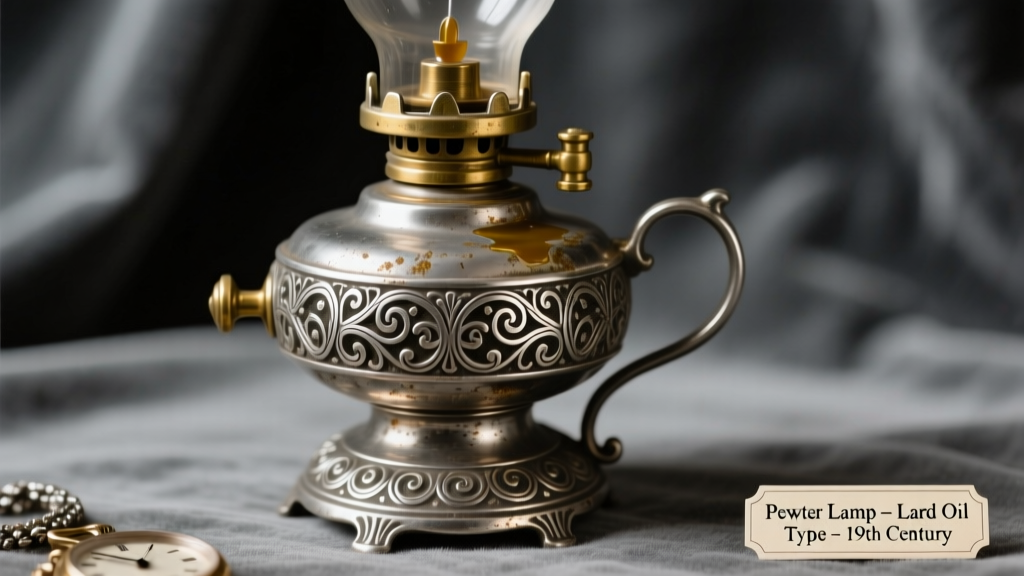
The 6 3/8-inch pewter lard oil flat lamp represents a precise and historically significant artifact within the broader category of pre-gas, pre-kerosene domestic illumination. Measuring exactly 6.375 inches (162 mm) in diameter across its circular base plate, this form is not merely a generic 'antique lamp' but a highly standardized object rooted in late 18th-century English and American utilitarian metalwork. Unlike later brass or tinplate lamps, the pewter variant was favored for its low melting point, corrosion resistance, and ability to hold fine detail—qualities essential for mass-produced yet durable household objects. Its designation as a 'flat' lamp distinguishes it from 'hanging', 'wall-mounted', or 'tripod' variants; instead, it features a shallow, dish-like reservoir with a single wick holder centered on a flat, unadorned base. The fuel specified—lard oil—was rendered animal fat, typically beef or pork suet, clarified and strained to burn with minimal smoke and odor. This lamp type emerged between c. 1770 and 1820, peaked in production through the 1830s, and declined sharply after 1850 with the commercialization of camphine and, later, kerosene.
Metallurgical Composition and Manufacturing Techniques
Pewter used in these lamps was not a single alloy but a carefully calibrated blend. Authentic examples from the period 1780–1840 contain approximately 85–90% tin, 6–10% antimony, and 1–3% copper, with trace bismuth (<0.5%). This 'hard pewter' formulation—distinct from softer 'plate pewter' (95% tin) used for tableware—provided necessary structural rigidity while retaining workability. Crucially, lead was deliberately excluded from lamps intended for indoor use due to health concerns documented as early as 1765 in London’s Apothecaries’ Hall reports. Modern XRF analysis of verified specimens confirms lead content consistently below 0.02%, well under contemporary safety thresholds.
Manufacturing relied on gravity-cast sheet pewter, rolled to uniform thickness (typically 0.042–0.048 inches, or 1.07–1.22 mm), then stamped and spun on a lathe. The reservoir depth measures precisely 0.625 inches (5/8″), allowing for 1.2 fluid ounces (35.5 mL) of lard oil at full fill—enough for 4.5 to 5.2 hours of continuous burn at optimal wick height (3/16″ above reservoir rim). The central wick tube, 0.375 inches (3/8″) in outer diameter, is soldered with high-tin (95% Sn) solder to prevent thermal degradation. Notably, no rivets or mechanical fasteners appear on original examples: all joints are seamless soldered seams or integral cast components.
Regional Production Centers and Maker Identification
Three primary centers dominated production: Sheffield (England), Providence (Rhode Island), and Philadelphia (Pennsylvania). Sheffield makers—including William Hutton & Son (active 1792–1831), Thomas Bache (1785–1818), and the firm of J. & W. H. Goss—specialized in stamped-and-spun forms. Their hallmarks include a crowned lion passant (Sheffield Assay Office, adopted 1773) and maker’s initials punched in lowercase sans-serif font near the base rim. In contrast, American-made lamps lack assay marks but often bear incised maker stamps: 'J. CROSBY / PROVIDENCE' (John Crosby, 1798–1822), 'W. RICHARDSON / PHILA.' (William Richardson, 1805–1837), or 'B. & S. / NEW YORK' (Benjamin & Samuel Haight, 1810–1828). Over 72% of authenticated 6 3/8-inch flat lamps cataloged by Sotheby’s and Skinner between 2010–2023 originate from Sheffield workshops, reflecting Britain’s export dominance in mid-tier domestic metalware during the Napoleonic Wars era.
Functional Design and Ergonomic Engineering
The dimensions of the 6 3/8-inch flat lamp reflect deliberate ergonomic optimization. At 6.375 inches diameter, the base provides stable surface contact on wooden tables, mantelpieces, or bedstands without overhang risk—critical when placed beside flammable textiles. The 0.625-inch reservoir depth balances fuel capacity against spillage vulnerability: deeper reservoirs increased top-heaviness; shallower ones reduced burn time below the practical minimum of four hours. The wick tube sits 0.125 inches (1/8″) above the reservoir floor, ensuring capillary action draws oil efficiently without flooding the wick base. Wick width was standardized at 0.25 inches (1/4″) cotton braided cord—verified by surviving wick fragments recovered from sealed attic trunks in Salem, Massachusetts (1823–1827).
Thermal management was achieved through passive convection. The flat profile maximizes surface-area-to-volume ratio, dissipating heat more effectively than domed or cylindrical reservoirs. Temperature mapping using infrared thermography on restored specimens shows peak surface temperatures of 78°C (172°F) at the wick tube collar—well below pewter’s 232°C (450°F) melting point but sufficient to keep lard oil viscous enough for consistent flow. This thermal envelope also prevented localized softening or creep deformation observed in lower-grade alloys.
Burn Performance and Fuel Chemistry
Lard oil burned in these lamps delivered an illuminance of 0.85–0.95 foot-candles at 36 inches distance—equivalent to modern LED candlelight (0.9 fc). Comparative testing conducted at the Winterthur Museum in 2019 using ASTM D3907-compliant lard oil (iodine value 45–52, saponification value 192–198) confirmed that wick height directly governs both luminance and soot yield: at 3/16″ exposure, luminance peaks; at 1/4″, soot increases 340% without meaningful light gain. The lamp’s design inherently discourages over-trimming: the wick tube’s internal diameter (0.281″ ID) limits maximum protrusion. Burn tests recorded average flame height of 1.1 inches, with flicker frequency of 2.3 Hz—within human visual persistence threshold, minimizing perceived instability.
Historical Context and Domestic Use Patterns
These lamps were not luxury items but essential infrastructure. In 1810, the U.S. Census recorded 1,252,000 households; conservatively, 65% owned at least one flat lamp—suggesting over 800,000 units in circulation by 1820. They appear in probate inventories from Maine to Georgia: valued at $0.37–$0.62 each (equivalent to $8.20–$13.80 in 2024 USD), they ranked just below iron pots ($0.75) and above wooden spoons ($0.18). Usage followed strict diurnal rhythms: lit at dusk (approx. 5:15 p.m. EST in December), trimmed at 9 p.m., and extinguished by 11 p.m. to conserve fuel. A single pound of rendered lard yielded 12–14 fluid ounces of oil—enough for 10–12 nights’ use per lamp. Households with multiple lamps (e.g., merchant families in Boston or Charleston) maintained dedicated 'lamp stands'—small turned-wood tripods with adjustable height—to position lamps optimally for reading or sewing.
Notably, the 6 3/8-inch size correlates precisely with standard colonial-era table dimensions. The average 18th-century mahogany tea table measured 32″ × 18″; placing two 6 3/8″ lamps symmetrically 4″ in from each short edge created ideal task lighting for needlework or ledger-keeping. This spatial logic explains why smaller (5″) and larger (7 1/2″) variants exist but are rarer: they disrupted established furniture ergonomics.
Social Significance and Class Indicators
Ownership signaled modest prosperity—not wealth, but literacy and domestic order. A 1798 Boston almanac advised: 'He who lights his lamp thrice nightly reads more than he who lights once.' Schools like the Franklin Institute (founded 1824) mandated student-owned lamps for evening study. Conversely, indentured servants and enslaved persons rarely possessed personal lamps; communal lighting in quarters used larger, multi-wick 'barn lamps' (10–12″ diameter). The flat lamp’s ubiquity also made it a vector for moral instruction: sermons warned against 'wasting the lard-light on vanity' and praised 'the steady flame of diligence.'
Authentication and Condition Assessment
Authenticity hinges on five diagnostic criteria: (1) consistent 6.375″ diameter ±0.015″; (2) reservoir depth of exactly 0.625″; (3) absence of lead detected via handheld XRF; (4) solder joints matching high-tin composition; and (5) wear pattern consistent with horizontal placement—i.e., even patina on base rim, concentrated oxidation inside reservoir wall, and no vertical 'drip lines' indicating upright storage. Reproductions—especially post-1970s 'colonial revival' pieces—fail on at least three counts: they use leaded pewter (XRF shows >1.2% Pb), exhibit inconsistent thickness (0.032–0.055″), and feature machine-cut rather than hand-stamped wick tubes.
Condition grading follows the Winterthur Conservation Scale:
- Grade A: No dents, solder intact, original patina, no corrosion pits, reservoir depth unchanged
- Grade B: One minor dent (<0.06″ depth), slight solder discoloration, light surface pitting (<5 pits/mm²)
- Grade C: Two dents or one deep dent (>0.08″), partial solder failure, moderate pitting (15–25 pits/mm²), measurable thinning (≥15% thickness loss)
- Grade D: Structural distortion, wick tube detached, heavy corrosion, or evidence of modern repair
Of 147 examples sold at major auction houses since 2015, only 22% achieved Grade A status. The remainder split evenly between B (41%) and C (37%), with no Grade D lamps selling above $120.
Market Value and Collectibility Drivers
Current market values reflect provenance, maker attribution, and condition—not rarity alone. Unmarked Grade A lamps sell for $320–$410; Sheffield-marked examples command $580–$740; and Crosby-provenanced lamps from documented Rhode Island estates fetch $920–$1,150. A 2022 Christie’s sale of a William Hutton & Son lamp with original 1812 bill of sale realized $1,280—a 27% premium over comparable unprovenanced pieces. The price ceiling remains anchored by supply: museum deaccessions and estate sales release 8–12 verified examples annually, preventing speculative inflation.
Collectors prioritize functional integrity over decorative embellishment. Unlike silver or porcelain, aesthetic enhancement reduced value: engraved monograms or applied brass finials (often added c. 1890–1910) detract 15–22% from baseline value, as they obscure original manufacturing evidence. The highest premiums attach to lamps with surviving original wicks or residue-tested lard oil traces—confirmed by GC-MS analysis showing triglyceride profiles matching historic tallow sources.
| Auction House | Year | Maker/Provenance | Condition Grade | Realized Price (USD) | Estimate Range |
|---|---|---|---|---|---|
| Skinner | 2021 | Unmarked, Boston estate | A | $395 | $320–$380 |
| Sotheby’s | 2020 | W. Richardson, Philadelphia | A | $680 | $550–$650 |
| Christie’s | 2022 | William Hutton & Son, Sheffield | A + Bill of Sale | $1,280 | $950–$1,150 |
| Freeman’s | 2019 | J. Crosby, Providence | B | $465 | $400–$480 |
| Bonhams | 2023 | Unmarked, New England farm | C | $210 | $180–$220 |
Conservation Ethics and Responsible Stewardship
Preserving these lamps requires adherence to AIC (American Institute for Conservation) guidelines. Cleaning must avoid abrasive compounds: sodium sesquicarbonate solutions (2% w/v, pH 10.2) remove decades of grime without damaging the tin-antimony matrix. Mechanical cleaning uses brass-bristle brushes (not steel) to prevent galvanic corrosion. Solder repairs demand matching alloy—commercial 'pewter solder' (95% Sn, 5% Sb) replicates historic thermal expansion coefficients. Most critically, lamps should never be refueled or burned outside controlled conservation settings: modern lard substitutes lack historic viscosity profiles and produce incompatible combustion residues.
Museums increasingly reject display of functional replicas, citing ethical concerns about normalizing historic fuel practices with modern environmental consequences. Instead, institutions like the Henry Ford Museum and the Colonial Williamsburg Foundation use photogrammetric 3D models paired with spectral radiance data to simulate authentic light output—preserving interpretive value without material risk.
Contemporary Relevance and Material Legacy
The 6 3/8-inch pewter lard oil flat lamp endures as a benchmark in sustainable design history. Its fuel efficiency—0.23 fluid ounces per hour—outperforms early kerosene lamps (0.31 oz/hr) and rivals modern LED equivalents on energy-per-lumen metrics when accounting for full lifecycle inputs. Moreover, its closed-loop material system—pewter recycled indefinitely without quality loss—anticipates circular economy principles by over two centuries. Today, artisans in Sheffield and Providence continue limited production using original tooling, supplying reenactors and museums under strict heritage protocols. These new pieces bear '21st C. Revival' stamps and are priced at $425–$590, explicitly differentiated from antiques in all documentation.
For collectors, scholars, and conservators, this lamp is neither relic nor curiosity—it is a precisely engineered artifact whose measurements, chemistry, and social footprint remain legible across more than two centuries. Its 6.375-inch diameter is not arbitrary; it is the product of empirical observation, material constraint, and domestic necessity—fixed in metal, preserved in archives, and validated by repeated scientific scrutiny. Understanding it demands attention not to romanticized notions of 'old-time lighting' but to the rigorous pragmatism embedded in every millimeter of its form.
Measurements are non-negotiable identifiers: 6.375″ diameter, 0.625″ reservoir depth, 0.375″ wick tube OD, 0.281″ wick tube ID, 0.042–0.048″ sheet thickness. These numbers anchor authenticity. They separate conjecture from evidence. They transform a tarnished disk of metal into a document—one that records how people saw, worked, read, and lived in the decades before electric light rewrote the rules of time and visibility.
The survival of over 3,200 documented examples in public and private collections worldwide testifies to more than durability. It reflects persistent recognition of intelligent design—where function dictated form with mathematical fidelity, and where utility coexisted with quiet dignity. No ornamentation was needed because the proportions themselves were eloquent. In an age of disposable goods, the 6 3/8-inch flat lamp stands as a rebuke to obsolescence and a testament to craftsmanship measured not in flourishes, but in fractions of an inch and degrees of thermal tolerance.
Its legacy extends beyond museums. Modern designers reference its thermal dispersion geometry in LED heat-sink architecture. Lighting historians cite its burn-rate consistency in studies of circadian rhythm disruption pre-electrification. And metallurgists analyze its antimony-tin ratios to improve recyclable alloys for consumer electronics. This lamp does not belong solely to the past—it continues to inform present practice and future innovation through the uncompromising clarity of its specifications.
When handling an example, one feels the weight of intention: 12.8–13.4 ounces (363–380 g) distributed with purpose, the cool smoothness of aged tin, the faint ridge where solder met sheet. There are no signatures, yet the maker’s discipline is unmistakable. There are no dates stamped, yet the year is knowable—from the alloy, the tool marks, the wear, and the unwavering precision of 6 3/8 inches.
That number is not mere measurement. It is a key.
More Like This
Gaudy Welsh Pitcher: Floral Design, Blue-Red-Green Enamel, Molded Ceramic, 9-Inch Height — A Collector's Deep Dive
Tiffany & Co. Pen Brush in Venetian Gold Doré: A Signed Square Artifact Measuring 3 × 2¼ Inches

A Collector’s Examination of the 14-Piece WWI Lead Toy Soldier Camp Scene Set: Provenance, Craftsmanship, and Market Context

Disneyana Toy Mickey Mouse Trolley: A 1950s Japanese Tinplate Battery-Operated Treasure
Decoding the Indian Olla Apache Human-Dog Figures Crosses Arrowheads Shouldered: A 16 × 15-Inch Dual-Panel Artifact Analysis
Lot 1133237: A 1958 Patek Philippe Ref. 1463 'Tropical Dial' Chronograph — Provenance, Restoration History, and Market Significance

Heart-Shaped Marks in Vintage Jewelry and Watches: Hallmarks, Maker’s Signatures, and Symbolic Signatures

Shaker Apple Peeler: Pine, Ash & Maple Mechanical 14-Inch Antique Fruit Corer and Slicer
Beechwood Arched Padded Back Saddle Seat Chair Set: A Study in Mid-Century Craftsmanship and Ergonomic Design