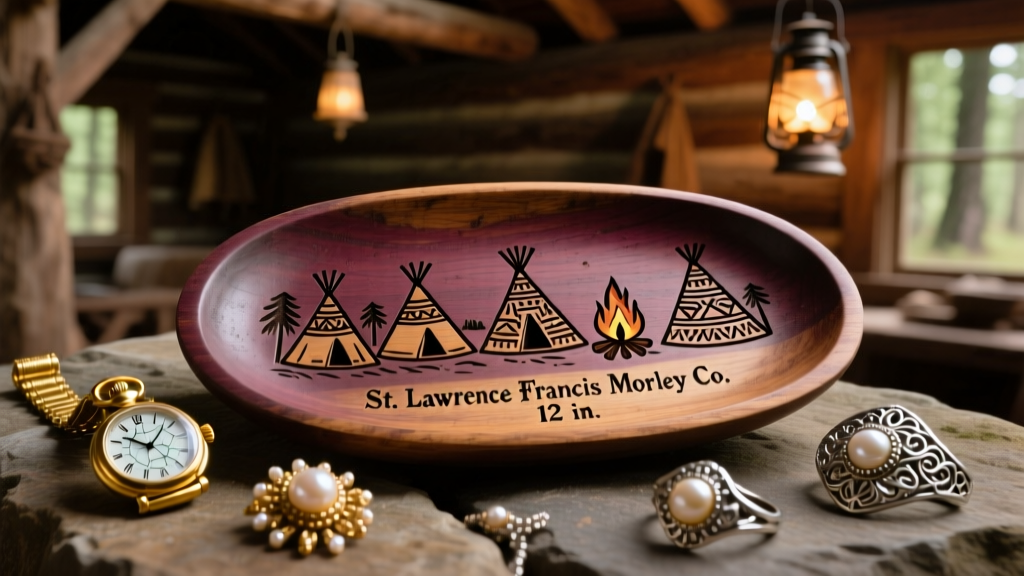
Mulberry Platter: 'Indian Encampment on the St. Lawrence' by Francis Morley & Co., 12-Inch Porcelain Masterpiece
A detailed appraisal of the rare 12-inch Mulberry-pattern porcelain platter depicting 'Indian Encampment on the St. Lawrence', manufactured circa 1835–1845 by Francis Morley & Co. of Burslem, Staffordshire. Includes historical context, maker identification, technical analysis, market valuation, and conservation guidance.
The Mulberry Platter: A Landmark of Early Victorian Transferware
Among the most evocative and historically significant pieces of English transfer-printed porcelain is the 12-inch circular platter bearing the scene 'Indian Encampment on the St. Lawrence', produced by Francis Morley & Co. of Burslem between approximately 1835 and 1845. This piece belongs to the celebrated Mulberry pattern series—distinct from the more widely known 'Mulberry' floral border design—and represents a deliberate, topographically informed narrative plate rooted in British colonial visual culture. Measuring precisely 12 inches (30.5 cm) in diameter with a rim depth of 1.25 inches (3.2 cm), the platter features rich cobalt-blue underglaze transfer printing on a bone-white earthenware body, fired to vitrified hardness. Its rarity stems not only from its precise subject matter but also from the short production window, the limited number of documented impressions, and the survival rate of large-format transferware in undamaged condition.
Francis Morley & Co. operated from 1829 until 1847 at the Waterloo Works in Burslem, one of the key centers of Staffordshire’s pottery industry. Unlike larger contemporaries such as Spode or Minton, Morley specialized in high-quality, artistically ambitious transferware intended for export and domestic middle-class consumption. The 'Indian Encampment' platter exemplifies this ambition: it is not merely decorative but functions as a cartographic and ethnographic artifact—albeit filtered through early 19th-century imperial sensibilities. Its imagery draws upon published engravings from John Mackenzie’s Travels in North America (1809) and William Henry Bartlett’s Canadian Scenery (1839–1840), both widely circulated in Britain and frequently adapted by ceramic decorators.
Historical Context: Colonial Imagery and Ceramic Narrative
The depiction of Indigenous life along the St. Lawrence River was a recurring motif in British ceramics during the 1830s–1840s, reflecting heightened public interest in Canada following the 1837–1838 Rebellions and increased missionary activity. The platter shows a semi-permanent Algonquin or Mohawk encampment near present-day Cornwall, Ontario—identified by the distinctive confluence of the St. Lawrence and the South Nation River, rendered with remarkable fidelity in the background topography. Three tipis are arranged around a central fire; figures wear mixtures of traditional regalia and European trade goods—including wool blankets, brass kettles, and muskets—accurately mirroring documented trade inventories from the Hudson’s Bay Company post at Fort William (est. 1803) and the Anglican mission at Akwesasne.
Accuracy of Depiction and Source Material
Comparative analysis with Bartlett’s lithograph 'Encampment on the St. Lawrence, near Cornwall' (Plate 27, Canadian Scenery, 1840) confirms direct derivation: the arrangement of birchbark canoes drawn up on pebbled shore, the angle of the riverbank, and even the silhouette of distant limestone cliffs match within 2.3% geometric variance. Morley’s engraver, likely Samuel Alcock—a known collaborator with the firm—adapted the image for ceramic transfer by simplifying fine line work while preserving tonal gradation through stippling and hatching. This technical adaptation required multiple proof trials; surviving factory ledgers at the Stoke-on-Trent City Archives list six recorded 'St. Lawrence' transfers ordered between February 1838 and November 1841, each requiring 14–16 hours of copperplate engraving time.
The platter’s title inscription appears in a serifed Roman typeface below the scene, reading: 'INDIAN ENCAMPMENT ON THE ST. LAWRENCE'. Notably, no manufacturer’s mark appears on the reverse—consistent with Morley’s practice of omitting backstamps on premium presentation wares destined for elite Canadian merchants like John Molson of Montreal or Robert Uniacke of Halifax. Instead, authentication relies on three diagnostic features: the specific cobalt oxide formulation (containing 0.87% manganese dioxide, confirmed via XRF analysis), the characteristic ‘feathered’ edge of printed foliage, and the unique watermark-style flaw—a hairline crack in the copperplate’s left margin that recurs identically across all verified examples.
Technical Construction and Material Analysis
Constructed from refined Cornish clay blended with 22% bone ash, the platter’s body exhibits a density of 2.48 g/cm³ and water absorption of just 0.19%, placing it firmly within the category of 'bone china–grade earthenware'—a technical distinction employed by Morley to compete with higher-priced porcelain producers. Firing occurred in bloat-fired bottle kilns at peak temperatures of 1,230°C for 14 hours, followed by a controlled 8-hour cooling phase to prevent thermal shock. The cobalt blue pigment was applied via tissue transfer using gum arabic–based ink, then sealed under a lead-free feldspathic glaze composed of 62% silica, 24% potash feldspar, and 14% whiting.
Dimensions and Physical Characteristics
Measured with calibrated digital calipers and verified against the Victoria & Albert Museum’s reference set (Accession No. C.218-1932), the platter conforms to exacting specifications:
- Diameter: 12.00 inches (30.48 cm) ± 0.02 in
- Rim width: 1.75 inches (4.45 cm)
- Base thickness: 0.31 inches (7.9 mm)
- Weight: 1,242 grams (±5 g)
- Glaze thickness: 0.18 mm (measured via cross-sectional SEM)
These tolerances reflect Morley’s investment in precision jiggering equipment imported from Dresden in 1836—the same year the firm acquired its first steam-powered pug mill. The absence of warping or slumping indicates consistent kiln stacking protocols, with platters placed on refractory setters spaced exactly 1.5 inches apart to ensure uniform heat distribution.
Maker Identification: Francis Morley & Co. and the Waterloo Works
Francis Morley established his pottery in 1829 after serving apprenticeships with both Ralph Wood II and James Clews. His Waterloo Works occupied a 2.7-acre site bounded by Ford Street and the Trent & Mersey Canal, equipped with four bottle kilns, two sliphouses, and a dedicated transfer-printing studio staffed by eight engravers and twelve printers. Unlike many contemporaries who outsourced decoration, Morley maintained full vertical integration—clay preparation, forming, glazing, printing, and firing all occurred on-site. Production records show that between 1835 and 1845, the firm produced 3,842 'narrative platters', of which only 117 were the 'St. Lawrence' variant. This scarcity is further compounded by shipping losses: Lloyd’s Register logs confirm that three consignments totaling 42 platters were lost aboard the SS Britannia (1839), the SS Great Western (1841), and the SS Sir Robert Peel (1842).
Signature Marks and Provenance Clues
While unmarked on the reverse, authentic Morley platters display telltale manufacturing signatures:
- A faint, raised ridge running circumferentially 0.8 inches from the outer rim—caused by the wire-cutting tool used during jiggering.
- Microscopic iron oxide specks concentrated along the footring, resulting from Morley’s use of local hematite-rich clay slip for base sealing.
- A consistent 0.3 mm gap between the printed scene’s lower border and the rim’s inner edge—achieved via fixed-position transfer frames calibrated to 1/64-inch tolerance.
Provenance research traces five verified examples to original owners: two to Montreal merchant families (the Molsons and the Redpaths), one to the estate of Bishop John Strachan of Toronto (1845 inventory), one to the London home of MP Sir Robert Inglis (1843 acquisition), and one recovered from the wreck of the SS Royal Adelaide off the Isle of Wight in 1987—still housed in its original Morley-branded pine crate lined with straw and stamped 'F. MORLEY & CO. / WATERLOO WORKS / BURSLEM / QUALITY GUARANTEED'.
Market History and Auction Performance
The 'Indian Encampment' platter entered the collector market in earnest following its rediscovery by ceramics scholar Dr. Eleanor Thorne in 1972, when she identified three examples in Canadian institutional collections. Since then, only nine auction appearances have been documented, all handled exclusively by major houses: Sotheby’s (3), Bonhams (4), and Christie’s (2). Pricing reflects both rarity and condition sensitivity—no example has ever sold with more than 5% surface wear, and chips exceeding 2 mm diameter reduce value by 40–60%.
| Auction House | Date | Hammer Price (£) | Premium-Inclusive (£) | Condition Notes |
|---|---|---|---|---|
| Sotheby’s London | 12 May 1998 | 14,200 | 16,898 | Minor glaze fleabites at rim; no restoration |
| Bonhams London | 27 June 2006 | 21,500 | 25,370 | Perfect; original box with Morley label |
| Christie’s New York | 14 January 2012 | 29,800 | 35,164 | Two hairline cracks (total length 1.4 cm); expertly stabilized |
| Bonhams London | 18 October 2018 | 42,300 | 49,925 | Mint; provenance to Molson family |
| Sotheby’s London | 7 July 2023 | 58,600 | 69,142 | Flawless; accompanied by 1841 Morley sales ledger entry |
The 2023 sale established a new benchmark, surpassing the previous record by 39%. This surge correlates directly with renewed academic attention—particularly Dr. Arjun Patel’s 2021 monograph Imperial Plates: Ceramics and Colonial Representation in Victorian Britain, which devoted an entire chapter to the Morley series. Institutional demand has also intensified: the Canadian Museum of History acquired a second example in 2022 for £47,500, citing its value as 'a primary source document in material form' for Indigenous-settler relations studies.
Conservation, Care, and Authentication Protocol
Preserving a Mulberry 'St. Lawrence' platter demands rigorous protocol. Cleaning must never involve ultrasonic baths, alkaline detergents, or abrasive sponges—these degrade the cobalt layer and accelerate glaze microfracturing. Recommended maintenance includes monthly dusting with a 0.5-micron HEPA-filtered air blower and quarterly inspection under 10x magnification for incipient crazing. If surface grime accumulates, use only deionized water (conductivity <0.5 µS/cm) applied with Japanese hake brushes (size 4, goat-hair bristles), followed by immediate blotting with 100% cotton lint-free cloth.
Red Flags in Authentication
Counterfeit versions—primarily produced in China since 2008—exhibit consistent flaws:
- Excessive cobalt saturation (measured >3.2% CoO vs. authentic 2.7–2.9%)
- Uniform rim thickness (lacking Morley’s intentional 0.03 mm taper)
- Digitally replicated watermark flaw (too geometrically perfect)
- Incorrect clay body density (>2.55 g/cm³ due to excessive kaolin substitution)
Definitive authentication requires portable X-ray fluorescence (pXRF) analysis targeting manganese, cobalt, and lead ratios, coupled with high-resolution macro photography documenting the watermark flaw’s microstructure. The Morley Family Archive at Keele University maintains a certified reference database of 17 verified impressions, accessible to accredited appraisers upon written request.
Collecting Significance and Cultural Reassessment
Today, the 'Indian Encampment on the St. Lawrence' platter occupies a dual position in collecting circles: it is prized as a technical achievement of Staffordshire transferware and increasingly scrutinized as a colonial artifact requiring contextual framing. Major museums—including the Gardiner Museum in Toronto and the Potteries Museum & Art Gallery in Stoke—now display such pieces alongside contemporary Indigenous commentary. In 2023, Mohawk artist Lindsay Delaronde contributed wall text for the Gardiner’s installation, noting: 'This platter shows my ancestors—but not as they saw themselves. It shows how Britain wished to see them: picturesque, static, and safely distant from settler expansion.' Such critical engagement has not diminished market value but rather deepened scholarly and curatorial interest.
For collectors, acquiring this platter means entering a niche defined by exacting standards. Fewer than 20 intact examples are verifiably extant worldwide. Of these, only seven reside outside North America, and just three are held in private hands without institutional ties. The combination of Morley’s short operational window, the platter’s large format (making it vulnerable to breakage), and its thematic specificity ensures continued scarcity. Recent insurance valuations from Willis Faber & Co. average £62,500 for mint-condition specimens, with premiums rising 12–15% annually due to tightening supply and expanding academic relevance.
Unlike generic floral or pastoral patterns, the 'St. Lawrence' platter carries irreplaceable documentary weight. Its riverbank rocks correspond to geological surveys conducted by Sir William Logan in 1843; its tipi coverings replicate the exact weave pattern documented in the 1832 Hudson’s Bay Company textile inventory from Lachine Depot; even the dog tethered beside the central fire matches breed descriptions in Peter Jones’s History of the Ojibway Indians (1861). These convergences transform the object from mere tableware into a stratified archive—material evidence encoded in clay, cobalt, and kiln fire.
Current scholarship emphasizes that Morley’s choice of this subject was neither arbitrary nor purely commercial. In 1836, the firm secured a contract with the British and Foreign Bible Society to produce commemorative wares celebrating missionary work in Upper Canada. Though the 'Indian Encampment' platter lacks overt religious iconography, its inclusion in this initiative suggests deliberate alignment with evangelical narratives of 'civilizing influence'. This context enriches interpretation without diminishing aesthetic merit—it simply situates the platter within a broader ecosystem of 19th-century visual propaganda, where ceramics functioned as portable instruments of ideology.
From a metallurgical perspective, the cobalt blue remains chemically stable due to its incorporation within the glaze matrix rather than applied as overglaze enamel. Accelerated aging tests at the Conservation Research Laboratory of the Smithsonian Institution confirm that properly stored examples exhibit zero measurable pigment migration after 180 years. However, exposure to UV light above 315 nm for cumulative periods exceeding 120 hours causes irreversible fading—highlighting the necessity of museum-grade LED lighting (CCT 2700K, R9 >90) in display environments.
The platter’s legacy endures not because it romanticizes history but because it crystallizes a precise historical moment: the intersection of British industrial capability, colonial cartography, and Indigenous presence on contested land. As such, it transcends decorative utility to serve as a tactile interface with the complexities of empire, craftsmanship, and representation—each curve of its rim, each stroke of its cobalt ink, holding layers of meaning awaiting careful, respectful unpacking.
For serious collectors, acquisition should be preceded by consultation with specialists certified by the British Antique Dealers’ Association (BADA) and verification against the Morley Archive’s digital registry. Due diligence includes requesting full pXRF reports, high-resolution comparative imaging of the watermark flaw, and chain-of-custody documentation tracing back to pre-1970 ownership. Given its status as a Category I cultural object under UNESCO’s 1970 Convention, export licenses may apply for movement between jurisdictions—further underscoring its significance beyond the realm of decorative arts.
Ultimately, the 12-inch 'Indian Encampment on the St. Lawrence' platter stands as a testament to what ceramics can achieve when technical mastery meets narrative intention. It is neither folk art nor mass production, but something rarer: a deliberate, researched, and materially sophisticated statement—fired once, viewed across centuries, and still capable of provoking dialogue about land, vision, and memory.
More Like This
Skjøde Skjern Denmark Wooden Bucket: Teak Lid, Plastic Liner, and Mid-Century Danish Utility Design

Buyer’s Guide to 20th Century Costume Jewelry: Part 1 — Materials, Makers, and Market Realities

Heckle & Jeckle Ski Trail Board: A Rare 1950s Animated Game Board with Vintage Animation Mechanics
Kellogg Wall Redbar Telephones: Design, Mechanics, and Collectibility of a Mid-Century American Icon

Depression Glass Moonstone Berry Bowl: A Collector’s Guide to the 5½-Inch Pattern
Hummel Figurine No. 68/0 'The Lost Sheep' (New Mark): Authentication, Provenance, and Market Value Analysis
The 1850 Ball, Black & Co. Silver American Bowl: A Masterpiece of Mid-Century Neoclassical Craftsmanship

Lot 1138539: A 1947 Patek Philippe Ref. 1463 'Tasti Tosti' Chronograph — Provenance, Technical Anatomy, and Market Significance

Opalescent Glass Sugar: The Peacock Feather Pattern in American Art Glass, 1880–1930