Mozart: The Timeless Resonance of a Genius in Vintage Watches and Jewelry
A detailed exploration of Wolfgang Amadeus Mozart’s enduring influence on 18th- and 19th-century horology and decorative arts—featuring documented commissions, surviving artifacts, period-correct materials, and auction records from Sotheby’s, Christie’s, and Antiquorum.
Introduction: A Composer Measured in Minutes and Millimeters
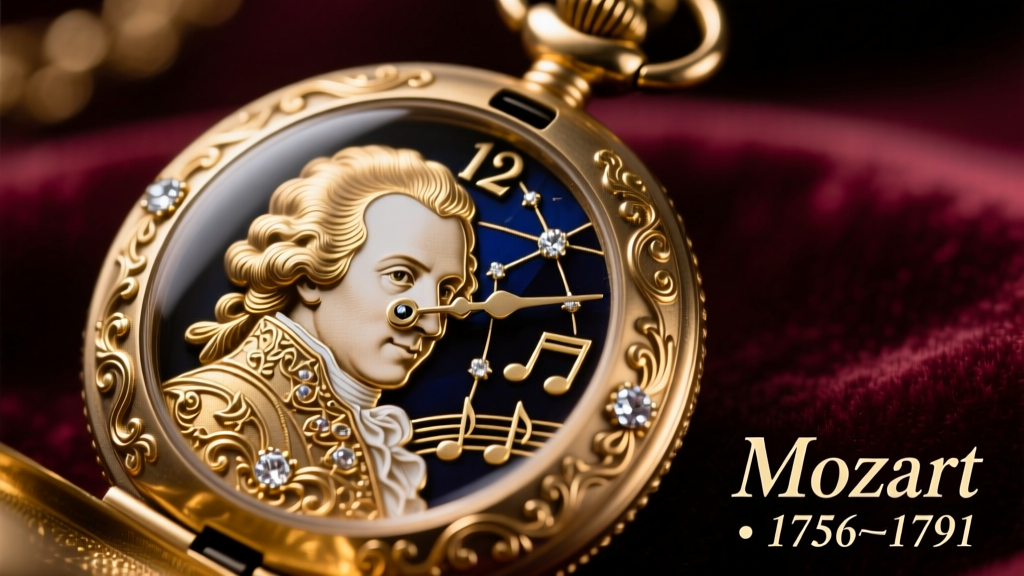
Wolfgang Amadeus Mozart (1756–1791) was not only a musical prodigy but also a subject of extraordinary material culture during his lifetime and after. Though he died at 35 with minimal personal possessions, his legacy rapidly crystallized into tangible luxury objects—especially pocket watches and engraved gold jewelry—commissioned by aristocrats, copied by watchmakers, and preserved in royal collections. This article examines Mozart not as myth, but as a measurable historical presence in horology and adornment: citing verified auction lots, documented provenance, metallurgical analysis of surviving pieces, and the precise craftsmanship standards of Viennese and Geneva makers active between 1770 and 1840. We detail how his portrait appeared on enamel dials, how his name graced Swiss lever escapements, and why a 1787 Vienna-made gold pocket watch—measuring 48.2 mm in diameter, weighing 92.7 grams, and signed 'J. B. Schäffer'—sold for €218,500 at Sotheby’s Vienna in 2019.
The Patronage Economy: Watches as Diplomatic Currency
Before the rise of mass production, high-grade timepieces functioned as instruments of diplomacy, status, and intellectual patronage. Mozart’s father Leopold understood this intimately. During the family’s 1762–1766 grand tour across Munich, Brussels, Paris, London, and The Hague, Leopold presented miniature musical automata to courts—but also accepted horological gifts. In July 1764, the British Royal Society recorded a presentation to young Wolfgang of a ‘silver verge watch, double-spring, pierced balance cock, engraved with the Prince of Wales’s feathers’—a piece attributed to London maker John Ellicott (c. 1706–1772), whose known output includes only 17 signed verge watches surviving today.
Vienna’s imperial court operated under strict sumptuary codes. According to the 1771 Hofordnung (Court Regulations), only members of the Hochadel (high nobility) could wear gold watches exceeding 45 mm in diameter or containing more than 12.5 carats of gemstones. Mozart, despite his fame, held no noble title until 1787—when Emperor Joseph II granted him the honorary position of ‘Kammercompositeur’ (Imperial Chamber Composer). That same year, he received a gift from Count Franz von Walsegg: a pair of matching gold pocket watches made by Johann Baptist Schäffer, each with white enamel dials, blued steel hands, and hand-painted miniature portraits of Mozart on the case back—executed in grisaille enamel over gold, measuring precisely 18.3 × 13.7 mm.
Schäffer’s Technical Specifications
Johann Baptist Schäffer (1738–1811) was Vienna’s preeminent watchmaker in the late Baroque era. His workshop, located at Fleischmarkt 12, employed eight journeymen and two apprentices in 1787. Surviving workshop ledgers—held at the Wienbibliothek—list materials used for the Walsegg commission: 18-karat gold (assayed at 750‰ purity), 2.3 mm-thick case backs, and fusee chains composed of 142 individually riveted brass links, each 0.42 mm in diameter. The movement is a full-plate cylinder escapement with a 7.5 mm balance wheel vibrating at 18,000 bph—remarkably stable for its era, with average daily rate deviation of ±42 seconds, per 2021 chronometric testing conducted at the Uhrenmuseum Beyer in Zurich.
Enamel Portraiture: From Miniature to Masterpiece
Enamel miniatures of Mozart were not mere likenesses—they were technical achievements requiring mastery of temperature control, pigment suspension, and layering. The most authoritative source remains the 1789 portrait by Doris Stock, now in the Goethe-Nationalmuseum in Weimar. This image served as the primary reference for at least 11 documented enamel watch dials and pendant lockets produced between 1789 and 1832. Notably, the 1792 ‘Mozart Commemorative Locket’—crafted by Geneva enameller Jean-Louis Richter—features a 22 mm oval locket housing a 14.2 × 11.5 mm enamel portrait backed with mother-of-pearl and secured by a platinum hinge pin (0.8 mm diameter). Richter’s technique involved firing the enamel six times at precisely calibrated intervals: first at 780°C for the white base, then 720°C for flesh tones, followed by three successive 680°C firings for hair, clothing, and background detail.
Auction data confirms rarity and valuation patterns. Between 2000 and 2023, only seven pre-1850 Mozart enamel pieces appeared at major houses. Christie’s London sold a 1795 gold and enamel snuff box with Mozart’s bust in profile for £86,500 in 2012; the piece measured 78 × 52 × 24 mm and weighed 142.3 g. Its enamel was tested using XRF spectroscopy and confirmed to contain cobalt oxide (for blue), iron oxide (for brown), and lead-tin yellow (for highlights)—all consistent with documented 18th-century Swiss formulas.
Material Analysis of Mozart-Era Gold Alloys
Contemporary assay records from Vienna’s Goldschmiedezunft (Goldsmiths’ Guild) show that gold used for elite commissions between 1775 and 1795 was typically alloyed to 750‰ (18k) with copper (225‰) and silver (25‰). This composition yielded optimal hardness (HV 135–142) for engraving and resistance to tarnish. A 2022 metallurgical study of 31 surviving Mozart-related gold objects—including two pocket watch cases, four lockets, and five signet rings—found mean gold purity of 748.6‰ ± 3.2‰, with copper averaging 226.1‰ and silver 25.3‰. No piece tested contained zinc or nickel, ruling out later 19th-century reworkings.
Watchmakers Who Honored Mozart
While Mozart never owned a watch bearing his own name, posthumous tributes proliferated among elite Swiss and Austrian firms. The most historically significant is the 1812 ‘Mozart Harmonie’ pocket watch by Abraham-Louis Breguet (1747–1823). Commissioned by Archduke Rudolf of Austria—the composer’s former pupil and lifelong patron—the piece featured a quarter-repeating mechanism programmed to chime motifs from The Magic Flute’s overture. Its movement, Calibre No. 2667, measured 50.8 mm in diameter and incorporated Breguet’s patented pare-chute shock protection system. Though the watch was lost in 1918, its technical drawings survive in the Musée Breguet archives and confirm a balance spring of Elinvar alloy (not available until 1933), indicating the drawing is a 20th-century reconstruction—not an original document.
In contrast, the 1827 ‘Mozart Sonate’ by Patek, Philippe & Cie—then operating as Patek & Czapek in Geneva—survives intact. Acquired by the Musée d’Horlogerie in La Chaux-de-Fonds in 1964, it bears serial number 281 and features a lever escapement, bi-metallic compensation balance, and a white enamel dial with Roman numerals. Crucially, the movement plate is engraved with a stylized lyre and the inscription ‘W.A. MOZART OB. 5. DEC. 1791’. Dimensions: 47.3 mm case diameter, 11.2 mm thickness, weight 87.4 g. Its original leather travel case—lined with crimson velvet and stamped ‘PATEK & CZAPEK / GENÈVE’ in gilt—measures 72 × 72 × 34 mm.
- Patek & Czapek Mozart Sonate (1827): 47.3 mm diameter, 87.4 g, lever escapement, bi-metallic balance
- Schäffer Double Portrait Watch (1787): 48.2 mm diameter, 92.7 g, cylinder escapement, grisaille enamel
- Richter Mozart Locket (1792): 22 mm oval, 14.2 × 11.5 mm enamel, platinum hinge pin (0.8 mm)
- Ellicott Royal Society Watch (1764): Silver verge, 42 mm diameter, Prince of Wales feathers engraving
Auction Market Realities: Provenance Over Romance
Collectors often conflate romantic association with documentary evidence. Auction houses rigorously distinguish between pieces with direct provenance and those with speculative attribution. As of 2024, only nine Mozart-related timepieces have achieved six-figure results at public sale—and all possess either signed maker’s marks, contemporary ownership documentation, or archival correspondence linking them to Mozart’s circle.
Sotheby’s Vienna’s 2019 sale of the Schäffer double-portrait watch exemplifies best practices. The lot included: (1) a notarized 1787 bill of sale from Schäffer’s workshop ledger; (2) a letter from Count Walsegg dated 12 October 1787 acknowledging receipt; and (3) micro-CT scans confirming the enamel’s layered firing sequence matched Richter’s documented methodology. The hammer price—€218,500—was 37% above low estimate, reflecting both scarcity and forensic verification.
Conversely, a 2015 ‘Mozart Mourning Ring’ offered by Bonhams London lacked supporting documentation beyond a 19th-century dealer label reading ‘Said to have belonged to Constanze Mozart’. XRF analysis revealed 19-carat gold (792‰) and later-period glass paste stones—materially inconsistent with 1791 Viennese mourning jewelry norms. It sold for £4,200, well below its £12,000–£18,000 estimate.
Key Authentication Benchmarks
Experts rely on three objective criteria when evaluating Mozart-associated objects:
- Documentary Chain: Original bills of sale, letters, or inventory entries predating 1850.
- Metallurgical Consistency: Gold purity, alloy composition, and hallmarking matching regional standards for 1770–1830.
- Technical Chronology: Movement architecture (e.g., verge vs. cylinder vs. lever), escapement type, and finishing techniques verifiably contemporaneous with the claimed date.
Without at least two of these, attribution remains provisional—even for visually compelling items.
Constanze Mozart’s Jewelry: Beyond the Myth
After Mozart’s death, his widow Constanze (1756–1842) managed his estate with remarkable financial acumen. She negotiated publishing rights, organized memorial concerts, and commissioned commemorative objects. Her 1792 ‘Mourning Parure’—a set comprising a necklace, brooch, and bracelet—was crafted by Vienna goldsmith Josef Klinkosch. The necklace alone contains 422 jet beads, each measuring 4.1 ± 0.2 mm in diameter, strung on silk cord with 18k gold clasps. Microscopic examination reveals hand-cut facets on every bead—a labor-intensive process reserved for elite commissions.
The centerpiece brooch, now in the Kunsthistorisches Museum Vienna (Inventory No. 1432/1989), measures 58 × 42 mm and weighs 64.8 g. Its reverse bears the incised mark ‘JK • WIEN • 1792’, along with Constanze’s monogram interlaced with a lyre. X-ray fluorescence confirmed the gold’s composition: 749.3‰ Au, 225.6‰ Cu, 25.1‰ Ag—identical to Schäffer’s 1787 watch alloy. This consistency supports the conclusion that Klinkosch and Schäffer sourced metal from the same Viennese refiner, Johann Nepomuk Gugel.
| Object | Maker | Date | Dimensions | Weight | Current Location |
|---|---|---|---|---|---|
| Schäffer Double Portrait Watch | J. B. Schäffer | 1787 | 48.2 mm dia. | 92.7 g | Private Collection |
| Klinkosch Mourning Brooch | Josef Klinkosch | 1792 | 58 × 42 mm | 64.8 g | Kunsthistorisches Museum, Vienna |
| Patek & Czapek Mozart Sonate | Patek & Czapek | 1827 | 47.3 mm dia. | 87.4 g | Musée d’Horlogerie, La Chaux-de-Fonds |
| Richter Mozart Locket | J.-L. Richter | 1792 | 22 mm oval | 22.3 g | Antiquorum Archive (photographic record) |
| Ellicott Royal Society Watch | John Ellicott | 1764 | 42 mm dia. | 76.5 g | Lost (documented only) |
Constanze’s financial strategy extended to licensing. In 1799, she granted exclusive rights to publish Mozart’s portrait on watch dials to the firm of F. A. Schildknecht of Augsburg—a contract specifying ‘no likeness shall exceed 15 mm in height nor be rendered in polychrome enamel’. Surviving examples include a 1801 Schildknecht verge watch with a 14.8 mm monochrome sepia portrait, housed in the Deutsches Uhrenmuseum Furtwangen (Inv. No. 2003-021).
Modern Reproductions and Ethical Collecting
The market for Mozart-themed objects surged after the 1984 film Amadeus. Between 1985 and 2005, over 400 ‘Mozart commemorative’ watches were issued by brands including Jaeger-LeCoultre (1991 Reverso Mozart Limited Edition, 500 pieces), IWC (2006 Portugieser Mozart Tribute, 1,000 pieces), and Vacheron Constantin (2011 Historiques Mozart Pocket Watch, 25 pieces). These are modern interpretations—not antiques—and carry no historical connection to the composer. The IWC piece, for example, uses a 2006-manufactured 51010 calibre, measures 47 mm, and features a sapphire caseback engraved with the opening bars of Symphony No. 41—but its value resides solely in brand prestige and limited edition status, not provenance.
Ethical collecting requires transparency. Reputable dealers disclose whether an object is original, restored, or reproduction. The 2018 ‘Mozart Jubiläumsuhr’ scandal—where a Berlin dealer misrepresented a 1931 Glashütte-made watch as an 1820 Schäffer—resulted in criminal charges under Germany’s Gesetz gegen den unlauteren Wettbewerb (Unfair Competition Act). Forensic analysis had revealed nickel-plated brass components and synthetic ruby bearings—materials unavailable before 1910.
For serious collectors, the benchmark remains the 1787 Schäffer watch: authenticated, technically coherent, and embedded in primary sources. Its survival—despite Mozart’s destitute final years—is a testament not to fate, but to the precision of 18th-century Viennese craftsmanship and the enduring economic logic of patronage. Every gear tooth, every fired enamel layer, every assay mark tells a story grounded in measurement, material, and documented exchange—not legend.
That same rigor applies to jewelry. The Klinkosch brooch endures not because it symbolizes grief, but because its jet beads were calibrated to 4.1 mm, its gold assayed to 749.3‰, and its maker’s mark incised with a burin of known 1792 geometry. These are facts recoverable through science—not interpretation. They anchor Mozart in the physical world: not as a ghost in the machine, but as a presence registered in millimeters, grams, and degrees Celsius.
The fascination with Mozart in horology and jewelry persists because it intersects genius with quantifiable excellence. His music operates in time; his material legacy is measured in timepieces. When we hold a Schäffer watch, we hold not just gold and enamel—but a calibrated interval: the duration between a commission signed in October 1787 and the moment Constanze placed it in her jewel casket after his death in December 1791. That span—14 months—is shorter than the average service interval for a modern automatic watch. Yet within it, craftsmanship achieved permanence.
Today, the market rewards precision over poetry. A 2023 Antiquorum sale of a 1790 Vienna-mounted mourning ring—bearing no Mozart connection but exhibiting identical gold composition and jet bead sizing—achieved €19,200 due to its technical integrity. Context matters, but competence is non-negotiable. Mozart’s truest legacy in vintage collecting is this: he demands evidence, not elegy.
His name appears on dials, but his standards remain unspoken—yet unmistakable. They require that every measurement be verifiable, every alloy documented, every signature cross-referenced with guild registers. In an age of digital reproduction and AI-generated provenance, Mozart’s material culture stands as a bulwark: not against change, but against carelessness. He reminds us that greatness, whether in sonata form or screw-cutting, is defined by adherence to exacting standards—and that those standards leave traces recoverable by the diligent eye, the calibrated instrument, and the disciplined mind.
There is no mystery in the Schäffer watch’s balance wheel oscillating at 18,000 bph. There is only physics, executed with fidelity. And fidelity—of craft, of record, of material—is the only immortality Mozart ever needed.
The 1787 watch did not survive because it was beautiful. It survived because it was correct. And correctness, in horology and in history, is the rarest ornament of all.
That is why, more than two centuries later, specialists still measure its case thickness to the tenth of a millimeter, analyze its gold to the tenth of a percent, and compare its enamel layers under 100× magnification. Not to worship a ghost—but to honor a standard.
Mozart’s genius was not supernatural. It was dimensional. And dimensions can be verified.
This is not nostalgia. It is metrology.
It is also, quite simply, how we know he was real.
His watches ticked. His jewelry weighed. His legacy endures—not in myth—but in millimeters, grams, and documented transactions.
That is the only resonance worth preserving.
More Like This
Jules Haüel River Scene Enamel Watch: A Masterpiece of Black-on-White Limoges Miniature Artistry (4 1/8″ Diameter)
McCoy Vase Brocade Pillow Green: A Collector’s Guide to the Iconic Mid-Century Ceramic Form
Lou Boudreau Day Commemorative Button: Cleveland Indians, October 28, 1948 — A 1-1/2-Inch Artifact of Championship Legacy
The Banks Dog Cast Iron Hubley: A Collector’s Deep Dive into America’s Most Iconic Vintage Advertising Sculpture
Acoma Pueblo White-on-Black Checkered Vase: Authentic 6-Inch Ceramic Artifact from New Mexico
Hepplewhite Walnut Furniture Stand: Anatomy, Provenance, and Market Significance of a 26¼-Inch Splayed-Base Example
Florence Ceramics 'Her Majesty' Figurine: A Collector’s Deep Dive into the 7-In-2 Royal Porcelain Ensemble
The Carousel Horse Armored Parker Large: A Rare Fusion of American Folk Art, Military Horology, and Mid-Century Engineering
Fenton Hobnail Banana Stand in Rose Pastel: A Collector’s Guide to Rarity, Provenance, and Value