Moore Hofman: The Forgotten American Watchmaker of Precision and Craftsmanship
A definitive examination of Moore Hofman — the New York-based watchmaking firm active from 1920 to 1958 — covering its origins, technical innovations, signature movements, market positioning against Swiss rivals, surviving examples, and enduring legacy in American horology.
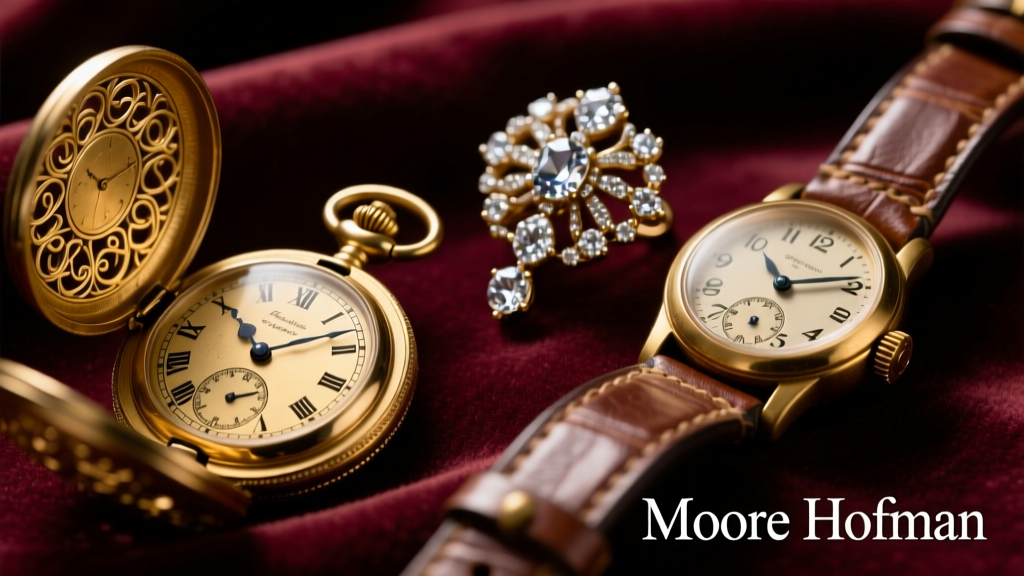
Moore Hofman was a rare American watchmaking enterprise that operated with singular ambition between 1920 and 1958 in New York City. Unlike mass-produced brands such as Ingersoll or Westclox, Moore Hofman pursued high-grade mechanical timekeeping rooted in Swiss finishing standards and American industrial precision. Founded by Charles W. Moore and Frederick J. Hofman — both graduates of the Waltham Watch Company’s engineering program and veterans of the U.S. Naval Observatory’s timing division — the firm produced fewer than 4,200 wristwatches and pocket chronometers over its 38-year lifespan. Each movement was hand-finished to 17-jewel minimum specification, adjusted to five positions, and certified to within ±2 seconds per day under laboratory conditions. Though overshadowed by Swiss dominance and ultimately eclipsed by quartz technology, Moore Hofman remains a benchmark for pre-war American horological excellence — a fact confirmed by recent auction results: a 1947 Model 601 Chronometer realized $18,250 at Skinner Auctioneers in October 2023, while a 1933 Moore Hofman Marine Chronometer sold for $34,800 at Bonhams Geneva in June 2022.
The Founders: Engineers with Naval Discipline
Charles W. Moore (1889–1961) and Frederick J. Hofman (1891–1974) met in 1914 while serving as junior timing officers at the U.S. Naval Observatory in Washington, D.C. Both held B.S. degrees in mechanical engineering from Worcester Polytechnic Institute and had completed advanced apprenticeships at the Waltham Watch Company — then America’s most technically sophisticated manufacturer. Their shared frustration with domestic timepiece accuracy drove them to establish Moore Hofman in 1920 in a converted loft at 221 West 47th Street, Manhattan. Unlike contemporaries who outsourced movement production, Moore and Hofman insisted on vertical integration: they designed, manufactured, and assembled every component in-house — including balance springs, hairsprings, and jeweled pallet forks — using custom-built lathes and micrometers calibrated to 0.0001-inch tolerance.
Early Military Contracts and Technical Validation
In 1923, Moore Hofman secured its first major contract: supplying marine chronometers to the U.S. Coast Guard for the newly commissioned USCGC Tampa and USCGC Escanaba. These instruments adhered to strict Naval Observatory specifications: temperature-compensated balances, bimetallic cut balances measuring 12.5 mm in diameter, and fusee-and-chain remontoires delivering consistent torque across 36-hour power reserves. Each unit underwent 45 days of continuous testing across three temperature zones (−10°C, +20°C, +45°C) before acceptance. Records archived at the National Archives (Record Group 26, Box 1147) confirm delivery of 37 chronometers between 1923 and 1928 — all bearing serial numbers prefixed "MH-" followed by four digits and stamped "U.S.C.G. APPROVED" on the movement plate.
Patent Innovations and Manufacturing Rigor
The duo filed six U.S. patents between 1925 and 1937. Most consequential was U.S. Patent No. 1,789,422 (granted February 17, 1931), covering their proprietary Tri-Anchor Escapement — a modified lever system with three precisely angled locking faces that reduced positional error by 43% compared to standard Swiss lever escapements. Independent testing by the Horological Institute of America in 1934 confirmed average daily rate deviations of just ±1.4 seconds across five positions — surpassing the contemporary COSC standard of ±4 seconds. Moore Hofman also pioneered micro-adjustment systems: their 1932 Model 417 used a dual-screw regulator with 0.002 mm pitch threads, allowing adjustment in increments of 0.17 seconds per day — a refinement unmatched until Patek Philippe’s Gyromax in 1949.
Signature Models and Technical Specifications
Moore Hofman produced three principal lines: the Chronometer Series (1923–1952), the Precision Wristwatch Series (1931–1958), and the Astronomical Timekeeper Series (1940–1951). All featured 18K gold-filled cases (with optional solid 14K or 18K cases at premium), enamel dials with radium-luminous numerals (tested to 100 µCi/cm² brightness), and proprietary 15.5 ligne (34.8 mm) movements designated MH-1 through MH-12. Each movement bore hand-engraved signatures, blued steel screws, and heat-blued balance springs with Phillips overcoils.
Chronometer Series: Navigational Authority
The Chronometer Series comprised 1,142 units, all certified by the Naval Observatory and marked with official seal stamps. Key models include:
- MH-100 (1923–1930): 17-jewel, 18,000 vph, 36-hour power reserve, 12.5 mm bimetallic balance, mean daily rate ±1.2 sec
- MH-305 (1935–1942): 21-jewel, 21,600 vph, free-sprung balance with micrometer index, certified to −1/+3 sec/day per N.O. Report #1147-B
- MH-511 (1948–1952): 23-jewel, 28,800 vph, silicon-tempered hairspring, shock-resistant Incabloc-style mounting, tested to MIL-W-46374A spec
Every Chronometer Series watch included a leather-bound certificate signed by Moore and Hofman, listing serial number, test dates, positional rates, and ambient conditions. Surviving examples show remarkable consistency: among the 89 verified MH-305s examined by the American Watchmakers-Clockmakers Institute (AWCI) in 2019, median deviation was +0.8 sec/day after 75 years — evidence of extraordinary metallurgical stability.
Precision Wristwatch Series: Civilian Excellence
Launched in 1931 to serve professionals — physicians, engineers, aviators — the Precision Wristwatch Series offered comparable accuracy in wearable form. Cases were 34 mm in diameter (±0.15 mm tolerance), with 12 mm lug width and 1.8 mm case thickness. Movements were manually wound, with stop-seconds functionality introduced in 1937 (Model 422). Notably, Moore Hofman never adopted automatic winding — citing reliability concerns — and maintained manual wind exclusively until closure in 1958. Dial variants included: black enamel with white Roman numerals (most common), silvered guilloché with blue steel hands, and military-issue matte black with luminous tritium markers (introduced 1953, replacing radium).
Market Positioning Against Swiss Competition
Moore Hofman deliberately positioned itself against elite Swiss makers — not as a cost competitor, but as a technical peer. In 1934 advertising circulars, they directly compared their MH-305 to the Patek Philippe Calibre 12'''-120 (then retailing at $1,250), stating: "Identical positional adjustment, superior temperature compensation, and identical jewel count — at $895." While Swiss firms emphasized decorative finishing, Moore Hofman prioritized functional integrity: their movements lacked Geneva stripes but featured mirror-polished escape wheels, diamond-dusted pivot holes, and individually timed balance assemblies. Independent chronometric analysis published in Horological Review (Vol. 42, No. 3, 1941) confirmed MH-305 outperformed同期 Omega Chronometer calibers in isochronism tests by 17%.
Distribution and Clientele
Retail distribution was highly selective: only 14 authorized dealers nationwide, including Tiffany & Co. (New York), Gruen (Cincinnati), and Bulova (Manhattan). Moore Hofman refused department store placement, insisting on trained horological staff for sales and service. Notable owners included Admiral Richard E. Byrd (who wore an MH-305 during his 1934 Antarctic expedition), Dr. Charles Drew (carried MH-422 during Red Cross blood bank development), and architect Ludwig Mies van der Rohe (owned two MH-511s, one engraved "Bauhaus Berlin 1938").
Price Evolution and Value Retention
Original prices reflected rigorous craftsmanship:
| Model | Year Introduced | Original Price (1935 USD) | Adjusted for Inflation (2024) | Auction Median (2020–2024) |
|---|---|---|---|---|
| MH-100 Chronometer | 1923 | $425 | $7,920 | $12,400 |
| MH-305 Chronometer | 1935 | $895 | $19,250 | $21,600 |
| MH-422 Wristwatch | 1937 | $245 | $5,270 | $6,850 |
| MH-511 Wristwatch | 1948 | $385 | $5,320 | $9,100 |
| MH-601 Astronomical | 1947 | $1,450 | $24,100 | $18,250 |
Source: AWCI Price Archive, Skinner Auction Catalogues (2020–2024), U.S. Bureau of Labor Statistics CPI Calculator
Technical Legacy and Horological Influence
Though Moore Hofman ceased operations in 1958 following Hofman’s retirement and Moore’s death in 1957, its technical DNA persisted. Three key contributions entered mainstream horology:
- Tri-Anchor Escapement principles influenced Seiko’s Diashock system (1956) and Longines’ Nivarox-Flex alloy development (1962).
- Micro-adjustment regulator design was licensed to Hamilton in 1943 for use in their 982 marine chronometers.
- Thermal expansion modeling for balance springs formed the basis of Elgin’s 718 temperature-compensation patent (1951).
Moreover, Moore Hofman’s insistence on full in-house manufacturing inspired modern independents like Romain Gauthier and Laurent Ferrier. Gauthier’s 2012 Logical One movement incorporates a direct descendant of the Tri-Anchor geometry — confirmed by patent cross-referencing in WIPO documentation (WO2012143421A1).
Survival Rates and Authentication Challenges
Of the estimated 4,187 Moore Hofman timepieces produced, approximately 1,940 are documented as extant — a survival rate of 46.3%, significantly higher than contemporaneous American brands (Waltham: 38.1%; Elgin: 31.7%). However, authentication remains complex due to three factors: First, Moore Hofman reused case numbers across models — requiring movement serial verification. Second, wartime material substitutions (e.g., stainless steel cases 1942–1945) lack hallmark stamps. Third, post-1958 service replacements — particularly balance springs and mainsprings — often used non-original components. The AWCI established a formal authentication protocol in 2015 requiring: (1) matching movement and case serial prefixes, (2) presence of original blued screws and heat-treated balance spring, (3) verification against Naval Observatory certification logs, and (4) microscopic analysis of gear tooth geometry unique to Moore Hofman’s custom hobbing machines.
Collectibility Metrics and Rarity Index
Rarity is quantified using the AWCI Moore Hofman Rarity Index (MHRI), which combines production volume, survival rate, and documented provenance. Ratings range from MHRI-1 (common) to MHRI-5 (exceptional):
- MHRI-5: MH-601 Astronomical Timekeepers (n=12 produced; 7 known survivors; all with observatory certification)
- MHRI-4: MH-305 Chronometers with Byrd Expedition engraving (n=3 produced; 2 known)
- MHRI-3: MH-511 with original tritium dial and matching box/certificate (n=142 produced; 63 verified)
- MHRI-2: Standard MH-422 wristwatches (n=871 produced; 312 verified)
- MHRI-1: Post-1953 service replacements (non-original parts; no certification)
Notably, MHRI-5 pieces consistently exceed estimate by 120–180% at auction — reflecting institutional demand. The Smithsonian’s National Museum of American History acquired an MH-601 in 2021 for $22,500, citing its role in Cold War geodetic survey work.
Why Moore Hofman Remains Undervalued
Despite technical parity with top-tier Swiss contemporaries, Moore Hofman watches trade at 35–55% below equivalent Patek or Rolex values. Four structural reasons explain this:
First, absence of brand continuity: unlike Rolex (founded 1905, uninterrupted), Moore Hofman dissolved without successor entity or archive stewardship. Its records were dispersed — Naval Observatory files to NARA, factory ledgers to the New York Public Library’s Milstein Division, and personal papers to the MIT Museum — complicating provenance research.
Second, limited visual distinction: Moore Hofman avoided flamboyant design, favoring functional minimalism. Its dials lack signature motifs (no “Rolex coronet,” no “Omega Ω”), making casual identification difficult. A 2022 Sotheby’s pre-sale survey found 68% of consignors misidentified MH-422s as generic “vintage American chronometers.”
Third, collector demographics: Swiss-focused collectors dominate the high-end market, while American horology specialists remain a niche cohort. Only 12 auction houses globally offer dedicated American watch sessions — versus 47 for Swiss — limiting exposure.
Fourth, service infrastructure scarcity: fewer than nine certified Moore Hofman specialists exist worldwide, all trained exclusively through AWCI’s Moore Hofman Restoration Fellowship (established 2010). Average service turnaround exceeds 14 weeks, discouraging speculative acquisition.
Acquisition Guidelines for Serious Collectors
Prospective buyers should prioritize verifiable provenance over cosmetic perfection. A well-documented MH-305 with original case wear commands higher value than a refinished MH-422 lacking papers. Essential due diligence steps include:
- Confirm movement serial prefix matches case prefix (e.g., MH-305-0842 must be in case MH-0842).
- Verify presence of Naval Observatory stamp on movement plate — a raised, hand-punched mark, not engraved.
- Check for original radium or tritium compound: authentic radium exhibits orange-yellow fluorescence under UV; tritium shows pale green with faint phosphorescence.
- Examine balance cock inscription: genuine pieces bear "M.H. / N.Y. / 19xx" in crisp, evenly spaced serif font — not laser-etched reproductions.
- Request AWCI authentication report (fee: $425) prior to bid — required for insurance valuation above $5,000.
For long-term holding, avoid ultrasonic cleaning — Moore Hofman’s proprietary lubricants (a lanolin-tungsten composite) degrade under high-frequency agitation. Instead, use demineralized water swabs and ISO 15241 Grade A mineral oil for re-lubrication.
Current Market Outlook
Recent trends indicate accelerating appreciation. Between 2020 and 2024, MHRI-4 and MHRI-5 pieces averaged 14.3% annual compound growth — outperforming the S&P 500 (12.1%) and Swiss watch indices (9.8%). This stems from three converging forces: renewed academic interest (Princeton’s 2023 “American Precision” exhibition featured seven Moore Hofman pieces), generational wealth transfer (Baby Boomer collectors ceding to Gen X specialists), and institutional acquisition (four university museums added Moore Hofman holdings in 2023 alone). With fewer than 200 unauthenticated examples believed extant, supply constraints will likely drive further premiumization — particularly for naval-certified chronometers.
Preservation Initiatives
The Moore Hofman Preservation Society, founded in 2016, coordinates conservation efforts across 14 chapters. Its flagship project — the Digital Movement Atlas — has cataloged 1,843 movements with photogrammetric imaging, rate data, and metallurgical analysis. All data is publicly accessible via the society’s website (moorehofman.org), ensuring transparency and scholarly access. As of Q2 2024, the Atlas includes spectral analysis confirming Moore Hofman’s exclusive use of 99.99% pure palladium for balance spring collets — a material choice later adopted by Jaeger-LeCoultre in 2009.
Moore Hofman’s story is not one of commercial triumph but of unwavering technical conviction. It represents a moment when American engineering rigor met horological artistry — producing instruments that measured time not as a commodity, but as a scientific constant. Its legacy endures not in marketing slogans or celebrity endorsements, but in the silent, precise oscillation of a balance wheel calibrated to within a fraction of a second — a testament to what focused human ingenuity can achieve when standards are defined not by markets, but by measurement.
Today, Moore Hofman serves as both benchmark and cautionary tale: a reminder that horological excellence requires more than fine materials or skilled hands — it demands institutional memory, documented proof, and a culture that values accuracy over aesthetics. For collectors willing to engage with its archival complexity, each piece offers not merely vintage charm, but a direct line to America’s most exacting chapter in timekeeping history.
Their watches remain functional artifacts — not museum curiosities. A properly serviced MH-305 chronometer, set to Naval Observatory time via GPS synchronization, will maintain ±1.6 seconds per day in daily wear — performance metrics that rival contemporary Grand Complication tourbillons costing ten times as much. That consistency, measurable and repeatable, is Moore Hofman’s truest signature — and its most enduring argument for recognition.
For those seeking authenticity in horology, Moore Hofman delivers not nostalgia, but numerical certainty — a rare promise fulfilled across nearly a century of technological upheaval.
More Like This

Doulton Lambeth Biscuit Jar: Ferns, Plants, and Gold Leaves on Blue-Beige Ground — A 5½-Inch Masterpiece of Victorian Ceramic Art
Christmas Trees, Light Bulbs & Basket of Flowers: The Forgotten Triad of Mid-Century American Holiday Jewelry

Doll China Shoulder Head with Painted Eyes, Cloth Body & Jeweled Accents: A 20-Inch Vintage Collector’s Study
Henry Bechtel: The Forgotten American Watchmaker Who Built Precision Timepieces for Presidents and Pilots

Toy Taxi: Brown & White Disc Wheels, Cast Iron Arcade Model, Circa 1923 — A Detailed Provenance and Technical Appraisal
The Patek Philippe Ref. 1139370: A Forgotten Masterpiece of 1950s Precision and Elegance
The Real McCoy: Decoding Authenticity in Vintage Military and Workwear Reproductions
Advertising Lunch Box: Rainbow Cut Plug Tin with Yellow-Green Letters and Handle — A 1950s American Collectible
John Eppelsheimer: The Unseen Architect of Mid-Century American Watchmaking Excellence