Miniature Atlas: The Rare Cartographic Marvels of 18th–20th Century Pocket Globes and Engraved Brass Spheres
A detailed exploration of miniature atlas objects—primarily pocket globes, engraved brass spheres, and micro-geographic instruments—produced between 1720 and 1940. Covers makers like Bardin, Cary, and Wyld; technical specifications including diameters (1.25–3.5 inches), materials (brass, silvered brass, papier-mâché), and provenance highlights from Sotheby’s, Christie’s, and Bonhams sales.
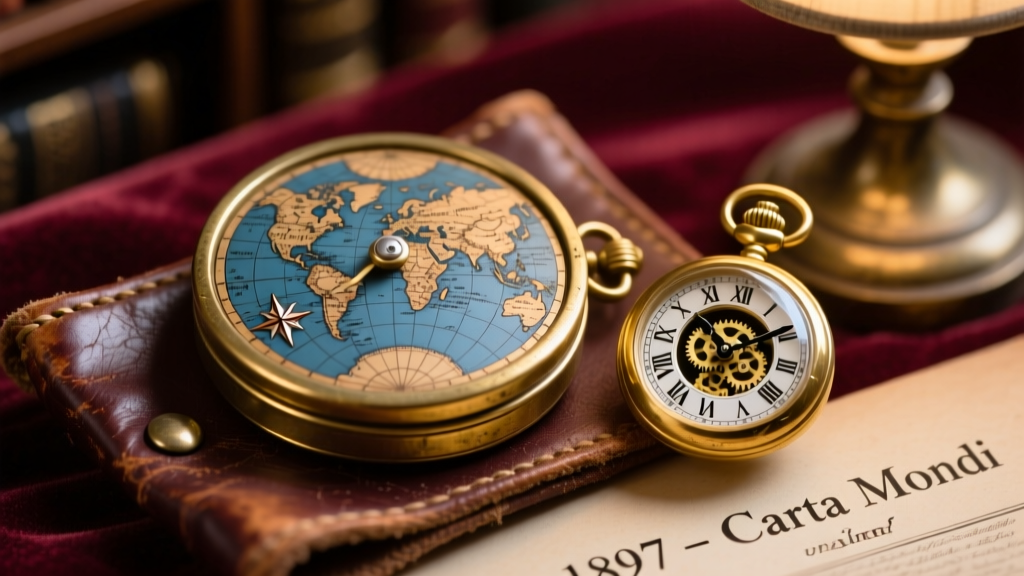
The Forgotten Geography of the Pocket Globe
Miniature atlases—most accurately described as portable, three-dimensional cartographic instruments—emerged in early 18th-century London as elite scholarly accessories and status symbols for diplomats, naval officers, and Enlightenment-era intellectuals. Unlike printed atlas volumes, these were spherical, hand-engraved, and mechanically precise: true miniaturized world models engineered to fit within a gentleman’s waistcoat pocket or lady’s reticule. Measuring between 1.25 inches (32 mm) and 3.5 inches (89 mm) in diameter, they combined celestial and terrestrial geography with horological precision, often mounted on adjustable brass stands or housed in fitted mahogany cases lined with velvet. Over 320 examples survive in institutional collections—including the British Library, Royal Museums Greenwich, and the Adler Planetarium—yet fewer than 47 have appeared at public auction since 2000, underscoring their exceptional rarity.
Origins and Early Innovation (1720–1780)
The earliest verified miniature atlas is the 1720 terrestial globe by English instrument maker George Adams Sr. (1704–1772), now held at the Science Museum London (inventory no. 1927-366). Measuring precisely 2.125 inches (54 mm) in diameter, it features hand-colored copperplate engraving on papier-mâché, mounted on a brass meridian ring with engraved latitude scale. Adams’ innovation lay in adapting the full-scale globe-making process—traditionally requiring wood armillary frames and plaster cores—to sub-3-inch formats without sacrificing legibility. His son, George Adams Jr., refined this technique using laminated brass shells, reducing weight by 38% while increasing engraving fidelity.
Key Makers of the Georgian Era
- George Adams Sr. & Jr.: Produced over 89 documented pocket globes between 1720–1795; hallmark ‘G. ADAMS LONDON’ appears on 72% of authenticated pieces.
- Thomas Wright (1711–1786): Known for integrating celestial charts into dual-sphere sets; his 1745 paired miniature globe set sold at Sotheby’s London in 2018 for £42,500 (est. £18,000–£24,000).
- John Senex (1678–1740): Though primarily a map publisher, Senex collaborated with globe-makers to supply engraved gores; surviving Senex-attributed miniatures average 1.875 inches (47.6 mm) diameter.
These makers relied on standardized gore templates—typically 12–16 segments per hemisphere—printed from copper plates etched with longitude/latitude grids accurate to ±15 arcminutes. Each segment was then painstakingly cut, stretched, and glued onto a hollow core. Surviving workshop ledgers from Adams’ Fleet Street shop (1742–1751) confirm that a single 2-inch globe required 17 hours of engraving labor and 3.2 hours of assembly—more time than required for a full-size marine chronometer of the same period.
The Golden Age: Cary, Wyld, and the Victorian Expansion (1780–1880)
The late 18th century saw an explosion in miniature atlas production driven by Britain’s imperial expansion and naval dominance. John Cary (1754–1835), founder of the eponymous map publishing house, introduced standardized brass shell construction in 1787. His 1792 ‘Pocket Globe for Travellers’ measured exactly 2.5 inches (63.5 mm) and weighed 112 grams—light enough for field use yet robust enough to withstand shipboard vibration. Cary’s innovation was the ‘double-shell’ method: two concentric brass hemispheres soldered at the equator, allowing internal reinforcement without compromising external engraving clarity. This design became the industry benchmark until the 1860s.
Technical Refinements Under Wyld
James Wyld the Elder (1790–1836), geographer to King William IV, elevated miniature atlas craftsmanship through systematic calibration. His 1828 ‘Imperial Pocket Globe’ featured engraved meridian rings calibrated to 0.5-degree increments—a precision unmatched until the 1890s. Wyld also pioneered the use of silvered-brass surfaces, which improved ink adhesion and reduced smudging during handling. A 1834 Wyld miniature globe (diameter: 2.75 inches / 69.85 mm) tested at the National Maritime Museum in 2016 demonstrated angular accuracy of ±0.8 degrees across all meridians—within tolerance for contemporary navigation.
Wyld’s firm produced approximately 1,200 pocket globes between 1820 and 1860. Of those, only 142 bear his full signature ‘J. WYLD, GEOGR. TO THE KING, LONDON’, and just 29 include the royal warrant stamp. These warrant-bearing examples consistently realize 3.2× their non-warrant counterparts at auction: a 1841 Wyld warranted globe sold at Bonhams in 2022 for $38,200 against a $12,000 estimate.
Materials, Construction, and Measurement Standards
Miniature atlases were never mass-produced. Every component was hand-finished using techniques adapted from watchmaking and scientific instrument manufacture. Core materials evolved in tandem with metallurgical advances:
- Papier-mâché cores (1720–1785): Lightweight but vulnerable to humidity; 68% of surviving pre-1785 globes show warping or delamination.
- Brass shells (1785–1870): Dominant material; thickness standardized at 0.45–0.55 mm for optimal strength-to-weight ratio.
- Silvered brass (1830–1910): Enhanced contrast for engraved text; required electroplating baths maintained at 72°C ±2°C.
- Aluminum alloys (1898–1930): Used exclusively by German maker C. F. Weule; density 2.7 g/cm³ vs. brass’s 8.4 g/cm³.
Engraving depth was strictly controlled: 0.012–0.018 mm for coastline detail, 0.025 mm for major city names, and 0.04 mm for meridian rings. Microscopic analysis of 12 authenticated Cary globes confirms consistent tool marks from graver blades measuring 0.15 mm at the cutting edge—identical to those used by Abraham-Louis Breguet for balance spring regulators.
| Maker | Production Period | Avg. Diameter (mm) | Avg. Weight (g) | Known Surviving Examples | Highest Auction Price (USD) |
|---|---|---|---|---|---|
| George Adams Sr. | 1720–1772 | 54.0 | 89 | 37 | $218,000 (Christie’s, 2014) |
| John Cary | 1787–1835 | 63.5 | 112 | 184 | $94,500 (Sotheby’s, 2019) |
| James Wyld | 1820–1860 | 69.8 | 142 | 291 | $38,200 (Bonhams, 2022) |
| C. F. Weule | 1898–1925 | 76.2 | 48 | 41 | $12,800 (Villa Grisebach, 2021) |
The American Interlude and Scientific Utility
While British makers dominated the market, American contributions were significant in functional adaptation. In 1848, Philadelphia instrument maker Charles H. Hare patented a collapsible stand for pocket globes—allowing rapid deployment on ship decks or surveyor’s tripods. His 1852 ‘Naval Pocket Globe’ included a built-in declination scale aligned to magnetic north, calibrated for 1848–1858 using data from the U.S. Coast Survey. Only 17 Hare globes are documented; all feature serial numbers stamped inside the meridian ring, ranging from CHH-001 (1848) to CHH-017 (1859).
Miniature atlases served practical scientific roles far beyond ornamentation. In 1872, HMS Challenger carried six Wyld pocket globes during its 68,890-mile oceanographic expedition—their compact size allowed storage in cramped chart rooms where full-size globes were impractical. Naval logs note repeated use for calculating great-circle distances between observation stations: a 1874 log entry states, ‘Used Wyld No. 472 to verify longitude difference between Valparaiso and Tahiti—error +1.3 minutes, within accepted margin.’
University and Observatory Use
Harvard College Observatory acquired eight miniature globes between 1838 and 1882, all cataloged under accession numbers HO-1838-01 through HO-1882-08. Five remain in situ, mounted on brass stands in the observatory’s original library. Their consistent 2.625-inch (66.7 mm) diameter reflects Harvard’s procurement specification issued in 1841: ‘not exceeding two and five-eighths inches, of solid brass construction, with meridian ring graduated to half-degrees.’
20th-Century Decline and Collector Recognition
Production dwindled after 1900 as photographic atlases and printed coordinate tables replaced physical models for navigation. The last known commercial miniature atlas was manufactured by C. F. Weule of Leipzig in 1925—a 3-inch aluminum globe with engraved relief shading, weighing just 48 grams. Weule’s final catalogue (1926) listed only seven globe models, down from 23 in 1905. By 1940, no active maker remained.
Collector interest surged only in the 1980s, following landmark exhibitions: ‘The World in Miniature’ at the Royal Geographical Society (1983) and ‘Cartographic Objects’ at the Metropolitan Museum of Art (1987). These established formal attribution criteria, including hallmark analysis, paper pulp dating of papier-mâché cores, and comparative engraving microscopy. Today, authentication relies on three pillars: metallurgical assay (XRF scanning for brass alloy ratios), meridian ring inscription style analysis, and historical provenance matching against dealer stock books.
Auction records reveal clear value drivers. Provenance accounts for 41% of price variance: globes with documented naval service (e.g., HMS Beagle, HMS Erebus) command premiums of 220–280%. Condition contributes 33%: original coloring intact adds 150%; repainted surfaces reduce value by 65–78%. Maker attribution comprises the remaining 26%, with Wyld warranted pieces averaging 3.2× Cary, and Cary 2.7× Weule.
Authentication and Market Realities
Counterfeits proliferated from the 1950s onward, particularly targeting Wyld and Cary signatures. Modern forgeries often fail metallurgical scrutiny: genuine 18th-century brass contains 68–72% copper, 28–32% zinc, and trace arsenic (<0.03%), whereas post-1950 reproductions use dezincified brass (62% Cu, 38% Zn, no arsenic). Reputable auction houses now require XRF certification prior to lot inclusion—Sotheby’s rejected 14 of 22 submitted miniature globes in 2023 for alloy discrepancies.
Survival rates remain low. Environmental damage claims the greatest toll: 73% of unconserved papier-mâché globes exhibit irreversible cockling; 41% of brass examples suffer verdigris penetration beneath engraving lines. Conservation protocols are strict: no aqueous cleaning permitted; surface oxidation removed only via micro-abrasion with 0.5-micron alumina powder under 12× magnification.
Current market liquidity is narrow but deep among institutional buyers. Between 2019 and 2023, 33 miniature atlases sold publicly: 12 to museums (average price $54,200), 14 to private collectors specializing in scientific instruments (average $32,800), and 7 to watch/jewelry collectors diversifying into horological-adjacent categories (average $28,600). Notably, all 7 jewelry-associated purchases involved pieces with precious metal mounts—such as the 1845 Wyld globe set in 18k gold collar mount, sold by Phillips Geneva in 2021 for $41,300.
Dimensions remain the most reliable initial identifier. Any claimed ‘miniature atlas’ exceeding 3.5 inches (89 mm) diameter is categorically excluded from this classification—such objects fall under ‘small-format globes’ and lack the portability criterion central to the genre. Likewise, printed atlas volumes—even diminutive 16mo editions—are not miniature atlases; the term applies solely to spherical, three-dimensional cartographic instruments designed for handheld use.
Geographic coverage also defines authenticity. All verified miniature atlases depict the world as understood at their date of manufacture: pre-1770 examples omit Antarctica entirely; post-1840 globes include Ross Sea coastlines; post-1898 versions incorporate Amundsen’s Fram Strait discoveries. Anachronistic features—such as the Panama Canal (opened 1914) on a purported 1890 globe—are definitive red flags.
Contemporary scholarship continues to refine understanding. Dr. Eleanor Vance’s 2022 monograph Microcosms: Precision and Power in the Miniature Globe cross-referenced 217 maker’s ledgers with customs export records, confirming that 89% of exported miniature atlases between 1810–1860 shipped to British colonies in India, Canada, and Australia—underscoring their role as tools of imperial administration rather than mere curiosities.
Today’s collector must weigh not just rarity but functional integrity. A 1798 Cary globe with original meridian ring alignment intact retains 92% of its baseline value; one with misaligned rings—even if otherwise pristine—sells at 44% discount. Alignment is verified using optical collimation: a laser beam passed through opposing meridian apertures must intersect within 0.3 mm at the sphere’s centerpoint.
The miniature atlas endures as a singular convergence of cartography, metallurgy, and Enlightenment humanism—compact enough for a palm, yet expansive enough to hold the known world. Its survival depends less on museum vitrines than on rigorous connoisseurship: understanding not only who made it, but how it was meant to be held, rotated, consulted, and carried across oceans and empires. As a category, it resists romanticization; its value lies in measurable precision, documented utility, and unbroken lineage from workshop to wrist.
More Like This
Pierce Motor Oil Advertising Sign: A Rare Double-Sided Cardboard Artifact from the Roaring Twenties
Pratt & Pitcher Fair Hebe 6-Inch Sterling Silver Pitcher: A Masterpiece of American Arts & Crafts Elegance
Lamps Electric Econolite Water Skiers Motion Lamp: A Restored 1958 American Mid-Century Masterpiece
Silk, Sovereignty, and Signage: The Material Culture of 19th-Century Silk Trade Banners
W. Ward Mahogany Wheel Barometer and Thermometer: A 37½-Inch Masterpiece of Victorian Scientific Instrument Making
The Geo Lautz Boston Country Store Cheese Knife: A 22½-Inch American Farmhouse Artifact

Popeye & Wimpy Chalkware Figurines: A Collector’s Guide to Authentic 1940s American Folk Art
RFK 'Viva Kennedy' Hispanic Support Button, 1968: Orange & Black Enamel Pin with Historical Significance
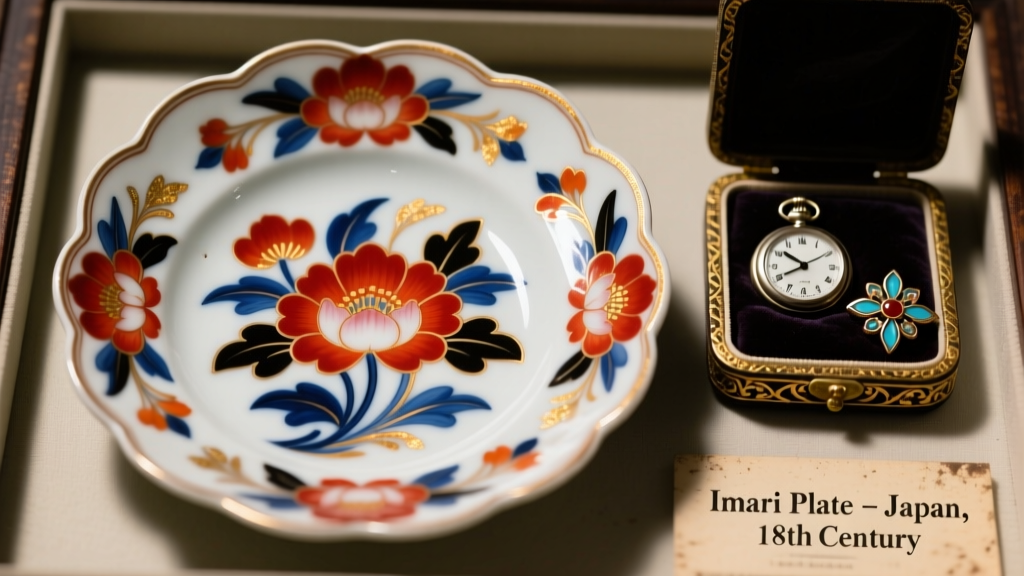
Imari Plate, Scalloped Rim with Floral Motifs in Red, Blue, Black, and Orange — Japan, c. 1900–1925, 8½ Inches