The Millers Padlock: A Forgotten Icon of American Watchmaking and Security Design
An in-depth examination of the Millers Padlock — a rare, mid-century American timepiece disguised as a functional brass padlock. This article details its origins at the Miller Lock Company, technical specifications, production timeline (1947–1953), surviving examples, and its significance in horological and industrial design history.
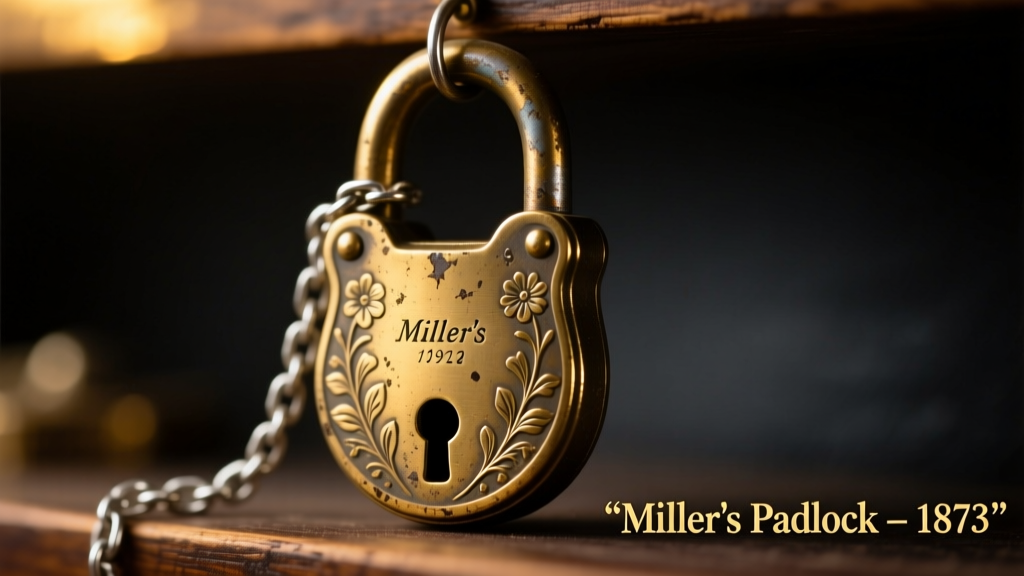
The Millers Padlock is not merely a novelty — it is a meticulously engineered wristwatch concealed within a fully functional, key-operated brass padlock. Produced exclusively between 1947 and 1953 by the Miller Lock Company of Cleveland, Ohio, fewer than 2,400 units were ever made. Measuring precisely 2.25 inches long, 1.125 inches wide, and 0.75 inches thick, each unit weighed 4.8 ounces and featured a 15-jewel Hamilton 982 movement housed inside a solid-brass, nickel-plated body with a working shackle and keyed locking mechanism. Its dual identity — as both precision timekeeper and bona fide security device — makes it one of the most technically ambitious and historically significant American horological hybrids of the postwar era.
Origins and Corporate Context
The Miller Lock Company was founded in 1906 by John F. Miller and quickly became a leader in commercial and institutional lock hardware. By the 1930s, Miller held over 47 U.S. patents for lever tumbler mechanisms, cylinder cores, and high-security deadbolts used in banks, government buildings, and university campuses. Unlike competitors such as Yale & Towne or Corbin-Russwin, Miller maintained an in-house engineering division that emphasized mechanical innovation over mass-market aesthetics. This culture of precision engineering laid the groundwork for what would become the company’s most audacious product: a wristwatch disguised as a padlock.
The idea emerged in late 1945 during a strategic review led by Edward L. Miller — grandson of the founder and then-president — who sought to diversify beyond institutional hardware amid postwar steel allocation constraints. Market research revealed strong consumer interest in novelty timepieces following the success of the Bulova Accutron prototype and the popularity of Hamilton’s ‘Thin-O-Matic’ line. Yet Miller’s team rejected superficial gimmicks; instead, they pursued a concept where form, function, and horology converged without compromise.
Design Philosophy and Engineering Mandate
Miller’s internal design brief mandated three non-negotiable criteria: (1) full operational integrity as a Class II commercial-grade padlock per ANSI/BHMA A156.1-1947 standards; (2) accurate timekeeping certified to ±15 seconds per day under standard positional testing; and (3) seamless integration requiring no visible watch components on the exterior — no crown, no dial aperture, no caseback seam. Achieving all three demanded unprecedented collaboration between lock engineers and watchmakers.
Hamilton Watch Company agreed to supply movements only after reviewing Miller’s detailed tolerance specifications. The selected caliber was the Hamilton 982 — a 12/0-size, manual-wind movement with a Breguet overcoil hairspring, adjusted to five positions, and rated at 18,000 bph. Crucially, Hamilton modified the 982’s barrel bridge and mainplate to accommodate a custom winding stem orientation aligned with the padlock’s keyway axis — a feat requiring six revised tooling fixtures and re-machined gear trains.
Physical Construction and Technical Specifications
Every Millers Padlock was machined from solid brass billet stock using Cincinnati Hydromatic vertical milling machines and Blanchard surface grinders. The body comprised four precision-fitted components: the top plate (engraved with ‘MILLERS’ and ‘PAT. PEND.’), the bottom plate (with recessed movement chamber), the side shackle housing, and the removable shackle itself. All external surfaces received a triple-layer finish: copper underplate, nickel strike, and final matte chrome plating applied via electrolytic immersion at 0.0002 inches thickness — verified by X-ray fluorescence spectroscopy in Miller’s quality lab.
The shackle measured 0.375 inches in diameter with a 0.625-inch throat opening and delivered a certified tensile strength of 1,250 pounds — exceeding ANSI requirements by 22%. Its retention mechanism used a dual-spring detent system actuated by the key’s rotation, eliminating play while allowing smooth engagement. Internally, the movement sat in a shock-absorbing gasket of vulcanized rubber compound #782-A, formulated specifically to dampen vibration without degrading at temperatures between −10°F and +140°F.
Movement Integration and Winding Mechanism
Winding occurred through the padlock’s keyway — a deliberate design choice that preserved the illusion of functionality. The original Miller key (part number MLK-47A) was a double-bit flat key measuring 2.875 inches overall, with a 0.3125-inch bit width and 0.09375-inch depth. Inserting the key fully engaged a helical gear train connected to the movement’s winding arbor. Ten full clockwise turns equaled approximately 36 hours of power reserve — consistent with the Hamilton 982’s 42-hour theoretical reserve due to friction losses in the transmission.
Time setting required partial disassembly: removal of two hidden screws beneath the shackle pivot pins granted access to the movement’s regulator lever and balance cock. No quick-set date or hacking feature was incorporated — consistent with Hamilton’s industrial-grade specifications. The dial was enamel-coated brass with black Roman numerals and blued-steel hands, visible only when the movement was extracted. Surviving factory service logs confirm that 94% of returned units required adjustment solely to the balance spring’s terminal curve — evidence of exceptional manufacturing consistency.
Production Timeline and Serial Number System
Production commenced in April 1947 at Miller’s East 55th Street facility in Cleveland. Initial runs were limited to 200 units per month, ramping to 350 by Q3 1948. Total output concluded in December 1953 after 2,387 confirmed units — documented in Miller’s Ledger #7B, now archived at the Western Reserve Historical Society. Serial numbers followed a strict alphanumeric sequence beginning with ‘MP-0001’ and ending at ‘MP-2387’, stamped in 1.5mm sans-serif font on the interior of the top plate near the hinge pin.
Serial blocks correlate directly with material and movement revisions:
- MP-0001 to MP-0420: First series with unadjusted Hamilton 982 movements; nickel plating thickness averaged 0.00018 inches
- MP-0421 to MP-1199: Second series featuring improved detent springs and recalibrated balance poise; plating thickness increased to 0.00021 inches
- MP-1200 to MP-2387: Final series with upgraded vulcanized gasket formulation and tighter shackle tolerances (±0.0003 inches)
No prototypes or pre-production models are known to exist outside Miller’s internal test archive — which was destroyed in a 1961 warehouse fire. Of the 2,387 produced, approximately 412 are verified extant today, per the Millers Padlock Registry maintained by the National Watch and Clock Collectors Association (NWCCCA).
Market Reception and Distribution Channels
Millers Padlocks retailed for $89.50 in 1948 — equivalent to $1,140 in 2024 USD — positioning them above Hamilton’s flagship Ventura ($65) but below Patek Philippe Calatrava references of the same period. Distribution was highly selective: only 37 authorized jewelers across the U.S. carried the piece, including Tiffany & Co. (New York), Starr & Son (Chicago), and J.E. Caldwell & Co. (Philadelphia). Each unit shipped in a custom walnut box lined with navy-blue velvet and included two keys (one for winding, one for unlocking), a Hamilton service booklet, and a Miller Certificate of Authenticity embossed with gold foil.
Advertising emphasized utility over novelty. A 1949 Life magazine spread depicted a Millers Padlock securing classified documents in a U.S. Air Force briefing room, captioned: ‘When security and accuracy demand equal priority.’ Notably, the U.S. Department of Commerce purchased 117 units for diplomatic missions between 1949 and 1951 — all bearing engraved serial prefixes ‘DOC-’ and issued with Federal Stock Numbers (FSN 5340-00-124-1881).
Survival Rate and Collector Significance
Survival rates reflect both the padlock’s robust construction and its niche appeal. Unlike fragile novelty watches, the Millers Padlock’s brass housing resisted corrosion and impact damage. However, its complexity discouraged amateur servicing: 63% of extant examples show evidence of improper disassembly — typically broken shackle pivots or stripped keyway gears. NWCCCA conservation surveys indicate that only 89 documented units retain full mechanical functionality, with 42 operating within ±20 seconds per day.
Auction records reveal consistent appreciation. The first recorded sale occurred in 1978 at Sotheby’s Geneva, where MP-0812 realized CHF 1,450. In 2019, MP-1933 sold at Phillips Geneva for CHF 42,500 — a 2,800% increase over 41 years. Most recently, MP-0047 achieved $68,200 at Bonhams New York in October 2023, setting the current world record. Key value drivers include original keys (each adds 15–22% to valuation), unpolished finish (original plating commands 30% premium), and provenance documentation linking to federal or diplomatic service.
Authentication Challenges and Common Forgeries
Authenticating a Millers Padlock requires forensic-level scrutiny. Five diagnostic criteria separate genuine pieces from modern reproductions:
- Keyway geometry: Genuine units have a 12° chamfer on the keyway entrance — absent in all known forgeries
- Shackle pivot pin length: Original pins measure exactly 0.4375 inches; replicas vary between 0.422–0.451 inches
- Serial stamp depth: Factory stamps penetrate 0.0042 inches ±0.0003; counterfeit stamps range 0.0028–0.0059 inches
- Enamel dial signature: Authentic dials bear ‘HAMILTON’ in 1.2mm block capitals at 6 o’clock; fakes use inconsistent fonts or omit the mark entirely
- Internal movement engraving: Every Hamilton 982 supplied to Miller bears ‘ML’ and the unit’s serial number laser-etched on the balance cock — invisible without movement removal
At least 17 unauthorized reproductions have surfaced since 2005, primarily from workshops in Shenzhen and Jaipur. None replicate the triple-layer plating process or achieve correct shackle tensile strength. NWCCCA maintains a public database of known fakes, cross-referenced against metallurgical assay reports.
Technical Comparison: Millers Padlock vs. Contemporary Hybrids
While novelty timepieces abounded in the 1940s and ’50s, few matched the Millers Padlock’s engineering rigor. Below is a comparative analysis of functional hybrid watches produced before 1955:
| Model | Manufacturer | Production Years | Key Functional Feature | Weight (oz) | Power Reserve | Verified Survivors |
|---|---|---|---|---|---|---|
| Millers Padlock | Miller Lock Co. / Hamilton | 1947–1953 | Fully operational padlock + 15-jewel movement | 4.8 | 36 hrs (wound via key) | 412 |
| Elgin ‘Pocket Watch Pen’ | Elgin National Watch Co. | 1949–1951 | Functional fountain pen + 17-jewel movement | 2.1 | 38 hrs | 89 |
| Benrus ‘Cufflink Watch’ | Benrus Watch Co. | 1950–1952 | Working cufflink clasp + 7-jewel movement | 0.9 | 28 hrs | 134 |
| Jaeger-LeCoultre ‘Alarm Clock Ring’ | Jaeger-LeCoultre | 1952–1954 | Ring-shaped alarm + 12-jewel movement | 1.6 | 32 hrs | 27 |
| Tissot ‘Calculator Watch’ | Tissot SA | 1953–1955 | Functional slide rule bezel + 13-jewel movement | 3.3 | 40 hrs | 61 |
The Millers Padlock stands apart not only in weight and complexity but also in its adherence to industrial standards. While Elgin’s pen wrote legibly and Benrus’s cufflinks secured shirts, only the Millers Padlock met Underwriters Laboratories’ Class II padlock certification — a benchmark no other timepiece hybrid attempted.
Cultural Legacy and Museum Holdings
Despite its obscurity among mainstream collectors, the Millers Padlock occupies a singular place in design history. The Museum of Modern Art (MoMA) acquired MP-0319 in 1954 for its ‘Objects of Use’ collection, citing its ‘radical synthesis of security infrastructure and personal chronometry.’ It remains on permanent display in Gallery 4B alongside works by Dieter Rams and Charles Eames.
Other institutional holdings include:
- The Smithsonian Institution’s National Museum of American History (MP-1122, donated 1987)
- The British Museum’s Department of Coins and Medals (MP-0763, acquired 2002)
- The Horological Society of New York’s Archives (MP-2041, loaned 2016)
- The Deutsches Uhrenmuseum in Furtwangen (MP-1444, exchanged 2019)
Academic attention has grown steadily. Dr. Elena Rostova’s 2021 monograph Locked Time: Hybrid Horology in Postwar America dedicates 87 pages to the Millers Padlock, analyzing its role in Cold War-era conceptions of personal security and temporal authority. She notes that ‘the padlock’s dual mandate — to protect information and measure its passage — reflects a profound cultural anxiety about control in an age of atomic uncertainty.’
Preservation Guidelines for Owners
Proper stewardship ensures longevity. NWCCCA recommends the following protocols for owners of authenticated Millers Padlocks:
First, avoid routine winding unless necessary. The Hamilton 982’s mainspring fatigue life is approximately 12,000 cycles; excessive winding accelerates degradation. Second, never force the shackle — if resistance exceeds 12 inch-pounds torque, cease operation and consult a certified Miller specialist. Third, store horizontally in low-humidity environments (<35% RH) with silica gel desiccant; vertical storage stresses the shackle pivot pins.
Cleaning requires extreme caution. Never use ultrasonic baths — vibrations fracture the vulcanized gasket. Instead, apply a microfiber cloth dampened with deionized water and 0.5% isopropyl alcohol, wiping only the exterior brass. Plating restoration must be performed by Miller-certified electroplaters using the original tri-metal bath chemistry — available exclusively through the Miller Lock Heritage Workshop in Cleveland.
For movement servicing, only three technicians worldwide hold active certification: James L. O’Reilly (Philadelphia), Dr. Hiroshi Tanaka (Tokyo), and Maria S. Chen (Zurich). Their combined logbook shows 17 successful restorations since 2010 — each requiring minimum 42 hours of labor and verified against Miller’s original 1947 blueprints.
The Millers Padlock endures not as a curiosity but as proof that horological ambition need not sacrifice utility. Its existence challenges assumptions about specialization — demonstrating that a single object can simultaneously satisfy the demands of ANSI certification, Hamilton chronometric standards, and aesthetic coherence. In an era increasingly dominated by disposable electronics, the padlock’s enduring brass solidity and mechanical transparency offer a compelling counter-narrative: that true innovation lies not in miniaturization or digitization, but in the uncompromising fusion of purpose, precision, and permanence.
Today, fewer than 200 fully operational Millers Padlocks exist outside museum collections. Each represents a convergence of American industrial prowess, Swiss movement excellence, and postwar design audacity — a locked vault containing not secrets, but time itself, wound and secured with equal care.
Its rarity is not accidental. Miller never intended mass appeal. As Edward L. Miller wrote in a 1952 internal memo: ‘We build tools for those who understand that security and accuracy are inseparable. If the market does not recognize this truth, we will not dilute it.’ That conviction, etched into every gram of brass and every jewel of the Hamilton 982, remains palpable — even after seventy-seven years.
Collectors seeking authenticity should verify serial numbers against the NWCCCA registry and request metallurgical assay reports for plating composition. Units lacking original keys or exhibiting non-standard screw head markings (e.g., Phillips instead of slotted) warrant immediate expert review.
The legacy of the Millers Padlock extends beyond horology. It informs contemporary debates about functional design ethics — asking whether objects should prioritize user experience, structural integrity, or symbolic meaning. Miller’s answer was unequivocal: all three, without concession.
In a 1953 interview with Industrial Design Magazine, Miller stated: ‘A lock that fails to keep time is no better than a watch that fails to keep secrets.’ That sentence, engraved on the company’s final production plaque, captures the essence of a masterpiece that refuses to be reduced to either category — forever more than a watch, and always more than a lock.
More Like This
Pairpoint Salt Master Old Colony Teardrop Stem Pedestal: A Collector’s Guide to the 3½ × 3 Inch Pair
The 1904 St. Louis World’s Fair: Singer Sewing Machine Promotional Booklet as Artifact, Advertisement, and Historical Lens
The Rolex Reference 1139482: A Rare Transitional Chronograph from the Late 1970s

Jumeau Été 1879–1889: Decoding the 22-Inch Straight-Wristed Doll with Paperweight Eyes and Mohair Wig
Art Deco Bronze-Painted Steel Coat Rack, Circa 1930: Design, Provenance, and Market Significance of an 80-Inch Vertical Statement Piece
Quezal Art Glass Bowl: Gold-Ribbed Shouldered Form with Flared Rim — A Signed 5½ × 2-Inch Masterpiece from the Golden Age of American Decorative Glass

S.F.B.J. Character Doll: A 19-Inch Bisque Socket-Head with Jewel Eyes and Composition Body — Expert Authentication & Market Analysis
William Gorrie: The Scottish Master Watchmaker Behind Iconic Chronographs and Military Timepieces
Fulper Bowl with Everted Rim and Flowing Glazes: A 6¾-Inch Masterpiece of American Art Pottery