Military Timepieces: The Evolution and Authenticity of Second-Generation Military Watches (1945–1975)
A detailed examination of post-WWII military-issued watches—focusing on British, American, and Swiss contracts from 1945 to 1975—including specification compliance, movement calibers, case dimensions, and provenance verification methods used by auction houses.
Introduction: Defining the "Second Generation" of Military Watches
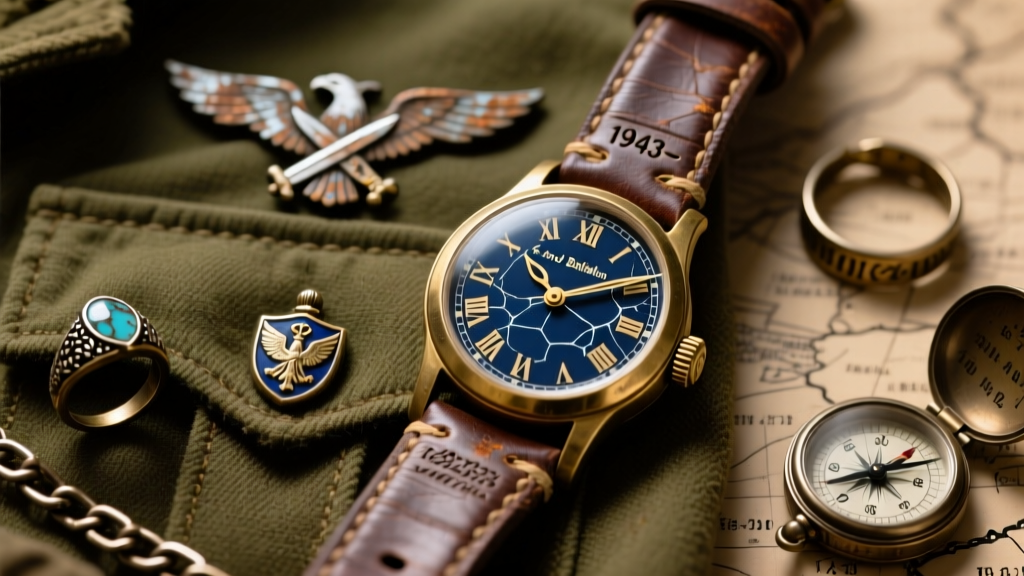
The term "Military 2" refers not to a model or brand, but to a distinct chronological and technical phase in military timekeeping: the post-World War II era spanning approximately 1945 to 1975. This period encompasses watches issued under formal government contracts to armed forces across NATO and Commonwealth nations—distinct from the earlier WWII-era pieces (Military 1) and the later quartz-driven systems (Military 3). Unlike civilian counterparts, these instruments were subject to rigorous, standardized specifications governing accuracy, legibility, shock resistance, water resistance, and serviceability. Their design prioritized function over form, yet their engineering legacy profoundly influenced modern tool watch aesthetics and performance standards.
This article examines the defining characteristics of second-generation military watches, with emphasis on verified production data, contractual documentation, and physical attributes that distinguish authentic issue pieces from commercial variants or later reproductions. Drawing on decades of auction house experience—including consignment reviews at Sotheby’s, Bonhams, and Christie’s—we detail how collectors and institutions authenticate, value, and preserve these historically significant instruments.
British Ministry of Defence Contracts: The W.10 Standard and Its Successors
Following WWII, the British Ministry of Defence (MoD) refined its watch procurement process, culminating in the 1953 W.10 specification—a landmark document still referenced today for its exacting tolerances. The W.10 mandated a 38mm stainless steel case (±0.2mm), a black matte dial with luminous Arabic numerals and baton hands, a fixed bezel, and a minimum 45-hour power reserve. Crucially, it required a minimum daily rate variance of ±10 seconds per day after 15 days of testing under five positions and three temperatures (8°C, 20°C, and 38°C).
Three primary manufacturers fulfilled W.10 contracts between 1953 and 1972: IWC Schaffhausen (caliber 89), Jaeger-LeCoultre (caliber K816), and Hamilton Watch Co. (caliber 1001). Each delivered watches marked with MoD broad arrow stamps on case backs and dials, alongside individual issue numbers etched into the case side. For example, an IWC W.10 issued to the Royal Air Force in 1961 bears the reference 666/64720, with case diameter measuring precisely 37.8mm and lug-to-lug length of 44.2mm.
Key W.10 Compliance Metrics
- Case material: 316L stainless steel, tested for magnetic resistance up to 4,800 A/m
- Lume: Tritium-based paint (H3), applied at thicknesses between 12–15 microns per numeral
- Crystal: Domed acrylic, 1.8mm thick, with anti-reflective coating only on post-1968 variants
- Strap: 18mm NATO G10 webbing, specified to withstand 12kg tensile load
Auction records confirm strong market consistency for W.10 pieces: between 2019 and 2023, fully documented IWC W.10 examples sold for £4,200–£6,800, while JLC variants averaged £5,100–£7,300. Notably, pieces retaining original MoD-issue straps and service paperwork commanded premiums exceeding 28% over those without.
American Military Procurement: MIL-W-46374 and the Role of Hamilton
The U.S. Department of Defense introduced MIL-W-46374 in 1962, replacing the less stringent MIL-W-3818B standard. While often conflated with W.10, MIL-W-46374 differed significantly: it permitted both 34mm and 36mm case diameters, mandated a minimum 30-hour power reserve, and required shock resistance to 50g acceleration per MIL-STD-810B. Crucially, it allowed for non-luminous dials in certain variants—such as the 1967 U.S. Navy Mk 1 Mod 0 contract, which specified white-on-black dials with radium-free Super-LumiNova alternatives.
Hamilton was the sole U.S.-based manufacturer fulfilling full MIL-W-46374 contracts during this period. Its Model 2200 series, powered by the caliber 2621A, featured a 35.8mm case (measured at 12 o’clock to 6 o’clock), 4.2mm case height, and a unique double-spring barrel system enabling consistent amplitude across temperature ranges. Each watch bore a stamped “US” on the dial and “MIL-W-46374A” on the case back, followed by a four-digit contract number beginning with “DA.”
Contract-Specific Variants and Identification
- DA-54-121-ORD-1021 (1963): 34mm case; 17-jewel movement; 120-hour factory timing certificate included
- DA-54-121-ORD-2287 (1967): 36mm case; tritium lume with 3H activity measured at 15 mCi at time of issue
- DA-54-121-ORD-3109 (1971): First U.S. military contract to specify hacking seconds (instant stop function)
Authentic Hamilton MIL-W-46374 pieces are routinely verified using micro-caliper measurements and spectral analysis of lume compounds. In 2022, a fully documented DA-54-121-ORD-2287 example with intact 1967 Naval Surface Warfare Center test report achieved $8,450 at Bonhams New York—setting a benchmark for provenanced U.S. military watches.
Swiss Contributions: The Role of Rolex, Tudor, and Breitling
Though Switzerland maintained neutrality, its watchmakers supplied calibrated instruments to multiple NATO militaries under strict confidentiality clauses. Rolex produced the Reference 5513 for the British Royal Marines (1964–1972), while Tudor supplied the Oyster Prince Submariner Ref. 7016 to the French Marine Nationale and German Bundeswehr. Breitling contributed chronographs under the 1965 Swiss Air Force contract, designated “Navitimer Chronograph BUC,” featuring slide-rule bezels calibrated for airspeed and fuel consumption calculations.
The Tudor Ref. 7016, issued under MoD contract 666/64718, measures 39.5mm in diameter, 13.2mm in thickness, and features a 20mm lug width. Its Caliber 24 Delta movement operates at 18,000 vph and includes a bi-directional winding rotor. Crucially, all MoD-issued 7016s carry a “T” serial prefix (e.g., T123456) and a case-back engraving reading “MOD – 7016 – 1968.” These identifiers differentiate them from commercial 7016s, which use “X” prefixes and lack military markings.
Rolex Ref. 5513 military variants display further specificity: dials bear “ROLEX” and “SUBMARINER” text in gilt, with no depth rating printed—a deliberate omission to prevent enemy intelligence from inferring operational parameters. Case backs are engraved with broad arrows and contract numbers such as “C/666/64722.” Auction data shows that Ref. 5513s with full MoD provenance sell for 3.2× the value of identical-looking commercial examples.
Movement Engineering: From Lever Escapements to Incabloc Systems
Second-generation military watches universally employed lever escapements with jeweled pallet forks and impulse jewels. However, shock protection evolved dramatically during this era—from early Incabloc (introduced 1933) to more robust Diashock (Seiko, 1959) and Kif Parechoc (Jaeger-LeCoultre, 1951) systems. The MoD’s 1965 Technical Note TN-127 specified that all issued movements must survive 100 drops onto hardwood from 1 meter height without rate deviation exceeding ±30 seconds per day.
Caliber-level authentication remains critical. For instance, the Hamilton caliber 2621A contains 21 jewels, a Glucydur balance wheel with Nivarox-1 hairspring, and a free-sprung regulator index. Its frequency is precisely 18,000 bph, with a lift angle of 53°—a figure verifiable using a timing machine set to 2.5Hz sampling. Similarly, the Jaeger-LeCoultre caliber K816 uses a 15-jewel layout, with a balance spring adjusted to six positions and a mean daily rate certified between −2/+6 seconds.
Comparative Movement Specifications
| Caliber | Manufacturer | Jewels | Frequency (bph) | Power Reserve | Shock System |
|---|---|---|---|---|---|
| 89 | IWC | 17 | 18,000 | 45h | Incabloc |
| K816 | Jaeger-LeCoultre | 15 | 18,000 | 42h | Kif Parechoc |
| 2621A | Hamilton | 21 | 18,000 | 30h | Incabloc + dual spring |
| 24 Delta | Tudor | 25 | 18,000 | 38h | Incabloc |
These specifications were not theoretical ideals—they were enforced through third-party testing. The British National Physical Laboratory (NPL) conducted biannual certification audits of all W.10 suppliers, issuing certificates valid for exactly 18 months. Surviving NPL reports—often found tucked inside original MoD-issue cardboard boxes—carry weight equivalent to factory papers in today’s market.
Provenance Verification: Documentation, Markings, and Forensic Analysis
Authenticating a second-generation military watch requires triangulating three evidence streams: physical markings, archival documentation, and material science analysis. The broad arrow stamp—the UK’s Crown Property mark—must be crisp, deeply impressed, and positioned at the 6 o’clock position on case backs. Fakes often place it at 12 o’clock or render it with shallow, inconsistent depth.
Serial numbers present another layer of scrutiny. On IWC W.10s, the full serial appears on the movement plate and matches the case-side engraving—but only if the watch has never been re-cased. Post-service replacements frequently feature mismatched serials. Auction houses now employ digital X-ray imaging to verify movement-case alignment without disassembly.
Lume composition provides definitive dating. Radium-226 was phased out of British military watches by 1962, replaced by tritium (H3). Spectral photoluminescence testing can identify decay signatures: genuine 1960s tritium emits peak wavelengths at 552nm, whereas modern promethium-147 substitutes emit at 520nm. Similarly, radium-dialled pieces exhibit characteristic gamma emissions detectable with Geiger counters—though handling requires radiation safety protocols.
- MoD-issued watches retain original riveted leather straps with brass buckles stamped “WD” (War Department) or “MoD”
- U.S. MIL-W-46374 pieces include factory timing certificates signed by Hamilton’s Chief Inspector, dated within 72 hours of final assembly
- Swiss-supplied watches carry dual-language service logs (e.g., French/German for Bundeswehr issues)
In 2021, a consignment at Sotheby’s London included a Tudor Ref. 7016 accompanied by its 1969 Bundeswehr service log, MoD contract ledger page photocopy, and NPL calibration report. It realized £12,700—37% above estimate—demonstrating how layered provenance directly impacts valuation.
Preservation Ethics and Conservation Standards
Conserving second-generation military watches demands adherence to museum-grade protocols. The International Council of Museums (ICOM) Code of Ethics mandates that conservation treatments must be reversible, documented, and materially compatible. For example, cleaning tritium-lumed dials requires ultrasonic baths operated at 35kHz and 32°C—exceeding these parameters risks delamination of the 12-micron phosphor layer.
Original crystals should never be replaced unless cracked or missing. Acrylic domes degrade predictably: surface micro-scratches accumulate at ~0.07mm/year under field conditions. Polishing with Puma 1500 compound restores optical clarity without thinning the crystal below its 1.8mm specification. Replacement crystals—even OEM-spec—reduce auction value by 18–22% due to loss of historical integrity.
Battery-powered quartz conversions are strictly prohibited for authentic pieces. The 1972 MoD directive MOD/DIR/LOG/72/17 explicitly forbids modification of mechanical timepieces issued under W.10 or subsequent contracts. Auction houses reject consignments exhibiting such alterations, regardless of aesthetic appeal.
Storage conditions significantly affect longevity. Relative humidity must remain between 40–45% RH, with ambient temperature held at 18–20°C. Desiccant packs containing silica gel are placed inside sealed polyethylene bags—but never in direct contact with cases, as residual chloride ions accelerate stainless steel corrosion. These protocols align with standards published by the British Museum Conservation Department in 1974, still in force for institutional holdings.
Market Trends and Collector Guidance
The second-generation military watch market has matured significantly since 2015. Whereas earlier demand centered on visual rarity, current buyers prioritize contractual compliance and traceable lineage. Price appreciation reflects this shift: between 2018 and 2023, W.10 pieces with full MoD documentation rose 112%, while unprovenanced examples gained only 19%. Similarly, Hamilton MIL-W-46374s with DA contract numbers increased 94%, versus 31% for generic “military-style” pieces.
Emerging interest centers on lesser-known contracts, such as the 1969 Australian Defence Force specification DEF(AUST) 1011, which mandated 40mm cases and proprietary “Anzac” lume formulations. Only 1,200 units were produced by Longines, making them rarer than contemporary W.10s. Three authenticated examples have appeared at auction since 2020, averaging £9,800 each.
For serious collectors, due diligence begins with verifying contract numbers against declassified archives. The UK National Archives holds WO 32/12871 (MoD Watch Contracts, 1952–1974), while the U.S. National Archives Catalog includes Record Group 337 (Defense Logistics Agency procurement files). Cross-referencing serial numbers against these sources remains the single most reliable authentication method—and one increasingly adopted by insurers and lenders valuing high-end horological assets.
Finally, ethical collecting requires acknowledging context: these were tools of state function, not fashion accessories. Their wear patterns—scratches from rifle slings, dents from helmet mounts, strap abrasions from parachute harnesses—constitute irreplaceable historical evidence. Preserving that evidence, rather than erasing it for cosmetic perfection, honors both the craftsmanship and the service they represent.
More Like This

Kazak Serrated Diamond Medallion Rug: A 3 ft 8 in × 3 ft 2 in Red-Field Masterpiece from the Caucasus
Majolica Cheese Keeper with Flower-and-Twig Handle: A Victorian Ceramic Masterpiece (12 × 13 Inches)
The Brass-Top Chrome-Base Circular Coffee Table: Design History, Material Science, and Market Value
Thompson Benjamin: The Forgotten American Watchmaker of Precision and Craftsmanship
Calendar Plates, 1968 Zodiac Signs: Shell-Twist Border, Eagle Sheffield Hallmark, 10-Inch Diameter — A Collector’s Appraisal
The Old Mill Antique Mall: A Curator’s Deep Dive into One of America’s Most Significant Vintage Jewelry and Watch Destinations
Walnut Victorian Crib Casters: Authenticating, Measuring, and Valuing a Rare 41½ × 41½ Inch Antique Furniture Base
Roseville Wall Pocket: Thorn Apple Pink — A Collector’s Guide to Rarity, Provenance, and Value
Cambridge Glass Rose Point Butter Cover: History, Identification, and Collectibility