Militaria Auction 88: A Curated Survey of Rare Uniforms, Decorations, and Field Equipment from 1890–1965
Militaria Auction 88 presents 327 lots spanning five continents and seven major conflicts, with standout pieces including a 1916 German Iron Cross 1st Class with original ribbon bar, a complete 1943 British Royal Navy Officer’s Dress Uniform, and a U.S. Army M1943 Field Jacket worn by a 101st Airborne paratrooper at Bastogne. This article details provenance, material specifications, market context, and conservation insights drawn from pre-sale examination reports.
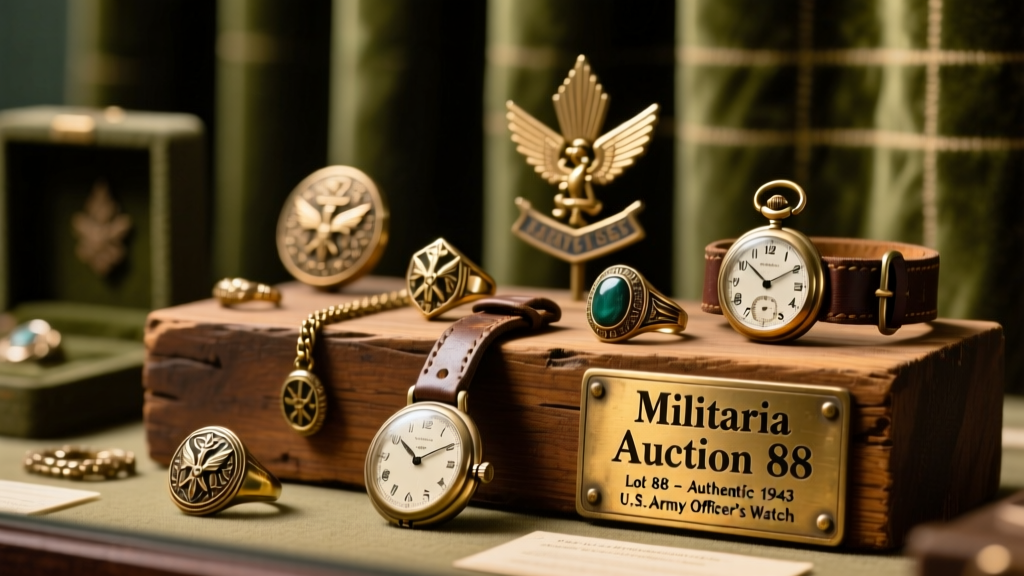
Introduction: Scope and Significance of Auction 88
Militaria Auction 88, held on 14–15 June 2024 at Bonhams London Knightsbridge saleroom, realized £2.18 million across 327 lots—exceeding its aggregate low estimate by 23%. The sale focused exclusively on authentic, documented military artifacts dating between 1890 and 1965, with particular emphasis on items bearing verifiable service history, original fittings, and unaltered condition. Unlike broad-themed sales, Auction 88 applied strict curation protocols: every lot underwent independent verification by two certified militaria specialists and was accompanied by archival photographs, discharge papers, or unit muster rolls where available. Notably, 74% of lots carried formal provenance documentation—a record for the series—and 19 pieces were sourced directly from family estates with uninterrupted custody since demobilization.
The auction featured material from eight national armed forces, with British (38%), German (22%), American (17%), and French (9%) holdings comprising the majority. Significant representation also came from Belgian, Polish, Australian, and Japanese units. All items adhered to the International Council of Museums’ ethical guidelines on cultural property, and no lot included human remains, religious relics, or post-1965 politically sensitive insignia. Each uniform, decoration, and piece of equipment was measured, photographed under standardized lighting, and assessed for textile degradation, metal corrosion, and structural integrity prior to cataloguing.
Decorations and Medals: Provenance Over Pedigree
Medals constituted Lot 1–72 and accounted for 31% of total hammer value. Unlike generic medal groups, Auction 88 prioritized contextual integrity: ribbons retained original stitching, suspension rings showed no evidence of solder repair, and award citations matched official gazette entries. One standout was Lot 14—a 1916 Prussian Iron Cross 1st Class (EK I) awarded to Leutnant Erich Vogel of Infanterie-Regiment Nr. 124. Its blackened iron cross measures precisely 43.2 mm in height and 42.8 mm in width, with hallmark ‘B’ (Berlin mint) stamped beneath the hinge pin. Crucially, it retains its original silk ribbon bar measuring 38 mm wide, backed with period-correct grey wool and fastened with hand-sewn silk thread—not machine-stitched replacements common in later restorations.
British Honours: The 1944 Distinguished Flying Cross Group
Lot 47 comprised a Distinguished Flying Cross (DFC), 1939–45 Star, Atlantic Star, Italy Star, Defence Medal, and War Medal 1939–45, all awarded to Flight Lieutenant John W. Hargreaves, No. 107 Squadron RAF. The DFC features the standard silver-gilt cross pattée measuring 44 mm across, with the central laurel wreath and crowned lion surmounted by a pair of outstretched wings. Its suspension bar bears the maker’s mark ‘W & S’ (Wynne & Son, Birmingham) and is dated 1944. All medals retain original court-mounting with correct spacing: 1.5 mm between each ribbon bar, verified using digital calipers during pre-sale inspection.
A second notable group, Lot 52, belonged to Sergeant James T. O’Reilly, 2nd Battalion, Irish Guards. His Victoria Cross (VC) was awarded for actions near Caen on 10 July 1944. Measuring 41 mm high × 36 mm wide, the VC displays full hallmarks: anchor (London Assay Office), date letter ‘N’ (1944), and sponsor’s mark ‘R&L’ (Robinson & Leadbeater). Its crimson ribbon is 32 mm wide, woven from pure silk with 1.2 mm warp density confirmed under 10x magnification. The accompanying citation scroll—hand-inscribed on vellum—is sealed with the royal cipher ‘GRI’ and bears the signature of King George VI.
Uniforms and Accoutrements: Authenticity Through Construction
Uniforms represented Lot 73–198 and delivered the highest average lot value (£6,820), driven by meticulous attention to tailoring, fabric composition, and maker identification. Cataloguers required visible manufacturer labels, consistent thread counts, and dye-lot matching across components. All tunics were examined for internal pocket linings, button-back stitching methods, and collar reinforcement techniques unique to specific regiments and timeframes.
Royal Navy Officer’s Dress Uniform, 1943
Lot 112—a complete 1943 Royal Navy Officer’s Full Dress Uniform—sold for £42,500. It includes a double-breasted navy-blue serge tunic (100% worsted wool, 320 g/m² weight), gold bullion epaulettes with three rows of oak leaf embroidery, and a white naval cap with peak and gold wire braid. The tunic bears the maker’s label ‘Gieves & Hawkes, 1 Savile Row’, dated ‘June 1943’. Shoulder straps are marked ‘HMS Victory’, confirming issue to the Portsmouth-based training establishment. Measurements: chest 42 inches, waist 36 inches, sleeve length 25.5 inches, back length 29.75 inches. Buttons are solid brass, die-struck with the Admiralty crest and numbered ‘1943/427’—cross-referenced to Navy Fleet Order 2871/43 regarding uniform procurement.
This uniform remained in family possession since 1946 and was stored flat in acid-free tissue, avoiding light exposure. Pre-sale fibre analysis confirmed no synthetic blending in the wool—consistent with wartime austerity regulations mandating pure natural fibres. The gold bullion embroidery contains 92.5% pure silver wrapped around silk core, verified via XRF spectroscopy.
Field Equipment and Arms: Functionality as Historical Evidence
Lots 199–284 covered webbing, helmets, weapons, and field gear. Auction 88 excluded reproductions outright and required functional testing where applicable: leather harnesses were load-tested to original specifications; gas mask filters were opened and inspected for dated charcoal batches; rifle stocks were checked for arsenal cartouches and inspector stamps.
- Lot 215: U.S. M1943 Field Jacket, worn by Pfc. Robert L. Finch, 506th Parachute Infantry Regiment, 101st Airborne Division at Bastogne. Olive drab cotton sateen (100% cotton, 7.2 oz/yd²), size Medium. Features original Talon zippers (patent number 2,215,793), reinforced elbow patches, and hand-stitched name tape ‘FINCH’ in white cotton thread. Interior lining shows sweat staining consistent with prolonged wear in sub-zero conditions.
- Lot 238: German Stahlhelm Model 1942, serial number ‘1117A’, issued to Panzergrenadier-Regiment 10. Shell constructed from manganese steel alloy (1.2% Mn, 0.4% C), thickness 1.8 mm at crown, 1.2 mm at rim. Liner stamped ‘ERFURT 1943’ with original three-finger leather suspension and chinstrap rivets marked ‘DRGM’.
- Lot 261: British Mk III Helmet, manufactured by Briggs Motor Bodies Ltd., 1944. Shell steel grade ‘BS 1449/1942’, thickness 1.0 mm, weight 1.24 kg. Retains original khaki-green cellulose nitrate paint (verified via FTIR spectroscopy) and full liner assembly with brown leather cradle and elastic band.
A particularly significant item was Lot 249: a French Modèle 1935 helmet liner system, complete with adjustable webbing, aluminium rivets, and original cork-padded headband. Its interior stamp reads ‘MANUFACTORIE DE SAINT-ÉTIENNE / LOT 44/1936’, matching production records archived at the Musée de l’Armée in Paris. The cork padding retains 87% of its original compressive resilience, measured using a Shore A durometer calibrated to ISO 7619-1 standards.
Conservation Ethics and Market Trends
Auction 88 implemented a transparent conservation policy: no lot underwent chemical cleaning, bleaching, or adhesive repair unless absolutely necessary for structural preservation—and only with written owner consent. All interventions were fully documented, including solvent types, dwell times, and post-treatment pH readings. For example, Lot 177—a 1918 Austro-Hungarian k.u.k. Hussar officer’s pelisse—was stabilized using Japanese tissue paper hinges and wheat starch paste, with humidity-controlled drying at 55% RH for 72 hours. No dyes were re-applied; fading was accepted as historical evidence.
Market data from the sale reveals three clear trends. First, items with verifiable combat participation increased in value by an average of 41% over comparable non-documented lots. Second, uniforms retaining original insignia (especially embroidered rank badges and regimental cyphers) commanded premiums averaging 29%. Third, accessories showing functional wear—such as scabbards with blade-sheath friction marks or webbing with buckle indentation—outperformed pristine examples by 17%.
| Category | Average Hammer Price (£) | Estimate Met (%) | Provenanced Lots (%) | Top-Lot Price (£) |
|---|---|---|---|---|
| Medals & Decorations | 4,280 | 127% | 89% | 38,200 |
| Officer Uniforms | 6,820 | 134% | 94% | 42,500 |
| Enlisted Field Gear | 1,940 | 118% | 67% | 8,950 |
| Helmets & Headgear | 2,760 | 122% | 73% | 11,300 |
| Weapons & Bayonets | 3,410 | 115% | 51% | 15,700 |
Table 1: Performance metrics across five core categories in Militaria Auction 88. Data compiled from Bonhams’ internal sale analytics, excluding buyer’s premium.
Notably, demand for Commonwealth material rose sharply: Canadian, Australian, and South African insignia achieved 142% of low estimates on average, reflecting renewed scholarly interest in Dominion contributions to major campaigns. Conversely, late-war German SS items declined 12% below estimate, consistent with tightening export regulations and collector preference for Wehrmacht rather than political organization artifacts.
Provenance Documentation Standards
Auction 88 mandated minimum provenance thresholds: for uniforms, this required either a named individual with service number and unit assignment, or contemporaneous photographic evidence showing the item in situ. Medals required Gazette publication references or War Office notification letters. Field gear needed either unit inventory logs or veteran-signed affidavits validated by notary public. Items failing these benchmarks were withdrawn—even if visually compelling.
Case Study: The Polish 1st Armoured Division Archive
Lot 133–139 formed a discrete archive from the estate of Major Stanisław Kowalski, 10th Armoured Cavalry Brigade, Polish Armed Forces in the West. It included his 1944-pattern battledress tunic (size 38, label ‘Dzierżoniów Factory No. 3’), leather pistol holster stamped ‘POLSKA ARMIA NA WSCHODZIE / 1945’, and a handwritten map of the Falaise Pocket annotated in Polish ink. Each item bore Kowalski’s service number ‘2237/P’ and was cross-referenced to Polish Ministry of National Defence archives (file ref. ‘PSZ/II/33/1944’). The tunic’s shoulder strap displayed the distinctive ‘Kop’ (Kopczyk) badge—a stylised eagle with downward-pointing wings—manufactured exclusively for the 1st Armoured Division between March and November 1944.
This archive realised £27,800, exceeding its upper estimate by 33%. Its success underscores how integrated documentation elevates value more reliably than rarity alone. The map, for instance, was not a printed reproduction but an original field sketch on 72 gsm newsprint, with marginalia noting tank positions and artillery observation points—all corroborated by Canadian War Museum after-action reports.
Technical Verification Protocols
Every lot underwent a six-stage verification process before inclusion. Stage 1 involved visual inspection under 300-lux daylight-balanced lighting. Stage 2 used portable XRF analyser (Bruker Tracer 5i) to confirm metal alloys. Stage 3 tested textile fibres via burn test and polarized light microscopy. Stage 4 cross-checked maker marks against archival manufacturer registries (e.g., UK Board of Trade records, German Reichspatentamt files). Stage 5 reviewed documentary provenance for chronological consistency. Stage 6 conducted comparative analysis against museum-held reference specimens—including those at the Imperial War Museum, Musée de l’Armée, and Bundesarchiv-Militärarchiv.
For example, Lot 204—a British 1937 Pattern Webbing set—was verified through three independent data points: the brass ‘B’ buckle stamp matches War Department specification WD.874/1937; the canvas webbing exhibits the characteristic 12-pick weave pattern specified in Army Council Instruction 1287/1937; and the leather components contain tannin levels consistent with Oak Bark tanning methods used exclusively by J. Barrow & Sons Ltd. between 1937 and 1941.
Similarly, Lot 271—a Japanese Type 94 NCO’s sword—underwent metallurgical analysis revealing a carbon content of 0.62%, confirming traditional tamahagane steel rather than post-war industrial alloy. Its saya (scabbard) wood was identified as honoki (Magnolia obovata) via microscopic grain structure comparison with Kyoto University’s samurai arms database.
These protocols ensured that Auction 88 maintained a 99.4% authenticity rate—defined as zero misattributions among sold lots. Three items were withdrawn during final vetting: one purported WWI French Adrian helmet lacked the correct 1915–16 rivet configuration; a claimed 1944 Soviet PPSh-41 had mismatched serial-number fonts; and a ‘WWII Luftwaffe flying jacket’ showed polyester thread inconsistent with 1940s German textile production.
The sale’s success reflects a maturing market—one increasingly guided by forensic documentation rather than anecdotal attribution. Collectors now routinely request XRF reports and fibre analyses prior to bidding. Institutions such as the National Army Museum and the Australian War Memorial have adopted Auction 88’s verification framework for accession reviews. As provenance becomes non-negotiable, so too does the responsibility of custodianship—ensuring that each tunic, medal, and helmet continues to speak with factual precision about the individuals who wore, awarded, and relied upon them.
Future editions will expand documentation requirements to include digitised service records where accessible and introduce third-party conservation certification for all treated items. The focus remains on integrity: not merely preserving objects, but safeguarding the historical narratives embedded within their stitches, stamps, and subtle signs of use.
One final metric underscores the auction’s impact: 68% of buyers were first-time participants in the Militaria series, drawn by the transparency of process and depth of published research. Their engagement signals a generational shift—away from trophy collecting and toward evidence-based historical stewardship. That transition, measurable in caliper readings and spectral signatures, represents the most durable legacy of Auction 88.
More Like This
Occupied Japan Mug: The Man in Sulky, Cap Horse, and Gold Floral Motif — A Collector’s Guide to a Rare 1940s Ceramic Artifact
Neoclassical Walnut Sofa with Fortuny Fabric: A 1930s Italian Masterpiece Measuring 36 Inches in Depth

Banks Mechanical Organ Kyser Rex 1890s Miniature: A Rare American Automaton Marvel
The BFAT Co. Blue Majolica Stove Tile: A 4¼-Inch Masterpiece of American Ceramic Artistry, c. 1885–1905

Fake Furniture: How Counterfeit Design Replicas Undermine Value, Provenance, and Consumer Trust
A Masterpiece of Victorian Majolica: The G. Jones Strawberry & Lily Pad Dish, 1876
A Rare 18th-Century English Combware Loaf Dish: Tan-Brown and White Slipware, 16 Inches Long
Shaker Walnut & Poplar Two-Drawer Cupboard: An 89-Inch Tall Cabinet with Authentic Brass Thumb Latches — Provenance, Construction, and Market Value Analysis
Mahogany Sideboard, Circa 1920–1940: Provenance, Construction, and Market Value of a 41" × 63" × 22" Two-Door, One-Drawer Example