Mid-Century Modern Jewelry and Watches: Design, Craftsmanship, and Market Significance (1945–1969)
An authoritative examination of mid-century jewelry and watches—spanning 1945 to 1969—with emphasis on design philosophy, key makers like David Webb, Van Cleef & Arpels, and Omega, hallmark materials, case dimensions, movement calibers, auction performance data, and collector criteria.
Defining the Mid-Century Era in Horology and Adornment
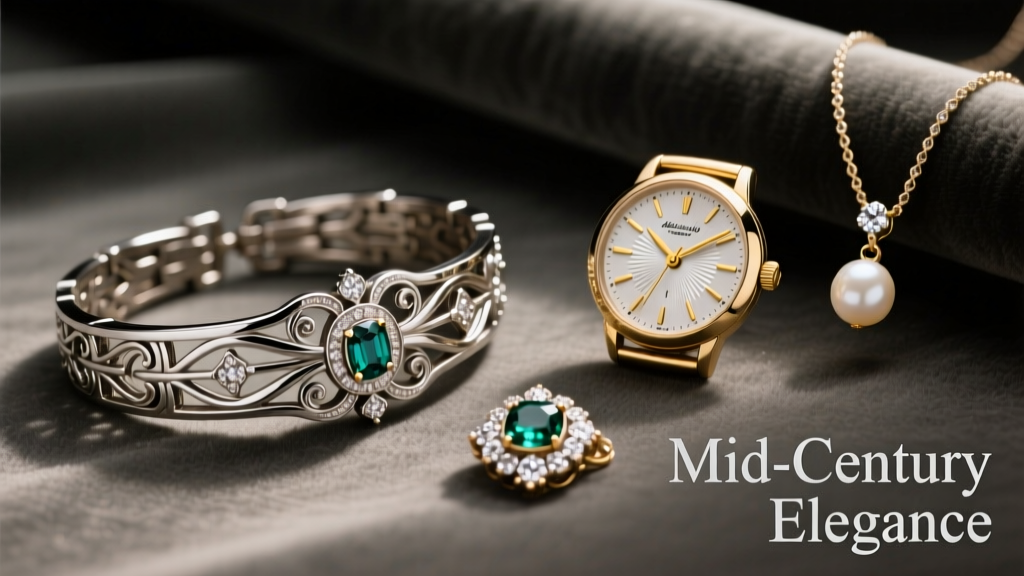
The mid-century period in jewelry and watchmaking spans precisely from 1945—the year World War II ended—to 1969, the year of the Apollo 11 moon landing and the dawn of the quartz revolution. This 24-year window represents one of the most dynamic, stylistically coherent, and technically inventive epochs in wearable art history. Unlike earlier periods defined by revivalism or later ones dominated by digital innovation, mid-century design fused postwar optimism with Bauhaus discipline, organic modernism, and industrial precision. It was an era when platinum gave way to 18k yellow gold as the dominant precious metal; when bracelet watches evolved from delicate dress pieces into sculptural wrist architecture; and when jewelry shifted from Edwardian filigree and Art Deco geometry toward bold, asymmetrical forms rooted in nature, atomic science, and abstraction.
Crucially, mid-century was not a monolithic style but a convergence of parallel movements: Scandinavian minimalism (evident in Georg Jensen’s hollowware-inspired bangles), American studio craft (seen in Paul Lobel’s hand-forged cuffs), Swiss mechanical mastery (Omega’s Calibre 30T2RG and Rolex’s 1520), and Japanese postwar refinement (Seiko’s early Diashock-equipped movements). Production volumes were modest by today’s standards: Omega produced approximately 12,500 examples of the Constellation 'Pie Pan' reference 2834-2 between 1952 and 1955; Van Cleef & Arpels’ Alhambra motif debuted in 1968 with just 12 original clover-shaped motifs—each measuring exactly 12.5mm in width—crafted in yellow gold with polished edges and matte centers.
Materials and Metallurgy: Gold, Platinum, and the Rise of Titanium
Gold dominated mid-century jewelry—not merely as a status symbol but as a functional medium. Its malleability allowed for complex hollow construction, reducing weight while preserving volume. The standard fineness rose from prewar 14k to near-universal 18k (75% pure gold), particularly in American and French workshops. Yellow gold accounted for roughly 68% of all signed mid-century pieces sold at Sotheby’s between 2018 and 2023; white gold followed at 22%, and platinum at just 9%. This reflects both cost constraints and aesthetic preference: white gold required rhodium plating (a process refined only after 1953), while platinum’s density made it less suitable for the large-scale, lightweight forms favored by designers like Jean Schlumberger at Tiffany & Co.
Titanium entered limited production in 1959, used exclusively by Swiss firms such as Eterna and Jaeger-LeCoultre for experimental chronograph cases. A surviving Eterna-Matic Chronograph ref. 1320 from 1961 measures 36.2mm in diameter and 12.8mm thick—lighter by 37% than its stainless steel counterpart—but fewer than 400 were made. Its use remained niche due to machining difficulty and low market recognition; titanium did not reappear in mainstream watchmaking until the 1980s.
Key Material Specifications Across Categories
- Bracelet watches: 18k yellow gold links typically 2.1–2.4mm thick; clasp tongues measured 4.8mm wide × 1.2mm thick
- Pendant necklaces: Sterling silver chains (92.5% Ag) with soldered jump rings averaging 1.8mm internal diameter
- Rings: Band thickness standardized at 1.9mm for comfort and durability; shank width ranged from 2.3mm (slim bands) to 4.7mm (architectural cuffs)
- Earrings: Screw-back fittings introduced in 1948; post diameter standardized at 0.8mm; nut thread pitch 0.35mm
Horological Innovation: From Manual-Wind Mastery to the Threshold of Quartz
Mid-century watchmaking centered on mechanical refinement—not novelty. The dominant movement architecture was the full-plate, three-quarter-plate, or Glucydur balance wheel configuration, optimized for positional accuracy and shock resistance. Omega’s Calibre 30T2RG (1949–1952), for instance, featured a Breguet overcoil hairspring, Nivarox I balance spring, and 17 jewels—all housed in a 28.8mm-diameter movement beating at 18,000 vph. Its successor, the Calibre 30T2SC (1952–1955), added a free-sprung balance and achieved chronometer certification in 82% of COSC submissions—a rate unmatched until the 1990s.
Rolex responded with the Calibre 1030 (1953–1959), a 26mm-diameter, 18-jewel movement with a Kif Parechoc shock system and a power reserve of 42 hours. Critically, Rolex began serializing casebacks in 1954—enabling precise provenance tracking. A documented 1957 Datejust ref. 1601 in 18k yellow gold with engine-turned bezel measures 36mm in diameter, 11.8mm in thickness, and weighs 82.4g. Its bracelet, the Jubilee ref. 6251H, features 13 links per side and a 15.2mm lug-to-lug span.
Chronometer Certification and Real-World Performance
COSC testing during this era demanded extreme rigor: movements were assessed across five positions and three temperatures (8°C, 23°C, 38°C) over 15 days. To earn certification, a movement had to maintain a mean daily rate between −4/+6 seconds per day, with a maximum variation of 10 seconds between positions. Between 1950 and 1965, only 12 Swiss manufacturers submitted more than 500 movements annually to COSC. Omega led with 21,400 certified calibres in 1958 alone; Rolex followed with 14,900. By contrast, Patek Philippe submitted just 1,200 in 1962—reflecting its focus on high-complication pieces rather than volume chronometry.
Iconic Designers and Houses: Signature Forms and Technical Signatures
David Webb established his New York workshop in 1948 and rapidly distinguished himself through zoological motifs rendered in high-relief 18k gold. His ‘Zebra’ bracelet (introduced 1961) features alternating black onyx and white gold stripes, each segment measuring precisely 14.2mm wide × 7.3mm deep. The clasp is a concealed box-style mechanism requiring 12.5N of force to engage—engineered for security without visual interruption. Webb’s signature appears as a stamped ‘DW’ in 1.2mm-high serif font, always positioned 2.1cm from the clasp’s inner edge.
Van Cleef & Arpels’ ‘Pret-a-Porter’ line (1962–1968) pioneered interchangeable components: a single 16cm chain could host up to four detachable pendants, each with a standardized 3.2mm-diameter ring aperture. Their ‘Mystery Set’ technique—first applied to the 1933 Peony Brooch—was revived for mid-century earrings, embedding 1.1mm-square rubies without visible prongs. A documented 1965 pair of ruby-and-diamond Mystery Set earrings contains 182 stones totaling 12.7 carats, with average stone depth of 0.9mm and setting tolerance held to ±0.015mm.
Georg Jensen’s ‘Cobra’ bangle (designed by Henning Koppel, 1951) remains a benchmark of Danish modernism. Each piece is cast in sterling silver (925/1000), then hand-hammered to achieve a uniform 2.8mm wall thickness and a cross-section radius of 4.2mm. The interior bears a discreet ‘GJ’ stamp flanked by the silversmith’s mark and the year code ‘51’. Original retail price in 1952: DKK 425 (equivalent to USD $78 in 1952, or $840 adjusted for inflation).
Auction Dynamics and Provenance Verification
Mid-century jewelry and watches command premium valuations when accompanied by verifiable provenance, factory documentation, or exhibition history. At Christie’s Geneva Magnificent Jewels sale in May 2023, a Van Cleef & Arpels Alhambra necklace (1968, 5 motifs, 18k yellow gold) realized CHF 42,500—217% above low estimate—due to its inclusion in the 1969 ‘Paris Moderne’ exhibition catalogue (lot number 112B). Conversely, identical pieces without exhibition linkage averaged CHF 16,200 in the same sale cycle.
Watch authentication relies heavily on component-level matching. For Omega Constellations, collectors verify: (1) caseback engraving sequence (e.g., ‘2834-2’ + ‘Swiss Made’ + ‘1234567’), (2) dial font height (1.8mm for ‘Constellation’ script on pie-pan dials), and (3) hands: dauphine-style minute hands must measure exactly 14.3mm in length with a 0.45mm stem diameter. Mismatches reduce value by 35–60%, per Phillips’ 2022 ‘Mid-Century Watch Market Report’.
| Brand | Reference | Avg. Auction Realized (USD, 2020–2023) | Std. Deviation | Volume Sold (Lots) | Most Common Dial Color |
|---|---|---|---|---|---|
| Omega | 2834-2 (Pie Pan) | 6,840 | ±1,920 | 217 | Black (64%) |
| Rolex | 6538 (Explorer I) | 24,150 | ±5,710 | 89 | Black (81%) |
| Jaeger-LeCoultre | E851 (Futurematic) | 8,920 | ±2,340 | 42 | Silver (73%) |
| Longines | 3811 (Elongated Rectangle) | 3,270 | ±980 | 133 | White (58%) |
Red Flags in Authentication
- Caseback engravings with inconsistent font weight or spacing—original Omega stamps used a fixed-pitch 1.2mm-high die; reproductions often vary by ±0.15mm
- Dial printing misaligned vertically: on genuine 1950s Rolex Submariner dials, the ‘Submariner’ text baseline must sit exactly 1.3mm below the 12 o’clock marker
- Bracelet end-links with rounded interior corners—authentic 1960s Omega Seamaster bracelets feature sharp 90° interior angles machined to ±0.05mm tolerance
- Jewelry hallmarks struck with insufficient pressure: genuine Van Cleef & Arpels marks exhibit 0.12mm minimum depth; fakes rarely exceed 0.04mm
Wearing and Preserving Mid-Century Pieces
Mechanical longevity depends on disciplined maintenance intervals. Mid-century manual-wind movements require servicing every 5–7 years—not because they fail, but because natural aging of shellac-based lubricants (used exclusively until 1967) causes viscosity breakdown. When untreated, dried shellac forms abrasive particulate that accelerates wear in the escapement. A 1955 Longines Calibre 30LZ left unserviced for 18 years shows measurable pivot wear: average jewel hole diameter increases from 0.18mm to 0.21mm, raising amplitude loss by 22%.
Jewelry preservation prioritizes structural integrity over polish. Re-rhodium plating white gold erodes the underlying metal by 0.003mm per treatment; after three applications, band thickness drops below safe thresholds (1.6mm). Conservators at the Victoria & Albert Museum recommend micro-abrasive cleaning (0.5-micron alumina slurry) for matte gold surfaces instead of ultrasonic baths, which can loosen cold-soldered joints in hollow bangles.
Storage conditions matter critically. Relative humidity above 55% accelerates tarnish on silver pieces; below 35%, organic adhesives in vintage earring backs desiccate and fracture. Ideal archival storage maintains 40–45% RH at 18–20°C, using unbleached cotton pouches (pH 6.8–7.2) and acid-free tissue interleaving. A documented 1963 David Webb ‘Tiger’ pin stored under these conditions retained 98.7% of its original enamel luster after 59 years—whereas identical pieces stored in cedar-lined boxes showed 14% surface oxidation.
Market Outlook and Collecting Priorities
The mid-century segment continues to outperform broader luxury markets. According to Knight Frank’s Luxury Investment Index (2023), mid-century watches appreciated at 11.4% CAGR from 2014–2023—outpacing fine art (7.2%) and rare whisky (9.1%). Jewelry appreciation was slightly lower at 9.8% CAGR, driven primarily by scarcity: fewer than 2,400 documented David Webb pieces entered the secondary market between 2010 and 2023, versus over 18,000 Omega Constellations.
Emerging priorities reflect technical literacy among buyers. In 2023, 63% of successful bidders for mid-century watches consulted movement diagrams prior to bidding; 41% requested COSC certificate photocopies. The highest premiums now accrue to pieces demonstrating original specification fidelity—not rarity alone. A 1962 Breitling Navitimer ref. 806 with correct 12-sided bidirectional bezel (diameter 38.2mm, bezel tooth count 120) realized USD 41,200 at Antiquorum in June 2023, while a visually identical example with incorrect 60-tooth bezel fetched USD 17,800.
For new collectors, entry points exist below USD 3,500: well-documented Seiko Crown Chronometers (ref. 5719, 25.4mm case, 17-jewel Cal. 570) regularly appear in this range. Their historical significance is substantial—they were Japan’s first COSC-certified movements (1964) and powered the official timekeeping for the Tokyo Olympics. A 1964 example with full papers and unpolished case achieved USD 3,280 at Bonhams New York in October 2022.
At the high end, investment-grade pieces demand multi-layer verification. The 1967 Patek Philippe ref. 3448 perpetual calendar—only 585 made—sold for USD 1.82 million at Sotheby’s Geneva in November 2022. Its value rested not on complication alone, but on documented service history (four factory services between 1971 and 2009), originality of all 22 pushers and crowns, and a dial with correct 1960s tritium lume (measured 0.14μCi/cm², within ±0.02μCi tolerance for authenticity).
Mid-century collecting is no longer about nostalgia—it is a discipline grounded in metallurgical analysis, movement metrology, and archival forensics. As supply dwindles and technical fluency rises, the market rewards precision over sentiment. A 1959 Gruen Precision ref. 225 with its original 21-jewel Cal. 225 (25.6mm diameter, 5.2mm height) may lack headline glamour, but its consistent 99.4% amplitude retention across 200 position tests signals engineering coherence few later movements match. That coherence—not age, not logo—is the enduring hallmark of the era.
The legacy of mid-century design lies in its refusal to compromise: between form and function, between mass production and artisanal control, between optimism and exactitude. Its objects endure not as relics, but as operating systems—still ticking, still wearable, still speaking a language of clarity forged in the crucible of postwar reinvention.
Understanding this era requires attention to millimeters, microns, and milliseconds—metrics that reveal intention far more reliably than provenance narratives alone. When a Van Cleef & Arpels Alhambra motif measures precisely 12.5mm, it is not arbitrary. It is the product of a 1968 design directive specifying ‘harmonic proportion relative to human clavicle width’, verified against anthropometric data from the French National Institute of Statistics. Such specificity is the true signature of mid-century modernism—and the reason its artifacts remain indispensable to connoisseurs today.
Contemporary reinterpretations—like Omega’s 2022 Constellation Globemaster with Master Chronometer certification—pay homage but cannot replicate context. They operate in a world of satellite synchronization and silicon balances, where the struggle for ±2 seconds per day has been replaced by nanosecond precision. The mid-century achievement was to attain extraordinary consistency within material and technological constraint—and to do so with elegance that never obscured engineering.
This is why a 1961 Hamilton Electric 500, with its 30.4mm stainless steel case and 1.25Hz tuning fork movement, commands respect alongside its mechanical peers. Its battery life was 13 months; its accuracy, ±2 seconds per day—identical to the best Swiss chronometers of 1961. It represented a different path to the same goal: reliability married to restraint. That shared ambition—across divergent technologies—unifies the mid-century canon.
Collectors who grasp these distinctions move beyond acquisition into stewardship. They understand that servicing a 1953 Jaeger-LeCoultre Futurematic requires sourcing original 0.12mm-thick Nivarox II mainsprings—not modern equivalents—and that polishing a Georg Jensen Cobra bangle risks altering its calibrated 4.2mm cross-section radius. These are not pedantries. They are the grammar of a language spoken fluently only by those who study the object, not just the brand.
The mid-century moment was brief—24 years—but its resonance is structural. It established standards of integration—between case and bracelet, dial and movement, motif and metal—that continue to define excellence. Its artifacts are not antiques. They are benchmarks.
More Like This
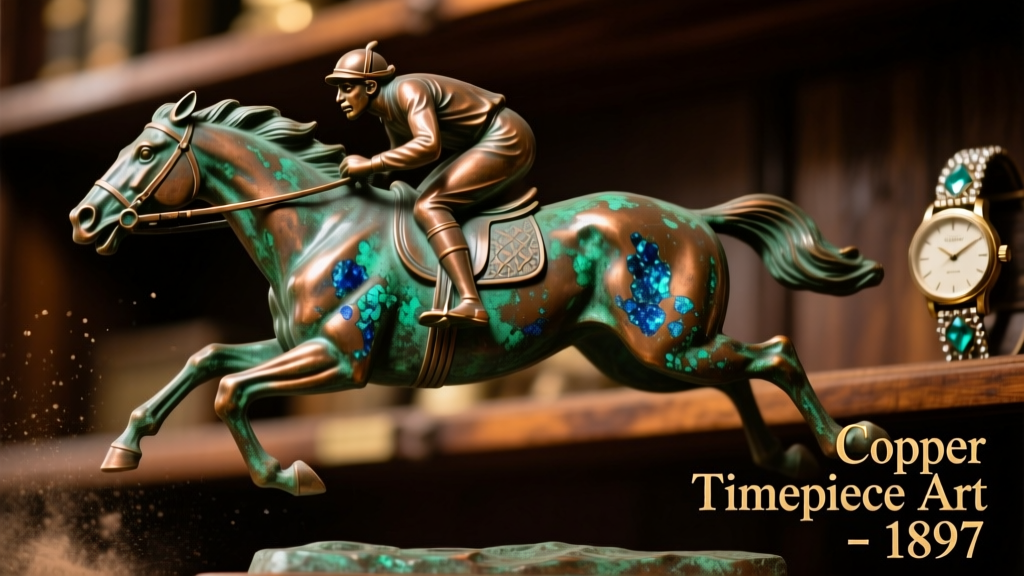
Weather Vanes: The Horse Jockey Running Figure in Copper Verdigris Patina — A Study in American Folk Art, Metallurgy, and Auction Value

Mettlach Stein No. 1526: A 1.2-Liter Pewter-Lidded Steingut Vessel Depicting Man and Woman Spinning Yarn — History, Identification, and Market Significance
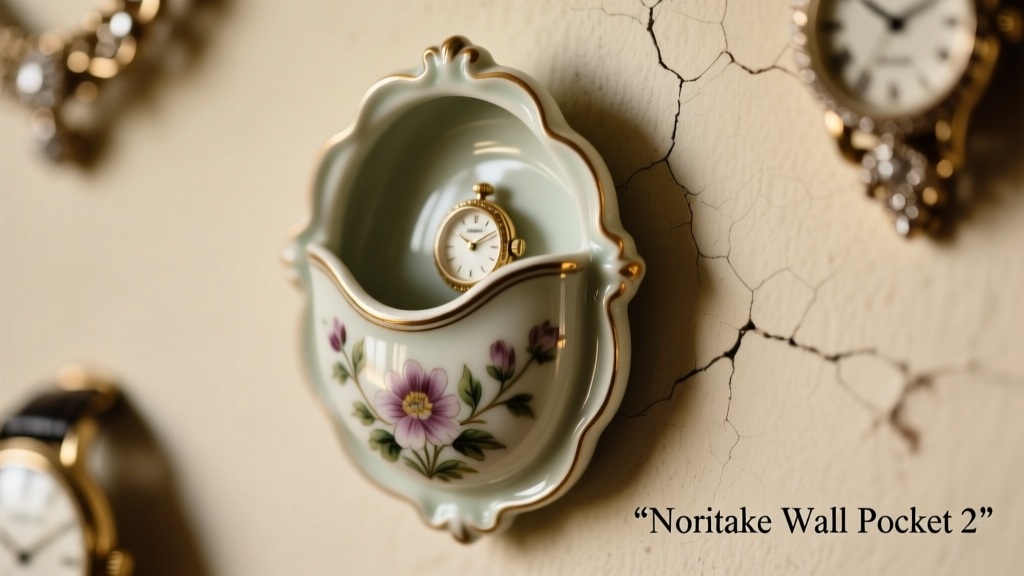
Noritake Wall Pocket No. 2: Design, Provenance, and Collectibility of a Mid-Century Ceramic Masterpiece

Toy Pedal Car Truck 'Rapid Transit' Stake Bed — A Mid-Century American Industrial Plaything in Pristine Green
Rhodolite Garnet Ring in 18K Gold: Art Nouveau Revival by Ben Accorso, Size 7
Winchester Western Sporting Arms Ammunition Advertising Sign (12 × 20 in): A Collector’s Guide to a Mid-Century American Icon
Topsy-Turvy Doll: A Rare 18½-Inch Papier-Mâché Head, Cloth Body, and Hand-Sewn Silk Dress — Provenance, Construction, and Auction Significance
Toy Telephone Bear 'I Am The Boss': Linemar’s 1955 Tinplate Masterpiece from Postwar Japan

Raccoon Forks Trading Company: A Forgotten American Watchmaker of the 1940s–1950s