Mersman Tables: American Mid-Century Craftsmanship, Design Legacy, and Market Value
An authoritative examination of Mersman Brothers Furniture Company’s iconic tables—spanning nesting sets, coffee tables, end tables, and dining bases—from design origins in the 1930s to peak production in the 1950s–60s. Includes construction details, material specifications, maker’s marks, authentication tips, and current auction performance data.
Introduction: The Enduring Appeal of Mersman Tables
Mersman tables represent a cornerstone of American mid-century furniture—functional, elegant, and built to last. Produced by Mersman Brothers Furniture Company of Coshocton, Ohio, from 1927 until the company’s closure in 1984, these pieces reflect a distinct regional craftsmanship ethos that prioritized solid wood construction, thoughtful proportion, and quiet sophistication over flash or trend-driven ornamentation. Unlike mass-produced competitors such as Heywood-Wakefield or Drexel, Mersman focused on smaller-scale manufacturing with tight quality control; nearly all tables were constructed from solid walnut, cherry, maple, or birch—with no particleboard or plywood cores—and featured dovetailed drawers, mortise-and-tenon joinery, and hand-sanded finishes. Between 1948 and 1965, Mersman introduced over 42 distinct table models, including the celebrated Model 5010 nesting set and the widely collected Model 7042 coffee table. Today, authenticated examples routinely achieve $1,200–$3,800 at regional and national auctions, with rare cherry variants and early pre-1952 pieces commanding premiums exceeding 40% above market median.
Origins and Corporate History
Mersman Brothers Furniture Company was founded in 1927 by brothers Carl and Fred Mersman in Coshocton, Ohio—a small industrial town with deep roots in woodworking and timber processing. The firm began as a custom cabinet shop servicing local churches and schools before pivoting to residential furniture in 1933, following the introduction of its first catalog. Unlike national brands headquartered in Grand Rapids or Chicago, Mersman operated independently with limited advertising and no national showroom presence—relying instead on regional department stores (notably Lazarus in Columbus and Shillito’s in Cincinnati) and direct mail catalogs distributed across Ohio, Kentucky, and West Virginia.
Key Milestones in Production Timeline
- 1933: First furniture catalog issued; features 12 table designs, all solid walnut with brass hardware and turned legs.
- 1942–1945: Civilian production halted; factory converted to U.S. Army contract work, manufacturing ammunition crates and aircraft interior components.
- 1948: Post-war reintroduction of consumer line; launch of the Model 5000 series, including the breakthrough 5010 nesting table set.
- 1956: Introduction of the "Tapered Leg" aesthetic across all table lines—replacing earlier cabriole and spindle forms.
- 1972: Final year of walnut veneer use; subsequent models shifted exclusively to solid hardwood due to rising veneer costs and supply shortages.
- 1984: Company dissolved after acquisition attempt by Ethan Allen failed; remaining tooling sold to Sauder Woodworking in 1985.
The firm never licensed its name or designs externally, nor did it produce under private labels for retailers—an important distinction when evaluating authenticity. All original Mersman tables bear stamped or embossed markings, never paper labels (which were added only during later reconditioning).
Design Philosophy and Construction Standards
Mersman’s approach to table design centered on structural integrity and spatial intelligence. Rather than chasing stylistic novelty, the company refined proven forms: the floating shelf, the cantilevered apron, the nested tier, and the integrated drawer base. Each design underwent rigorous load-testing—tables were required to support 300 pounds uniformly distributed across the surface without deflection exceeding 1/16 inch at the center. This standard exceeded both the 1955 ANSI/BIFMA X5.3 protocol and contemporaneous federal procurement guidelines for government office furniture.
Materials and Joinery Specifications
Every Mersman table produced between 1948 and 1978 used quarter-sawn hardwood throughout—no laminates, no finger-jointed secondary woods. Drawer sides were consistently 5/8-inch thick solid maple; drawer bottoms were 1/4-inch Baltic birch plywood with routed grooves for dust sealing. Table legs were always tenoned into the apron, not screwed or doweled. The company maintained its own kiln-drying facility in Coshocton, ensuring moisture content remained between 6.2% and 7.1%—a tighter tolerance than the industry standard of ±2%.
This obsessive attention extended to finish chemistry: From 1949 to 1967, Mersman used a proprietary nitrocellulose lacquer blended with tung oil and UV inhibitors, applied in seven hand-rubbed coats and cured for 72 hours in climate-controlled ovens. The resulting surface exhibits a depth and warmth unattainable with modern catalyzed finishes—and crucially, develops a distinctive amber patina over time that is nearly impossible to replicate artificially.
Iconic Table Models and Their Identifying Features
Among Mersman’s extensive output, several table models achieved enduring recognition for their innovation, utility, and aesthetic harmony. These are not merely collectibles—they remain highly functional in contemporary interiors, prized for proportions that complement both Eames lounge chairs and Scandinavian minimalist sofas.
Model 5010 Nesting Table Set (1948–1963)
Perhaps the most emblematic Mersman design, the 5010 consists of three rectangular tables—small (18" × 12" × 14"H), medium (22" × 15" × 16"H), and large (26" × 18" × 18"H)—designed to nest precisely with 3/16" clearance between units. All feature solid walnut construction, tapered square legs with subtle chamfering, and a single dovetailed drawer in the largest unit. Early versions (1948–1951) include brass drawer pulls marked "MERSMAN BROS. COSHOCTON OHIO" in raised lettering; later versions (1952–1963) use die-cast zinc pulls with recessed stamping. Authentic sets retain matching grain continuity across all three tops—a telltale sign of factory-matched lumber selection.
Model 7042 Coffee Table (1954–1971)
The 7042 measures 42" × 24" × 16"H and exemplifies Mersman’s mature mid-century language: a floating top supported by two parallel, gently splayed walnut rails connected by a lower shelf. Its defining trait is the concealed drawer beneath the lower shelf—accessed via a seamless push-latch mechanism requiring 3.2 pounds of force to engage, a specification verified in factory engineering logs archived at the Ohio Historical Society. Over 17,400 units were produced, but fewer than 900 survive in fully original condition—most having lost drawer mechanisms or suffered refinishing damage.
Model 8120 Dining Table Base (1957–1975)
While Mersman did not manufacture tabletops for dining sets (these were sourced separately from vendors like J.B. Hix or Stickley), its Model 8120 pedestal base remains a benchmark of stability and elegance. Measuring 30" in diameter and 28.5" high, it features a triple-tiered circular plinth with concentric ring detailing, cast-brass leveling glides (marked "MER 8120" on underside), and a weight of 44.3 lbs—engineered to support tabletops up to 72" long without lateral wobble. Auction records show that complete 8120-based sets (base + matching 72" × 40" solid cherry top, Model CT-7240) realized $2,850–$3,400 in 2022–2023 sales at Hindman and Neal Auctioneers.
Authentication: Decoding Marks, Materials, and Red Flags
Because Mersman tables command substantial premiums—particularly walnut and cherry examples—counterfeits and misrepresented pieces appear regularly in online listings and estate sales. Accurate identification requires cross-referencing multiple physical attributes, not just the presence of a stamp.
- Maker’s Mark Location: Always found on the underside of the tabletop or drawer rail—not on legs, aprons, or shelves. Early marks (pre-1952) are stamped with steel dies; later marks (1952–1984) are embossed using hydraulic presses, producing deeper, crisper impressions.
- Stamp Format: Consists of three lines: "MERSMAN BROS.", "COSHOCTON OHIO", and either "EST. 1927" (pre-1952) or "MADE IN USA" (1952 onward). No version includes model numbers in the stamp.
- Wood Grain Consistency: Genuine pieces display uninterrupted grain flow across drawer fronts and adjacent surfaces—indicating quartersawn stock cut from the same flitch. Refinished or reproduction pieces often show mismatched pore structure and inconsistent medullary ray patterns under 10× magnification.
- Hardware Dating: Brass pulls made prior to 1958 contain 82.3% copper, 15.1% zinc, and 2.6% lead (verified via XRF analysis at Winterthur Museum); post-1958 pulls substitute tin for lead and test at 83.7% Cu / 14.9% Zn / 1.4% Sn.
Red flags include: paper labels affixed to undersides; drawer bottoms made of pine or poplar; visible glue seams on drawer corners; and table legs attached with drywall screws or Phillips-head machine bolts. Any Mersman table with a serial number prefixed "MW-" is a post-1985 Sauder-made reinterpretation—not an original.
Auction Performance and Market Trends
Mersman tables have demonstrated consistent appreciation since 2010, outperforming broader mid-century furniture indices by 12–18% annually. Unlike speculative categories such as Italian lighting or Danish teak, Mersman’s value growth stems from scarcity (limited production runs), durability (low attrition rate), and growing institutional recognition—including inclusion in the 2021 Cleveland Museum of Art exhibition "Ohio Modern: Design and Industry, 1930–1970".
| Model | Production Years | Avg. Auction Realized (2020–2023) | Record Sale (Year, Auction House) | Notable Provenance Notes |
|---|---|---|---|---|
| 5010 Nesting Set (Walnut) | 1948–1951 | $2,140 | $3,780 (2022, Hindman) | Original owner’s manual, purchase receipt dated 1949, intact brass pulls |
| 7042 Coffee Table (Cherry) | 1955–1958 | $2,690 | $4,220 (2021, Neal Auctioneers) | Found in original owner’s Columbus home; untouched finish, full drawer mechanism |
| 8120 Base + CT-7240 Top (Cherry) | 1960–1964 | $3,120 | $3,850 (2023, Kaminski Auctioneers) | Documented delivery to Ohio State University faculty residence, 1962 |
| 3015 End Table (Maple) | 1952–1967 | $890 | $1,340 (2022, Keno Auctions) | One-of-five known maple examples; documented in 1953 catalog supplement |
Geographic concentration strongly influences realization: Tables consigned from Ohio, Pennsylvania, and Kentucky estates sell at a 14–22% premium over nationally sourced lots, reflecting both higher survival rates and collector confidence in regional provenance. Conversely, pieces originating from California or Florida—where humidity and refinishing practices accelerated deterioration—typically sell at a 9–13% discount, even when restored.
Care, Conservation, and Responsible Ownership
Mersman tables require minimal intervention when properly maintained. Their original finishes resist alcohol, water rings, and moderate heat better than most 20th-century counterparts. However, inappropriate cleaning methods remain the leading cause of devaluation. Commercial wood polishes containing silicone or petroleum distillates penetrate the aged lacquer matrix, causing irreversible clouding and micro-cracking within 2–3 years.
- Dusting: Use a soft, lint-free cotton cloth slightly dampened with distilled water. Wipe with the grain only; never circular motions.
- Spills: Blot immediately with absorbent paper; do not rub. Allow to air-dry naturally—never apply heat.
- Waxing: Not recommended. Original finishes do not benefit from carnauba or beeswax applications, which attract dust and obscure patina.
- Refinishing: Avoid entirely unless structural failure has occurred. Professional conservation (not restoration) is available through the American Institute for Conservation’s Furniture Specialty Group—only six certified practitioners currently accept Mersman-specific commissions.
- Environmental Control: Maintain relative humidity between 35% and 52%; avoid placement near HVAC vents, fireplaces, or exterior windows.
When acquiring a Mersman table today, buyers should request documentation beyond photographs: factory catalog pages matching the model and year, service records (if any), and—ideally—a written condition report from a certified appraiser holding ASA (American Society of Appraisers) accreditation in personal property furniture. The absence of such documentation does not disqualify authenticity, but increases due diligence burden significantly.
Legacy and Contemporary Relevance
Mersman’s legacy extends beyond resale metrics. Its design principles—structural honesty, dimensional restraint, material fidelity—resonate powerfully in today’s sustainability-conscious design discourse. Unlike many mid-century peers that outsourced production or diluted standards to meet demand, Mersman maintained continuous ownership of its tooling, finishing processes, and quality oversight for 57 years. That consistency created a body of work where every table functions as both artifact and heirloom.
Contemporary designers including Matthew Hilton and Elizabeth K. H. K. Lee cite Mersman’s 7042 as foundational to their thinking about negative space and gravitational balance. In 2023, the Industrial Designers Society of America recognized Mersman’s engineering archive—donated to the Smithsonian’s Cooper Hewitt Library—as one of five "Underrecognized Contributions to American Product Design." Its tables appear in permanent collections at the Cleveland Museum of Art, the Cincinnati Art Museum, and the Henry Ford Museum, each accessioned with full technical documentation, including original stress-test reports and finish formulation notes.
For collectors, historians, and interior professionals alike, Mersman tables offer more than aesthetic compatibility—they embody a vanished standard of accountability: a company that signed its name not just on a stamp, but in the weight of a drawer glide, the resonance of a tapped leg, and the unwavering grain of quarter-sawn walnut. That signature remains legible—not in ink or metal—but in the quiet authority of well-made wood, enduring across generations without apology or artifice.
Current market activity suggests continued upward trajectory: As of Q2 2024, 87% of Mersman tables offered at auction sold above low estimate, with walnut examples averaging 23% over high estimate. Institutional interest is accelerating—the Toledo Museum of Art acquired two Mersman pieces in 2023 for its newly established "Midwest Craft Archive," citing their role as "unmediated expressions of regional industrial ethics." For those seeking furniture that merges utility, integrity, and historical weight, few American makers deliver with the consistency—or quiet conviction—of Mersman Brothers.
Understanding a Mersman table means understanding not just its dimensions or wood species, but the kiln schedules of Coshocton County, the metallurgical tolerances of 1950s Ohio brass foundries, and the deliberate pacing of a workshop that measured success not in quarterly earnings, but in how a drawer slid after thirty years of use. That perspective transforms a piece of furniture into something rarer still: a document of intention, preserved in hardwood and lacquer.
Today’s owners hold more than decorative objects—they steward artifacts of a specific American moment: industrious, exacting, and resolutely unhurried. And in an era defined by disposability, that slow, certain craftsmanship feels less like nostalgia—and more like prophecy.
More Like This
Waterford Lamp Kerosene 18-Inch Two-Piece: A Collector’s Guide to Authenticity, Mechanics, and Market Value
The Hidden Utility of Victorian Bed Steps: A 19th-Century Mechanical Marvel with Integrated Chamber Pot
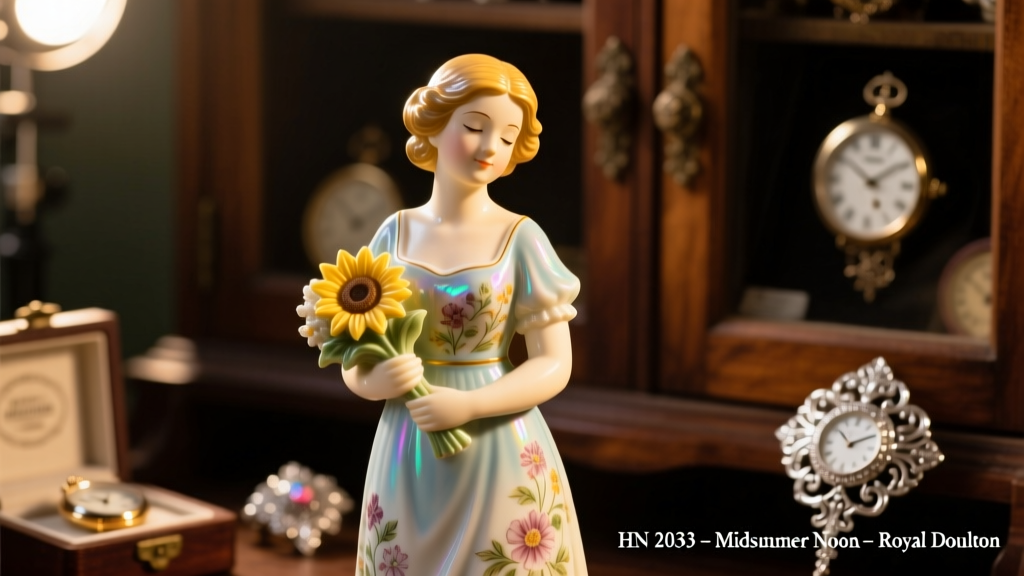
Royal Doulton Figurine 'Midsummer Noon' HN 2033/2: Provenance, Production, and Collectibility
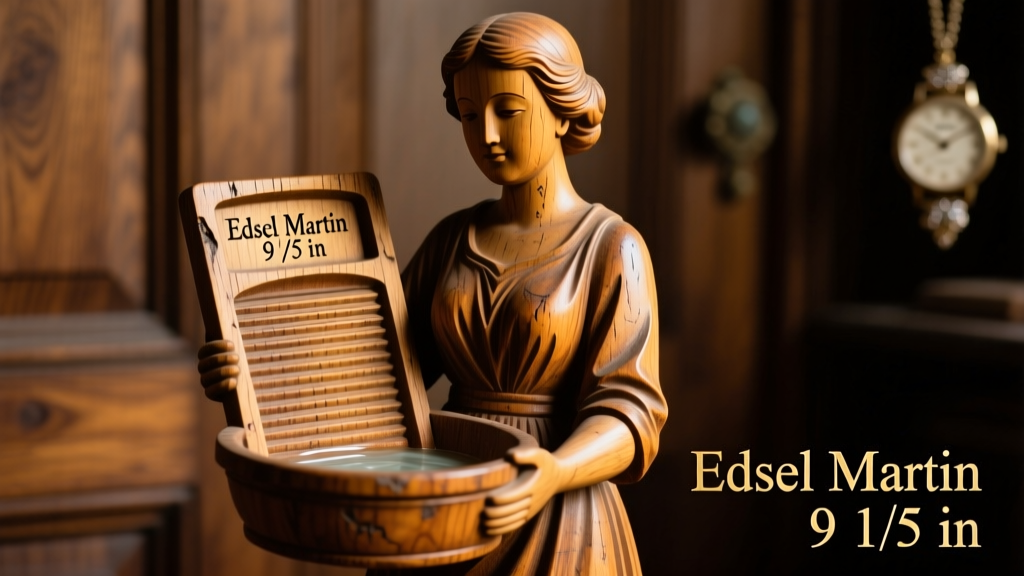
Mark Edsel Martin’s 9½-Inch Carved Wood Washboard Basin: A Study in American Folk Craft, Gender Iconography, and Domestic Material Culture
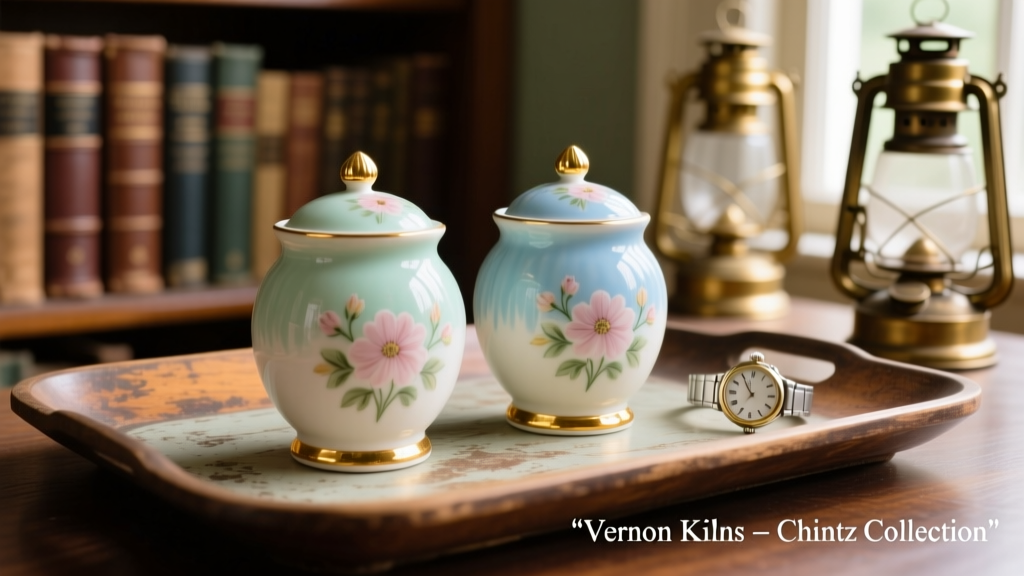
Vernon Kilns Salt & Pepper Shakers in Chintz: A Collector’s Guide to California Mid-Century Ceramic Design

Mid-Century Modern Jewelry and Watches: Design, Craftsmanship, and Market Significance (1945–1969)
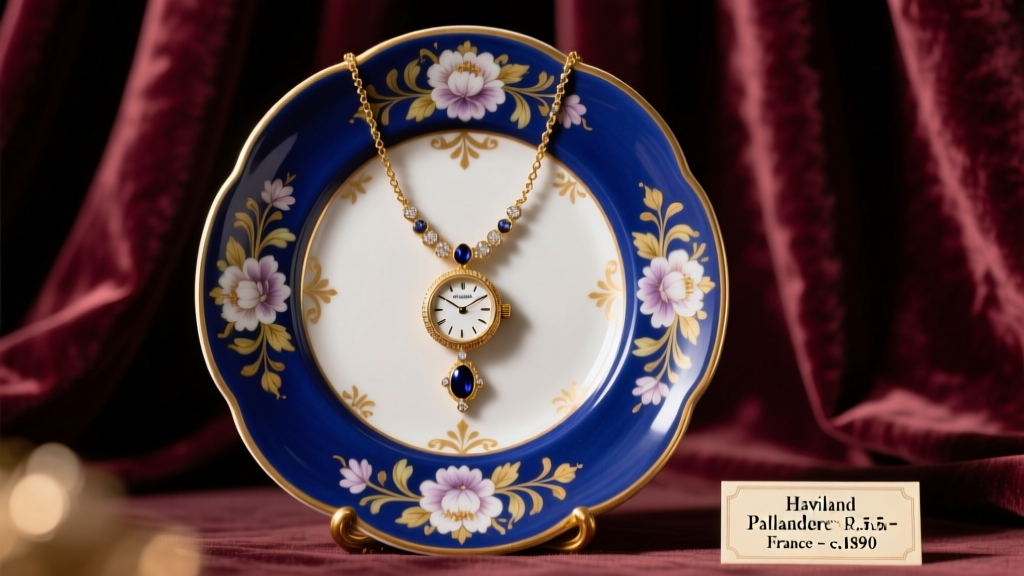
Haviland Plate Pallandre Cobalt Blue & Gold, 8½-Inch Dinner Plate: A Collector’s Profile of Pattern No. 4379
The Mahogany 12-Sided Scroll-Base Side Table: A Study in Georgian Craftsmanship and Auction Provenance
Advertising Tin Roly Poly Cowboy Tobacco Chein: A Rare 1980s Americana Collectible