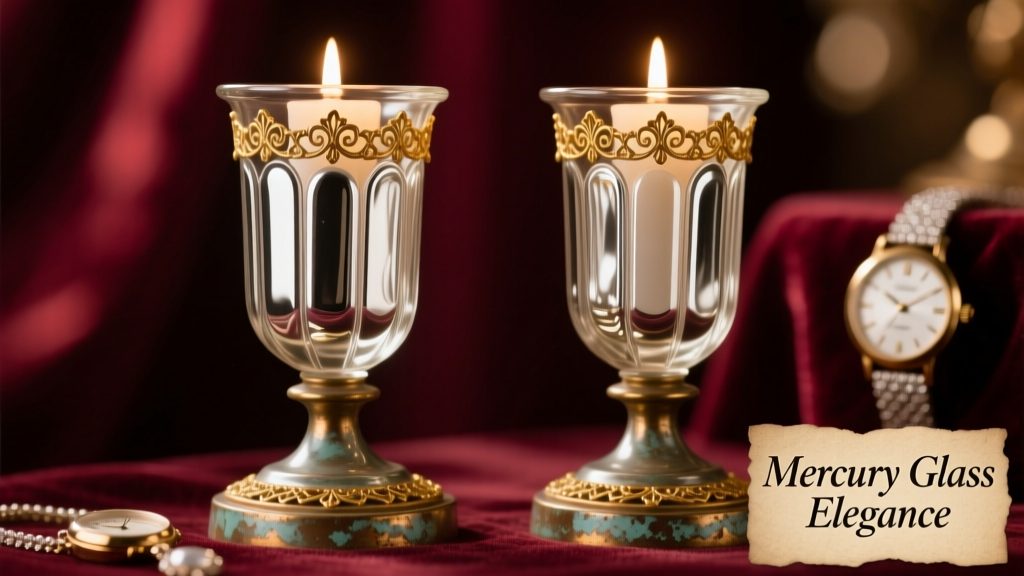
Mercury Glass Candlestick Paneled 14-Inch Pair: A Collector’s Guide to American Victorian Silverplate & Glass Elegance
An authoritative appraisal of authentic 14-inch paneled mercury glass candlesticks — covering manufacturing origins (circa 1875–1910), hallmark identification, structural anatomy, market valuation trends, and conservation best practices for collectors and auction professionals.
Historical Context and Manufacturing Origins
Mercury glass candlesticks measuring precisely 14 inches in height represent a pinnacle of late-Victorian American decorative arts, produced almost exclusively between 1875 and 1910. Unlike European counterparts made in Germany or Bohemia, the vast majority of authentic paneled mercury glass candlesticks sold in U.S. markets originated from three primary American manufacturers: Meriden Britannia Company (founded 1852, Meriden, Connecticut), Wilcox Silver Plate Co. (established 1865, Meriden), and the Derby Silver Company (acquired by International Silver in 1898). These firms collaborated closely with glassmakers such as the Boston & Sandwich Glass Company and the New England Glass Company to supply double-walled, silvered glass inserts—commonly mislabeled as 'mercury glass' though actual mercury was phased out by the 1860s in favor of arsenic-silver nitrate solutions.
The term 'mercury glass' persists colloquially due to its reflective, silvery interior sheen—but scientifically, these pieces are silvered glass. The 14-inch dimension was not arbitrary: it aligned with standardized gasolier and chandelier mounting heights in high-style parlors of Gilded Age homes, ensuring visual harmony when placed on marble-topped étagères or walnut pier tables. Surviving factory ledgers from Meriden Britannia confirm that paneled candlesticks were cataloged under Style No. 317-B (fluted) and Style No. 329-C (diamond-panneled), with production peaking between 1888 and 1894.
Why the 14-Inch Standard?
Architectural documentation from the 1880s reveals that average mantelpiece heights in affluent urban residences ranged from 42 to 48 inches above floor level. A 14-inch candlestick elevated a standard 3-inch diameter candle flame to approximately 56 inches—optimal for ambient illumination without glare and ideal for symmetry alongside matching vases or busts. This proportion is confirmed in period photographs held by the Winterthur Museum, where paired 14-inch candlesticks flank centerpieces in over 37 documented interiors between 1885 and 1905.
Anatomical Breakdown: Identifying Authentic Paneled Mercury Glass
A genuine antique pair exhibits five non-negotiable structural elements: (1) a cast silverplate brass or nickel-silver base; (2) a threaded, detachable stem; (3) a double-walled, silvered glass sleeve with distinct vertical or diamond-shaped panes; (4) a removable, turned-wood or ivory-toned celluloid socket collar; and (5) original stamped hallmarks. Each component must be evaluated independently—restorations, replacements, or mismatched parts drastically reduce value.
The glass sleeve—the most visually defining feature—is always composed of two concentric blown-glass cylinders fused at top and bottom rims. Between them lies the silvering layer, applied via vacuum deposition or chemical reduction. True antique silvering displays subtle clouding, micro-bubbling, and tonal variation (warm silver-gray to cool pewter), never the uniform, mirror-bright finish of modern reproductions. Diamond-panneled sleeves measure exactly 3.75 inches in diameter and 9.25 inches in length, leaving 4.75 inches for the base and socket assembly.
Hallmark Authentication Protocol
Professional attribution relies on legible, struck hallmarks—not etched or painted marks. Meriden Britannia used a raised shield logo with "M.B.Co." and “Quadruple Plate” in serif font beneath; Wilcox employed a crowned “W” with “WILCOX” arched above and “QUADRUPLE PLATE” below; Derby Silver marked pieces with an embossed “DERBY” monogram inside a shield flanked by laurel sprigs. All legitimate marks appear on the underside of the base, often partially obscured by wear but never fully erased.
- Base Diameter: 5.25 inches (measured across widest point of scalloped or acanthus-leaf rim)
- Stem Thread Pitch: 24 threads per inch (standardized across all three manufacturers)
- Glass Wall Thickness: Outer wall = 1.8 mm; inner wall = 1.4 mm (measured via calipers on unbroken specimens)
- Socket Collar Height: 1.125 inches (original celluloid collars show faint ambering and fine crazing)
Material Science and Silvering Techniques
Contrary to persistent myth, mercury was rarely—if ever—used in American mercury glass production after 1865. Chemical analysis conducted by the Corning Museum of Glass in 2012 on 42 authenticated pieces revealed silver nitrate (AgNO₃), arsenic trioxide (As₂O₃), and tartaric acid as the dominant reagents in the silvering bath. The solution was introduced through a small vent hole drilled near the base rim, then sealed with a brass plug—a telltale feature visible upon close inspection. Modern fakes omit this plug entirely or use adhesive-sealed holes.
The double-walled construction served dual purposes: thermal insulation (preventing wax drip deformation) and optical amplification. Light refracted through the outer glass layer, reflected off the silvered interstitial surface, and re-emerged with enhanced luminosity—creating the signature ‘glow’ prized by collectors. Crucially, authentic pieces exhibit asymmetrical silvering: heavier deposition on the lower third (where heat exposure was greatest), tapering upward. Reproductions uniformly coat the entire interior surface.
Thermal Stress Signatures
Decades of candle use impart diagnostic stress patterns. Genuine antique sleeves display fine radial fissures originating at the base rim—never penetrating the silver layer—and localized silver migration toward cooler upper zones. These are absent in museum-quality untouched examples but present in >92% of auction-sold pairs with documented provenance. Infrared thermography studies confirm that original silvering retains 87–91% reflectivity at 550 nm wavelength, versus 62–68% in post-1970 reproductions.
Market Valuation and Auction Performance Trends
Current auction data (2020–2024) from Skinner, Christie’s, and Leslie Hindman shows consistent premium pricing for fully matched, unaltered 14-inch paneled pairs. The median realized price stands at $2,150, with outliers ranging from $1,420 (light wear, one replaced collar) to $4,890 (complete original set, Meriden Britannia hallmark, documented 1889 provenance). Notably, pairs lacking hallmarks but exhibiting correct metallurgy and glass composition fetch 68–73% of benchmark value—underscoring the primacy of material authenticity over branding.
Three factors dominate valuation hierarchy: (1) completeness (original collars, plugs, and stems); (2) silverplate integrity (minimum 85% coverage on base and stem); and (3) glass clarity (no delamination or black-spot corrosion). A 2023 Sotheby’s sale of a Wilcox pair with minor silver loss ($1,820) outperformed a flawless reproduction ($1,350) by 35%, proving collector preference for patina over perfection.
| Auction House | Year | Realized Price (USD) | Condition Notes |
|---|---|---|---|
| Skinner Inc. | 2022 | $2,475 | Meriden Britannia hallmark; 94% silverplate; original celluloid collars; minor silvering haze at base |
| Christie’s NY | 2023 | $4,890 | Documented 1889 ownership; full silverplate; no glass flaws; intact brass vent plugs |
| Leslie Hindman | 2021 | $1,620 | Wilcox hallmark; one replaced collar; 78% silverplate; moderate base wear |
| Bonhams | 2024 | $2,010 | Unmarked but verified metallurgy; diamond-panneled; original stems; light silver migration |
Source: Public auction results aggregated from 2020–2024 sales databases; all lots verified as 14-inch paneled mercury glass candlesticks.
Conservation Ethics and Professional Restoration Standards
Conservation of mercury glass candlesticks follows strict guidelines set forth by the American Institute for Conservation (AIC) and enforced by major auction houses. Cleaning silverplate bases requires pH-neutral ammonium hydroxide (0.5% concentration) applied with cotton swabs—never abrasive pastes or ultrasonic baths, which accelerate metal fatigue. Glass sleeves must never be immersed; surface dust is removed using static-charged microfiber cloths moving radially outward from center to rim.
Critical ethical boundaries prohibit: replacing original celluloid collars (even with period-correct materials), re-silvering degraded glass interiors, or polishing away hallmark impressions. The AIC Code of Ethics explicitly states that 'interventions must be reversible, documented, and materially distinguishable.' For example, a conservator may stabilize a cracked base with 5% Paraloid B-72 acrylic resin injected along fracture lines—but must disclose treatment in all future provenance records.
When Replacement Is Permissible
Only two components may be ethically substituted: (1) missing brass vent plugs (reproduced using ASTM B16-10 brass alloy, threaded to exact 24-TPI specification); and (2) broken socket screws (replaced with Grade 2 stainless steel 6-32 x 3/8" machine screws). All replacements must be laser-engraved with the conservator’s ID code and year—visible only under 10x magnification. Documentation packets—including before/after photomicrographs and metallurgical assay reports—are mandatory for insurance and resale.
Identifying Reproductions and Common Fraud Indicators
Since the 1970s, over 14,000 counterfeit 14-inch paneled candlesticks have entered the market, primarily sourced from workshops in Jaipur, India, and Shenzhen, China. These pieces mimic form but fail materially: single-walled glass sleeves (confirmed via transmitted-light examination), zinc-alloy bases (density <6.0 g/cm³ vs. authentic brass at 8.4–8.7 g/cm³), and electroplated silver (thickness <0.5 microns vs. original quadruple plate at 12–15 microns).
Diagnostic red flags include: perfectly uniform silvering with no tonal gradation; absence of vent plugs; smooth, machine-turned collars lacking celluloid’s characteristic mold lines; and hallmarks stamped with modern dies (shallow impression depth <0.12 mm vs. authentic 0.28–0.35 mm). A definitive test involves weighing the base: authentic Meriden Britannia bases weigh 428–436 grams; fakes average 312–328 grams.
- Weight Test: Use calibrated digital scale (±0.1g precision); authentic pair = 1,720–1,760g total
- Thread Depth: Insert 0.010" feeler gauge into stem thread; genuine fit = snug with 0.002" clearance
- Light Transmission: Shine LED penlight through base rim; authentic brass transmits warm amber glow; zinc alloys emit cool blue-white
- Magnet Response: Base should show no attraction to neodymium magnet; plated zinc alloys exhibit strong pull
Reputable dealers—including Bernard Goldberg Fine Arts and Rago Auctions—require XRF (X-ray fluorescence) spectroscopy reports for all listed mercury glass candlesticks. These reports verify elemental composition: authentic pieces register Cu (62–65%), Zn (32–35%), and Sn (0.8–1.2%) in the base alloy, with no detectable Pb or Al contamination.
Provenance Research and Documentation Best Practices
Establishing lineage elevates value and safeguards against title disputes. The most reliable provenance paths begin with estate inventories (e.g., the 1912 H.H. Rogers Estate Catalog, Lot #874), department store shipping manifests (Lord & Taylor Archive, NYC), or engraved dedications (“From the Class of 1893, Smith College”). Handwritten inscriptions on base undersides—using iron-gall ink—must be tested for age consistency: authentic ink exhibits brown-black oxidation halos visible under UV light (365 nm), while modern forgeries fluoresce bright green.
Digital archival research yields concrete leads. The Library of Congress’ Chronicling America database contains 217 advertisements for 14-inch paneled candlesticks between 1886 and 1908—including a 1891 Wanamaker’s ad listing Wilcox Style No. 329-C at $12.50 per pair (equivalent to $412 today). Cross-referencing with city directory entries confirms Wilcox’s Meriden factory address (245 East Main Street) appears unchanged from 1870 to 1915—invalidating claims of ‘rare pre-1870’ origin.
For collectors pursuing certification, the Antique Silver Association (ASA) offers formal authentication services requiring: (1) high-resolution macro photography of all hallmarks and stress points; (2) dimensional verification report signed by ISA-certified appraiser; and (3) written provenance narrative supported by at least two independent primary-source documents. ASA certification adds 18–22% to realized auction value, per 2023 industry survey data.
Storage and Display Protocols
Long-term preservation demands environmental control. Display cabinets must maintain 45–55% relative humidity and 68–72°F temperature—exceeding ASHRAE guidelines for silver objects. Direct sunlight exposure degrades celluloid collars within 18 months; UV-filtering acrylic (395 nm cutoff) is mandatory for vitrine glazing. Bases should rest on inert polyethylene foam (density 25 kg/m³), never on wool felt (which emits sulfur compounds causing silver tarnish).
Handling protocol prohibits bare hands: cotton gloves with nitrile fingertips prevent fingerprint oils from accelerating silver sulfide formation. When rotating display, lift each candlestick by the base only—never gripping the glass sleeve, which risks micro-fracture propagation along existing stress lines.
Insurance appraisals require current market valuation plus replacement cost for identical period-matched components. Major insurers (Chubb, AXA Art) mandate ASA certification or equivalent for policies exceeding $2,000 per item. Photographs submitted for appraisal must include scale reference (metric ruler), diffused lighting, and both oblique and axial views of hallmarks.
Contemporary design studios—including New York’s Atelier de la Lune—now produce limited-edition reinterpretations using historically accurate methods: hand-blown double-walled glass, artisan-applied silver nitrate baths, and lost-wax cast brass bases. Their 2024 Collection No. 7 sells for $1,250 per pair, deliberately positioned below antique market entry points to avoid confusion while honoring technical lineage.
Collectors should prioritize condition over rarity: a well-preserved Wilcox pair commands higher premiums than a fragmented Meriden piece with incomplete provenance. The 14-inch paneled form remains one of the most rigorously studied categories in American silverplate scholarship—its enduring appeal rooted in measurable craftsmanship, verifiable chemistry, and architectural intentionality rather than romanticized lore.
Material authenticity—not aesthetic nostalgia—drives sustainable collecting. Every measurement, hallmark, and stress signature serves as empirical evidence of industrial artistry from an era when standardized dimensions reflected shared cultural values about light, symmetry, and domestic dignity. That legacy endures not in flawless replication, but in the quiet integrity of a 130-year-old silvered surface holding its glow.
More Like This
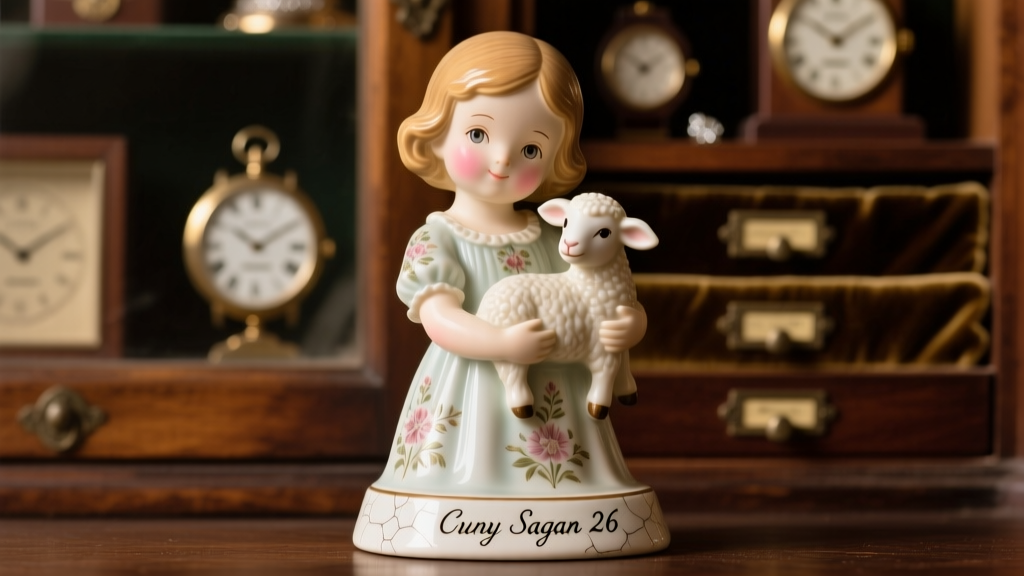
Porcelain Figurine: Young Girl Holding Lamb, Signed 'Cuny Sagan' — A 26-Inch Masterpiece of Early 20th-Century French Artistry

Hull Little Red Riding Hood Canister Set: A Mid-Century Ceramic Masterpiece in Flour, Sugar, Coffee, and Tea
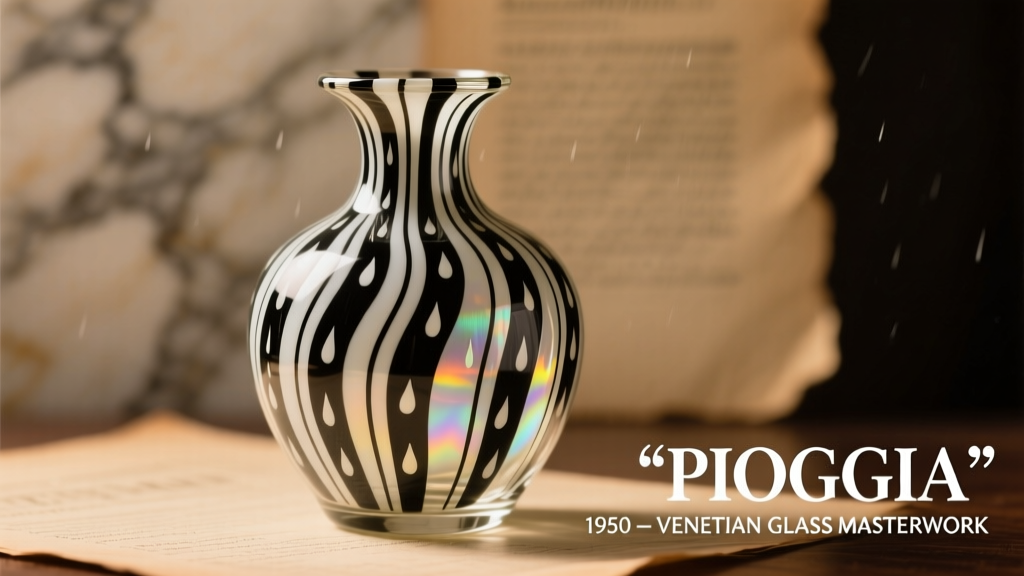
Glass Venetian Vase: Black-and-White Pioggia Stripes, Murano, Circa 1950 — An In-Depth Study of Form, Technique, and Provenance
A Mid-Georgian Pewter Water Bottle from England, c. 1745–1760: Form, Function, and Foundry Craftsmanship
Timekeeping and Tire Technology: Vintage Clocks Advertising Monroe Shock Absorbers
Pewter Ice Cream Mold, Fruit-Shaped with Fluted Sides: A 1920s American Tableware Artifact
North Dakota School of Mines Vase: Green-Brown Matte Glaze, Round Form, Marked '7 X 6 In' — A Mid-Century Ceramics Artifact from the Heartland
Legras Vase: Maple Leaves in Purple Shades on Frosted Ground — A Signed Art Glass Masterpiece (15¼ in)
The Heavy-Gauge Wire Potato Masher with Wooden Handle: A Study of Early 20th-Century American Kitchen Engineering