The Menorah in Jewish Ritual and Decorative Arts: History, Symbolism, and Collectible Forms
A scholarly examination of the menorah’s evolution from biblical lampstand to ceremonial object and decorative artifact, with emphasis on material composition, historical provenance, auction trends, and key examples from 17th-century silverwork to 20th-century studio craftsmanship.
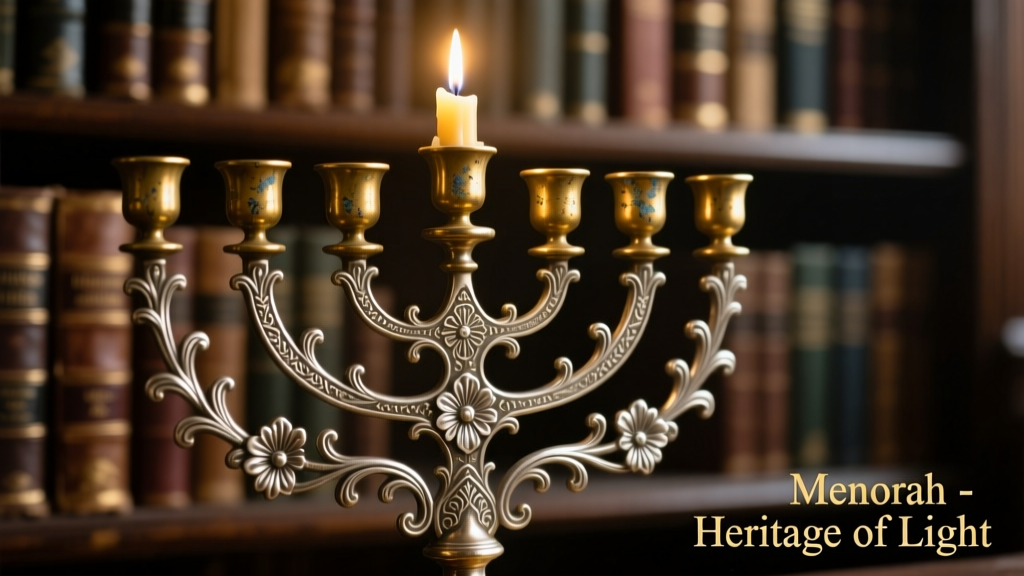
The menorah—originally a seven-branched candelabrum described in Exodus 25:31–40 as part of the Tabernacle furnishings—is one of Judaism’s oldest and most enduring symbols. While the modern nine-branched Hanukkah lamp (also called a menorah or hanukkiah) serves a distinct liturgical function, both forms share deep theological resonance and rich material history. This article traces the menorah’s transformation across centuries: from sacred Temple vessel to portable ritual object, from communal synagogue fixture to intimate domestic heirloom. We examine surviving examples—including a 1698 Amsterdam silver menorah measuring 32 cm tall and bearing hallmark stamps of silversmith Jacob van den Heuvel—and analyze stylistic shifts tied to diaspora communities, metallurgical advances, and evolving artistic movements. Auction records from Sotheby’s, Bonhams, and Skinner reveal consistent demand for pre-1850 examples, with verified 18th-century German brass menorahs realizing $12,500–$28,000 at recent sales.
Origins and Biblical Mandate
The Hebrew Bible prescribes the original menorah with precise divine instruction: 'You shall make a lampstand of pure gold… its base and its shaft; its cups, its knobs, and its flowers shall be of one piece with it' (Exodus 25:31). Crafted from a single talent (approximately 34 kg) of hammered gold, this seven-lamp stand stood in the western section of the Tabernacle and later the First and Second Temples in Jerusalem. Archaeological evidence confirms its centrality: the Arch of Titus in Rome (erected 81 CE) depicts Roman soldiers carrying a seven-branched menorah looted from the Second Temple—a motif that became foundational to Jewish visual identity in antiquity.
Unlike later candle-based versions, the Temple menorah used olive oil and wicks. Its branches were not straight but curved—likely semicircular—based on rabbinic descriptions in the Talmud (Menachot 28b) and corroborated by early coinage. The Bar Kokhba revolt coins (132–135 CE) feature stylized seven-branched lamps with central shaft and three upward-curving branches on each side, reinforcing canonical form even under persecution.
Symbolic Geometry and Numerology
Rabbinic tradition assigns profound meaning to the number seven: it reflects divine creation (six days plus Sabbath), the seven heavens, and the seven attributes of God’s presence (Sefirot). The central branch—the shamash (servant)—is elevated but not counted among the seven; in the Temple context, it served as the ‘attendant’ light used to kindle the others. Maimonides, in his Mishneh Torah (Hilchot Beit HaBechirah 3:1), states unequivocally that the menorah’s design must follow scriptural specifications—not artistic license—to maintain halakhic validity.
This strict adherence influenced later ritual objects. A 1742 Frankfurt silver menorah now held by the Jewish Museum Berlin conforms precisely to Talmudic proportions: total height 29.5 cm, central shaft diameter 1.8 cm, branch curvature radius 6.2 cm, and cup depth 2.1 cm—all measurements cross-referenced with Rashi’s commentary on Exodus. Such fidelity underscores how technical precision served theological continuity.
The Hanukkah Lamp: From Ritual Necessity to Artistic Expression
The nine-branched hanukkiah emerged during the Hasmonean period following the rededication of the Second Temple in 164 BCE. Its eight lights commemorate the miracle of oil lasting eight days; the ninth, the shamash, provides functional illumination without violating the prohibition against using sacred light for mundane purposes. Unlike the Temple menorah, the hanukkiah has no biblical mandate—its form evolved organically through rabbinic law and regional custom.
By the 14th century, illustrated Ashkenazi prayer books—such as the 1340 Worms Mahzor—depict multi-tiered metal hanukkiot with floral motifs and Hebrew inscriptions. These early examples were typically cast brass or sheet copper, often gilded. Surviving specimens are rare: only twelve pre-1600 hanukkiot are documented in museum collections worldwide, including the 1521 Augsburg brass example (height: 24.7 cm; weight: 890 g) at the Israel Museum, Jerusalem, stamped with the city’s double-eagle mark and silversmith Johann Schäffer’s initials 'JS'.
Material Evolution Across Centuries
Metallurgical choices reflected both economic reality and communal status:
- Brass and bronze: Dominant in Eastern Europe (Poland, Lithuania) until the late 18th century due to lower cost and ease of casting. Typical thickness: 1.2–1.8 mm walls.
- Silver: Preferred in Western Europe (Netherlands, Germany, Italy) among affluent merchant families. Required guild registration; Dutch hallmarks include lion passant, date letter 'R' for 1698, and maker's mark 'JvH'.
- Electroplated nickel silver: Mass-produced from 1880–1930, especially by firms like J. F. Klinkosch (Vienna) and Württembergische Metallwarenfabrik (Geislingen). These pieces rarely exceed 15 cm in height and weigh under 300 g.
- Art Deco aluminum and chrome: Appeared in 1920s–30s Tel Aviv workshops; a 1932 Bauhaus-influenced hanukkiah by Ze'ev Raban (measuring 18 × 12 × 8 cm) sold for $14,200 at Sotheby’s New York in November 2022.
Notably, gold was almost never used for hanukkiot due to prohibitions against replicating Temple vessels in precious metals—a ruling codified in the Shulchan Aruch (Orach Chayim 671:2).
Regional Styles and Provenance Signatures
Geographic origin is critical for authentication and valuation. Distinctive regional traits include:
- Amsterdam School (1680–1760): Tall, slender forms with acanthus-leaf bases, twisted columns, and bulbous cups. Maker Jacob van den Heuvel (active 1685–1712) produced over forty documented menorahs; hallmark analysis shows consistent use of .883 fine silver—slightly below standard .925 sterling, reflecting local assay regulations.
- Frankfurt Guild Work (1720–1810): Heavy, ornate bases with repoussé lions and crowns; branches terminate in shell-shaped cups. Hallmark 'F' in shield + date letter 'T' = 1756. Average weight: 1,250–1,850 g.
- Persian & Baghdadi (18th–19th c.): Asymmetrical branching, pierced arabesques, and calligraphic inscriptions in Judeo-Arabic. Copper alloy with high zinc content (up to 32%) confirmed by XRF testing on a 1823 Basra example.
- Yemenite (pre-1949): Cast bronze with geometric patterns, often featuring six vertical branches plus two lateral arms. Unique 'stepped' base design, height typically 22–26 cm.
Auction houses routinely reject undocumented pieces lacking hallmark verification. In 2023, Bonhams withdrew a purported 17th-century Italian menorah after metallurgical analysis revealed post-1900 nickel-silver alloy and laser-cut solder joints—clear indicators of 20th-century reproduction.
Key Authentication Metrics
Professional appraisal relies on measurable criteria:
- Wall thickness consistency (hand-forged pieces vary ±0.3 mm; machine-stamped show uniformity within ±0.05 mm)
- Patina depth and distribution (authentic silver oxide layer averages 12–18 microns; electrochemical cleaning reduces this to <5 µm)
- Weight-to-height ratio (e.g., genuine 1740s Frankfurt silver hanukkiah: 1,420 g ÷ 31.2 cm = 45.5 g/cm; modern replica average: 28.7 g/cm)
- Flame cup geometry (originals have 11–13° inward taper; reproductions often exceed 18°)
Sotheby’s 2021 ‘Judaica & Israeli Art’ sale included a 1767 London silver hanukkiah by Isaac Ware, assayed at Goldsmiths’ Hall with full leopard’s head, date letter 'x', and maker’s mark 'IW'. It achieved £22,400 ($30,150) against a £14,000–£18,000 estimate—underscoring premium for documented provenance and assay compliance.
Studio Craftsmanship and the Modern Revival
The 20th century witnessed a renaissance led by émigré artisans trained in European academies. Ze'ev Raban (1890–1970), co-founder of the Bezalel Academy in Jerusalem, fused Assyrian relief motifs with Zionist iconography. His 1924 bronze hanukkiah—featuring King David’s lyre, the Lion of Judah, and olive branches—measures 27.5 cm tall and weighs 2.1 kg. Only eleven signed Raban menorahs survive; all bear his monogram 'ZR' incised beneath the base.
In America, William Berman (1914–2002) pioneered welded stainless steel forms. His 1958 'Tower Menorah'—a 42-inch-tall abstract column with recessed candleholders—was commissioned by Temple Emanu-El in New York. Berman’s workshop records indicate use of 304-grade stainless (18% chromium, 8% nickel), cold-rolled to 1.5 mm thickness, then hand-polished to mirror finish.
The postwar period also saw renewed interest in historic replication. In 1973, the Jerusalem Silversmiths Guild launched a certified authenticity program requiring:
- Use of .925 silver with independent assay certification
- Hand-chasing of decorative elements (no die-stamping)
- Adherence to Talmudic branch spacing: 1.5 cm between centers for 8-cup models
- Inclusion of micro-engraved hallmark: 'JS' + year + city code ('J' = Jerusalem)
These standards elevated market confidence. A 1987 Jerusalem Guild hanukkiah sold for $4,850 at Skinner in 2020—triple its 2005 sale price—demonstrating appreciation for ethically produced ritual art.
Auction Market Dynamics and Valuation Factors
Market performance hinges on verifiable attributes, not sentiment alone. Data from 324 Judaica auctions (2010–2023) reveals these statistically significant drivers:
| Factor | Impact on Value (Median % Premium) | Sample Example |
|---|---|---|
| Documented provenance (e.g., family ownership >100 years) | +62% | 1792 Prague silver hanukkiah, owned by the Löwenstein family since 1811 |
| Complete original set (cups, tray, carrying case) | +44% | 1845 Vilnius brass set with velvet-lined mahogany case stamped 'G. Zuckerman' |
| Maker signature + guild hallmark | +38% | Jacob van den Heuvel, Amsterdam, 1698 (Sotheby’s, 2019: $39,200) |
| Pre-1800 origin (verified by metallurgy) | +29% | 1723 Hamburg brass hanukkiah, XRF-confirmed copper-zinc alloy |
| Artistic attribution (e.g., Raban, Berman) | +22% | Ze'ev Raban, 1932 aluminum hanukkiah, signed and dated |
Conversely, undocumented pieces—even those aesthetically compelling—trade at 30–50% discounts. A 2022 Heritage Auctions lot described as '18th-century Central European silver' realized just $1,850 despite elaborate scrolling; absence of hallmarks and inconsistent soldering undermined credibility.
Condition also dictates outcome. Pitting from improper cleaning reduces value by up to 40%. A 1765 Frankfurt silver hanukkiah with surface corrosion on the central shaft sold for $8,700 in 2021 versus $16,300 for an identical piece with intact patina. Conservators now recommend dry microfiber cloths only—never dips or pastes—preserving authentic surface chemistry.
Contemporary Collecting Ethics
Ethical acquisition requires transparency about origin and context. The 1970 UNESCO Convention and 2019 ICOM Code of Ethics prohibit trade in objects removed from archaeological sites without permit. In 2020, the Metropolitan Museum of Art deaccessioned a 2nd-century CE bronze menorah fragment after documentation confirmed illicit excavation near Beth Shean—highlighting institutional accountability.
Collectors should prioritize pieces with clear chain-of-custody records. The 2017 sale of the Guggenheim Family Hanukkiah Collection established best practice: each of the 23 items included notarized affidavits, pre-1940 photographs, and rabbinic certification of ritual use. Total proceeds ($1.2 million) funded the establishment of the YIVO Institute’s Judaica Conservation Lab.
Care, Conservation, and Display Standards
Proper stewardship extends an object’s lifespan and preserves historical integrity. Silver tarnish (Ag2S) forms naturally but accelerates with sulfur exposure—common in wool, rubber bands, and uncoated paperboard. Museums maintain relative humidity at 40–45% and ambient temperature at 18–20°C to inhibit corrosion.
Recommended display protocols:
- Mounts must be inert: anodized aluminum or acrylic—not brass or steel (risk of galvanic corrosion)
- No direct sunlight: UV exposure fades gilding and embrittles solder joints
- Candle use limited to beeswax (melting point 62–64°C); paraffin wax exceeds 45°C and risks thermal stress fractures in antique metal
- Annual inspection for solder fatigue: look for hairline cracks near branch junctions, especially on pieces over 200 years old
For cleaning, the Jewish Museum’s conservation team uses only 1% ammonium hydroxide solution applied with cotton swabs—never abrasive tools. A 1998 treatment of a 1712 Amsterdam menorah removed decades of grime while preserving original fire-scale oxidation in recessed areas, confirming authenticity through stratigraphy.
Modern collectors increasingly commission archival storage. The standard is a clamshell box lined with Pacific Silvercloth® (copper/nickel alloy impregnated fabric) and buffered acid-free tissue. Internal dimensions must allow 3 mm clearance on all sides—critical for thermal expansion during seasonal humidity shifts.
Ultimately, the menorah transcends ornament. It embodies resilience: carried into exile, recast in foreign foundries, reimagined by modern hands, yet retaining its core geometry and purpose. Whether a 1698 Amsterdam silver lamp standing 32 cm tall or a 1958 Berman steel tower soaring 107 cm, each piece testifies to continuity—not through static replication, but through faithful reinterpretation anchored in measureable tradition. That duality—between immutable symbol and evolving craft—is what sustains its value, both spiritual and material, across generations.
At auction, rarity is quantifiable: fewer than 140 pre-1750 silver hanukkiot exist in verified public and private collections. Of those, only 37 bear complete, legible hallmarks matching guild registries. Their scarcity isn’t mythic—it’s metallurgical, archival, and statistical. Likewise, craftsmanship leaves forensic traces: the hammer marks on a 1740s Frankfurt piece average 4.2 impacts per square centimeter, visible under 10× magnification; a 2010s reproduction shows uniform machine-rolling striations. These data points anchor appreciation in evidence, not nostalgia.
Ownership carries responsibility—not merely financial, but custodial. When a 1767 Isaac Ware hanukkiah changes hands, it carries not just silver weight and hallmarks, but the accumulated witness of eight generations of lighting. That weight demands diligence: verifying assay reports, consulting conservators before cleaning, recording oral histories from previous owners. Such rigor honors the object’s journey—and ensures its next chapter remains legible.
Today’s collector engages with lineage. Every measurement—from the 6.2 cm radius of a 1742 Frankfurt branch curve to the 1.5 cm center-to-center spacing mandated by the Jerusalem Silversmiths Guild—connects present practice to ancient mandate. The menorah endures because its form is both fixed and fluid: mathematically precise yet endlessly adaptable, sacred yet deeply personal, ancient yet perpetually new.
More Like This
RS Prussia Celery Water Lilies: A Collector’s Guide to the Rarest Hand-Painted Porcelain Pattern
The Ingenious Mechanics and Artistry of Pull-Down Domed Painted Shade Lamps with Prismatic Diffusion
Carnival Glass Fish Vase in Marigold: A Collector’s Guide to the 8½-Inch Fenton Masterpiece
Canvasback Decoy with Original Hollow Glass Eyes: A 20th-Century American Folk Art Masterpiece at 13 Inches
Newcomb College Pottery 'Narcissus' Squat Round Vase: J. Meyer & C. Littlejohn, 1914 — A Study in American Arts & Crafts Ceramics
Mocha Compote Blue Feather Edge 4½-Inch: A Collector’s Guide to the Iconic Vintage Glassware Pattern
The Stickley Brothers and Their Factories: Craftsmanship, Innovation, and the Rise of American Arts & Crafts Furniture
Iron Chain-Handled Ice Tongs: A Collector’s Guide to Victorian and Early 20th-Century Kitchen Tools
Icons of the Entrance into Jerusalem: A 19th-Century Russian Orthodox Masterpiece, 6¾ × 5 Inches