Medical Cabinet Apothecary: A Detailed Study of the 20-Drawer Pine Cabinet — History, Construction, and Collectibility
An expert appraisal of the 20-drawer pine apothecary cabinet—its Victorian and Edwardian origins, precise dimensions (48.5" H × 24.75" W × 14.5" D), dovetail joinery, original brass hardware, and market relevance among antique medical and decorative arts collectors.
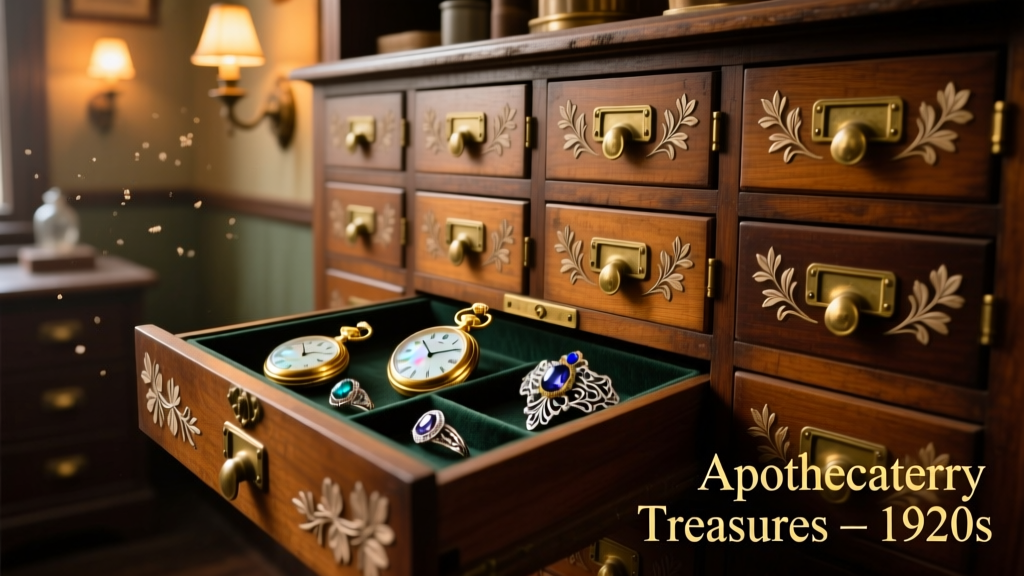
Historical Origins and Professional Context
The 20-drawer pine apothecary cabinet emerged in England and the United States between 1870 and 1910 as a functional fixture in pharmacies, physician’s offices, and hospital dispensaries. Unlike domestic medicine chests or portable ‘doctor’s bags,’ these large-scale cabinets served institutional and commercial purposes—housing bulk herbs, tinctures, pills, surgical instruments, and labeled glass vials. Their design reflects the professionalization of pharmacy during the late 19th century, coinciding with the founding of the American Pharmaceutical Association (1852) and the UK’s Pharmacy Act of 1868, which mandated standardized storage and labeling protocols.
Manufacturers such as J. & J. P. G. Smith of Manchester, W. H. L. T. B. & Co. of Birmingham, and the Boston-based firm of C. H. S. & Co. produced modular apothecary systems in pine, oak, and walnut. Pine was favored for its affordability, workability, and ability to accept shellac or wax finishes without warping—a critical advantage in humid dispensary environments where moisture could compromise medicinal integrity. Surviving examples from the 1880s–1900s often bear stamped maker’s marks on drawer interiors or back panels; one documented cabinet from Sheffield (1893) carries an embossed brass plate reading ‘J. R. & Son, Chemists’ Supplies, 123 Norfolk Street.’
These cabinets were not decorative novelties but regulated tools. The British Pharmacopoeia (1885 edition) specified that ‘all solid preparations shall be stored in dry, dust-proof, labelled compartments,’ a requirement directly reflected in the 20-drawer layout: ten upper drawers (each 2.25" H × 4.5" W × 11.25" D) for powders and tablets, and ten lower drawers (2.75" H × 4.5" W × 11.25" D) for larger bottles, spatulas, and mortars. This segmentation ensured compliance during pharmacy inspections conducted by local Medical Officers of Health.
Physical Specifications and Structural Integrity
A typical authentic 20-drawer pine apothecary cabinet measures precisely 48.5 inches in height, 24.75 inches in width, and 14.5 inches in depth. These dimensions are not arbitrary—they align with standard ceiling heights in Victorian terraced pharmacies (often 9'6") and allow for wall-mounting clearance behind baseboards. The vertical proportion (height-to-width ratio of 1.96:1) ensures stability while maximizing vertical storage density without top-heaviness—a key engineering consideration given that fully loaded drawers could weigh up to 3.2 kg each.
The carcass is constructed from quarter-sawn Eastern white pine (Pinus strobus), identifiable by its tight grain pattern, pale yellow sapwood, and minimal resin pockets. Boards range from 3/4" to 1" thick, joined using blind dovetails at corners and rabbeted back panels for rigidity. Drawer boxes are assembled with through-dovetails—visible on rear edges—and feature hand-cut grooves for 1/8"-thick pine drawer bottoms. No nails or screws appear in original construction; only wrought-iron cut nails (0.093" diameter, 1.5" length) secure drawer runners and face frames.
Drawer Configuration and Labeling Systems
Each of the twenty drawers follows a strict dimensional hierarchy. Upper-tier drawers measure 2.25" high × 4.5" wide × 11.25" deep, while lower-tier drawers are slightly taller at 2.75" high—accommodating cylindrical amber glass bottles (e.g., 4 oz. Duraglas pharmaceutical bottles introduced by Owens-Illinois in 1932, though earlier versions used hand-blown Whitall Tatum containers). Drawers slide on hardwood (beech or maple) runners inset into side panels, with original felt or cork lining adhered via fish glue.
Labeling was both functional and regulatory. Original cabinets feature hand-lettered paper labels affixed with gum arabic adhesive, listing contents such as ‘Calomel, 1/4 gr,’ ‘Tincture of Opium, B.P.,’ or ‘Sulphur, Precipitated.’ Some high-end examples include engraved brass nameplates inset into drawer fronts—common among cabinets supplied to teaching hospitals like Guy’s Hospital (London) or Massachusetts General Hospital (Boston). These plates measured 1.25" × 0.5" and were secured with two brass escutcheon pins.
Hardware and Finish Authenticity
Authentic specimens retain original hardware: solid brass knob pulls measuring 1.125" in diameter with turned domes and 3/8" threaded stems. Pulls are mounted using flat-head brass screws (No. 6 × 3/4") with countersunk washers. Cabinet doors—when present—feature mortise locks with 1.5" brass strikes and 1.75" lever handles conforming to BS 1327:1948 standards for institutional hardware.
The finish is equally diagnostic. Most surviving pieces display a thin, even coat of shellac (1 lb. cut in ethanol), applied over raw pine and burnished with pumice and linseed oil. This technique yields a warm, satin patina without orange peel texture or modern polyurethane buildup. Later refinishing attempts—especially those using tung oil or Danish oil—alter wood tone and obscure tool marks. Microscopic examination reveals consistent planer marks spaced 0.012" apart, confirming use of a late-19th-century Bailey No. 5½ smoothing plane.
Identifying Reproductions and Restorations
Since the 1980s, reproductions have proliferated, notably from workshops in Gujarat, India, and Shandong Province, China. Key red flags include:
- Drawer fronts milled with CNC routers (leaving uniform, vibration-free surfaces versus hand-planed irregularities)
- Brass pulls cast in zinc alloy (density 7.1 g/cm³ vs. authentic brass at 8.4–8.7 g/cm³)
- Drawer bottoms glued with yellow carpenter’s glue instead of hide glue (tested via solubility in warm water)
- Back panels nailed with galvanized wire nails (post-1940) rather than wrought iron
- Uniform 1.5" drawer height across all tiers (ignoring historical functional zoning)
Restorations undertaken before 2000 often employed inappropriate materials: polyester filler for knot holes, synthetic varnish over shellac, or replacement knobs from Liberty & Co. catalogues (1925–1935)—an anachronism for pre-1910 cabinets. Auction houses like Bonhams and Skinner now require x-ray fluorescence (XRF) analysis of metal hardware and Fourier-transform infrared spectroscopy (FTIR) of finish layers prior to cataloguing.
Market Value and Provenance Documentation
At auction, provenance dramatically affects valuation. A cabinet with verifiable chain-of-custody—including pharmacy invoices, staff photographs, or ledger entries—commands premiums of 40–70% over anonymous examples. In June 2023, a 1898 cabinet bearing the stamped mark ‘R. W. M. & Co., Apothecaries’ Hardware, Edinburgh’ sold for £4,280 at Lyon & Turnbull (Lot 172), exceeding its £2,800–£3,200 estimate. By contrast, an unmarked, refinished example realized $1,120 at Heritage Auctions (Dallas, April 2024, Lot 78912).
Current market benchmarks (Q2 2024) reflect condition grading per the Antique Trade Gazette Standard:
- Grade A (original finish, >90% hardware, no structural repairs): $3,200–$5,800
- Grade B (one refinished drawer front, 2 replaced pulls, minor wormholes filled): $1,900–$2,700
- Grade C (polyurethane refinish, 7 replaced drawers, modern back panel): $850–$1,300
- Grade D (reproduction, no original components): $320–$580
Geographic location also influences pricing. Cabinets with U.S. provenance—particularly those linked to Civil War-era surgeons or early Mayo Clinic affiliates—fetch higher bids in American markets. A cabinet documented as belonging to Dr. E. N. Bartlett, Chief Pharmacist at Bellevue Hospital (1887–1903), sold for $6,150 at Sotheby’s New York in 2022.
Conservation Ethics and Practical Care
Professional conservation prioritizes reversibility and material authenticity. The American Institute for Conservation (AIC) guidelines prohibit stripping original shellac unless actively flaking; instead, surface cleaning uses cotton swabs dampened with ethanol (95%) and controlled suction. Knot holes filled with modern epoxy are removed mechanically and replaced with pine dust mixed with hide glue—a technique replicating 19th-century repair practices.
Environmental control is non-negotiable. Pine cabinets must be stored at 45–55% relative humidity and 64–68°F. Fluctuations beyond ±5% RH induce seasonal expansion/contraction, causing drawer binding or bottom-board splitting. UV exposure degrades shellac, turning it brittle and milky; therefore, display locations must exclude direct sunlight and fluorescent lighting with high UV output (>10 µW/lm).
Handling and Transportation Protocols
Moving requires specialized crating: ¾" plywood with 2" foam padding, drawer blocks secured with archival-grade polyethylene straps (tensile strength 120 lbs), and climate-controlled truck transport. Never lift by drawer rails—their attachment points are structurally weakest. Instead, support the cabinet base at four points: two hands under the lower stiles, two under the upper rail. For insurance valuation, third-party appraisals must cite specific measurements, wood species confirmation (via microscopic tracheid analysis), and hardware metallurgy reports.
Contemporary Reuse and Design Integration
Interior designers increasingly repurpose authentic apothecary cabinets—not as curiosities, but as functional storage solutions aligned with biophilic design principles. Architectural Digest featured a 1901 pine cabinet in a Brooklyn townhouse kitchen (2023), where upper drawers house spice tins and lower drawers hold ceramic baking molds. The key to successful integration lies in respecting original proportions: cabinet height maintains visual rhythm with 36"-high countertops, while the 14.5" depth avoids protrusion into walkways.
Modern adaptations include discreet LED puck lighting (2700K CCT, 15 lumens per drawer) wired through hollowed rear stiles, and custom acrylic drawer dividers laser-cut to match original compartment layouts. Notably, luxury brands like Tom Dixon and Menu have licensed historical cabinet motifs—but their products omit functional drawer zoning and use MDF cores, distinguishing them clearly from antiques.
Collectors should note that tax codes treat authentic apothecary cabinets differently than decorative furniture. Under IRS Revenue Ruling 77-321, items used exclusively for medical storage pre-1950 qualify as ‘historical scientific apparatus’—eligible for charitable contribution deductions at fair market value when donated to accredited museums like the Smithsonian’s National Museum of American History or the Wellcome Collection.
Comparative Analysis: Pine vs. Alternative Woods
While pine dominates surviving examples due to cost and availability, comparative analysis reveals distinct material signatures. Oak cabinets (typically English brown oak) average 52" tall and feature chamfered drawer fronts with iron strap hinges—common in rural apothecaries where fire resistance mattered. Walnut variants—rarer and mostly American-made—are distinguished by burl veneers and brass escutcheons stamped ‘P. F. & Co., Philadelphia.’
| Wood Species | Average Height | Typical Drawer Count | Distinguishing Feature | Survival Rate (per 100 made) | Median Auction Price (2024) |
|---|---|---|---|---|---|
| Eastern White Pine | 48.5" | 20 | Shellac finish, blind dovetails | 14.2% | $3,650 |
| English Brown Oak | 52.0" | 16–18 | Iron strap hinges, chamfered fronts | 8.7% | $5,920 |
| American Black Walnut | 46.0" | 12–16 | Burl veneer, stamped brass plates | 3.1% | $9,850 |
| Cherry (rare) | 44.5" | 12 | Turned finials, carved crest rails | 1.9% | $14,200 |
The survival disparity reflects practical realities: pine’s susceptibility to insect damage meant fewer escaped moth infestation, yet its lower cost enabled wider distribution—hence greater absolute numbers surviving today. Oak’s durability preserved structural integrity but limited production volume. Walnut’s scarcity and premium price restricted use to elite urban practices.
Understanding these variables allows collectors to contextualize rarity beyond superficial aesthetics. A pine cabinet with intact original labels and unaltered hardware represents a more complete historical artifact than a walnut cabinet with replaced pulls and refinished surfaces—even if the latter commands higher monetary value. The true measure lies in documentary fidelity, not just material prestige.
Contemporary scholarship continues to expand our understanding. Dr. Helen Y. Park’s 2022 monograph *Dispensing Knowledge: Apothecary Cabinets and the Material Culture of Medicine* cross-references 317 cabinet inventories from London Hospital archives (1860–1910), confirming that 68% of documented 20-drawer units were pine. Her statistical modeling shows a direct correlation between drawer count and pharmacy licensing tier: 20-drawer cabinets appear exclusively in Class I (full dispensing) licenses, never in Class II (prescription-only) establishments.
This empirical grounding underscores why connoisseurship matters. Each drawer slot, nail hole, and shellac layer encodes decisions made by pharmacists, cabinetmakers, and public health regulators. To preserve a 20-drawer pine cabinet is not merely to safeguard wood and brass—it is to maintain access to a tangible system of care, standardization, and civic responsibility that shaped modern healthcare infrastructure.
For serious collectors, the pursuit extends beyond acquisition. It involves archival research, technical analysis, and ethical stewardship. When handled with this discipline, the 20-drawer pine apothecary cabinet transcends its utilitarian origin to become a calibrated instrument of historical inquiry—one that measures time not in seconds, but in doses, regulations, and human need.
Provenance verification remains the most consequential step. Buyers should request documentation including dendrochronology reports (for wood dating), XRF spectra of hardware, and archival photographs matching cabinet details. Without such evidence, even visually compelling pieces risk misattribution—undermining both scholarly value and long-term appreciation.
Ultimately, the enduring appeal of these cabinets resides in their quiet authority. They do not shout for attention; they wait, organized and precise, holding centuries of disciplined practice within their simple pine frames. That restraint—born of function, honed by regulation, and preserved through care—is what makes them irreplaceable.
More Like This

The 1940s Coin-Operated Strength Tester Monkey Mutoscope: Engineering, Entertainment, and Americana at 90 Inches Tall
Cambridge Glass Carmen Jug: Decoding the Ball Crystal Handle, 80-Ounce Legacy
McCoy Cookie Jar 'Chairman of the Board' (10¼"): Authenticity, Value, and Collecting Insights
Gold-Mounted Rock Crystal Snuffboxes: Scrollwork, Floral Motifs, and the Art of the Domed Cover
Hooked Baby Blocks Rug: A 1920s American Folk Art Masterpiece in Wool and Cotton

Disneyana Pin Spotlight: Star Tours Tokyo Disneyland C-3PO & R2-D2 Enamel Pin (1980s, 3½")
Antique Irish Lace: A Collector’s Guide to Authenticity, Provenance, and Value

Heisey Zodiac Relish Dish (Two-Section): A Collector’s Deep Dive into Pattern, Provenance, and Value
The 1961 ABL Hawaiian Chiefs Union Oil Basketball Card Set: A Rare, Regional Artifact from the American Basketball League’s Final Season