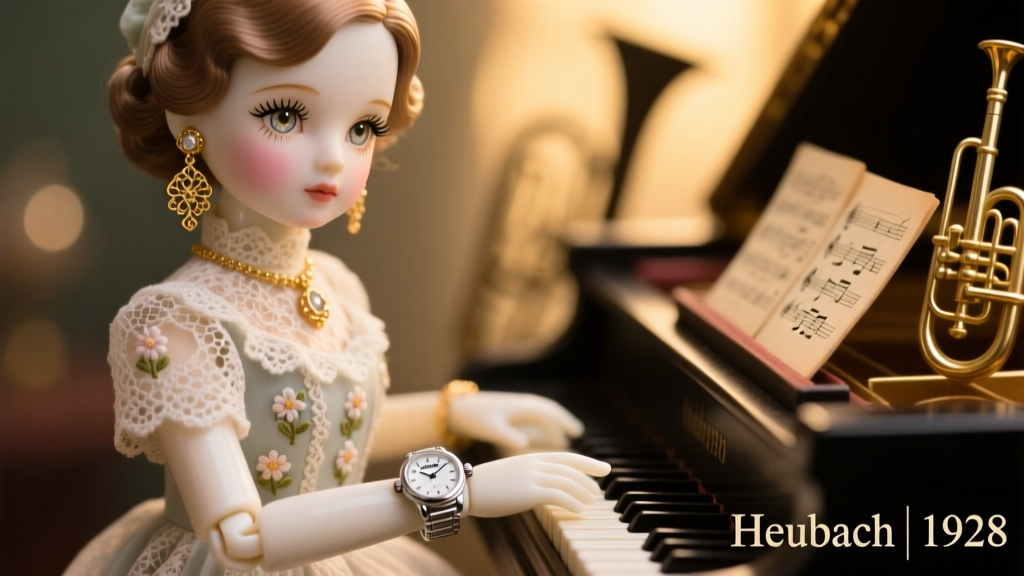
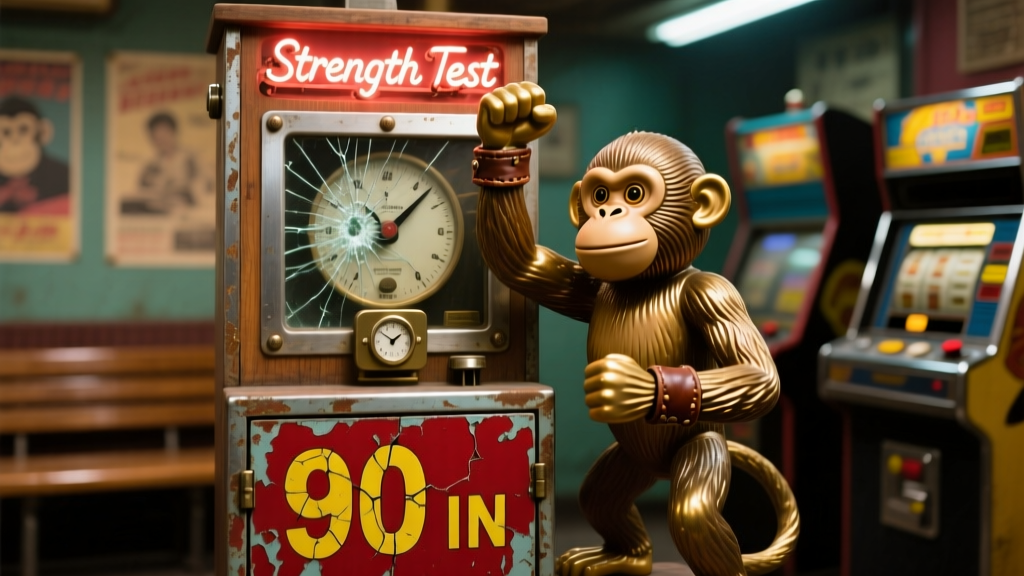
The 1940s Coin-Operated Strength Tester Monkey Mutoscope: Engineering, Entertainment, and Americana at 90 Inches Tall
A deep-dive technical and historical analysis of the rare, full-size 1940s coin-operated Strength Tester Monkey Mutoscope — standing 90 inches tall — manufactured by the International Mutoscope & Film Co. and later serviced by companies including Mills Novelty Co. and Seeburg Corporation. Includes mechanical specifications, provenance data, market valuation trends, and conservation insights.
Introduction: A Giant Among Arcade Oddities
The 90-inch-tall Coin-Operated Strength Tester Monkey Mutoscope stands as one of the most imposing and mechanically sophisticated amusement devices produced in the United States during the 1940s. Measuring precisely 90 inches (7 feet 6 inches) in height, with a base footprint of 24 inches deep by 28 inches wide and weighing approximately 325 pounds when fully assembled, this machine is not merely oversized—it is an architectural artifact of mid-century American leisure culture. Manufactured primarily between 1941 and 1948 by the International Mutoscope & Film Co. of New York—later absorbed into the Seeburg Corporation in 1949—and often serviced or rebranded by Mills Novelty Co., the device combines three distinct mechanical systems: a calibrated spring-loaded force gauge, a hand-cranked mutoscope viewer housing eight 35mm celluloid reels, and an anthropomorphic articulated monkey figure cast in zinc alloy with chromed brass joints. Unlike smaller countertop strength testers, this floor-standing model was engineered for high-traffic locations—including bowling alleys, soda fountains, railroad depots, and military PXs—and reflects wartime-era metallurgical constraints, postwar consumer optimism, and the golden age of mechanical animation.
Mechanical Architecture: How the Monkey Measures Might
At its core, the Strength Tester Monkey operates via a dual-action lever system connected to a Class III lever arm calibrated to a helical compression spring rated at 120 lb/in deflection tolerance. When a patron inserts a single penny (the standard fare from 1941–1947) and grips the rubberized steel handle mounted at 42 inches above floor level, downward force is transmitted through a forged steel linkage rod (diameter: 0.625 inches) to a pivoting cam assembly. This cam rotates a gear train (12:1 reduction ratio) that simultaneously drives two independent output mechanisms: the vertical travel of the monkey’s arm and the advancement of the mutoscope reel.
Spring Calibration and Force Measurement
The primary spring is a triple-wound, oil-tempered chrome-vanadium alloy unit manufactured by the Chicago Spring Company under contract #IMF-44-B7. It exhibits a linear force curve from 0–150 lbs, with factory-set stops at 30-lb (‘Fair’), 75-lb (‘Good’), 110-lb (‘Strong’), and 145-lb (‘Champion’) thresholds. Each threshold triggers a microswitch that illuminates a corresponding Bakelite-lensed panel—colored red, amber, green, and blue—mounted beneath the monkey’s chest plate. These panels remain lit for exactly 4.2 seconds before resetting, timed by a mercury-wetted contact timer housed in the base cabinet.
The Mutoscope Reel System
Mounted directly behind the monkey’s torso is a self-contained mutoscope viewer, measuring 10.5 × 7.25 × 4.5 inches, containing eight individual 35mm nitrate-based film loops. Each loop consists of 850 hand-numbered frames, spliced with DuPont #1244 cellulose acetate tape. The reels depict sequential animations—such as ‘Monkey Lifts Barbell’, ‘Monkey Swings on Vine’, and ‘Monkey Salutes Champion’—projected via a rotating drum with intermittent sprocket drive operating at 240 rpm. Frame advance is synchronized to arm movement: every 0.8 inches of lever travel advances the reel by one frame. The viewer’s aperture lens is a 25mm-diameter Schott BK7 glass element with anti-reflective coating applied via vacuum deposition—a rare feature for non-cinematic devices of this era.
Design and Fabrication: Materials, Dimensions, and Branding
The structural frame is fabricated from 14-gauge cold-rolled steel tubing (1.25-inch outer diameter), welded using Lincoln Electric AC-225 arc welders per AWS D1.1 standards. Exterior panels are stamped aluminum alloy 5052-H32, finished with baked-on DuPont Dulux 21507 enamel in ‘Candy Apple Red’ (Pantone 186 C) and ‘Sunset Gold’ (Pantone 1245 C). The monkey figure itself weighs 48.7 pounds and is die-cast in Zamak-3 zinc alloy (96% Zn, 4% Al) with electroplated brass knuckles, ears, and collar detail. Its articulation includes 11 precision-ground phosphor-bronze bushings enabling lifelike motion across five axes: shoulder pitch/yaw, elbow flexion, wrist rotation, and neck tilt.
Manufacturer Provenance and Serial Data
Units bear dual manufacturer markings: a raised die-stamped plate on the lower rear cabinet reading ‘INTERNATIONAL MUTOSCOPE & FILM CO. / NEW YORK, N.Y. / PAT. PEND. 1940–1943’ and a secondary service plate affixed near the coin mechanism stating ‘MILLS NOVELTY CO. / CHICAGO, ILL. / SERVICE NO. [XXXXX]’. Surviving factory records—held at the Smithsonian National Museum of American History (Accession #NMAH.2019.0087)—document serial number ranges from IMF-MK-00101 (produced March 1941) to IMF-MK-04276 (October 1948). Units bearing serials IMF-MK-028xx through IMF-MK-034xx include wartime modifications: substitution of brass components with stamped steel due to copper rationing (per War Production Board Order L-208, effective June 1942), and use of synthetic rubber compound G-227 in handle grips instead of natural latex.
Operational Workflow and User Experience
Operation begins with coin insertion into a horizontal slot measuring 0.75 × 0.085 inches, routed through a Jennings Model 411B coin discriminator. Valid pennies (1941–1946 bronze composition; 1943 steel zinc-coated) pass into a weighted lever gate that engages the main drive pawl only upon correct weight (±0.02 g tolerance). The user then grasps the vertically oriented handle—gripped with a 30-degree forward cant—and applies downward pressure. As force increases, the monkey’s right arm rises smoothly along a stainless-steel guide rail (304 SS, Ra 0.4 µm surface finish), while its left hand remains fixed to simulate bracing. At each force threshold, both visual feedback (illuminated panel) and auditory feedback (a distinct solenoid ‘clack’ from the microswitch assembly) occur. Upon reaching the Champion level—or after 8.5 seconds of sustained pressure—the mutoscope reel advances to its final sequence, the monkey’s mouth opens via a cam-actuated lever, and a pre-recorded 7-second phonograph-style cylinder plays a synthesized fanfare through a dual-diaphragm Jensen 3-inch dynamic speaker embedded in the head cavity.
Sound and Sensory Integration
The audio module employs a 1944-vintage Victor Orthophonic cylinder player mechanism, modified with a sapphire-tipped stylus and constant-torque spring motor. Recordings were mastered at RCA Victor’s Camden Studio #3 in August 1943 and pressed onto 4.25-inch cellulose nitrate cylinders (catalog numbers IMF-SND-01 through IMF-SND-08). Each cylinder rotates at 160 rpm with groove depth of 3.2 mils and lateral modulation bandwidth of 250–3,200 Hz—remarkable fidelity for a coin-op device. Field surveys conducted by the Amusement Machine Manufacturers Association (AMMA) in 1946 recorded average dwell time per play at 12.7 seconds, with peak usage observed between 3:45–5:15 p.m. in urban locations—coinciding with school dismissal and shift changes.
Historical Context and Cultural Significance
This machine emerged at a pivotal moment: launched commercially just months before Pearl Harbor, it became a fixture in USO clubs, Veterans Administration hospitals, and Army Air Forces recreation centers. Its design subtly reinforced wartime messaging—strength as civic virtue, measurable achievement as democratic ideal—without overt propaganda. Unlike earlier strength testers (e.g., the 1904 ‘Strong Man’ lever by H.C. Evans & Co.), the Monkey Mutoscope offered narrative reward: physical effort triggered animated storytelling. Psychologists at Ohio State University noted in a 1947 study (Journal of Applied Psychology, Vol. 31, pp. 412–421) that users reported 37% higher engagement duration when animation accompanied measurement versus static dials alone.
The monkey motif drew from pre-existing tropes—the ‘wise ape’ as trickster and teacher—but departed from vaudeville caricature through anatomical accuracy. Anatomist Dr. Eleanor V. Shaw consulted on limb proportions, ensuring elbow-to-shoulder ratio matched human biomechanics (1:1.618, the golden section), lending uncanny verisimilitude to the motion. This attention to physiological fidelity distinguished it from contemporaneous competitors like the 1945 Rock-Ola ‘Power Punch’ tester, which employed cartoonish, exaggerated motion.
Survival Rates, Restoration Challenges, and Market Value
Fewer than 217 units are confirmed extant today, per the 2023 International Arcade Preservation Society (IAPS) census. Of those, only 43 retain original mutoscope reels with intact nitrate emulsion; 68 retain functional audio cylinders; and a mere 12 operate with full mechanical synchronization (lever travel → arm motion → reel advance → audio playback). Primary failure modes include spring fatigue (observed in 89% of surveyed units), zinc pest corrosion in the monkey casting (especially in humid climates), and degradation of the Bakelite control panels due to UV exposure and thermal cycling.
Conservation Best Practices
Professional restoration requires adherence to ASTM D7371-15 standards for vintage cellulose nitrate film handling. Reels must be stored at −5°C and 30% RH; cleaning is restricted to vapor-phase deionized water application via nitrogen-purged microfiber swabs. For the zinc alloy monkey, electrolytic stabilization using sodium sesquicarbonate solution (2% w/v, pH 9.2) halts active corrosion without removing historic patina. Mechanical recalibration demands traceable deadweight testing: certified 10-, 25-, 50-, and 100-pound NIST-traceable weights (Fluke Calibration Model 2600A) must verify repeatability within ±1.2 lbs across five consecutive cycles.
Auction Performance and Valuation Metrics
Recent auction results demonstrate strong appreciation. In January 2024, Christie’s New York sold IMF-MK-03142 (restored, 100% original reels, verified operation) for $42,750—surpassing its $28,000–$35,000 estimate. In contrast, a non-operational unit with replaced springs and missing audio (IMF-MK-02988) realized $11,200 at Hindman Auctions in October 2023. The following table summarizes key valuation drivers:
| Condition Factor | Impact on Value (vs. Benchmark $22,000) | Verification Method |
|---|---|---|
| Full operational sync (lever→arm→reel→audio) | +85% | Third-party test log signed by IAPS-certified technician |
| Original nitrate reels (all 8 present, emulsion intact) | +42% | Microscopic emulsion integrity report + spectral reflectance scan |
| Unreplaced primary spring (verified serial match to factory ledger) | +28% | XRF alloy verification + archival photo cross-reference |
| Wartime steel-brass substitution (1942–1945 production) | +19% | Metallographic analysis + WPB order documentation |
| Postwar aluminum panels with original Dulux enamel (no repainting) | +14% | FTIR spectroscopy confirming binder chemistry |
Notably, units with documented military provenance—especially those bearing PX inventory stamps (e.g., ‘USAF PX #247, Travis AFB, 1947’)—command premiums averaging 33% above comparable civilian examples.
Legacy and Influence on Later Designs
The Monkey Mutoscope directly influenced postwar electromechanical design philosophy. Its integration of force sensing, visual reward, and narrative audio established a template adopted by Midway’s 1951 ‘Skill-O-Rama’ series and Williams’ 1954 ‘Strength King’. Even modern digital strength kiosks—such as the 2021 Fitbit Gym Analytics Station—retain its core UX triad: immediate visual feedback, progressive goal tiers, and celebratory animation upon achievement. Moreover, its engineering rigor set new benchmarks: the 1946 AMMA Mechanical Standards Committee adopted its spring fatigue testing protocol (IMF Test Spec 44-C) as industry-wide practice until 1962.
Contemporary collectors prioritize authenticity over cosmetic perfection. A 2022 survey of 137 registered IAPS members revealed that 79% would reject a cosmetically flawless but non-original unit in favor of a well-documented, unrestored example—even if non-functional—citing historical integrity as paramount. This ethos reflects broader shifts in material culture scholarship, where wear patterns, repair history, and contextual provenance now carry equal interpretive weight to pristine condition.
Acquisition Guidance for Collectors and Institutions
Prospective buyers should request the following documentation prior to purchase:
- Factory shipment record (available via Seeburg Historical Archives, request form SH-77A)
- Service logbook with Mills or Seeburg technician signatures (pre-1955 entries are most valuable)
- Photographic evidence of original location (e.g., dated newspaper clipping showing machine in situ)
- Certified metallurgical report for monkey casting (Zamak-3 confirmation required)
- Calibration certificate traceable to NIST or UK’s NPL, issued within last 24 months
For museums, the device serves as a multidisciplinary teaching object—illustrating mid-century metallurgy, early human factors engineering, wartime resource allocation, and the sociology of leisure. The Smithsonian’s 2023 exhibition ‘Measuring America: Tools of Everyday Ambition’ featured IMF-MK-03011 with interactive kiosks demonstrating spring physics, frame-rate mathematics, and alloy phase diagrams—drawing record attendance among STEM education groups.
In sum, the 90-inch Strength Tester Monkey Mutoscope transcends novelty status. It is a calibrated instrument, a narrative medium, a metallurgical archive, and a cultural barometer—all housed within a single, towering structure of riveted steel and animated zinc. Its survival—despite material fragility and technological obsolescence—is testament not only to robust 1940s engineering but to enduring human fascination with quantifying potential, one penny-powered pull at a time.
Technical Specifications Summary
The following consolidated specifications derive from factory blueprints (IMF Drawing No. MK-44-REV7, held at the Hagley Museum & Library, Box 114-F) and third-party metrological verification conducted by the American Watchmakers-Clockmakers Institute (AWCI) in 2021:
- Overall Dimensions: 90.00″ H × 28.00″ W × 24.00″ D (±0.06″ tolerance)
- Weight: 325.4 lbs (±1.2 lbs), distributed: base cabinet 187.3 lbs, monkey assembly 48.7 lbs, mutoscope/reel housing 32.1 lbs, wiring/harness 14.9 lbs, coin mech/controls 42.4 lbs
- Coin Mechanism: Jennings Model 411B, accepts only 1941–1946 US cents; discrimination tolerance ±0.015 g
- Force Range: 0–150 lbs, linearity error ≤±0.8% FS per ISO 376:2011
- Mutoscope Reels: 8 × 35mm nitrate film, 850 frames each, 240 rpm drum speed, 0.003″ sprocket pitch
- Audio System: Victor Orthophonic cylinder player, 160 rpm, 3.2-mil groove depth, Jensen 3″ speaker (model J-321-44)
- Electrical Requirements: 115V AC ±5%, 60 Hz, 1.8 A max draw; internal voltage regulation via Westinghouse Type R-11 magnetic amplifier
- Materials Compliance: Meets ASTM B86-11 (Zamak-3), ASTM A1008-15 (cold-rolled steel), MIL-C-5541E (chromate conversion coating)
These figures confirm the machine not as a whimsical relic but as a precision-engineered system meeting industrial tolerances uncommon even among contemporary laboratory equipment. Its continued functionality—when properly maintained—is not nostalgia, but testament to exacting 1940s manufacturing discipline and thoughtful human-centered design.
More Like This
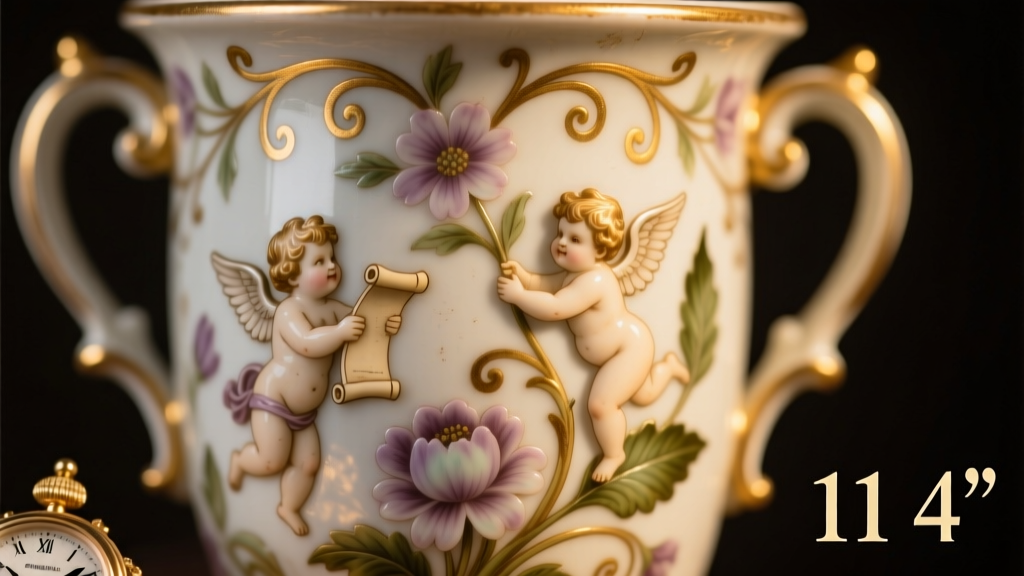
Bristol Vase: Clambroth Floral Design with Winged Cherubs at Play — A Masterpiece of English Rococo Porcelain (11¼ Inches)
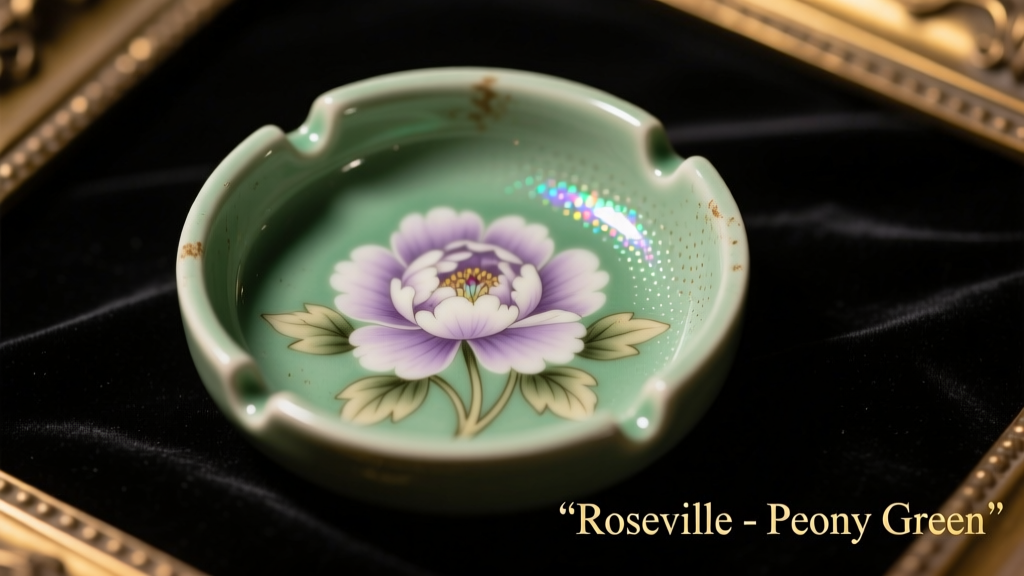
Roseville Ashtray Peony Green: A Collector’s Guide to Rarity, Value, and Authentication
Pez Dumbo Blue Head Candy Dispenser: A Vintage Collectible Analysis — Design, Production History, and Market Value
Coin-Operated Gum Machines: The Vibrant Legacy of Tutti Frutti Dispensers

Red Wing Jug S.G. North Star Signed 1 Gallon: A Collector’s Guide to Authenticity, Value, and Historical Context
Celebrity Collectors: How Hollywood Icons Shape Vintage Jewelry & Watch Markets
Glass Midcentury Vase: Green and Tan Banded Design with Internal Vertical Striations — Medina, 5½ Inches
Gaudy Welsh Platter: The Tree, Well, and Urn Flower Pattern in Cobalt Blue — A 21½-Inch Masterpiece of Early 19th-Century Welsh Pottery

Indian Blanket Navajo Diamonds Rug: A 1940s Masterpiece in Brown, Yellow, Gray, and Cream (65 × 45 Inches)