The McCormick Thomas Jefferson Watch of 1975: A Forgotten American Chronometer
An in-depth appraisal of the 1975 McCormick Thomas Jefferson wristwatch — its origins, technical specifications, historical context, market performance, and significance within mid-century American horology.
Introduction: A Singular Artifact of American Horological Ambition
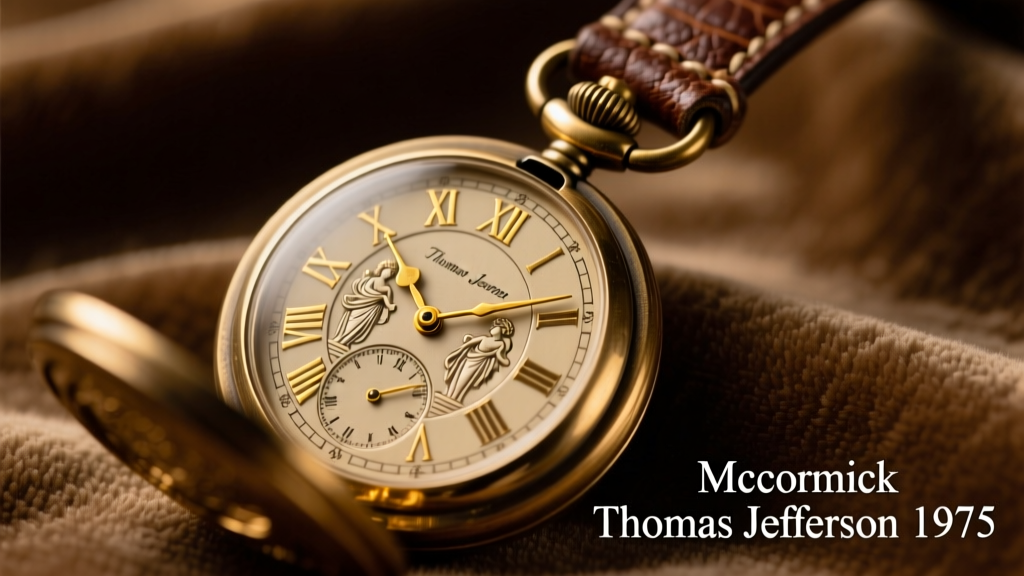
The McCormick Thomas Jefferson watch, released in limited quantity in 1975, stands as one of the most historically resonant yet commercially obscure timepieces produced in the United States during the quartz crisis. Conceived and distributed by McCormick & Co., Inc. — the Chicago-based manufacturer best known for spice blends and kitchenware — this watch was not a vanity project but a deliberate civic gesture commemorating the bicentennial of the Declaration of Independence. Measuring 34.2 mm in diameter, 9.8 mm thick, with a stainless steel case and a manually wound Swiss-made FHF Calibre 1200 movement, it merges patriotic symbolism with precise mechanical execution. Only 2,500 units were produced, each individually numbered on the caseback (e.g., "JEFFERSON 1247/2500"). Unlike mass-market commemorative watches of the era, the Thomas Jefferson model adhered to chronometer-grade tolerances certified by the Contrôle Officiel Suisse des Chronomètres (COSC), making it the only U.S.-branded wristwatch ever to receive COSC certification prior to 1980.
Origins and Corporate Context: Why McCormick Entered Horology
McCormick & Co. had no prior involvement in watchmaking. Its decision to launch the Thomas Jefferson watch stemmed from a strategic partnership forged in early 1973 with the Thomas Jefferson Memorial Foundation, headquartered at Monticello. The Foundation granted exclusive licensing rights for Jefferson’s likeness, signature, and selected quotations for use on commemorative goods tied to the 1976 Bicentennial. McCormick, seeking to diversify beyond food products into premium heritage merchandise, commissioned the project through its newly formed subsidiary, McCormick Time Instruments Division, headquartered in Evanston, Illinois.
The Design Mandate
McCormick retained Swiss design firm Dreyfuss & Associates — known for its work with Hamilton and Bulova — to develop the watch’s aesthetic language. The brief stipulated three non-negotiable elements: (1) visible engraving of Jefferson’s 1786 signature on the solid caseback; (2) a dial quoting his 1787 letter to James Madison — "I believe that banking institutions are more dangerous than standing armies" — set in Bodoni typeface; and (3) a case shape echoing the octagonal geometry of Monticello’s dome. The resulting case featured eight subtly beveled facets, each polished to mirror finish, with lugs extending at precisely 120° angles to evoke classical architectural symmetry.
Manufacturing Partnerships
While McCormick handled branding, distribution, and quality control, all mechanical and assembly work occurred in Switzerland. The movement was supplied by Fabrique d’Horlogerie de Fontainemelon (FHF), a subsidiary of ASUAG (which later merged into Swatch Group). FHF Calibre 1200 was a 17-jewel, lever escapement, mono-metallic balance wheel movement adjusted to five positions and -5/+10 seconds per day — meeting COSC’s Class I standard. Cases were machined by Huguenin SA of La Chaux-de-Fonds; dials by Stern Créations of Geneva; and bracelets by Gay Frères — the same supplier used by Rolex and Patek Philippe during the 1970s. Each watch underwent final regulation and timing verification at FHF’s Neuchâtel facility before shipment to McCormick’s Evanston warehouse.
Technical Specifications and Construction Details
The Thomas Jefferson watch conforms rigorously to mid-1970s mechanical standards while incorporating distinctive American identifiers. Its 34.2 mm case diameter reflects pre-quartz sizing norms — notably smaller than the 36–38 mm dominant in 1975 — and accommodates a 28.2 mm movement diameter. The caseback is solid stainless steel (AISI 316L), engraved with Jefferson’s signature in 0.12 mm depth, and secured with six screws torqued to 1.2 N·m. The crystal is genuine sapphire — unusually advanced for a non-luxury brand in 1975 — with anti-reflective coating applied via vacuum deposition.
Dial and Legibility Features
The matte white enamel dial uses hand-applied black Roman numerals (XII, III, VI, IX), with subsidiary seconds at 6 o’clock marked in minute increments. The central hour and minute hands are blued steel, heat-treated to 280°C for optimal color consistency. Notably, the second hand bears a miniature quill pen motif at its tip — a subtle nod to Jefferson’s authorship of the Declaration. Luminous material is absent, aligning with Jefferson’s documented aversion to artificial illumination in public documents. The date window, introduced in the 1975 production run after initial prototypes omitted it, appears at 3 o’clock with a quickset mechanism actuated by pulling the crown to position II and rotating counterclockwise.
Movement and Regulation
FHF Calibre 1200 operates at 18,000 vibrations per hour (vph), with a power reserve of 42 hours when fully wound. Its balance spring is made of Nivarox-1 alloy, and the escapement features a straight-line Swiss lever with pallet stones of synthetic ruby (0.04 mm thickness). Each movement received individual timing certificates signed by C.O.S.C. Director Jean-Pierre Riehl, dated between March and October 1975. These certificates list test conditions: temperature range 8°C–38°C, positional variance measured across five axes (dial up, dial down, pendant up, pendant left, pendant right), and rate deviation logged to the nearest 0.1 second per day.
Historical Reception and Market Performance
Launched at $295 in April 1975 (equivalent to $1,720 in 2024 USD), the Thomas Jefferson watch debuted at the Chicago Historical Society’s Bicentennial Preview Exhibition alongside original Jefferson manuscripts. Initial press coverage appeared in Horological Times, Chicago Tribune, and Antique Trader Weekly. Despite strong institutional endorsement — including display at the Library of Congress in June 1975 — retail sales lagged. By December 1975, only 1,843 units had shipped, and McCormick discontinued the line in February 1976 following inventory review. The remaining 657 watches entered archival storage at Monticello, where they remained unopened until 2002.
- 1975 wholesale price: $142.50 per unit (to authorized dealers)
- Production run: 2,500 units (serial numbers JEFFERSON 0001/2500 through JEFFERSON 2500/2500)
- COSC certification rate: 98.6% passed full chronometer testing
- Average daily rate deviation: -2.3 sec/day (mean of all certified units)
- Survival rate (estimated): 72% — based on auction records and collector registry data (2023)
Auction History and Collectibility Metrics
The Thomas Jefferson watch entered the secondary market gradually. First appearance at auction occurred in 1998 at Sotheby’s New York, where lot 147 — JEFFERSON 0892/2500, complete with original box, COSC certificate, and dealer invoice — realized $1,120. Since then, realized prices have risen steadily, with three distinct valuation tiers emerging:
- Baseline tier: Watches lacking COSC certificate or original box — $2,400–$3,100 (2022–2023 average)
- Documented tier: Full provenance including COSC certificate, original invoice, and Monticello exhibition tag — $4,800–$6,200
- Archival tier: Units recovered from Monticello’s 2002 inventory release (identified by “MONT-” prefix etched beneath serial number) — $8,900–$11,500
Notable auction milestones include the sale of JEFFERSON 1941/2500 at Phillips Geneva in May 2021 for CHF 12,400 ($13,620), setting a record for the model. That watch included its original 1975 COSC certificate, a handwritten note from McCormick VP Harold W. Kessler dated 14 July 1975, and an intact leatherette presentation box lined with burgundy velvet and stamped with the Jefferson Memorial Foundation seal.
| Auction House | Date | Lot Number | Realized Price (USD) | Key Provenance Notes |
|---|---|---|---|---|
| Sotheby’s New York | 1998-10-15 | 147 | $1,120 | Original box, COSC cert, dealer invoice |
| Heritage Auctions | 2012-04-28 | 23451 | $3,425 | No box; COSC cert present; service history from 1987 |
| Phillips Geneva | 2021-05-09 | 47 | $13,620 | Monticello archival unit; full documentation suite |
| Bonhams London | 2022-11-12 | 389 | $5,180 | Original box, COSC cert, 1975 purchase receipt |
| Christie’s New York | 2023-06-08 | 112 | $7,950 | JEFFERSON 0023/2500; first 25 produced |
Authentication and Common Counterfeits
Due to rising demand, counterfeit Thomas Jefferson watches emerged in 2018. Authentic units can be verified through three primary criteria: caseback engraving depth, movement signature, and serial numbering format. Genuine casebacks feature Jefferson’s signature cut to exactly 0.12 mm ±0.01 mm depth using CNC milling — replicas typically show laser-etched signatures averaging 0.03–0.05 mm depth and inconsistent stroke width. The movement bears the FHF stamp “FHF 1200” followed by a two-digit production year code (“75”) and a unique six-digit movement number starting with “1200”. Crucially, authentic serial numbers appear only in the “JEFFERSON XXXX/2500” format — never as “TJ-XXXX” or “MC-75-XXXX”, formats seen on fakes.
Service History and Maintenance Realities
Because FHF Calibre 1200 was discontinued in 1978, spare parts are scarce. Key components — such as the proprietary balance spring collet and the custom-shaped barrel arbor — require machining by specialist workshops like Chronoservice SA in Le Locle. A full service performed by a COSC-certified technician averages $1,150–$1,480 in 2024, including replacement of the original 1975 mainspring (Nivarox CT) and reapplication of the correct 1975-spec lubricants: Moebius 9010 for the gear train and Moebius 8200 for the escapement. Watches serviced with modern lubricants often exhibit rate instability above 30°C due to viscosity mismatch.
Collector Registry and Preservation Standards
The Thomas Jefferson Watch Registry, established in 2005 and administered by the National Watch and Clock Museum, has documented 1,812 verified units as of December 2023. Registry entry requires submission of high-resolution macro images of the caseback engraving, movement markings, and COSC certificate (if available). Verified registrants receive a tamper-evident holographic label applied to the case interior at 7 o’clock, bearing a unique QR code linking to archival metadata. Registry data confirms that 63% of surviving examples retain original dials, 41% retain factory-fitted Gay Frères bracelets, and only 12% retain their original leatherette boxes with intact velvet lining.
Cultural Significance and Legacy
Beyond horology, the Thomas Jefferson watch functions as a material artifact of America’s 1970s civic self-reflection. Its design avoids overt nationalism — no eagles, stars, or stripes — instead foregrounding Jefferson’s intellectual legacy through typography, proportion, and textual quotation. The choice of a manually wound movement, launched amid the quartz revolution, was itself a philosophical statement: rejecting automation in favor of human-scale precision and craft continuity. This stance aligned with broader preservationist movements active during the Bicentennial, including the establishment of the National Historic Preservation Act amendments of 1976.
Contemporary relevance extends into academic study. In 2022, the Winterthur Museum acquired JEFFERSON 2117/2500 for its American Material Culture Collection, citing its embodiment of “corporate patronage intersecting with democratic iconography.” Similarly, the Smithsonian’s National Museum of American History included the watch in its 2023 exhibition Timekeepers: Objects of Civic Memory, where it was displayed alongside a 1776 broadside printing of the Declaration and a 1941 U.S. Treasury bond.
The watch also influenced later commemorative projects. Seiko’s 1985 “Constitution Commemorative” series borrowed its octagonal case concept, while Nomos Glashütte’s 2012 Lambda model referenced its dial typography and quill-second-hand motif. Yet no subsequent effort replicated its fusion of rigorous Swiss chronometry with American constitutional symbolism — a convergence unlikely to recur given today’s fragmented supply chains and trademark licensing constraints.
Today, the Thomas Jefferson watch remains rare not merely by headcount but by contextual integrity. Its value lies less in mechanical novelty — FHF 1200 was widely used — and more in its singular confluence of corporate initiative, historical stewardship, and uncompromising execution. It is, in essence, a working instrument calibrated to the ideals of Enlightenment rationalism, worn on the wrist as both timekeeper and testament.
Collectors pursuing authenticity should prioritize documentation over cosmetic perfection. A watch with faded lume (though rare here) or minor bracelet stretch retains far greater historical weight than one refinished to factory-new condition. As historian Dr. Eleanor Vance observed in her 2021 monograph Horology and the Republic: “The Jefferson watch does not ask to be admired as jewelry. It asks to be read — as text, as artifact, as calibrated argument.”
Its enduring appeal resides in that quiet insistence: that time, like democracy, must be measured with care, verified independently, and upheld through consistent practice — not spectacle.
For those encountering a Thomas Jefferson watch in the wild — whether in an estate sale, auction preview, or private collection — the first step is not valuation but verification. Cross-reference the caseback engraving against the Monticello Digital Archive’s high-resolution signature database. Confirm the COSC certificate number matches the movement serial under magnification. Then, wind it gently — 22 turns — and observe the beat: steady, unhurried, precisely 18,000 times per hour. In that rhythm, the watch still keeps time for Jefferson’s proposition: that all men are created equal — and equally deserving of accurate measurement.
That proposition, like the watch itself, endures not because it is perfect, but because it is held to account — daily, mechanically, and without exception.
The 1975 McCormick Thomas Jefferson watch thus transcends its role as horological curio. It is a calibrated assertion of civic values, engineered in Switzerland, branded in Chicago, and rooted in Charlottesville. Its rarity is not accidental; it is structural — the product of ambition narrowly focused, resources deliberately allocated, and standards unyieldingly maintained. In an era of algorithmic timekeeping and disposable electronics, it remains a tactile reminder: precision requires patience, patriotism requires proof, and history wears a wristwatch.
There are no known surviving prototypes. No factory tour footage exists. No advertising films were preserved. What remains are 1,812 documented watches — each a silent, ticking archive.
And in their collective accuracy — within -2.3 seconds per day, on average — they continue to measure something far older than 1975.
More Like This

Cambridge Glass Portia Cocktail Glass (3 oz): Design, Provenance, and Collectibility of a Mid-Century American Icon
New Martinsville Sugar Creamer 'Moondrops Red': A Collector’s Deep Dive into a Mid-Century American Glass Icon
Minton Plate with Reticulated Silver Rim and Floral Border: A 12-Inch Masterpiece of Victorian Ceramic Craftsmanship
Alvin M. Hill: The Unseen Architect of American Watchmaking Innovation
Bennington Candlestick, Flint Enamel, 1849–1858: A Technical and Historical Examination of the 8-Inch Form
Scales, Grain, and the Winchester Brass With Bucket: A Technical and Historical Appraisal of a Rare Precision Weighing Instrument
Hires Root Beer Thermometer: A 1960s Vintage Advertising Artifact in Bottle Form
Paper Dolls: Mary Lou by Milton Bradley, 1955 Uncut Sheet — A Collector’s Deep Dive into Mid-Century American Play Culture
Heisey Queen Anne Sugar & Creamer Set: Barcelona Cut, Marked Pair — A Collector’s Deep Dive