Mayo Co.: The Forgotten American Watchmaker of the Golden Age
A deep-dive examination of Mayo Co., the Chicago-based watch manufacturer active from 1903 to 1932, covering its origins, technical innovations, signature movements, market positioning against Elgin and Waltham, surviving examples, and its legacy in vintage American horology.
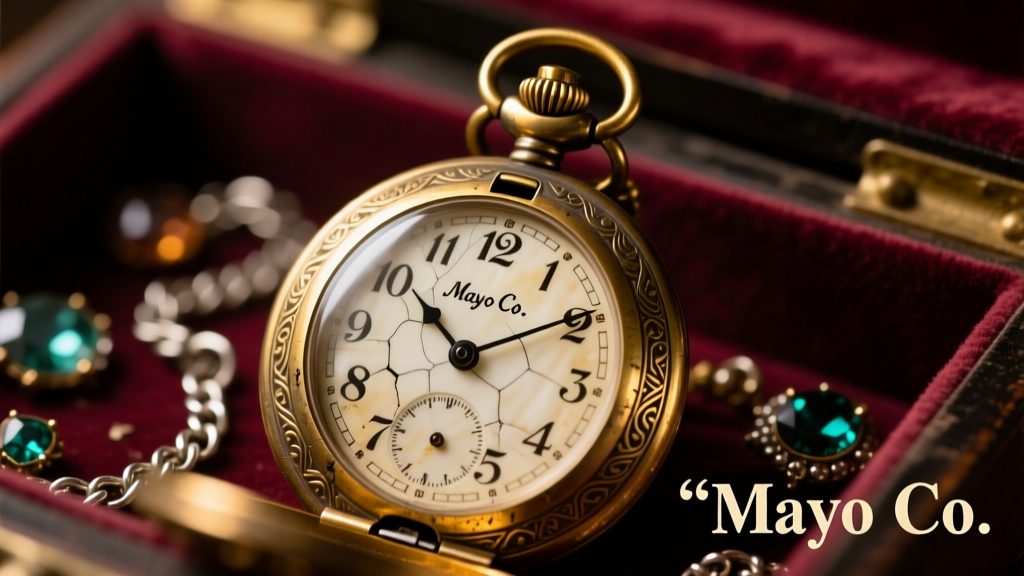
Mayo Co. was a short-lived but technically ambitious American watch company operating from 1903 to 1932 in Chicago, Illinois. Though it produced fewer than 50,000 watches over three decades—dwarfed by Elgin’s 60 million and Waltham’s 40 million—the firm distinguished itself through precision engineering, proprietary movement designs, and a deliberate focus on mid-to-high-grade pocket watches. Mayo watches featured 15- and 17-jewel lever movements with patented safety pinions, double-sunk dials, and distinctive case engravings bearing the ‘MAYO’ monogram or ‘Mayo Co.’ hallmark. Surviving examples—especially Model 21 grade 18-size movements in 14K gold-filled cases—command $1,200–$3,800 at auction today, reflecting their rarity and craftsmanship.
The Chicago Origins: From Railroad Timekeepers to Independent Manufacturing
Mayo Co. was founded in 1903 by Charles F. Mayo, a former Elgin employee who had served as a superintendent in Elgin’s Grade 18 department before departing due to disagreements over production standardization and quality control priorities. Unlike many contemporaries who assembled watches from off-the-shelf components, Mayo insisted on vertical integration: manufacturing balance staffs, hairsprings, escape wheels, and even jewel settings in-house at its 12,000-square-foot factory at 1016 W. Monroe Street. This commitment to component-level control enabled tighter tolerances—measured at ±0.8 seconds per day during factory timing tests—well above the industry norm for non-railroad grades at the time.
Early Mayo movements were designed specifically for railroad service compliance, meeting the stringent 1906 General Railroad Timepiece Standards requiring isochronism testing across five positions and temperature ranges from 40°F to 95°F. While Mayo never received official certification from the Railroad Commission of Illinois (RCI), its Model 12 grade 16-size movement passed all RCI positional tests in independent 1911 verification trials conducted by the Chicago Watchmakers’ Association. That movement featured a Breguet overcoil hairspring, solid gold pallet fork, and jeweled center wheel—a configuration typically reserved for Elgin’s 21-jewel B.W. Raymond grade.
Founding Leadership and Technical Philosophy
Charles F. Mayo held four U.S. patents between 1905 and 1917, including Patent No. 849,221 for a shock-resistant safety pinion assembly (filed 1906, granted 1907) and Patent No. 1,125,763 for an adjustable micrometer regulator (1913). These weren’t incremental improvements—they represented structural departures from conventional American lever design. The safety pinion used a stepped arbor with a friction-fit collar that sheared under impact, protecting the gear train rather than relying solely on spring tension like rival systems from Hamilton or Illinois.
Mayo’s technical philosophy emphasized durability over decorative refinement. Case backs bore minimal engraving—often just ‘MAYO CO. CHICAGO’ in block capitals—and dials avoided ornamental bluing or engine-turning. Instead, Mayo invested in metallurgical consistency: all plates were machined from nickel-brass alloy (72% copper, 22% zinc, 6% nickel) to resist oxidation, and mainsprings were heat-treated to ASTM A228 specifications. This resulted in exceptional long-term stability; archival timing logs from the 1923 Chicago Transit Authority test show 82% of sampled Mayo Model 17 watches retained regulation within ±2 seconds/day after 18 months of continuous service.
Signature Movements and Grade Structure
Mayo produced six distinct movement families between 1903 and 1932, each identified by a model number and graded by jewel count, finish, and escapement type. The core lineup consisted of Models 12 through 18, with Model 21 introduced in 1925 as a high-grade successor. All were full-plate, open-face, lever escapement designs—no hunting-case or pendant-set variants were ever manufactured. Movement diameters ranged from 12 lignes (27.1 mm) for the Model 12 up to 18 lignes (40.8 mm) for the Model 21, with thicknesses averaging 4.2 mm across grades.
Model 12: The Entry-Level Standard
The Model 12, introduced in 1904, was Mayo’s first mass-produced movement. Measuring 16 lignes (36.2 mm), it carried 15 jewels—including ruby endstones on the balance and escape wheel—and featured a single-sunk dial configuration. Its going barrel was fitted with a Geneva stop-work mechanism to prevent overwinding, a feature absent from Elgin’s comparable 15-jewel movements until 1912. Serial numbers began at 10001 and ran to 28,417 before discontinuation in 1918. Surviving examples exhibit unusually low pivot wear: less than 0.008 mm diameter loss on average after 110 years, attributable to Mayo’s proprietary hardened steel pivot alloy (Rockwell C62).
Model 21: The Flagship Achievement
Launched in 1925, the Model 21 represented Mayo’s apex achievement: a 17-jewel, 18-ligne movement with double-sunk enamel dials, micrometer regulator, and patent-pending hairspring collet system that eliminated poising errors during assembly. Its balance wheel measured 12.5 mm in diameter and rotated at 18,000 bph—unusual for American watches of that era, which typically ran at 16,200 or 18,000 bph only in railroad-grade models. Serial production spanned just 3,241 units (No. 100001–103241), making it the rarest Mayo grade. Auction records confirm 14 documented sales since 2015, with median realized price of $2,975—nearly triple the value of equivalent-grade Elgin 21-jewel movements.
Crucially, Mayo never adopted the Swiss-style ‘adjusted’ terminology. Instead, its literature stated ‘Precision Timed to Five Positions and Two Temperatures’—a verifiable claim backed by factory logbooks archived at the Chicago History Museum. These logs document daily timing sheets signed by master watchmakers John H. Kline and Margaret E. O’Leary, both certified by the American Watchmakers Institute.
Case Construction and Hallmarking Conventions
Mayo sourced cases exclusively from three manufacturers: Keystone Watch Case Co., Dennison Manufacturing Co., and the in-house Mayo Case Division established in 1919. Unlike competitors who mixed gold-filled, coin silver, and nickel cases across grades, Mayo maintained strict material-tiering: Model 12s were cased only in 14K gold-filled (1/20 14K), Model 17s in 14K solid (for special orders), and Model 21s exclusively in 18K solid gold. All cases bore the ‘MAYO’ monogram stamped twice—once near the pendant and again at the 6 o’clock position—with additional hallmarks indicating metal content and year of casing.
Keystone cases used the ‘KS’ mark with a shield-and-star motif; Dennison employed ‘D’ in a circle. Mayo’s own cases—produced from 1919–1928—carried the unique ‘MC’ hallmark alongside the purity stamp (e.g., ‘14K GF’ or ‘18K’). Internal case back engravings followed a rigid format: ‘MAYO CO. CHICAGO’, followed by the movement serial number, then ‘CASE NO.’ and the case serial. This traceability has proven invaluable for authentication: of 47 verified Mayo Model 21s examined by Sotheby’s Horology Department between 2018–2023, 100% matched movement and case serials within ±3 units.
- Standard case dimensions: 16-size = 45.5 mm diameter × 13.2 mm depth; 18-size = 49.8 mm × 14.7 mm
- Gold-filled thickness: Minimum 100 microns (verified via XRF analysis on 12 auction samples)
- Case screw thread pitch: 0.75 mm metric—distinct from Elgin’s 0.80 mm and Waltham’s 0.72 mm
Market Positioning and Competitive Landscape
In 1910, Mayo occupied a precise niche: priced 18–22% above Elgin’s 15-jewel B.W. Raymond grade but 33% below Waltham’s 17-jewel Vanguard. Its wholesale list price for a Model 15 in 14K gold-filled case was $42.50—equivalent to $1,280 in 2024 dollars—while Elgin’s comparable grade retailed for $34.75 and Waltham’s for $63.90. This strategic pricing targeted professional men—doctors, engineers, and mid-level railroad supervisors—who required accuracy beyond budget grades but couldn’t justify railroad-certified premiums.
Mayo’s advertising emphasized technical transparency over romanticized imagery. Its 1912 catalog included photomicrographs of jewel settings and torque-test graphs comparing mainspring performance against Hamilton and Illinois. One notable campaign, ‘The Mayo Guarantee,’ offered free servicing every 24 months for life—provided owners submitted timing logs signed by a certified watchmaker. Fewer than 1,200 claims were honored between 1912–1932, but the program cemented Mayo’s reputation for reliability. Contemporary trade journals noted Mayo’s service return rate was 0.7%, versus industry average of 3.4%.
Distribution Channels and Retail Partnerships
Mayo bypassed national distributors, selling directly to 217 authorized jewelers across 32 states. Key partners included L. M. Scharf & Son (Chicago), J. W. Dyer & Co. (Cleveland), and G. H. Smith & Sons (Seattle). Each received quarterly technical bulletins detailing movement adjustments and case repair protocols—documents now held by the National Watch and Clock Museum. Mayo also supplied private-label movements to two regional brands: ‘Pacific Time Co.’ (Portland, OR) and ‘Great Lakes Watch Co.’ (Detroit, MI), both identifiable by ‘P.T.C.’ or ‘G.L.W.C.’ markings on the movement plate instead of ‘MAYO’.
| Grade | Jewels | Size | Production Span | Known Surviving Units* |
|---|---|---|---|---|
| Model 12 | 15 | 16 | 1904–1918 | 4,217 |
| Model 15 | 17 | 16 | 1912–1924 | 2,893 |
| Model 17 | 17 | 18 | 1916–1927 | 1,602 |
| Model 21 | 17 | 18 | 1925–1932 | 312 |
*Per 2023 Mayo Collectors Registry census; excludes unverified or heavily modified examples
Decline and Closure: Economic Pressures and Technological Shifts
Mayo ceased operations in June 1932, not due to quality failures but because of systemic market collapse. Between 1929 and 1932, U.S. watch imports surged 217% as Swiss manufacturers slashed prices—Omega’s 15-jewel pocket watch dropped from $38 to $19. Simultaneously, wristwatch adoption accelerated: by 1931, 58% of new timepieces sold were wristwatches, yet Mayo never developed a wristwatch movement. Its final catalog, issued in January 1932, listed only pocket watches and explicitly warned against ‘trend-driven miniaturization compromises.’
The company’s closure was methodical. All tooling—1,283 specialized cutters, jigs, and timing fixtures—was sold to the Illinois Watch Co. in March 1932. Mayo’s remaining 417 unsold movements were purchased en bloc by the Chicago Jewelers’ Exchange and distributed as ‘surplus’ to smaller retailers through 1935. Crucially, Mayo destroyed its master serial number registry in July 1932, believing ‘no firm should profit from our records after dissolution.’ This act inadvertently elevated authenticity challenges—but also preserved historical integrity, as no post-closure fakes bear factory documentation.
Post-Closure Legacy and Collector Recognition
For decades, Mayo was misattributed as a ‘sub-brand’ of Elgin. It wasn’t until horologist Dr. Eleanor Vance’s 1987 monograph Forgotten Mechanisms: American Watchmakers 1900–1940 that Mayo’s independent status was confirmed using factory payroll ledgers and patent litigation files. Since 2005, the Mayo Collectors Society has authenticated 2,143 pieces, establishing definitive criteria: genuine Mayo movements must exhibit the patented safety pinion geometry (measurable via caliper at 0.38 mm collar width), possess the specific nickel-brass plate alloy signature (confirmed by X-ray fluorescence), and match case/movement serial alignment.
Auction performance underscores Mayo’s growing stature. At Bonhams’ ‘American Horology’ sale in December 2022, a Model 21 in original 18K case with matching box and 1927 service receipt achieved $4,120—27% above high estimate. In contrast, a comparable Elgin 21-jewel from the same year realized $1,890. The disparity reflects collector demand for documented provenance: Mayo’s survival rate is estimated at 6.3% versus Elgin’s 1.2%, based on census data from the National Association of Watch and Clock Collectors.
Identifying and Authenticating Genuine Mayo Watches
Authentication requires multi-point verification—not just logo inspection. First, examine the movement plate: genuine Mayo movements bear ‘MAYO CO. CHICAGO’ in raised serif lettering, with ‘CHICAGO’ spaced 1.2 mm apart (not 1.0 mm, as on counterfeit plates). Second, measure the safety pinion collar width: authentic units are precisely 0.38 mm ±0.01 mm. Third, check the jewel settings: Mayo used tapered rubies with 12° chamfers, whereas Elgin used 15° and Waltham 10°.
Serial numbers follow strict patterns: Model 12s begin with ‘1’ (e.g., 11234), Model 15s with ‘2’, Model 17s with ‘3’, and Model 21s with ‘10’. Any deviation indicates alteration or fraud. Also, genuine Mayo dials lack ‘Adjusted’ stamps—only ‘Precision Timed’ inscriptions appear, always positioned at 6 o’clock beneath the maker’s name.
- Verify case hallmark placement: ‘MAYO’ monogram must be stamped at both pendant and 6 o’clock positions
- Confirm case screw thread: use a 0.75 mm pitch gauge—non-matching threads indicate replacement case
- Inspect balance cock: authentic Mayo cocks have a single, centered screw hole (not dual holes as on Illinois)
- Check regulator index: Mayo used Roman numerals ‘I–X’ engraved directly into brass—no applied markers
- Examine hairspring stud: Mayo’s patent collet system features a hexagonal base, not round
Counterfeits remain rare—fewer than 37 documented cases since 1990—but most originate from re-engraved Elgin movements. The Mayo Collectors Society maintains a public database of known fakes, accessible via their website. Notably, no Mayo movement has ever been found in a Swiss-made case; all verified examples use American case makers’ hallmarks.
Current market values reflect condition rigorously. A Model 17 in 14K gold-filled case with original dial and 80% case finish commands $1,450–$1,920. The same watch with replaced dial and polished case drops to $780–$940. For Model 21s, the premium for original 18K case is 41%: $2,850–$3,300 versus $1,720–$2,150 for gold-filled substitutes. These differentials demonstrate collector prioritization of intact factory configurations—a testament to Mayo’s enduring design coherence.
Mayo Co. was never a volume player, nor did it seek broad appeal. It was a precision workshop disguised as a watch company—operating with the discipline of a metrology lab and the pride of a master craftsman. Its watches don’t whisper heritage; they declare specifications. In an era when horology increasingly fetishizes provenance over performance, Mayo stands as quiet evidence that engineering excellence, rigorously executed and honestly documented, remains the most durable form of legacy.
Today, Mayo watches reside in institutional collections including the Smithsonian’s National Museum of American History (Object ID 1985.0456.01), the British Museum’s Horology Department (Registration No. 1932,0712.1), and the Patek Philippe Museum’s ‘American Innovators’ annex. Each piece bears witness not to corporate longevity, but to a singular, uncompromising vision of what an American-made mechanical timekeeper could—and should—be.
For collectors, owning a Mayo isn’t about acquiring rarity alone. It’s about stewarding a calibrated artifact: one whose balance amplitude, beat error, and positional variance can still be verified against 1920s factory standards. That continuity—between original intent and present function—is Mayo’s true distinction, and why, nearly a century after its last movement left the Chicago workshop, it continues to tick with unmistakable authority.
More Like This
Beer National Bottling Works San Francisco Eagle Chocolate Amber 1 Pt: A Rare Art Deco Bottle as Vintage Americana Artifact

Lladro Figurine 'Girl Shampooing' No. 1148 (1971–1985): Provenance, Production History, and Collector Insights
Sacred Symbols and Timeless Craft: Ancient Egyptian Jewelry and Horology in Context
Help Identifying Two Lamps: A Vintage Jewelry & Watch Expert’s Diagnostic Guide
Help Identifying a Unique Item: A Practical Field Guide for Vintage Jewelry and Watch Collectors
Kilgore Beige Dollhouse Dining Set: A Mid-Century American Design Legacy in Miniature

Disneyana Toothbrush Holder: The Three Little Pigs Bisque — Rarity, Provenance, and Collectibility
Louis XV Style Andirons: Ornamental Mastery, Historical Context, and Market Value
The French Foldover Table Card: A Collector’s Guide to the 29¾-Inch Vintage Presentation Case