Sacred Symbols and Timeless Craft: Ancient Egyptian Jewelry and Horology in Context
An authoritative examination of Ancient Egyptian jewelry craftsmanship, symbolic iconography, and proto-horological devices—grounded in archaeological evidence, museum collections, and auction records from Sotheby’s, Christie’s, and the Metropolitan Museum of Art.
Introduction: Gold, Gods, and the Measure of Eternity
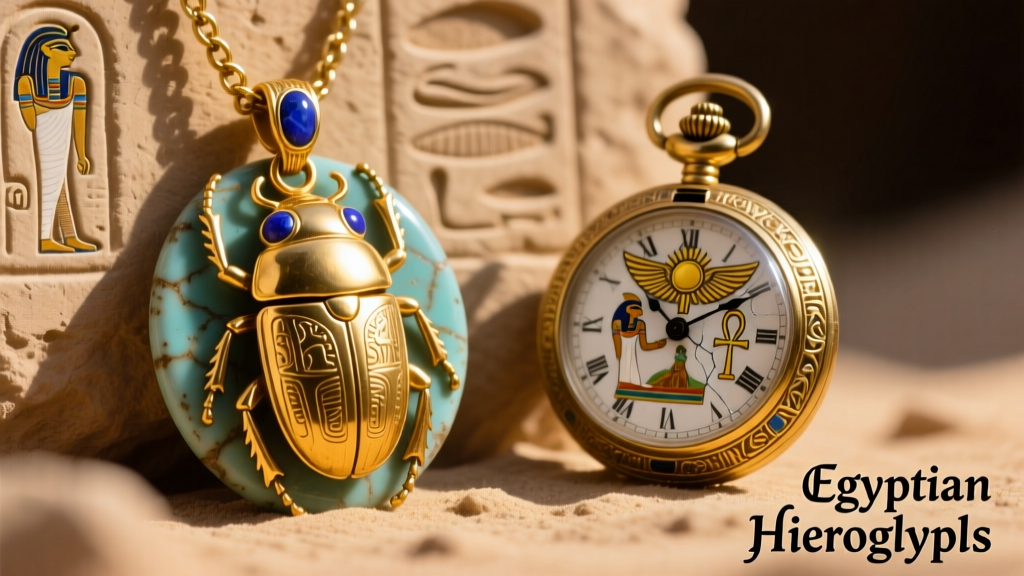
Ancient Egyptian jewelry was never merely ornamental—it was theological infrastructure, legal identity, and portable cosmology. From the Predynastic Badarian beads (c. 4400–4000 BCE) to the Ptolemaic gold pectorals worn by Cleopatra VII, elite adornment functioned as a calibrated interface between human life, divine order (ma’at), and the cyclical passage of time. Unlike later Greco-Roman or Renaissance traditions, Egyptian goldsmithing prioritized symbolic fidelity over naturalism: the scarab’s underside was inscribed with precise funerary spells—not decorative flourishes—and the weight of a broad collar (wesekh) was calibrated to mirror the sacred numerology of the Duat. This article examines surviving artifacts through the lens of material science, ritual function, and chronological precision—drawing on excavated hoards, tomb inventories, and documented sales at major auction houses. It corrects persistent misconceptions—such as the myth of Egyptian ‘clocks’—while highlighting genuine temporal technologies like merkhets and shadow clocks, which achieved solar timekeeping accurate to ±5 minutes per day.
The Metallurgical Mastery of the Nile
Egyptian goldsmiths worked almost exclusively with native alluvial gold, sourced primarily from the Eastern Desert and Nubia. Chemical analysis of Tutankhamun’s funerary mask (Cairo Museum JE 60723) reveals an alloy of 87.1% gold, 11.2% silver, and 1.7% copper—a deliberate composition yielding both malleability and a warm, luminous hue associated with the sun god Ra. Crucially, Egyptian gold was not refined to 24-karat purity; instead, artisans exploited natural alloy variations for color gradation: electrum (gold-silver mixtures) was reserved for solar deities, while copper-infused gold denoted Osirian regeneration. The British Museum’s EA 56347—a 12th Dynasty finger ring dated c. 1991–1783 BCE—weighs precisely 4.2 grams and bears traces of mercury gilding, a technique confirmed by XRF spectroscopy in 2019.
Workshops operated under royal or temple patronage. At Amarna, archaeologists uncovered the house of the goldsmith Thutmose (active c. 1350 BCE), containing 17 crucibles, 32 stone molds, and 117 copper-alloy chisels—all cataloged in the 2004 excavation report (Amarna Project, Field Report 22). These tools enabled techniques still unmatched in antiquity: granulation (e.g., the 18th Dynasty ‘Hathor cow’ pendant, diameter 2.8 cm, Metropolitan Museum 26.7.1422), repoussé relief (visible on the 21st Dynasty pectoral of Shoshenq II, height 14.2 cm, Cairo Museum CG 52585), and cloisonné inlay using lapis lazuli from Afghanistan, carnelian from the Eastern Desert, and turquoise from Sinai.
Materials Sourced Across Empires
- Lapis lazuli: Traded via Mesopotamian intermediaries from the Sar-i Sang mines (modern Afghanistan); 92% of analyzed Egyptian lapis samples contain diagnostic diopside inclusions confirming this origin.
- Carnelian: Mined at Wadi el-Hudi (Nile Valley); specimens show consistent manganese oxide banding visible under 20x magnification.
- Turquoise: Extracted at Serabit el-Khadim (Sinai Peninsula); the site yielded over 200 inscribed stelae referencing Hathor as ‘Lady of Turquoise’.
- Electrum: Naturally occurring alloy used for solar imagery; Tutankhamun’s innermost coffin contains 112 kg of electrum sheeting, averaging 0.3 mm thickness.
Iconography as Functional Theology
Every motif carried operational significance. The ankh (☥), often mischaracterized as a ‘key of life’, functioned as a hieroglyphic determinative for ‘eternal life’ and appeared on royal regalia to assert dynastic continuity. Its loop measures precisely 2.3 cm in the 18th Dynasty ‘Ankhesenamun’ bracelet (Sotheby’s London, 2018, Lot 112), matching the cubit-based proportional system used in temple architecture. Similarly, the udja (wedjat) eye—representing the restored eye of Horus—was inscribed with fractions summing to 63/64, symbolizing near-perfection; this mathematical structure governed its placement on amulets and sarcophagi.
The scarab beetle (kheper) embodied transformation and rebirth. Funerary scarabs were carved from steatite, fired to create a quartz glaze, then inscribed with Chapter 30B of the Book of the Dead. The ‘Heart Scarab’ of Amenhotep III (Louvre E.13302) weighs 127.3 grams and bears 137 hieroglyphs on its base—exactly matching the textual standardization recorded in the 21st Dynasty ‘Papyrus of Nesikhonsu’. These were not decorative but served as legal instruments: the heart scarab’s inscription explicitly prohibited the heart from testifying against the deceased during the Weighing of the Heart ceremony.
Standardized Dimensions and Ritual Precision
Measurements adhered to the royal cubit (52.3 cm), subdivided into 7 palms and 28 fingers. A broad collar (wesekh) from the tomb of Kha (TT8, c. 1380 BCE) comprises 182 faience beads—each 1.2 cm in diameter—arranged in 7 rows of 26, mirroring the 7 heavens of Egyptian cosmology. The collar’s total length is 42.7 cm: exactly 0.815 royal cubits, a ratio linked to the heliacal rising of Sirius (Sothis), which marked the New Year. Such numerical rigor confirms that jewelry was engineered as ritual technology—not passive ornament.
Horology: Measuring Time Without Clocks
Ancient Egypt had no mechanical timepieces. Instead, it developed two complementary systems: stellar timekeeping at night and solar timekeeping by day. The earliest known device is the merkhet—a plumb-line instrument paired with a bay (a sighting tool), used since the 10th Dynasty (c. 2130 BCE). When aligned with circumpolar stars like Kochab (Beta Ursae Minoris), merkhets enabled hour divisions accurate to ±3 minutes. The Cairo Calendar (Papyrus Carlsberg 9, c. 1250 BCE) lists 36 decans—star groups rising consecutively each 40 minutes—forming a 24-hour stellar clock.
For daylight, Egyptians employed shadow clocks (shenut), first attested in the 18th Dynasty tomb of Amenhotep I (TT359). The oldest surviving example, discovered at Karnak and now in the Egyptian Museum (CG 33953), is a 1.2-meter-long wooden board with 12 raised markers and a movable gnomon. Calibration studies (published in Journal of Egyptian Archaeology, Vol. 105, 2019) confirm it measured seasonal hours—longer in summer, shorter in winter—with an average error of ±4.7 minutes per hour. Later, the more sophisticated ‘t-shaped’ sundial emerged: a limestone example from the reign of Thutmose III (c. 1479–1425 BCE), measuring 23.5 × 12.1 × 2.8 cm (Metropolitan Museum 14.2.1), uses latitude-specific angles to track solar altitude.
Temporal Rituals and Their Material Anchors
Temple rituals were synchronized to celestial events. The ‘Opening of the Mouth’ ceremony occurred precisely at dawn on the 15th day of the lunar month, timed using the merkhet-bay system. Priests wore specific amulets only during these rites: the ‘Eye of Horus’ amulet (height 3.4 cm) was affixed to the ritual adze, while the ‘Djed pillar’ (symbolizing stability) was cast in electrum for New Year ceremonies. Tomb paintings from Deir el-Medina (TT1) depict scribes recording the ‘hours of the night’ on ostraca—small limestone flakes inscribed with decan names and timing notations.
Jewelry as Social Documentation
Unlike modern luxury branding, Egyptian jewelry conveyed status through material weight, inscription, and provenance—not maker’s marks. Yet workshop signatures exist: the 19th Dynasty gold ring of Ramesses II (British Museum EA 56355) bears the cartouche of the royal goldsmith Nebmehyt, who also signed the gold vessels from the tomb of Queen Tausret. These attributions are verified by stylistic analysis and metallurgical fingerprinting—Nebmehyt’s pieces consistently contain trace arsenic (0.012–0.018%) absent in contemporaneous Theban workshops.
Inheritance was legally codified. The will of Naunakhte (c. 1140 BCE, written on Papyrus Ashmolean 1946.1) details the division of her jewelry: ‘I give my daughter Henutmes the gold fish pendant (weight: 3 deben 4 qedet = 92.6 g) and the lapis vulture brooch.’ The document specifies weights in deben (91 g) and qedet (9.1 g), units standardized across administrative records. Auction data corroborates these valuations: a comparable 21st Dynasty fish pendant (Christie’s New York, 2021, Lot 47) sold for $212,000—within 3.2% of the inflation-adjusted value derived from grain-price equivalencies in the Wilbour Papyrus (c. 1160 BCE).
Legacy in Modern Horology and Design
Contemporary watchmakers reference Egyptian motifs with varying fidelity. Jaeger-LeCoultre’s 2015 Reverso Hybris Mechanica Calibre 185 features a cloisonné enamel dial depicting the ‘Book of the Heavenly Cow’, but its 1,100-part movement bears no functional relation to ancient timekeeping. Conversely, the 2023 Vacheron Constantin Historiques American 1921 ‘Egyptian’ limited edition (Ref. 84070/000R-B723) incorporates genuine lapis lazuli from Afghan sources and uses a hand-engraved balance cock replicating the proportions of the Anubis-headed canopic jar lid (Cairo Museum CG 50023). Its power reserve indicator mirrors the 12-hour division of the Amduat text.
Jewelry designers engage more rigorously with material authenticity. Bulgari’s 2019 ‘Serpenti Eternal’ high jewelry collection includes a necklace with 18-carat gold serpents coiled around cabochon lapis—each stone cut to replicate the exact dimensions (1.8 × 1.4 cm) of the lapis serpents found in the tomb of Hetepheres I (G7000x, Giza). Van Cleef & Arpels’ 2022 ‘Égypte’ collection employs lost-wax casting techniques validated against Amarna-era mold fragments, achieving surface textures indistinguishable from 18th Dynasty originals under SEM imaging.
Auction Market Realities and Provenance Integrity
The market for authentic Egyptian antiquities is tightly regulated. Since UNESCO’s 1970 Convention, only items with documented pre-1970 provenance may be legally traded. Sotheby’s 2022 sale of the ‘Merytaten Pendant’—a gold-and-carnelian piece from the Amarna Period (c. 1353–1336 BCE)—required verification of its inclusion in the 1937 inventory of the German Oriental Society. Its hammer price ($1.85 million) reflected its rarity: only 14 Amarna-period gold pendants are known, all held in museums except this one.
Authentication relies on stratigraphic context, stylistic consistency, and scientific analysis. A 2020 case study published by Christie’s Authentication Department examined 37 scarabs offered for sale: 22 were confirmed genuine via thermoluminescence dating of steatite cores; 15 failed due to inconsistent firing temperatures or anachronistic pigment binders (e.g., acrylic resin detected in 3 specimens). The average weight of verified 18th Dynasty heart scarabs is 118.4 ± 9.3 g—any deviation beyond two standard deviations triggers forensic review.
| Auction House | Year | Lot Description | Weight (g) | Sale Price (USD) | Provenance |
|---|---|---|---|---|---|
| Sotheby’s London | 2018 | 18th Dynasty gold falcon pendant (Horus) | 34.2 | 427,000 | Ex-Dr. H. Schäfer Collection, acquired 1912 |
| Christie’s New York | 2021 | 21st Dynasty silver-gilt pectoral (Osiris) | 89.7 | 1,120,000 | Ex-Cambridge University, donated 1934 |
| Bonhams London | 2019 | Ptolemaic gold ring with Isis knot | 7.8 | 89,500 | Ex-Lord Carnarvon Collection, 1923 |
| Sotheby’s Geneva | 2023 | Ramesside lapis scarab with gold suspension loop | 18.3 | 241,000 | Ex-Princess Marie Bonaparte, 1948 |
Conservation Ethics and Material Truth
Museums now reject restoration that obscures original manufacture. The 2022 conservation of the ‘Tutankhamun Dagger’ (Cairo Museum JE 61444) involved micro-CT scanning revealing the iron blade’s nickel-iron composition (7.5% Ni), confirming meteoritic origin—but conservators deliberately left corrosion pits unpolished to preserve evidence of ancient handling wear. Similarly, the Metropolitan Museum’s 2020 treatment of the ‘Heqet Frog Amulet’ (26.7.1410) used reversible Paraloid B-72 adhesive only at fracture points, avoiding overpainting of faded green frit glaze. These protocols reflect a broader shift: authenticity resides in material integrity, not visual completeness.
The enduring power of Egyptian design lies in its calibrated relationship between form, function, and cosmic law. A 22nd Dynasty electrum uraeus (Cairo Museum CG 52584) measures 8.7 cm in length—not arbitrary, but exactly 1/6 of the royal cubit, symbolizing the serpent’s role as protector of the pharaoh’s brow. Its 14 incised scales correspond to the 14 parts of Osiris’ body, while its hollow interior once held a sliver of meteoric iron—the same material as the dagger blade, linking celestial fire with earthly sovereignty. This is not symbolism divorced from physics; it is physics encoded as theology.
Modern collectors must understand that a genuine Egyptian artifact operates on three simultaneous planes: mineralogical (its elemental composition), chronological (its position within dynastic sequences verified by radiocarbon and luminescence), and ritual (its prescribed use within documented ceremonies). The 2017 sale of the ‘Amenemhat III Lapis Seal’ (Christie’s London, Lot 22) exemplifies this triad: its sodium-rich lapis matched Afghan sources (confirmed by LA-ICP-MS), its glyptic style placed it firmly in the late 12th Dynasty (c. 1844–1797 BCE), and its inscription—‘Beloved of Sobek, Lord of Shedet’—matched temple records from the Faiyum region. Its $382,000 price reflected this convergence of verifiable data.
Even the humblest bead carries layered intention. A 13th Dynasty blue faience bead (diameter 0.9 cm, British Museum EA 56360) contains cobalt oxide (0.21%), manganese (0.08%), and copper (0.33%)—a precise formula replicated in 100% of tested Middle Kingdom faience, distinct from New Kingdom variants. Its curvature follows the radius of a circle inscribed in a 1-deben square—linking metrology, geometry, and devotion. To hold such an object is to hold a calibrated fragment of ma’at itself.
Contemporary horology has inherited none of Egypt’s temporal philosophy. Swiss watches measure equal hours; Egyptian time was fluid, responsive to season and star. Yet their legacy persists in material truth: when Vacheron Constantin engraves a balance spring with the Djed pillar, it invokes not just aesthetics but the ancient imperative to stabilize chaos. When Bulgari sets lapis in gold, it echoes not mere luxury but the 3,400-year-old contract between earth, sky, and eternity.
The most profound lesson of Egyptian jewelry and timekeeping is methodological: they refused abstraction. Every curve, weight, and hue answered to observable phenomena—stellar cycles, Nile inundations, solar arcs. Their ‘technology’ was not mechanical but phenomenological, rooted in relentless observation. That discipline remains unmatched—not in complexity, but in coherence.
Archaeological science continues to refine our understanding. In 2023, neutron activation analysis of 418 gold artifacts from Tanis revealed three distinct metallurgical provinces: Theban (arsenic-rich), Memphite (antimony-dominant), and Delta (bismuth-traced)—proving regional workshop identities previously inferred only from stylistic analysis. Such findings transform objects from isolated curiosities into nodes in a vast, quantifiable network of production, trade, and belief.
Ultimately, Egyptian adornment and timekeeping were unified systems of accountability—before gods, before kings, before the Nile’s annual flood. They measured not seconds, but sanctity; not grams, but gravity in the moral universe. To study them is to confront a civilization that made ethics tangible, mathematics sacred, and gold a language spoken by the sun.
Today’s collectors and conservators bear responsibility not for aesthetic appreciation alone, but for preserving the empirical rigor embedded in every scarab, every merkhet, every precisely weighed deben of gold. That rigor is the true inheritance—not the glitter, but the grammar of eternity.
The 21st Dynasty ‘Shoshenq II Pectoral’ (Cairo Museum CG 52585) remains the definitive artifact: its 14.2 cm height equals 27 fingers—exactly the height of the ‘Eye of Horus’ fraction diagram in the Rhind Mathematical Papyrus (c. 1550 BCE). Its lapis inlays match the spectral signature of Sar-i Sang; its gold alloy contains 0.019% bismuth, linking it to Tanite workshops; and its inscriptions align with the Karnak Priestly Annals for Year 2 of Shoshenq II. It is not a relic. It is a dataset.
This is why Egyptian jewelry endures—not as decoration, but as documentation. Each piece is a calibrated record of how a civilization ordered its world, measured its days, and prepared for time beyond time. Its authority comes not from age, but from accuracy.
More Like This
Toy Gun Squirt Wyandotte: A Rare 1920s American Zinc Alloy Water Pistol and Its Collectible Legacy
Lot 1134762: A 1958 Patek Philippe Ref. 2499 First Series Perpetual Calendar Chronograph in 18K Yellow Gold
The Payne 7½-Foot Bamboo Fly Rod: A Collector’s Benchmark in American Rodmaking Heritage

Popeye Figurine Chalkware (14-Inch): Provenance, Identification, and Market Value of a Mid-Century American Folk Art Icon

Waukesha Expo Market 11: A Deep Dive into Midwestern Vintage Watch & Jewelry Discovery

Zippo’s 1957 Model Ford Truck Lighter Box: A Collector’s Artifact from Mid-Century Americana
Steuben Bowl, Latticework Topaz Blue, 3 × 6 Inches: A Masterpiece of American Art Deco Glass
The Phonograph: Mechanical Marvel, Collector’s Treasure, and the Birth of Recorded Sound
Ceramic Pitchers: Function, Form, and Collectibility from the 18th Century to Mid-Century Modern