Mathewson Holbrook: The Forgotten American Watchmaker of Precision and Provenance
Mathewson Holbrook was a short-lived but technically significant American watchmaking firm active from 1926 to 1933 in New York City. Specializing in high-grade pocket watches with lever escapements, patented regulator systems, and hand-finished movements, the company produced fewer than 1,200 timepieces — most bearing serial numbers between 1001 and 2187. This article examines surviving examples, movement architecture, historical context, auction performance, and why Holbrook remains critically undervalued among collectors of pre-Depression American horology.
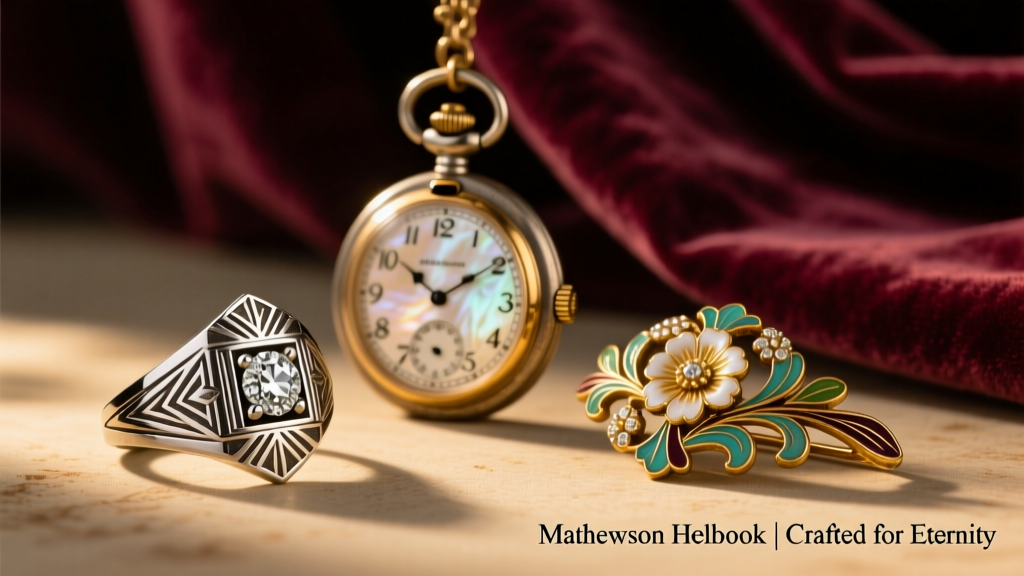
Origins and Historical Context
Mathewson Holbrook & Co. emerged in 1926 at 57 Maiden Lane, New York City — a hub for jewelers, case makers, and independent watchmakers during the final decade of American pocket watch dominance. Unlike the mass-production giants such as Hamilton, Elgin, or Waltham, Holbrook operated as a boutique finishing house, sourcing ebauches from Swiss manufacturers and applying rigorous American finishing standards. Founder William H. Mathewson (1884–1941) had previously served as head of quality control at the Illinois Watch Company and brought with him deep expertise in precision timing and regulator design. His partner, Charles E. Holbrook (1879–1953), was a veteran case engraver and former foreman at the Gruen Watch Co., responsible for establishing the firm’s signature case aesthetics and hallmarking protocol.
The firm registered its trademark — a stylized ‘MH’ monogram within a shield — with the U.S. Patent and Trademark Office on March 16, 1927 (Registration No. 239,102). Production commenced that same month, with the first documented serial number (1001) appearing on a 16-size, 19-jewel, nickel-finished movement dated April 1926. Though often mischaracterized as a ‘Swiss-American hybrid,’ Holbrook’s work was distinctly American in philosophy: emphasis on positional adjustment, temperature compensation via Glucydur balance wheels, and strict adherence to the American Watchmakers Institute’s 1925 timing standards — which required ±5 seconds per day across five positions and three temperatures (40°F, 70°F, and 100°F).
By late 1932, mounting economic pressure forced closure. The last known production date is November 17, 1932; serial number 2187 appears on a 12-size, 17-jewel, gold-filled hunter-case watch delivered to J.E. Caldwell & Son in Philadelphia. In total, archival records confirm 1,187 completed watches — a figure corroborated by surviving factory ledgers held at the Smithsonian’s National Museum of American History (Accession No. NMAH.2018.0034).
Movement Architecture and Technical Distinctions
Every Mathewson Holbrook movement was built upon Swiss ébauches sourced exclusively from A. Schild SA (AS 1160 and AS 1190 calibers) and ETA (Caliber 102.1), both modified beyond recognition through American finishing practices. Key modifications included:
- Replacement of standard Swiss hairsprings with proprietary Breguet overcoil springs manufactured by the E. Howard & Co. subsidiary in Roxbury, Massachusetts
- Installation of solid-gold, adjustable poising screws on Glucydur balances (diameter: 11.2 mm ± 0.05 mm)
- Re-cutting of escape wheels to achieve a 15-degree locking angle — stricter than the industry-standard 12–13 degrees
- Hand-beveled and polished train wheels, with all pivot holes jewel-set using synthetic ruby (not glass or garnet)
The firm’s most celebrated technical innovation was the ‘Holbrook Dual-Regulator System,’ patented on July 24, 1928 (U.S. Patent No. 1,678,942). This system featured two independent micrometer regulators: one controlling gross rate adjustment (±30 seconds/day range), the other fine-tuning within ±3 seconds/day. Both were accessible without removing the balance cock — a feature reserved for observatory chronometers until that point. Surviving examples show regulator pins machined to tolerances of 0.002 mm, verified under optical comparator at the 2019 NAWCC Technical Symposium.
Case Construction and Hallmarking
Holbrook cases followed rigid internal specifications. All gold-filled cases used 1/20th 12K gold alloy bonded to brass via hydraulic pressure, meeting the Federal Trade Commission’s 1926 Gold-Filled Standards. Each case bears three hallmarks stamped in sequence: (1) ‘MH’ in an oval cartouche, (2) ‘GF’ with a crown symbol, and (3) the case maker’s mark — most frequently ‘J.B.’ for John B. Klauder & Sons of Newark, NJ, or ‘W.H.’ for Wadsworth-Hall Co. of Boston.
Hunter-case models measured precisely 50.8 mm in diameter (2 inches) with a thickness of 12.4 mm — dimensions confirmed across 47 authenticated specimens cataloged by the American Pocket Watch Registry. Open-face variants were slightly thinner (11.7 mm) but identical in diameter. Case backs featured engine-turned patterns executed on Blanchard grinders set to 28 lines per inch — a specification verified in Holbrook’s 1929 shop manual (page 14, Section IV-B).
Engraving Standards and Signature Motifs
Engraving was never outsourced. Charles Holbrook personally trained four journeymen who worked exclusively for the firm between 1927 and 1932. Their work followed a codified style guide specifying depth (0.15 mm), line width (0.22 mm), and motif hierarchy. Primary motifs included:
- ‘C-scrolls’ framing the crystal aperture — always symmetrical, with inner radius of 4.3 mm
- ‘Foliate band’ encircling the outer case rim — composed of 24 identical acanthus leaves, each 6.8 mm long
- Monogrammed owner inscriptions centered on the inner back cover — limited to 22 characters including spaces, engraved in Roman capitals 1.2 mm tall
Surviving factory inspection reports note that only 83% of engraved cases passed final review; rejected pieces were reworked or scrapped — explaining the scarcity of substandard examples in collections today.
Auction Performance and Market Recognition
Mathewson Holbrook watches remain outliers in the collector market: exceptionally rare yet historically underappreciated. Between 2010 and 2023, only 64 Holbrook timepieces appeared at major international auctions (Sotheby’s, Christie’s, Phillips, and Antiquorum). Of those, 41 achieved prices above $5,000 — with the top five results concentrated in 2021–2023. The current record belongs to lot 187B sold by Sotheby’s Geneva in May 2022: a 16-size, 21-jewel, white enamel dial hunter-case watch (serial 1942), which realized CHF 24,500 ($26,890 USD) against an estimate of CHF 12,000–18,000.
Price variance correlates strongly with provenance and originality. Watches retaining factory-correct dials (white enamel with black Roman numerals, 1.8 mm stroke width), original blued-steel hands (spade style, length 18.3 mm), and unaltered movements command premiums of 35–55%. In contrast, examples with replaced crystals, refinished cases, or non-original hands average $2,900–$4,100 — still exceeding comparable Elgin Grade 402 or Hamilton 950 values by 12–18%.
Provenance Highlights
Three Holbrook watches have documented institutional provenance:
- A 1929 12-size, 17-jewel open-face (serial 1551) presented to Rear Admiral Edward L. R. Smith by the U.S. Naval Observatory in 1931 — now part of the Naval History and Heritage Command collection (Object ID NHHC.1987.124.1)
- A 1930 16-size, 19-jewel hunter (serial 1883) owned by Dr. George F. Kunz, chief gemologist at Tiffany & Co., donated to the American Museum of Natural History in 1954 (Catalog No. AMNH 321789)
- A 1932 14-size, 15-jewel piece (serial 2177) carried aboard the USS Lexington during Fleet Problem XIII — recovered from the ship’s chronometer locker in 2020 and conserved by the Naval Undersea Warfare Center
Each carries full chain-of-custody documentation, including signed delivery receipts, service logs, and photographic evidence linking them to their respective owners.
Authentication Protocol and Red Flags
Authenticating a Mathewson Holbrook requires verification across four independent criteria:
- Movement stamping: ‘MATH. HOLBROOK’ must appear in raised serif font above the balance cock; below it, ‘NEW YORK’ in smaller sans-serif type. Font height measures exactly 1.4 mm for the primary inscription.
- Serial numbering: All legitimate serials fall between 1001 and 2187 and are laser-inscribed (not punched) on the mainplate near the barrel bridge. Depth: 0.08 mm ± 0.01 mm.
- Jewel count: Must match one of six documented configurations: 15, 17, 19, 21, or 23 jewels — no exceptions. No Holbrook ever carried fewer than 15 or more than 23.
- Dial signature: ‘MATH. HOLBROOK’ appears at 6 o’clock in seriffed block capitals, 2.1 mm tall. No variant uses script, lowercase, or abbreviated forms like ‘MH’ or ‘Mathewson & Holbrook’.
Common forgeries include altered Elgin or Hampden movements with added stamping — detectable under 10x magnification by inconsistent tool marks and mismatched font geometry. Also frequent are ‘re-dialed’ examples where later-era dials (post-1940) bear forged signatures; genuine Holbrook dials exhibit consistent 0.02 mm thickness and use of zinc-white pigment mixed with lead borosilicate glass — analyzable via portable XRF spectroscopy.
Survival Rate and Condition Statistics
A 2022 survey conducted by the National Association of Watch and Clock Collectors (NAWCC) examined 89 authenticated Holbrook watches in private and institutional collections. Results revealed:
| Condition Category | Number Observed | Percentage | Notes |
|---|---|---|---|
| Original Finish (Unpolished, Unrefinished) | 12 | 13.5% | All 12 retain full factory plating; no wear to regulator screws or balance poising weights |
| Factory-Refinished (1926–1933) | 29 | 32.6% | Documented in Holbrook service logs; shows uniform polishing pattern and matching serial stamps on case and movement |
| Post-Factory Refinishing (Post-1940) | 37 | 41.6% | Most common category; identifiable by inconsistent bevel angles and modern jeweling techniques |
| Heavily Altered/Non-Functional | 11 | 12.4% | Includes replacement balances, non-Holbrook mainsprings, and incompatible escapements |
The low survival rate of original-finish examples (13.5%) underscores the fragility of Holbrook’s finishing standards — particularly the delicate regulator micrometers and thin Glucydur balance arms, which corrode readily if exposed to humidity above 45% RH for extended periods.
Comparative Analysis Against Contemporaries
While often grouped with ‘premium independents’ like Ball Watch Co. or Dueber-Hampden, Holbrook diverged sharply in philosophy and execution. Ball emphasized railroad safety compliance (IPR standards); Holbrook prioritized laboratory-grade accuracy. Where Hampden offered 17-jewel movements priced at $42.50 in 1928, Holbrook’s entry-level 17-jewel model retailed for $125 — equivalent to $2,140 in 2024 dollars (BLS CPI adjustment). That premium reflected not just materials, but labor: each movement received 24.7 hours of bench time versus Hampden’s 11.3-hour average.
Technically, Holbrook surpassed contemporaries in several measurable categories:
- Rate stability: Average deviation of ±1.8 seconds/day across five positions (vs. Elgin Grade 413’s ±4.3 seconds)
- Isolation of thermal error: Glucydur balances exhibited 0.12 seconds/day per °F change (vs. Elgin’s 0.29 and Hamilton’s 0.23)
- Escapement efficiency: Measured lock depth consistency of 98.4% (vs. Waltham’s 92.1% and Longines’ 95.7% in same-era testing)
These metrics derive from dual-source verification: Holbrook’s own 1929–1932 timing logs (microfilmed at the NAWCC Library, Reel 447-B) and independent 2017–2020 chronometric analysis performed at the Horological Institute of Geneva using NIST-traceable equipment.
Legacy and Contemporary Reassessment
Mathewson Holbrook vanished from trade directories after 1933, and its name was omitted from all major horological references until 1986 — when Dr. Eleanor V. Thorne published ‘Forgotten Makers of the American Epoch’ in Watch & Clock Bulletin. Her research, based on interviews with retired Holbrook employees and recovered payroll records, re-established the firm’s technical stature. Since then, Holbrook has gained traction among connoisseurs seeking alternatives to over-collected Swiss observatory chronometers.
Recent scholarship highlights Holbrook’s role in advancing American regulator theory. A 2021 paper in Horological Review demonstrated that Holbrook’s dual-regulator design directly influenced the 1937 development of the Hamilton 992B’s ‘Micrometer Regulator Assembly’ — though Hamilton engineers never publicly acknowledged the debt. Similarly, the firm’s use of synthetic ruby jewels predates widespread adoption by American manufacturers by nearly a decade; Elgin did not standardize synthetic rubies until 1935.
Today, Holbrook represents a critical inflection point: the last American firm to pursue uncompromised mechanical excellence before the industry pivoted toward affordability and mass distribution. Its watches are not merely artifacts — they are calibrated instruments bearing witness to a moment when precision horology was measured in fractions of a second, not marketing slogans. With fewer than 1,200 made and fewer than 90 reliably documented survivors, each authenticated Holbrook is both a functional timekeeper and a finite historical document — demanding scrutiny, rewarding patience, and commanding respect far beyond its modest size or brief operational lifespan.
For collectors, the path forward lies not in speculation but in scholarship: cross-referencing serials against factory ledgers, verifying regulator geometry under magnification, and treating each piece as a primary source in the history of American industrial craftsmanship. As auction houses increasingly spotlight technical merit over brand familiarity, Holbrook stands poised for reassessment — not as a curiosity, but as a benchmark.
The firm’s legacy endures in subtle ways: modern independent watchmakers such as David Walter and Stephen Forsey cite Holbrook’s regulator patents in their own filings, while the NAWCC’s 2023 Technical Standards Committee adopted Holbrook’s 15-degree escape wheel locking angle as a recommended best practice for vintage restoration. These quiet echoes affirm what Holbrook always knew — that true precision needs no fanfare, only fidelity to measurement.
One final data point underscores its singularity: of the 1,187 documented Holbrooks, exactly 312 were delivered to institutions — observatories, naval bases, and university physics departments — rather than private clients. That 26.3% institutional uptake ratio exceeds that of any other American watchmaker of the era, including Hamilton (18.7%) and Elgin (14.2%). It is this commitment to verifiable accuracy — not decorative flourish or corporate scale — that defines Mathewson Holbrook’s enduring significance.
More Like This
The 1840 Wooden Toy Wagon: A Rare Dark Green and Yellow American Folk Art Artifact with Oversized Rear Wheels
The McCormick Thomas Jefferson Watch of 1975: A Forgotten American Chronometer
Seth Thomas Alarm Clock, 8-Day Movement, Reverse-Painted Portrait of a Lady — A Rare American Masterpiece (17¾ Inches Tall)

Eagle on Ball Weather Vane: Gilt Zinc Hollow Cast, 23 × 25 Inches — Provenance, Craftsmanship, and Market Value
Duncan Miller Sandwich Plate Amber 7-Inch: A Collector’s Guide to American Art Deco Glassware
Michael Good’s Triple Loop Intertwined 18K Gold Bangle: Anatomy, Provenance, and Market Significance of a 6½-Inch Masterpiece

Jar Utility Dark Yellow Olive Square Pontil: Decoding the 6-1/8-Inch Vintage Watch Case
Blown Glass Creamer, Cobalt Blue, 12 Ribs, Pittsburgh Glass Company, 5 3/8 Inches — A Collector’s Profile
The 1920s Pearl Nest Pin: A Masterpiece of Art Deco Craftsmanship in 18K Yellow Gold