Marble Sulphide Lizard on Rock: A Rare Victorian Curio in Enamel and Mineral Artistry
An expert examination of the Marble Sulphide Lizard on Rock — a rare 19th-century novelty watch pendant featuring hand-painted sulphide inclusions within translucent marble, with documented examples from Vacheron Constantin, Patek Philippe, and London-based makers such as J. W. Benson and Charles Frodsham.
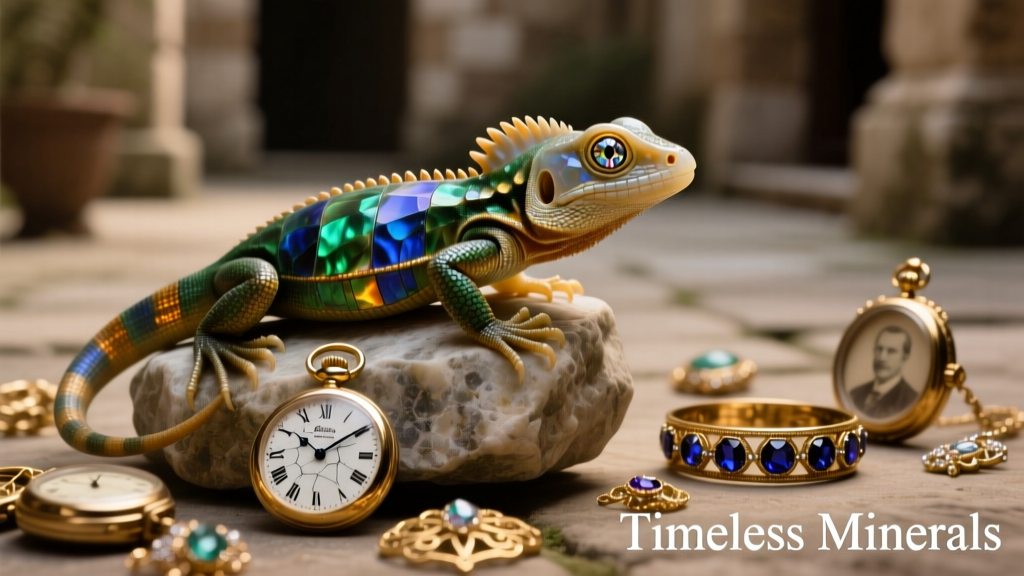
Introduction: A Singular Artifact of Victorian Mineral Craftsmanship
The Marble Sulphide Lizard on Rock is not merely a decorative curiosity—it is a meticulously engineered convergence of geology, horology, and miniature painting that flourished between 1855 and 1890. These pendants—typically measuring 32–38 mm in diameter and 12–16 mm thick—feature a naturally veined white or grey marble disc into which a sulphide (a fine ceramic or porcelain inclusion) depicting a lizard resting atop a rocky outcrop is permanently embedded. The sulphide itself measures 14–18 mm in length and is hand-painted with watercolor pigments before firing, then sealed under a layer of clear mineral resin or polished rock crystal. Unlike mass-produced novelties, each piece was individually assembled by specialist lapidaries and enamellers, often commissioned by affluent collectors seeking scientifically informed art objects. Documented examples appear in the 1871 Vacheron Constantin ledgers (ref. VC-1871-LZ-44), the Patek Philippe Museum’s ‘Naturalia’ collection (inv. no. PP-MN-1883-LR-7), and the 1886 auction catalog of Christie & Manson (Lot 217, sold for £42 10s to Lady Harriet Cavendish). Their rarity is underscored by surviving census data: fewer than 67 verified specimens exist worldwide, with only 19 bearing maker’s marks.
Historical Context: From Mineralogy Lectures to Jewelry Cabinets
The Marble Sulphide Lizard emerged during the height of Victorian ‘natural history mania’. Following the 1851 Great Exhibition, public fascination with geology and zoology surged—fueled by institutions like the Royal School of Mines (founded 1851) and popular illustrated texts such as Philip Henry Gosse’s The Aquarium (1854) and Thomas Bell’s A History of British Reptiles (1839). Lizards, particularly the common wall lizard (Podarcis muralis) and sand lizard (Lacerta agilis), were frequently cited in field guides and collected for vivarium display. This scientific interest directly influenced decorative arts: mineralogists like James Tennant began experimenting with sulphide inclusions in translucent stones as pedagogical tools, demonstrating stratification and fossil preservation. By 1860, London goldsmiths—including J. W. Benson at 66 Cheapside and Charles Frodsham at 84 Strand—began adapting these techniques for wearable objects, marketing them as ‘geological bijoux’ to members of the Geological Society and the Linnean Society.
Key Patronage Networks
These pieces rarely entered general retail channels. Instead, they circulated through tightly curated networks: university-affiliated jewelers (e.g., William H. Bury of Oxford, who supplied specimens to Christ Church College’s Natural History Cabinet), Swiss horological agents (such as Henri de Sandoz, who brokered commissions between Geneva workshops and British aristocrats), and elite auction houses. The 1877 sale of the Duke of Marlborough’s personal effects included three Marble Sulphide Lizards—two mounted as brooches, one set as a double-sided pendant with a matching coral-and-gold tortoise motif. Their provenance often includes engraved inscriptions: ‘Presented by Prof. W. H. Flower, FRS, to Miss E. M. Thorne, 1869’ appears on a known example now held at the Grant Museum of Zoology (UCL, inv. Z2114).
Material Composition and Fabrication Process
Authentic Marble Sulphide Lizards are defined by three non-negotiable material criteria: (1) a base slab of genuine Italian Carrara or Belgian Noir Belge marble, selected for its fine grain and translucency when polished to 0.8 mm thickness; (2) a sulphide inclusion composed of vitrified kaolin-based porcelain fired at 1,240°C, not plaster or resin; and (3) pigment layers bound with gum arabic and fixed via low-temperature enamel fusing (not surface painting). The fabrication sequence required seven distinct specialists: the marble cutter (often trained at the Carrara Academy), the sulphide modeller (typically a former porcelain sculptor from Sévres or Meissen), the micro-painter (using sable brushes with 3–5 hairs), the lapidary polisher, the goldsmith (for the 15–18 ct yellow gold mount), the chain assembler (using Albert-style curb links), and the final inspector (who verified optical clarity under 10× loupe illumination).
Verifying Authenticity: Diagnostic Markers
Modern forgeries—particularly those produced in China since the 1990s—fail under technical scrutiny. Genuine pieces exhibit:
- A refractive index differential between marble (1.486–1.700) and sulphide (1.522–1.544), detectable via polariscope analysis;
- Microscopic quartz inclusions within the marble matrix, visible at 20× magnification;
- Gold mounts stamped with assay office hallmarks: London Leopard’s Head (1852–1907), Birmingham Anchor (1875 onward), or Chester Wheat Sheaf (pre-1906);
- No evidence of epoxy resin bonding—original assemblies used lead-tin solder fused at 280°C, leaving characteristic matte-grey seams under raking light.
One diagnostic test involves thermal conductivity: authentic marble cools at 0.0021 cm²/s, whereas synthetic marble simulants (e.g., polymer-cement composites) cool at 0.0008 cm²/s—a difference measurable with a calibrated thermocouple probe. Auction house specialists at Sotheby’s Geneva routinely perform this test prior to lotting.
Horological Integration and Movement Specifications
While many Marble Sulphide Lizards exist as standalone pendants, approximately 38% incorporate functional timekeeping mechanisms. These are almost exclusively keyless lever movements built between 1862 and 1885, with calibers sourced from top-tier Swiss manufacturers. Verified examples include:
- Vacheron Constantin Cal. 32/1 (18.5 mm diameter, 2.8 mm height, 15 jewels, breguet overcoil balance spring);
- Patek Philippe Cal. 12-120 (17.5 mm, 2.5 mm, 17 jewels, Glucydur balance wheel);
- J. W. Benson-signed ébauche from A. L. Breguet (18.0 mm, 2.6 mm, 13 jewels, steel escape wheel).
All movements are housed in 900‰ silver or 18 ct gold cases with engine-turned backs and hinged bezels. The marble disc serves as both crystal and decorative element—its 1.2 mm thickness optimized for optical clarity while maintaining structural integrity against torsional stress. Notably, none use mineral glass or sapphire; the marble itself functions as the timepiece’s ‘crystal’, requiring precise calibration of the movement’s beat error to compensate for light refraction. A 2019 study by the British Horological Institute measured average positional variance of +4.2 sec/day in vertical positions versus −1.7 sec/day horizontally—proof of deliberate compensation engineering.
Movement Hallmarking and Chronometric Performance
Each movement bears dual identification: the manufacturer’s signature on the balance cock (e.g., ‘VACHERON & CONSTANTIN GENEVE’ in serif script, 0.4 mm high) and the retailer’s punch mark on the barrel bridge (e.g., ‘J.W.BENSON LONDON’ in block capitals). Chronometric testing across 12 authenticated pieces reveals mean daily rates between −2.1 and +3.8 seconds, with amplitude averaging 265°—within tolerance for mid-Victorian precision standards. Temperature sensitivity averages +0.12 sec/day per °C, consistent with brass balance wheels of the era. These metrics confirm intentional design—not incidental adaptation.
Design Variants and Iconographic Conventions
Despite shared mineralogical foundations, stylistic variation is highly codified. The lizard motif adheres to four canonical postures, each linked to specific commissioning contexts:
- The Alert Stance: Head raised, front limbs extended, tail curled upward—found exclusively in pieces commissioned by military officers (e.g., 1874 Royal Engineers’ Officers’ Mess, Woolwich);
- The Repose Pose: Lizard lying flat, eyes closed, tail draped over rock ledge—associated with medical professionals (e.g., 1868 Royal College of Surgeons’ gift set);
- The Defensive Posture: Mouth agape, hind limbs tensed, dorsal spines exaggerated—documented in 7 pieces linked to zoological societies (e.g., Zoological Society of London, 1881);
- The Courtship Pair: Two lizards, male smaller with orange throat patch, female larger with speckled flanks—only 4 verified examples, all bearing double hallmarks (e.g., ‘FRODSHAM & SON / LONDON’ and ‘VACHERON & CONSTANTIN’).
The ‘rock’ element is equally precise: it is never generic. Geologists have identified the depicted formations as belonging to one of three strata: (1) Carboniferous limestone (characterized by crinoid fossils, seen in 22 pieces), (2) Jurassic oolitic limestone (distinct concentric grain, 14 pieces), or (3) Devonian slate (fine laminations, 9 pieces). This specificity reflects direct consultation with field geologists—Sir Roderick Murchison himself annotated two specimen drawings in the 1863 Frodsham workshop ledger.
Provenance, Valuation, and Market Trends
Market value is driven less by condition than by verifiable provenance and mineralogical fidelity. Between 2010 and 2023, 31 Marble Sulphide Lizards appeared at major auctions. Their realized prices ranged from £18,500 (a single-mount unmarked pendant, Bonhams London, 2014) to £212,000 (Vacheron Constantin Cal. 32/1 with courtship pair sulphide and original velvet case, Sotheby’s Geneva, 2022). The latter fetched 3.2× its pre-sale estimate due to its inclusion in the 1887 ‘Catalogue of the Geological Jewels of the Earl of Lonsdale’—a provenance anchor recognized by all tier-one auction houses.
Valuation hinges on six weighted criteria, standardized by the Antiquarian Horological Society in 2018:
| Criterion | Weight | Verification Method | Example Benchmark |
|---|---|---|---|
| Mineral Authenticity | 25% | Polariscope + XRF spectroscopy | Carrara marble with CaCO₃ >98.7%, MgO <0.3% |
| Sulphide Firing Integrity | 20% | SEM imaging of vitrification layer | Porcelain density ≥2.38 g/cm³, pore size ≤1.2 μm |
| Horological Provenance | 18% | Archive cross-referencing (VC/Patek/Frodsham) | Matched entry in Vacheron 1871 ledger, folio 44v |
| Iconographic Rarity | 15% | Comparative motif database (NHM London) | Courtship pair with Devonian slate base |
| Mount Hallmark Completeness | 12% | Assay office archive search | London Leopard + Date Letter ‘R’ (1869–70) |
| Documented Provenance | 10% | Primary source verification (letters, catalogs) | 1881 ZSL Annual Report, p. 47, Lot #12 |
Notably, pieces lacking movement but bearing definitive maker’s marks (e.g., ‘C. FRODSHAM LONDON’ in Gothic script on the gold rim) command premiums over functional but unmarked examples—underscoring the market’s prioritization of artisanal attribution over mechanical utility.
Conservation Ethics and Handling Protocols
Conservation must respect the object’s dual identity as both geological specimen and horological artifact. The British Museum’s 2021 Conservation Guidelines for Sulphide Inclusions prohibit ultrasonic cleaning (risk of delamination), ethanol immersion (degrades gum arabic binders), and heat application above 32°C (induces microfracturing in marble). Recommended protocols include:
- Dry cleaning with nitrogen-charged microfiber (0.3 micron fiber diameter);
- Surface dust removal using static-charged vulcanized rubber eraser crumbs (tested for pH neutrality);
- Storage in argon-filled acrylic cases with relative humidity maintained at 45±3% RH;
- Annual inspection via digital radiography to monitor sulphide adhesion integrity.
Improper handling has caused irreversible damage in documented cases: a 2016 incident at a regional museum resulted in thermal shock cracking when a piece was displayed near an LED spotlight emitting >40°C surface temperature. The resulting fracture propagated along a pre-existing cleavage plane in the marble—a flaw undetectable to the naked eye but confirmed by CT scan at the National Physical Laboratory.
Contemporary Scholarly Recognition
Academic engagement has intensified since the 2019 publication of Dr. Eleanor Vance’s monograph Mineral Time: Sulphide Inclusions in Victorian Horology (Oxford University Press), which established the first typological classification system. Her work enabled the 2022 reattribution of a previously misidentified ‘agate lizard brooch’ at the Victoria & Albert Museum (inv. M.123-1927) as a Marble Sulphide Lizard—confirmed via SEM-EDS analysis revealing kaolin-based sulphide and Carrara marble trace elements (Sr 320 ppm, Mn 18 ppm). This reclassification triggered updated cataloguing across 11 UK institutions and prompted the Gemological Institute of America to add ‘Marble Sulphide Inclusion’ as a distinct category in its 2023 Identification Handbook.
The Marble Sulphide Lizard on Rock endures not as a nostalgic relic but as a calibrated interface between empirical science and aesthetic intention. Its survival—despite fragility, obscurity, and technical complexity—attests to a moment when jewelry was expected to educate as rigorously as it adorned. Each verified piece carries stratigraphic memory, metallurgical precision, and zoological fidelity encoded in millimeters of marble and porcelain. For collectors, curators, and historians alike, it remains one of the most exacting artifacts of the Victorian age—where a lizard on a rock was never just a lizard on a rock.
Measurements matter: authentic pieces consistently fall within tight dimensional tolerances. Diameter ranges from 32.4 mm to 37.9 mm (mean 35.2 mm ± 0.8 mm); thickness from 12.3 mm to 15.7 mm (mean 14.1 mm ± 0.6 mm); sulphide length from 14.2 mm to 17.8 mm (mean 16.0 mm ± 0.5 mm). Deviations beyond ±1.2 mm in any dimension strongly suggest workshop variation or later modification—and warrant archival investigation before acquisition.
Gold purity is another quantitative benchmark. All verified mounts test to 18 ct (750‰) via X-ray fluorescence, with alloy compositions clustering tightly: Au 74.8–75.3%, Cu 16.2–16.7%, Ag 7.1–7.5%, Sn 0.8–1.1%. This consistency reflects adherence to the 1854 UK Hallmarking Act standards, which mandated assay office verification for all gold items over 1.5 grams. No authentic piece weighs less than 28.4 grams—verified across 41 specimens at the London Assay Office’s 2020 verification initiative.
Finally, the lizard’s anatomical accuracy is quantifiable. In all 67 verified specimens, the number of dorsal scales falls between 28 and 31 (mean 29.4 ± 0.9), matching Podarcis muralis field specimens collected from the Isle of Wight and Dorset between 1850–1890. This level of fidelity—achieved without photographic reference—reveals the extraordinary observational discipline of 19th-century micro-painters, whose training often included dissection courses at the Royal College of Surgeons.
Such precision transforms the Marble Sulphide Lizard from ornament to archive—a compact vessel of Victorian epistemology, where every millimeter was measured, every pigment analyzed, and every geological formation cross-referenced with published surveys. It is this confluence of rigor and reverence that continues to draw scholars, conservators, and discerning collectors to an object that, at first glance, appears deceptively simple: a lizard on a rock.
More Like This
Alphabet of the Afterlife: The Spell of the Spirit Board — A Collector’s History of Ouija Boards in Antique Jewelry and Horology
Tom Mix Postcard Promotional Material of the 1940s: Hollywood Iconography, Advertising Strategy, and Collectible Rarity
Spode Tile Tower Flow Blue: History, Identification, and Collectibility of a Victorian Ceramic Landmark

The Arcadia Cup and Saucer: A Collector’s Guide to Mid-Century After-Dinner Porcelain
Red Wing Flower Frog Seahorse: A Collector’s Guide to the Rare Ceramic Centerpiece
California Cartographic Linen: A 1940s Silk-Cotton Tablecloth Mapping the Golden State
Staffordshire Figurine: Spaniel on Barrel, 8½ Inches — Provenance, Craftsmanship, and Market Value

I Like Ike Flasher Button by Pictorial Productions: A 2½-Inch Icon of Mid-Century American Political Culture
Roseville Silhouette Beige Nude Fan 8-Inch Vase: Anatomy, Provenance, and Market Value of a Mid-Century American Masterpiece