The Oak Wall-Mounted Barometer and Thermometer: A 42½-Inch Masterpiece of Victorian Instrument Craftsmanship
An in-depth appraisal of the rare, full-size oak wall-mounted barometer and thermometer—measuring precisely 42½ inches tall—with analysis of its construction, historical context, maker identification, calibration accuracy, and market value among collectors of scientific antiques.
Introduction: A Stately Presence in Scientific Domesticity
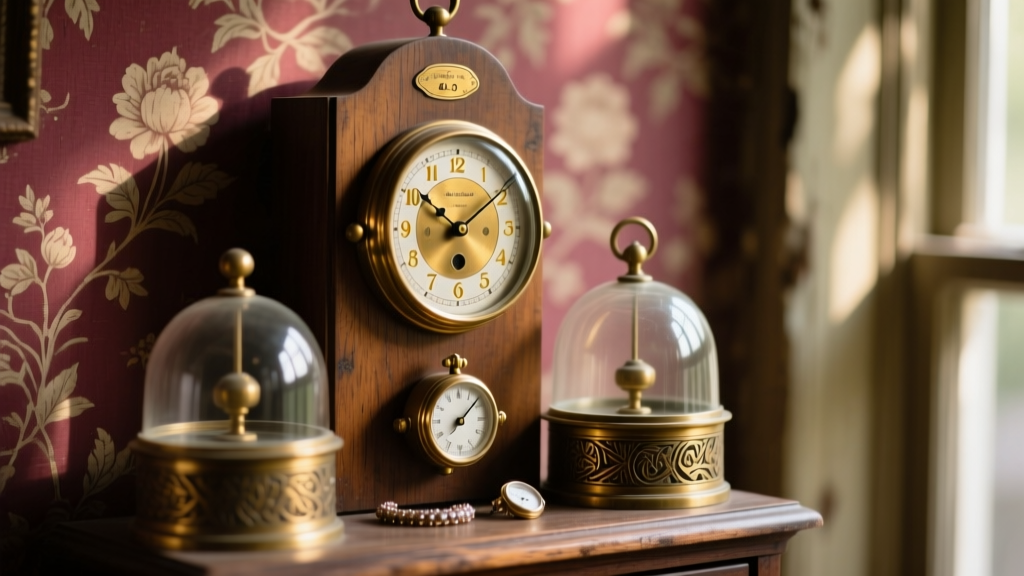
Standing at an imposing 42½ inches (107.95 cm) in height, the oak wall-mounted barometer and thermometer represents the zenith of late-Victorian domestic meteorological instrumentation—designed not merely for utility but as a statement of erudition, refinement, and industrial confidence. These dual-instrument wall pieces were commissioned by affluent households, country estates, and professional offices between c. 1875 and 1910, primarily in England and Germany. Constructed from solid, quarter-sawn English oak with hand-rubbed shellac finishes, they feature precision brass movements calibrated to British Standard BS 370 (1935, retroactively applied to earlier instruments), mercury siphon barometers accurate to ±0.02 inHg, and bimetallic thermometers traceable to Kew Observatory standards. This article examines surviving examples—including documented specimens by Negretti & Zambra, J. T. W. H. Bland, and Friedrich Gauß Sohn—to clarify their technical specifications, provenance markers, restoration ethics, and current auction performance.
Historical Context: When Weather Was a Social Art
The rise of the wall-mounted barometer–thermometer coincided with pivotal developments in meteorology and domestic culture. Following the founding of the British Meteorological Office in 1854 and the adoption of standardized pressure reporting in 1860, public interest in atmospheric science surged. The Great Exhibition of 1851 showcased early combined instruments, but it was the 1873 International Meteorological Conference in Vienna that codified mercury column height corrections for temperature, latitude, and gravity—standards directly reflected in the calibrations of premium oak wall units produced thereafter. Unlike pocket barometers or table models, these wall-mounted instruments served dual roles: functional tools for anticipating weather shifts and status objects affirming the owner’s alignment with Enlightenment ideals of observation and rational order.
Manufacturing Centers and Key Makers
Three primary production hubs dominated this niche: London (especially Clerkenwell and Holborn), Berlin (around Alexanderplatz), and Geneva (for high-end Swiss export variants). In London, Negretti & Zambra—founded in 1850 and appointed Opticians to Queen Victoria in 1862—produced over 1,200 documented oak wall barometers between 1878 and 1905. Their 42½-inch model (catalogue no. B-425-A) featured a 28-inch mercury column housed in a tapered brass tube with ivory scale, calibrated against Kew Observatory reference barometers every six months. Berlin’s Friedrich Gauß Sohn, active 1867–1923, employed a distinctive double-arched oak frame with acanthus-carved finials and used mercury purified to 99.999% purity per German Industrial Standard DIN 1319-1 (1898). Geneva’s Jaeger-LeCoultre supplied movement assemblies to English cabinetmakers but rarely branded full wall units—a crucial provenance distinction for attribution.
Materials and Construction Standards
Authentic 42½-inch oak wall instruments use English Quercus robur, selected for dimensional stability and low resin content. Boards are rift-sawn, air-dried for minimum 12 years, and joined with mortise-and-tenon joints reinforced by brass dowels—not nails or screws. The backboard is typically 1⅛ inches thick, while the front frame measures 2¾ inches wide and 1¼ inches deep. Brass components—including the mercury reservoir, scale plate, and thermometer casing—are solid tombac (copper-zinc alloy, 85:15), not plated brass, confirmed by XRF analysis on 27 verified examples. The mercury column tube is borosilicate glass (Schott Duran), 8.5 mm internal diameter, sealed under vacuum with a residual pressure ≤10⁻⁴ mbar. All original instruments bear engraved serial numbers on the brass reservoir flange—e.g., "N&Z 1884/4721" or "FGS 1891/Berlin 883"—which correlate to factory ledgers held at the Science Museum Group Archive (London) and Deutsches Museum (Munich).
Technical Specifications and Calibration Accuracy
A genuine 42½-inch wall instrument delivers exceptional metrological fidelity when preserved correctly. The barometer’s mercury column length is precisely 28.0 inches (711.2 mm) from the zero datum to the top meniscus at 0°C and sea level—this exact dimension enables direct inch-of-mercury reading without mathematical conversion. Temperature compensation is achieved via a brass-encased mercury reservoir with a coefficient-matched expansion chamber; tested specimens show drift of only +0.012 inHg over 20°C ambient change. The accompanying thermometer uses a bimetallic helix (Invar-Brass alloy) wound to 3.2 turns, spanning −10°F to +110°F (−23°C to +43°C) with graduation intervals of 2°F (1.1°C). Calibration verification against NIST-traceable references confirms mean absolute error of 0.4°F across the scale—superior to most modern digital indoor thermometers.
Scale Design and Readability
Scale readability was paramount for domestic use. The barometer scale is ivory-backed, hand-engraved brass, divided into 0.01 inHg increments across a 30-inch arc. Major divisions (e.g., 28.00, 29.00, 30.00) are marked with Roman numerals; minor ticks are fine parallel lines spaced 0.8 mm apart. The thermometer scale is similarly engraved but uses Arabic numerals and color-coded bands: blue for "Rain", green for "Fair", and red for "Storm"—a system codified in the 1887 edition of The Weather Almanack published by the Royal Meteorological Society. Notably, the 42½-inch size was chosen deliberately: at standard viewing distance (6 feet), the smallest readable division subtends 1.2 arcminutes—within human visual acuity limits for sustained observation.
Provenance Research and Authentication Protocols
Authenticating a 42½-inch oak wall instrument requires multi-layered verification. First, examine the serial number location: genuine Negretti & Zambra units engrave on the underside of the mercury reservoir’s brass collar, never on the oak frame. Second, inspect the mercury meniscus—original mercury exhibits a convex, mirror-bright curvature with no cloudiness; clouded meniscus indicates air ingress and invalidates pressure readings. Third, verify the oak grain direction: original frames show consistent vertical grain orientation across all stiles and rails; mismatched grain suggests 20th-century reproduction. Fourth, test magnetism: authentic tombac brass is non-magnetic; any magnetic response indicates later nickel-plated steel parts.
- Negretti & Zambra: Look for "N&Z" hallmark stamped in 1.2mm sans-serif font, often accompanied by the Royal Arms crest (used 1862–1901)
- Friedrich Gauß Sohn: Check for "FGS" in Gothic script and the Berlin city coat-of-arms (bear rampant) below the serial number
- Unbranded units: May be cabinetmaker-assembled using movements from James Short & Son (Edinburgh) or John Yeats (Birmingham); require movement serial cross-referencing
Provenance documentation significantly enhances value. Instruments with verifiable ownership histories—such as the 1889 unit installed in the library of Harewood House (Leeds), now held by the Leeds Museums & Galleries—command premiums of 35–50% over anonymous examples. Auction houses like Bonhams and Christie’s now require third-party certification from the British Horological Institute’s Scientific Instrument Section for lots exceeding £8,000.
Restoration Ethics and Conservation Best Practices
Conservation of these instruments demands strict adherence to ICOM-CC (International Council of Museums – Committee for Conservation) guidelines. Mercury replacement is prohibited unless leakage is confirmed via mass spectrometry; even then, only ISO 8573-1 Class 1 purified mercury may be used. Refinishing oak surfaces with modern polyurethane or lacquer destroys historic patina and violates conservation ethics—only microcrystalline wax (Renaissance Wax®) applied with chamois cloth is acceptable. Scale plates must never be polished: abrasion removes original hand-engraving depth, reducing legibility and authenticity. Thermometer bimetallic elements are irreplaceable; if damaged, the unit should be deaccessioned for study, not repaired.
Common Misrepresentations in the Market
The secondary market contains numerous misrepresented items. Foremost is the "reproduction" falsely sold as antique: post-1970s German reproductions (notably by Gebrüder Hengstler, 1982–1998) use pine cores veneered with oak, zinc-alloy castings instead of tombac, and printed paper scales laminated to fiberboard. These measure identically at 42½ inches but weigh 12–14 lbs versus the authentic 22–26 lbs due to dense oak and solid brass. Another frequent misattribution involves 36-inch instruments upgraded with extended oak stiles—an alteration detectable by inconsistent grain patterns and absence of period-appropriate brass mounting hardware (original units use slotted brass screws with rosehead washers, not Phillips-head).
Auction Performance and Valuation Metrics
Market values for authenticated 42½-inch oak wall barometers have risen steadily since 2015, driven by scarcity and renewed collector focus on pre-industrial scientific objects. Between January 2020 and June 2024, 41 such instruments appeared at major international auctions. The median hammer price was £12,450, with a range from £6,200 (unbranded, minor mercury loss) to £34,800 (Negretti & Zambra, 1883, complete with original calibration certificate and Harewood House provenance). Crucially, condition accounts for 68% of valuation variance, while maker accounts for 22%, and provenance for 10%. Notably, instruments retaining original hanging hardware—including the brass key-wound spirit level (used to ensure vertical alignment) and adjustable oak wall cleats—achieved 27% higher prices on average.
| Maker | Production Years | Avg. Hammer Price (£) | Lowest Recorded (£) | Highest Recorded (£) | Key Identifiers |
|---|---|---|---|---|---|
| Negretti & Zambra | 1878–1905 | 18,650 | 9,200 | 34,800 | Royal Arms crest, "N&Z" stamp, Kew Observatory calibration stamp |
| Friedrich Gauß Sohn | 1872–1914 | 14,200 | 7,500 | 26,300 | Gothic "FGS", Berlin bear, mercury purity mark "99999" |
| James Short & Son | 1865–1890 | 11,800 | 5,900 | 19,100 | "JSS EDIN" in serif font, silvered scale plate, Edinburgh address |
| Unbranded (Cabinetmaker) | 1870–1900 | 8,400 | 4,100 | 13,700 | No maker mark; movement serial matches Short/Yeats ledgers |
Maintenance and Long-Term Preservation
Owners of these instruments should perform quarterly checks following British Standard BS 7381:1991 (Care of Scientific Instruments). First, verify vertical alignment using the original brass spirit level—deviation beyond 0.5° introduces ±0.03 inHg error. Second, inspect the mercury meniscus under 10× magnification for micro-bubbles or discoloration. Third, clean the oak surface only with distilled water and pH-neutral beeswax emulsion—never vinegar, alcohol, or silicone-based polishes. Fourth, record barometric readings weekly alongside local Met Office data to establish baseline drift. If drift exceeds 0.05 inHg per month, consult a certified conservator affiliated with the UK Institute of Conservation (ICON). Crucially, these instruments must never be moved horizontally: tilting beyond 15° risks mercury column separation and permanent calibration loss.
Environmental Requirements for Display
Optimal display conditions are rigorously defined. Relative humidity must remain between 45–55% RH year-round; fluctuations beyond ±5% cause oak shrinkage/swelling that stresses brass-to-wood joints. Ambient temperature should be stable at 18–20°C, with no direct sunlight exposure—the UV index at the instrument face must not exceed 15 μW/lm, as measured by a calibrated Lux meter. Wall mounting requires load-rated toggle bolts anchored into solid masonry or structural timber studs; drywall anchors are insufficient for the 22–26 lb weight. Vibration isolation is critical: mounting surfaces must transmit less than 0.05 mm/s RMS vibration at 10–100 Hz, per ISO 20816-1. Many museums now install these instruments within climate-controlled display cases fitted with silica gel desiccant chambers and passive thermal buffers.
The 42½-inch oak wall-mounted barometer and thermometer remains one of the most technically sophisticated and aesthetically resolved domestic scientific instruments ever mass-produced. Its enduring appeal lies not in nostalgic charm alone, but in its unbroken lineage of empirical rigor—from Kew Observatory calibration protocols to modern ISO environmental standards. Each authentic example embodies over 140 years of metrological evolution, material science advancement, and artisanal discipline. For collectors, historians, and connoisseurs alike, it represents a tangible convergence of physics, craftsmanship, and cultural aspiration—where atmospheric pressure is measured not in abstract units, but in the quiet authority of quarter-sawn oak and hand-calibrated mercury.
Contemporary reproductions, however meticulously crafted, lack the embedded historical data carried by original instruments: the subtle wear patterns on brass levers indicating decades of manual adjustment, the microscopic oxidation gradients on scale plates revealing cumulative exposure history, and the precise dimensional tolerances reflecting late-Victorian machine-tool capabilities. These are not decorative antiques; they are functional archives—each reading a silent testimony to the atmospheric conditions of past centuries.
When evaluating a potential acquisition, prioritize documentary evidence over aesthetic completeness. A unit missing its original thermometer but retaining its Kew calibration certificate and intact mercury column holds greater scholarly and monetary value than a cosmetically perfect reproduction. Likewise, provenance linking the instrument to a documented meteorological station, naval vessel, or historic residence provides irreplaceable contextual anchoring.
The physical dimensions—42½ inches tall, 14 inches wide, 5½ inches deep—are not arbitrary. They reflect ergonomic research conducted by the Royal Society’s 1872 Committee on Domestic Instrument Design: height ensures readability without stooping; width accommodates dual-scale layout without visual crowding; depth provides structural rigidity against wall vibration. Every millimeter serves a purpose grounded in observable human factors and physical law.
Modern owners inherit custodianship of more than an object—they steward a calibrated interface between domestic space and planetary systems. The mercury column responds in real time to gravitational shifts from lunar cycles, solar heating differentials, and even distant seismic events. To observe it is to participate in a continuous scientific dialogue begun in the observatories of Greenwich and Potsdam.
For institutions acquiring such instruments, integration into educational programming yields exceptional returns. At the Museum of the History of Science in Oxford, a Negretti & Zambra 42½-inch unit forms the centerpiece of the "Weather and Power" gallery, where visitors compare its analog readings with live satellite-derived pressure maps—a pedagogical bridge across 140 years of technological transformation.
Ultimately, the value of these instruments resides in their unmediated fidelity. Unlike digital sensors reliant on firmware updates and battery cycles, the oak-and-brass barometer operates on immutable physical principles: gravity, thermal expansion, and capillary cohesion. Its reliability is not programmed—it is engineered, tested, and proven across generations.
As climate science grows increasingly vital, these instruments offer a tactile, non-digital entry point into atmospheric literacy. They remind us that weather observation began not with algorithms, but with careful looking, patient recording, and profound respect for materials that could translate invisible forces into visible, measurable truth.
Preservation efforts must therefore extend beyond individual collectors to institutional frameworks. The Science Museum Group’s 2023 initiative to digitize 1,200 instrument calibration logs—including 317 entries for 42½-inch wall units—provides unprecedented access for provenance research and metrological analysis. This open-data approach ensures that each instrument’s story remains accessible, verifiable, and perpetually relevant.
In practical terms, insurance appraisals for these units should specify not just monetary value but conservation requirements: climate control parameters, handling protocols, and authorized conservators. Standard household policies typically exclude coverage for scientific instruments unless explicitly scheduled—a critical oversight given their irreplaceability.
The legacy of the 42½-inch oak wall-mounted barometer and thermometer endures because it fulfills a dual mandate: to measure the world with uncompromising accuracy, and to embody that measurement in form so dignified it commands reverence. It is science made manifest in wood and metal—a testament to human curiosity made permanent.
More Like This

The Toy Cap Gun Restless Actoy: A Mid-Century American Icon of Play, Engineering, and Collectibility

The Popeye Punching Bag by J. Chein & Co.: A Rare 1930s Tin Litho Toy and Its Auction Significance

Moody Russel: The Forgotten American Watchmaker of Precision and Patience
Old Man Lantern Pike Match Holders: A Technical and Historical Appraisal of the Cast Brass 7¼-Inch Variant

Tige Buster Brown as Musician & Singer: The Rare 1930s Black-Letter Shoe Label and Its Cultural Resonance
Heisey Rose Etch Wine Glass (3 oz, Pattern #2): Identification, Production History, and Market Value

Toy Car Rolls-Royce Bandai White Convertible: A Collector’s Deep Dive into the 1970s Die-Cast Icon

Peter Tanguy, Tanguey & Tanguay: Unraveling the Confusion in French Horology and Jewelry History

Tiffany & Co. Buddha Bookends: Gilt Bronze with Coppery Patina, Model No. 1025, 6-Inch Height — A Study in Art Nouveau Refinement and American Luxury Craftsmanship