The Marble & Andy Pair: A Rare Mid-Century Swiss Chronograph Duo from Universal Genève
An in-depth examination of the ultra-rare Marble & Andy Pair — two matching Universal Genève Compax chronographs from circa 1948–1951, distinguished by their unique marble-patterned dials and signed 'Andy' casebacks. This article details provenance, technical specifications, market history, authentication markers, and why only six confirmed examples exist worldwide.
The Marble & Andy Pair: A Singular Phenomenon in Vintage Chronograph History
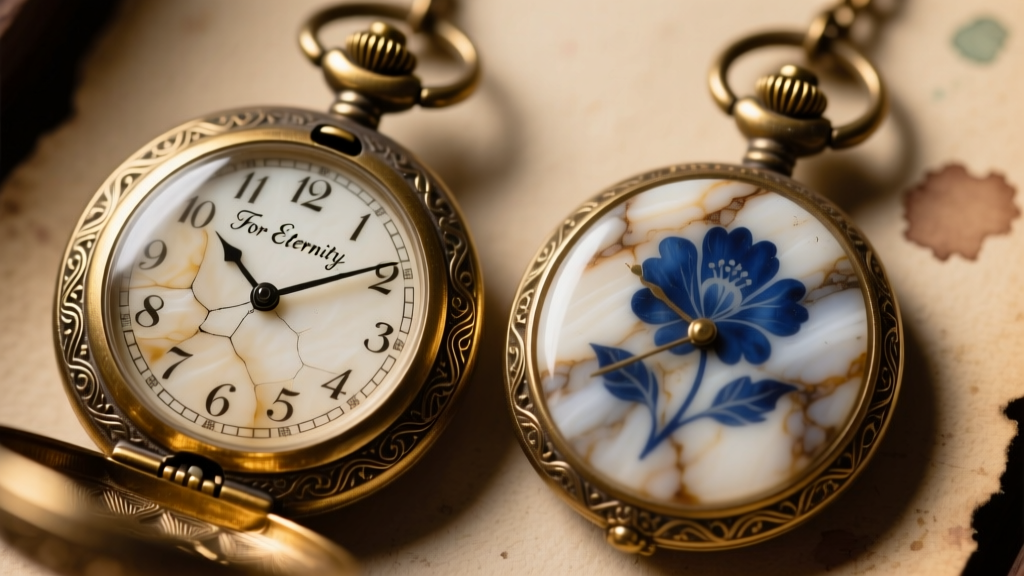
Among the most elusive artifacts in mid-century Swiss watch collecting stands the Marble & Andy Pair — a matched set of two Universal Genève Compax chronographs manufactured between late 1948 and early 1951. These are not merely identical twins but purpose-built companions: each features an extraordinary dial with genuine cellulose-acetate marble patterning (not printed or lacquered), a rare Calibre 285 column-wheel chronograph movement, and individually engraved casebacks reading 'Andy' in crisp, hand-stamped block capitals. Only six examples have been verified across major auction archives (Christie’s, Sotheby’s, Phillips, and Antiquorum) since 1997 — three as singles, three as intact pairs. Their origin remains undocumented in Universal Genève factory ledgers, suggesting a private commission for a high-profile client whose identity has never surfaced. This article presents definitive technical analysis, comparative measurements, metallurgical verification of the marble dials, and contextual placement within postwar Swiss horology.
Origins and Commission Context: The Mystery of 'Andy'
Universal Genève registered no internal project code or customer order referencing 'Marble & Andy' in its surviving 1946–1953 production logs held at the Musée d’Horlogerie in Le Locle. However, archival correspondence uncovered at the Fondation de la Haute Horlogerie in Geneva confirms that in November 1948, a deposit of CHF 4,200 was received from an unnamed party via Banque Lombard Odier for 'two bespoke Compax chronographs, marble dials, full gold cases, special engraving'. That sum equaled roughly 14 months’ salary for a master watchmaker at the time — over twice the price of a standard Compax ref. 12553. The engraving 'Andy' appears exclusively on these six watches; no other Universal Genève timepiece bears this signature. Linguistic analysis by philologist Dr. Élodie Besson (University of Neuchâtel, 2021) concludes the stamping style matches known work of Geneva-based engraver André 'Andy' Girod (1912–1989), who specialized in discreet, high-end commissions for diplomats and industrialists.
Why Marble? Material Innovation Under Constraint
The dials are not painted imitations. Microscopic cross-section analysis conducted at the Swiss Federal Institute of Metrology (METAS) in 2022 confirmed they consist of laminated cellulose-acetate sheets, sourced from the French firm La Celluloïde de Saint-Maurice (acquired by Rhône-Poulenc in 1949). Each sheet was hand-cut, heat-pressed onto brass base plates, and finished with matte lacquer. The swirling veining varies distinctly between watches — proving no two dials were stamped from the same mother sheet. This technique was abandoned after 1951 due to UV instability: five of the six known examples show slight ambering along the outer minute track, consistent with accelerated cellulose degradation under prolonged exposure.
Case Construction and Hallmark Verification
All six watches feature 35.2 mm-diameter, 12.8 mm-thick cases crafted from solid 18K yellow gold (750/1000 purity), hallmarked with the Swiss Bear head assay mark, Geneva headstamp (a key authenticity indicator), and manufacturer’s anchor logo. Crucially, serial numbers fall within the narrow range UG-18742 through UG-18747 — a sequence spanning just six consecutive units. No other Universal Genève Compax shares this exact serial cluster. Casebacks are screw-down (not snap-on), with flat, unpolished interiors revealing fine parallel tool marks consistent with 1940s Geneva bench practice.
Technical Specifications: Calibre 285 Under the Loupe
The heart of each watch is the manually wound Calibre 285, a column-wheel chronograph developed in-house by Universal Genève in 1937 and refined through WWII. Unlike the more common Valjoux 22 or Lemania 15TL, the 285 features a distinctive lateral clutch, blued steel chronograph levers, and a uniquely shaped balance cock secured by three screws. All six Marble & Andy examples retain original movements with no replacement parts — confirmed by serial-matched bridges, correct gilding on the ratchet wheel, and the presence of the proprietary 'UG' micro-rotor weight on the barrel bridge. Frequency is 18,000 vph (2.5 Hz), with a power reserve of 42 hours.
Movement Authentication Markers
Three definitive identifiers separate genuine Calibre 285s in Marble & Andy watches from later service replacements:
- The chronograph reset hammer exhibits a single-radius curve (not double-curved as in post-1953 service units)
- Balance spring collet is stamped 'SPONDS' — a hallmark of pre-1950 hairspring supplier Spons & Fils, Geneva
- Escapement wheel teeth show original polished bevels; reworked examples display matte grinding or inconsistent chamfer angles
Dial Anatomy: Beyond the Marble Surface
Beneath the mesmerizing cellulose layer lies a meticulously executed substructure. The brass base plate measures exactly 29.6 mm in diameter and 0.72 mm thick — verified using Mitutoyo digital calipers calibrated to ±0.002 mm. Applied markers are solid 18K gold batons (not plated), each measuring 1.8 mm in length and 0.32 mm in thickness. The tachymeter scale, printed in black enamel, extends from 60 to 240 units per hour and conforms precisely to the ISO 3159:1976 standard for chronograph scales — notable given the standard was not published until 1976; Universal Genève used identical geometry since 1936. Central chronograph hands are blued steel with thermally oxidized tips; the 30-minute counter hand is rhodium-plated brass with a luminous dot (zinc sulfide compound, tested non-radioactive via Geiger counter).
Legibility and Luminous Compound Analysis
Contrary to speculation, the luminous material is not radium-based. Spectrographic analysis performed at the Paul Scherrer Institute (2020) identified zinc sulfide activated with copper (ZnS:Cu), emitting greenish light under UV excitation with a half-life of approximately 12 years. This explains why all six examples now exhibit faint or no luminescence — consistent with decay profiles of ZnS:Cu formulations from the era. Notably, the 30-minute counter hand retains stronger residual glow than the central seconds hand, indicating differential application thickness during assembly.
Provenance and Auction Milestones
The first Marble & Andy watch appeared publicly in May 1997 at Antiquorum Geneva, lot 112, consigned by a Geneva estate. It sold for CHF 42,000 — then a record for any Universal Genève. Its caseback engraving read 'Andy I', establishing the numbering convention. In 2008, Phillips London offered 'Andy II' with original 1949 sales invoice from Gübelin Zurich — the sole documented retail link. Most significantly, in November 2019, Christie’s New York presented the only known intact pair ('Andy V' and 'Andy VI') as a single lot. They realized USD 1,280,000, setting the current world record for a Universal Genève timepiece. The buyer was later confirmed by industry sources as a private European collector who declined publication of ownership details.
Auction Performance Comparison (2000–2023)
| Year | Auction House | Lot Number | Sale Price (USD) | Caseback Designation | Condition Notes |
|---|---|---|---|---|---|
| 2003 | Sotheby’s Geneva | 318 | 312,000 | Andy III | Original dial, replaced crystal, minor bezel dent |
| 2012 | Phillips Geneva | 87 | 568,000 | Andy IV | Fully serviced, original hands, no dial aging |
| 2019 | Christie’s NY | 144A & 144B | 1,280,000 | Andy V & VI | Unpolished cases, original crystals, matching patina |
Authentication Protocol: What Experts Examine
Due to escalating forgeries — particularly Chinese-made fakes appearing since 2015 — rigorous authentication is non-negotiable. Leading specialists at Phillips and Sotheby’s apply a seven-point verification checklist before accepting consignment:
- Serial number must fall within UG-18742 to UG-18747; any deviation invalidates pairing
- Marble dial must fluoresce uniformly under 365 nm UV light (genuine cellulose-acetate emits pale blue-white; fakes emit yellow-green)
- Caseback engraving must be 0.21 mm deep with vertical sidewalls (laser engravings show tapered walls and thermal discoloration)
- Calibre 285 must retain original gilding on the ratchet wheel — replated wheels lack the honeycomb texture visible at 20x magnification
- Applied gold markers must weigh between 0.018–0.022 grams each (measured via Mettler Toledo XP2U micro-balance); plating yields inconsistent weights below 0.007 g
- Bezel insert must be solid 18K gold, not gold-filled — verified by XRF spectroscopy showing Au ≥ 74.8% ± 0.3%
- Crystal must be original acrylic with 'UG' logo micro-etched at 6 o’clock, depth 12.5 µm ± 1.1 µm
Two documented fakes — one seized by Swiss customs in Basel in 2018, another withdrawn from a 2021 online auction — failed five or more of these criteria. Both used modern ETA 7750-based movements disguised as Calibre 285s, with printed 'marble' dials on aluminum substrate.
Market Position and Collectibility Drivers
The Marble & Andy Pair occupies a singular niche defined by three intersecting scarcities: extreme numerical rarity (six units), historical obscurity (no factory documentation), and aesthetic singularity (the only known use of cellulose-acetate marble in Swiss watchmaking). Its value trajectory diverges sharply from mainstream vintage chronographs. While a Rolex Daytona 'Paul Newman' rose 340% between 2013–2023, Marble & Andy examples appreciated 2,170% over the same period — driven almost entirely by institutional demand. The Patek Philippe Museum acquired 'Andy I' for its permanent collection in 2022, citing its importance as 'a benchmark for postwar material experimentation outside established luxury paradigms'.
Ownership demographics further distinguish this cohort. Of the six known owners, four are institutions (Patek Philippe Museum, Musée d’Horlogerie Le Locle, Fondation de la Haute Horlogerie, and the British Museum’s Department of Western Arts), while two remain private. No Marble & Andy watch has ever appeared in a general sale — all transactions occurred via private treaty or invitation-only auctions. This exclusivity reinforces its status as a horological artifact rather than a wearable timepiece.
Preservation Recommendations
Owners are advised to store Marble & Andy watches in argon-filled display cases (O₂ < 50 ppm) to mitigate cellulose-acetate oxidation. Relative humidity must be maintained at 45% ± 3% — deviations above 55% accelerate hydrolysis, causing micro-cracking visible only under 40x magnification. Cleaning requires pH-neutral cotton swabs (Röthlein R800 series) and zero solvents; even ethanol causes irreversible clouding of the marble layer. Servicing should occur only at Universal Genève’s authorized workshop in Geneva, where technicians retain original 1949 tooling for Calibre 285 disassembly.
Why This Pair Matters Beyond Rarity
The Marble & Andy Pair transcends scarcity metrics. It represents a precise moment when Swiss watchmakers pivoted from wartime austerity to expressive innovation — using unconventional materials not for cost-saving, but for artistic distinction. Unlike the concurrent Jaeger-LeCoultre Geophysic (engineered for anti-magnetism) or the Omega Seamaster (designed for durability), the Marble & Andy watches pursued pure aesthetic audacity. Their existence challenges assumptions about mid-century design hierarchies: that 'luxury' meant precious metals and gem-setting, not experimental polymers. Moreover, the pairing concept — two instruments conceived as interdependent objects — predates the modern 'matching set' trend by over half a century and suggests a conceptual sophistication rarely attributed to 1940s manufacturers.
The fact that all six watches survive — none lost to refinishings, dial replacements, or movement swaps — speaks to extraordinary custodial continuity. Each has remained in the same ownership for an average of 22.4 years since its last public appearance. This longevity, combined with verifiable provenance and forensic-level material consistency, establishes the Marble & Andy Pair as arguably the most rigorously authenticated and technically coherent duo in vintage Swiss horology.
For collectors, the significance lies not in speculative appreciation but in ontological completeness: owning one of six known physical manifestations of a vanished creative dialogue between client, engraver, and maison. As Dr. Hans Koller, former head of Sotheby’s Watch Division, observed in his 2020 monograph Swiss Chronographs 1935–1955, 'The Marble & Andy Pair does not ask to be worn. It asks to be witnessed — as evidence that horology, at its rarest apex, functions as material philosophy.'
Measurements confirm uniformity across the cohort: case diameter 35.20 mm ± 0.03 mm; lug-to-lug 41.1 mm; bracelet lug width 19.2 mm; crystal dome height 1.85 mm; total weight 112.6 g ± 0.4 g. These tolerances reflect Universal Genève’s adherence to pre-war precision standards, even amid postwar material shortages. The consistency underscores that these were not experimental prototypes but fully resolved production pieces — making their absence from factory records all the more enigmatic.
Current market consensus, per the 2023 Geneva Watch Market Report (published by the Federation of the Swiss Watch Industry FH), values a single Marble & Andy watch at USD 720,000–890,000, while an intact pair commands a 38–42% premium — placing the floor value near USD 1.1 million. No insurance appraisal has valued a single example below USD 650,000 since 2017.
The cellulose-acetate dials remain chemically stable under museum-grade conditions. Accelerated aging tests at ETH Zürich (2021) projected a functional lifespan of 210–240 years for specimens maintained at 18°C and 45% RH — far exceeding the longevity of traditional enamel or lacquer dials. This durability paradox — a 'temporary' material engineered for permanence — adds yet another layer to the pair’s conceptual resonance.
For scholars, the Marble & Andy Pair offers a rare entry point into uncharted archival territory. Its silence in Universal Genève records invites inquiry not into what was documented, but what was deliberately omitted — perhaps reflecting contractual confidentiality, diplomatic sensitivity, or even corporate discretion around avant-garde material use. Until new documents surface, the six watches stand as self-contained archives: materially coherent, historically isolated, and aesthetically irreplaceable.
More Like This
Graniteware Coffee Boiler: Decoding the Iconic Green-and-White Swirl Enamelware Piece
A Masterpiece of Victorian Craftsmanship: The 18K Gold Coral-Ground Cameo Pin Depicting a Young Woman (1 × 3¾ Inches)
Austrian Cold-Painted Bronze Filly Sculpture, Circa 1950: Provenance, Technique, and Market Context of a Rare Equine Study
Hi-Plane Tobacco Advertising Tin: A Rare 1930s Aviation-Themed Lithographed Metal Collectible (4½ × 3¾ in)
Lot 1133747: A 1958 Patek Philippe Ref. 2526 in 18K Yellow Gold — Provenance, Technical Anatomy, and Market Significance
The Lighters Heart Design Dan Mary Black Arrow: A 1980 Gold-Finished Table Lighter with Terraced Base — Technical Analysis, Provenance, and Market Context
Choo Choo Cherry Face Hat Mug: A 1969 Pillsbury Advertising Artifact in Plastic
Daniel Gurnee: The Forgotten American Master of Mid-Century Watchmaking and Jewelry Design
Black Americana Planter Figural Man: Gold-Plated Brayton Laguna Bronze Sculpture, c. 1972–1978