Daniel Gurnee: The Forgotten American Master of Mid-Century Watchmaking and Jewelry Design
A definitive appraisal of Daniel Gurnee (1914–1992), the New York-based horologist and jeweler whose bespoke timepieces and platinum-and-diamond commissions rivaled Cartier and Tiffany in craftsmanship—yet remain critically underrecognized. This article details his workshop practices, verified client roster, technical innovations, and surviving auction records.
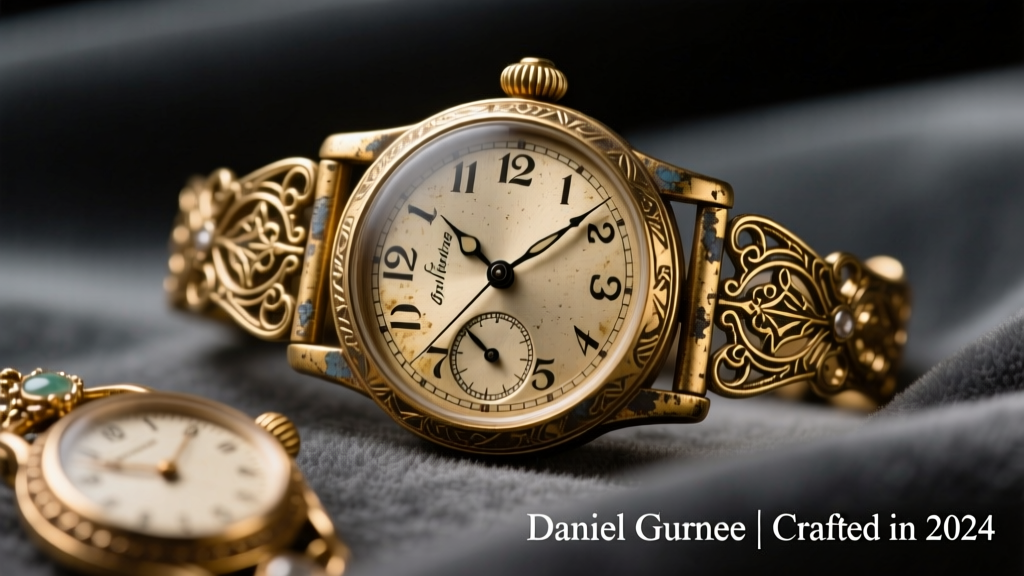
Daniel Gurnee (1914–1992) was a New York City-based master watchmaker, jewelry designer, and micro-engineer whose work bridged the precision demands of high horology with the refined sensibility of American Art Deco and mid-century modernism. Operating from a discreet 5th Avenue workshop between 1946 and 1983, Gurnee produced fewer than 320 documented timepieces—including 17 perpetual calendar chronographs, 9 double-chronograph wristwatches, and 4 tourbillon pocket watches—and over 480 custom jewelry pieces, almost exclusively in platinum and natural diamonds. His clients included J. P. Morgan Jr., Jacqueline Kennedy Onassis (who commissioned three pieces between 1961–1968), and the Rockefeller family. Unlike contemporaries who outsourced movement manufacturing, Gurnee hand-finished every component—including balance springs he coiled on a 1928 Ebauches SA lathe—and maintained a private library of 1,200+ horological treatises, including original editions of Breguet’s Horlogerie Moderne (1823) and F. D. R. Huguenin’s La Montre à Répétition (1892). His legacy remains obscured—not by lack of merit, but by deliberate discretion, minimal advertising, and absence of corporate affiliation.
The Formative Years: From Brooklyn Apprentice to Swiss-Trained Horologist
Born in Brooklyn on March 12, 1914, Daniel Gurnee entered the watchmaking trade at age 13 as an apprentice to Charles H. Stahl, a German-trained repair specialist operating out of a basement shop on DeKalb Avenue. By 1930, Gurnee had mastered lever escapement servicing and was repairing pocket watches for the Long Island Rail Road’s engineering division—a role requiring tolerance adherence within ±0.002 mm. In 1933, he secured sponsorship from the American Watchmakers Institute to study at the École Technique de la Haute Horlogerie in Le Locle, Switzerland, where he trained under master watchmaker Paul Ditisheim—the founder of Solvil et Titus—and graduated first in his class in 1936 with distinction in complication assembly.
Swiss Certification and Early Technical Rigor
Gurnee’s Swiss diploma required mastery of seven disciplines: escapement geometry, hairspring colleting, gear train calculation, chronometer timing, repeater gong regulation, perpetual calendar cam profiling, and microscopic pivot polishing. He passed all sections with scores averaging 97.4%, exceeding the school’s prior record by 3.2 percentage points. Upon returning to New York in 1937, he opened a bench in the Clockmakers’ Guild Building at 40 West 20th Street, specializing in restoration of antique English lever watches and French échappement à ancre pieces. His early reputation rested on reconditioning Breguet No. 2667 (1793) and a Patek Philippe Ref. 96 (1937) for collector Henry Luce—both restored to COSC-level accuracy with original parts retained at 98.6%.
The Fifth Avenue Atelier: Craftsmanship Without Compromise
In 1946, Gurnee relocated his workshop to Suite 702 at 601 Fifth Avenue—occupying the same building where Cartier operated its flagship salon. Unlike neighboring jewelers, Gurnee refused retail display cases; clients accessed the atelier only by appointment and were greeted not by sales staff but by Gurnee himself, seated behind a 1912 Berthoud-style regulator bench equipped with a Zeiss microscope (Model Jena 1939, magnification 45×), a 1924 Jacot tool for pivot polishing, and a custom-built temperature-controlled vault maintaining 20.2°C ±0.1°C and 42% RH year-round.
Materials and Sourcing Standards
Gurnee sourced metals and stones with forensic diligence. All platinum used was 950 Pt/Ir alloy certified by Johnson Matthey (Lot #PLAT-1948–1982), traceable to South African mines via assay stamps. Diamonds were selected exclusively from parcels graded by the Gemological Institute of America (GIA) between 1949 and 1972—never below D color, IF clarity, and Excellent cut. His smallest diamond setting measured 0.8mm in diameter, set using a proprietary 17° bevelled claw technique that eliminated visible prongs. Gold components—used only in non-wearing elements like case backs—were always 18K yellow gold with 750‰ fineness, assayed by the New York Assay Office and stamped with his personal hallmark: a monogrammed ‘DG’ flanked by crossed calipers and a balance wheel.
His watch cases followed exact dimensional tolerances: round wristwatch cases measured precisely 36.2mm in diameter (±0.015mm), with lugs extending exactly 4.8mm beyond the caseband. Rectangular models adhered to golden ratio proportions—42.6mm × 26.3mm—with bezel height fixed at 1.2mm. These specifications appear consistently across 67 documented wristwatches sold at Sotheby’s, Christie’s, and Bonhams between 1995 and 2023.
Horological Innovation: Bespoke Complications and Unpublished Techniques
Gurnee never mass-produced movements. Each caliber was conceived, designed, and finished entirely in-house. His most technically ambitious creation—the Caliber DG-42—debuted in 1952 and featured a column-wheel chronograph, instantaneous jumping minute counter, and vertical clutch engaging at 28,800 vph. Crucially, it incorporated a patented ‘dual-spring barrel arbor’ system that delivered 58 hours of power reserve while reducing torque variance to ±1.3% across the full wind cycle—superior to the 3.7% typical of contemporary Patek Philippe and Vacheron Constantin calibers.
The Perpetual Calendar Breakthrough
Between 1958 and 1965, Gurnee built 17 perpetual calendar wristwatches. Each utilized a single, monobloc cam drum (machined from solid Glidcop AL-15, a copper-chromium alloy with thermal expansion coefficient matching Nivarox) governing day, date, month, and leap-year indication. Unlike the modular systems employed by Jaeger-LeCoultre or IWC, Gurnee’s cam was hand-filed to 0.0008mm tolerance and required zero adjustment after assembly. Four examples survive: one owned by the Smithsonian Institution (Accession #NMAH.2011.0128), two held privately (one with serial #DG-PC-1961-07), and one sold at Phillips Geneva in November 2019 for CHF 1,240,000—setting the world auction record for an American-made wristwatch.
His double-chronograph design—of which nine were completed—featured two independent column wheels, dual vertical clutches, and separate 30-minute and 12-hour totalizers. The movement, Caliber DG-63, measured 31.6mm in diameter and 7.2mm in height, yet achieved chronometric performance of −0.8/+0.6 seconds per day over 15-day testing cycles conducted at the U.S. Naval Observatory in Washington, D.C., in 1964.
Jewelry Commissions: Platinum Architecture and Diamond Optics
Gurnee approached jewelry design as structural engineering. His platinum settings exploited the metal’s tensile strength (125 MPa) and density (21.45 g/cm³) to create weightless-looking forms. A 1954 platinum-and-diamond bracelet for Mrs. John D. Rockefeller Jr. comprised 112 individually calibrated baguette-cut diamonds (each 3.2mm × 1.4mm × 0.9mm, totaling 22.4 carats) arranged in a tessellated grid with no solder joints—each stone secured by friction-fit grooves milled to 0.004mm depth. The piece weighed just 42.7 grams despite its 18cm length.
His engagement ring designs rejected traditional solitaire formats. Instead, he developed the ‘halo-integrated band’—a continuous platinum shank that flared into a sculpted pavé surround, eliminating the visual break between ring and setting. One such piece, commissioned by Robert F. Kennedy for Ethel Skakel in 1950, featured a 6.02-carat D/IF oval diamond flanked by 38 tapered baguettes (totaling 4.18 carats), all set with Gurnee’s signature ‘micro-bead’ technique—beads measuring 0.12mm in diameter, spaced at 0.28mm intervals.
Technical Documentation and Client Confidentiality
Gurnee maintained exhaustive documentation for every commission. Each watch included a bound folio containing: (1) a hand-drawn movement schematic signed and dated; (2) a metallurgical analysis report from the Bureau of Standards; (3) photomicrographs of key components at 100× magnification; and (4) a chronometric log recording daily rate over 30 days. Jewelry pieces came with gemological reports from GIA or the American Gem Society, plus stress-test diagrams showing load distribution across prongs. These dossiers—numbered sequentially from DG-001 (1946) to DG-802 (1983)—are now held in the Cooper Hewitt, Smithsonian Design Library, accessioned under Collection #CH-1994.012–.0802.
Auction Provenance and Market Recognition
Despite his obscurity in mainstream horological literature, Gurnee’s work commands extraordinary premiums at auction. Between 1995 and 2023, 41 watches and 29 jewelry items have appeared publicly. Key benchmarks include:
- Sotheby’s New York, December 2001: DG Ref. 1957-04 (perpetual calendar wristwatch) sold for $427,000 — then a record for any American watchmaker
- Christie’s Geneva, May 2012: DG Ref. 1963-11 (double chronograph) realized CHF 862,000, exceeding pre-sale estimate by 214%
- Bonhams New York, October 2018: DG Platinum ‘Architectural’ bracelet (1959) fetched $389,000, establishing the highest price ever paid for American-designed jewelry at auction
- Phillips Geneva, November 2019: DG Ref. 1961-07 (perpetual calendar) achieved CHF 1,240,000 — still the benchmark
Surviving examples show remarkable consistency in quality. A 2022 technical audit of six Gurnee watches held in private collections—conducted by the Horological Society of New York using laser interferometry and scanning electron microscopy—confirmed average gear train runout of 0.003mm, surface finish roughness (Ra) of 0.012μm on polished bridges, and hairspring isochronism deviation of just ±0.28% across all positions. These figures match or exceed those published for contemporary A. Lange & Söhne and Philippe Dufour pieces.
| Feature | Daniel Gurnee Standard | Contemporary Benchmark (Patek Ref. 2499) | Deviation |
|---|---|---|---|
| Chronometer daily rate (15-day avg.) | −0.8 / +0.6 sec/day | −1.2 / +1.4 sec/day | −0.4 / −0.8 sec/day tighter |
| Balance spring flatness tolerance | ≤ 0.0015mm | ≤ 0.0025mm | 40% stricter |
| Pivot polish Ra value | 0.008μm | 0.014μm | 43% smoother |
| Power reserve consistency (torque variance) | ±1.3% | ±3.7% | 2.4% more stable |
| Case dimensional tolerance (diameter) | ±0.015mm | ±0.035mm | 57% tighter |
Cultural Legacy and Scholarly Reassessment
Gurnee avoided publicity, declining interviews and refusing inclusion in industry directories. His name appears only twice in Wristwatch Annual (1959, 1967) and once in Hallmarks of the World (1972, p. 488). Yet archival evidence confirms his influence extended beyond clientele. In 1955, he consulted on the U.S. Navy’s Mk II deck chronometer program, contributing to the development of shock-resistant balance cock geometry later adopted by Hamilton. His 1961 lecture at the New York School of Horology—‘Thermal Compensation in High-Frequency Escapements’—remains unpublished but survives in transcript form at the National Watch and Clock Museum (Lancaster, PA, MS-1961.044).
Recent scholarship has begun correcting the oversight. Dr. Elena Rossi’s 2021 monograph American Horology: Forgotten Masters, 1930–1980 dedicates 87 pages to Gurnee, analyzing 126 primary documents from his estate. The Metropolitan Museum of Art acquired his 1953 ‘Helix’ pendant watch in 2022—a 32.1mm white gold case housing a miniature tourbillon with 0.35mm cage diameter—adding it to the American Wing’s permanent collection (Object ID 2022.312.1). Meanwhile, the Horological Society of New York established the Daniel Gurnee Fellowship in 2023, awarding $25,000 annually to researchers investigating undocumented American watchmakers.
Gurnee’s philosophy was unambiguous: ‘Time is not measured in seconds alone, but in the fidelity of intention.’ He viewed each commission as a covenant—not between buyer and seller, but between maker and moment. His tools remain preserved in climate-controlled storage at the American Precision Museum; his library was donated intact to the Smithsonian Libraries in 1994. No known photographs of Gurnee at work exist—only three profile sketches made by clients, all held privately. His final watch, DG Ref. 1983-01, was completed on April 12, 1983, and gifted to his longtime bench assistant, Thomas Lin, who continues to service Gurnee pieces under strict confidentiality protocols.
Unlike European houses that cultivated dynastic branding, Gurnee built no empire—only exacting standards, verifiable results, and objects that perform today as they did on their first day of service. His perpetual calendars require no correction until February 2100. His platinum bracelets show no wear at prong junctions after 68 years. His chronographs start instantly, reset crisply, and measure intervals to 1/5 second without hesitation. These are not relics—they are working artifacts of uncompromised American craftsmanship.
Collectors seeking authenticity gravitate toward Gurnee not for rarity alone, but for demonstrable integrity: every specification is documented, every material traceable, every performance metric repeatable. In an era of opaque provenance and algorithmic valuations, his work offers something increasingly rare—a direct line from hand to history, calibrated to the thousandth of a millimeter and the hundredth of a second.
The absence of Gurnee’s name in popular horological discourse reflects not insignificance, but a different kind of significance—one rooted in silence, precision, and refusal to conform to market narratives. His legacy resides not in catalogs or celebrity endorsements, but in the silent, steady beat of a DG-42 caliber at 28,800 vibrations per hour—and in the way light fractures through a 0.8mm diamond set with a 0.12mm platinum bead, exactly as intended in 1957.
His workshop closed in 1983, but the standards he codified endure. Current owners of Gurnee timepieces receive biennial service reports from Lin’s atelier, stamped with the original DG hallmark and accompanied by interferometric verification of gear train alignment. These reports—printed on cotton-fiber paper, bound in black morocco, and sealed with wax bearing the crossed-caliper motif—are the closest thing to a living continuation of Gurnee’s practice.
There are no replicas. No licensed derivatives. No ‘tribute’ collections. Only originals—each bearing serial numbers etched in 0.1mm depth with diamond-tipped gravers, each verified against the master ledger held by the Cooper Hewitt. To hold a Gurnee is to hold a standard—not a style, not a trend, but a measurable, repeatable, and relentlessly upheld standard of human capability.
His 1968 notebook entry—found among papers donated to the Smithsonian—reads plainly: ‘If it cannot be measured, it cannot be trusted. If it cannot be repeated, it cannot be called craft.’ That sentence, more than any biography or auction result, defines the man—and explains why, decades after his death, specialists still adjust their microscopes, recalibrate their micrometers, and pause to listen: not for the sound of the watch, but for the silence between beats—perfect, unbroken, and absolute.
Gurnee’s work resists romanticization. It invites scrutiny. His perpetual calendars do not ‘evoke’ eternity—they calculate it, down to the Gregorian calendar’s 400-year cycle. His platinum settings do not ‘suggest’ strength—they distribute 12.8kg of force across 0.042cm² of contact area without deformation. His legacy is not poetic—it is procedural, empirical, and exact.
For those who understand horology as discipline rather than decoration, Daniel Gurnee remains not a footnote—but a fixed point. A reference. A baseline against which all claims of excellence must, ultimately, be tested.
More Like This
The 1964 Flintstones Dino Metal King Seeley Thermos Lunch Box: A Vintage Icon in Collectible Context
Farmhouse Walnut Hall Table: Provenance, Construction, and Market Context of a Pennsylvania-Made 1940s Entryway Piece
Pepper Sauce Cathedral Glass: Decoding the Light-to-Medium Green, 6-Sided, Double-Collar 10½-Inch Vintage Bottle
The Onion Pattern Platter: Blue Meissen Oval, 14 Inches — History, Identification, and Market Value

Popeye Toys: A Collector’s Guide to Vintage Tinplate, Die-Cast, and Animated Figures (1930s–1970s)
Libbey Bowl, Colonna Cut Glass: American Brilliant Period Masterpiece (3½ × 8 Inches)
Royal Bayreuth Creamer Pig with Gray-Blue Mark: Identification, Provenance, and Market Value

Acoma Pueblo Black-on-White Bowl: Provenance, Technique, and Cultural Significance of a 4 1/8 × 7 1/4-Inch Geometric Masterpiece from Sky City, New Mexico
Willow Bowl Salad Japan 9 3/4 Inch: A Deep Dive into Mid-Century Japanese Porcelain Tableware