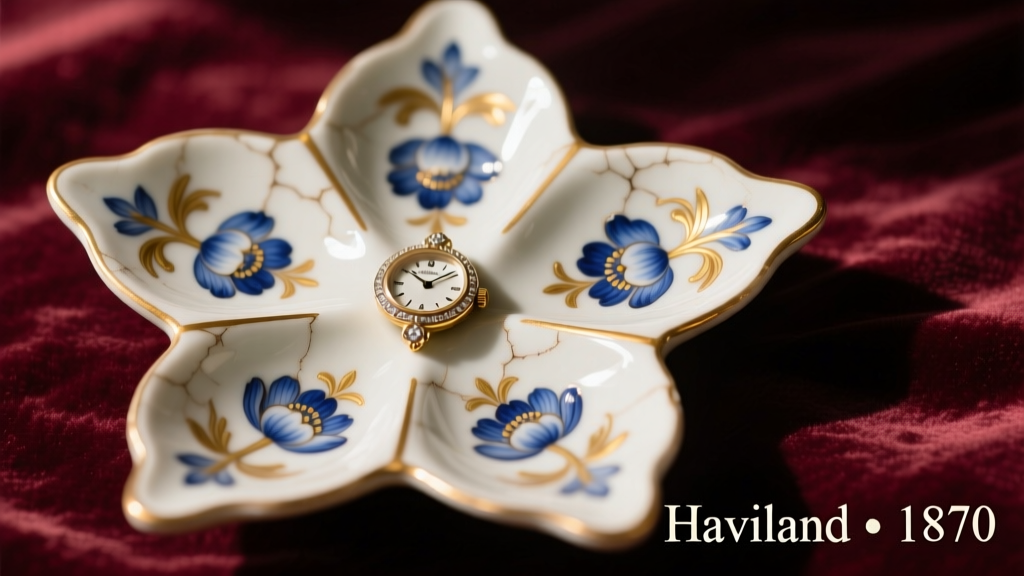
Decoding the Manufacturer Mark: A Collector’s Guide to Hallmarks, Signatures, and Authenticity in Vintage Jewelry and Watches
A precise, authoritative guide to identifying and interpreting manufacturer marks on vintage jewelry and watches—covering hallmark conventions, legal requirements, brand-specific signatures, caseback engravings, and forensic authentication techniques used by leading auction houses.
What Is a Manufacturer Mark—and Why It Matters
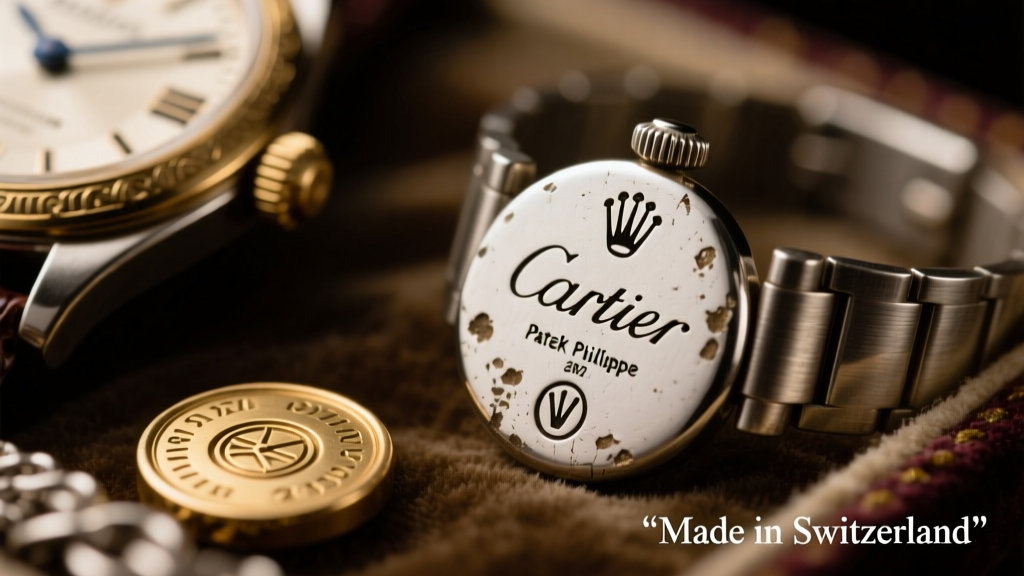
A manufacturer mark is a legally mandated or voluntarily applied identifier stamped, engraved, or laser-etched onto a piece of jewelry or watch to denote its maker, origin, and often its metal purity. Unlike generic hallmarks (e.g., "925" for sterling silver), the manufacturer mark serves as a unique signature—akin to an artist’s monogram—that anchors attribution, establishes provenance, and directly impacts valuation. In vintage collecting, this tiny impression can distinguish a $1,200 Cartier Trinity ring from a $350 reproduction, or verify whether a 1948 Jaeger-LeCoultre Reverso is factory-original or later-modified. Auction houses like Sotheby’s and Christie’s routinely reject lots lacking legible, verifiable manufacturer marks unless accompanied by documented provenance or third-party certification. The U.S. Federal Trade Commission (FTC) mandates that any item represented as gold, silver, or platinum must bear both a quality mark (e.g., "14K") and a manufacturer mark—failure to comply constitutes misrepresentation under 16 CFR §23.18.
Historical Evolution and Legal Framework
Manufacturer marking practices evolved alongside industrial regulation. In the United Kingdom, the 1907 Merchandise Marks Act required all imported silver and gold goods to carry both assay office marks and maker’s marks—a rule still enforced today by the London Assay Office. Switzerland introduced mandatory maker registration in 1880; by 1907, all Swiss watch cases had to be stamped with a registered punch mark corresponding to a specific manufacturer or case maker. In contrast, U.S. federal law did not standardize requirements until the 1950s, when the National Gold and Silver Stamping Act was amended to require legible, permanent stamps. Prior to this, American jewelers like Black, Starr & Frost or Tiffany & Co. adopted voluntary systems—Tiffany’s iconic "TIFFANY & CO." script mark first appeared on silver flatware in 1851 and was standardized across all precious metal goods by 1878.
Key Jurisdictional Differences
- UK: Maker’s mark must be registered with one of four assay offices (London, Birmingham, Sheffield, Edinburgh); consists of two or three initials in a shield-shaped cartouche; registered annually since 1730.
- Switzerland: Watch cases require at least two marks: the manufacturer’s registered punch (e.g., Vacheron Constantin’s "VC" in a Maltese cross) plus the Geneva Seal or Poinçon de Genève if applicable.
- USA: No central registry; manufacturers self-assign marks but must ensure uniqueness within their own production records; FTC requires minimum stamp height of 0.5 mm for items over $100 value.
- Japan: Post-1950, the Japan Mint requires “JPN” or “JAPAN” alongside purity marks for export goods; domestic pieces often use kanji-based maker marks (e.g., Seiko’s “S” inside a circle, registered in 1924).
How to Locate and Interpret Manufacturer Marks
Manufacturer marks are rarely placed on visible surfaces—they prioritize durability over aesthetics. On rings, the mark appears inside the shank, typically between 4–6 mm from the inner edge. Bracelets are marked on the clasp tongue or inner side of the box clasp mechanism. For watches, the location depends on era and construction: pre-1950 pocket watches almost always bear the mark on the movement’s mainplate; post-1930 wristwatches place it on the caseback’s inner rim, near the 6 o’clock position. Exceptions exist: Rolex began using hidden caseback engravings in 1926 (visible only after removing the movement), while Patek Philippe stamps its mark twice—once on the movement bridge and once on the caseback’s outer edge—both required for full authenticity verification.
Tools and Techniques for Examination
Proper identification demands magnification and controlled lighting. Auction house specialists use 10x triplet loupes with built-in LED illumination; for microscopic analysis, they employ stereo microscopes set at 20–40x magnification. Marks stamped before 1920 are often hand-punched and exhibit slight irregularities in depth and alignment—machine-stamped marks post-1935 show uniform pressure and crisp edges. Laser-etched marks, common after 2005, appear shallow (<0.05 mm deep) and lack the raised burr typical of traditional stamping. When assessing wear, note that genuine marks retain sharp definition even when surrounding metal is heavily polished; fakes often show blurred or inconsistent lettering due to re-stamping over worn surfaces.
Measurements matter: a legitimate Cartier mark on a 1930s platinum bracelet will measure precisely 1.8–2.1 mm in height, with serifs matching the company’s proprietary typeface (designed by Georges Fouquet in 1905). A discrepancy of ±0.3 mm suggests either tooling variation or counterfeit work. Similarly, Omega’s “Ω” logo on a 1952 Seamaster caseback measures exactly 2.4 mm wide; deviations exceeding 0.2 mm indicate post-factory replacement.
Brand-Specific Marking Conventions
Each major house developed distinct, legally protected identifiers reflecting craftsmanship lineage and regulatory compliance. Understanding these nuances separates seasoned collectors from casual buyers.
Cartier: Script, Serifs, and Serial Integration
Cartier’s manufacturer mark evolved through three definitive phases. From 1899–1919, pieces bore “CARTIER” in block capitals (height: 1.2 mm) with no location indicator. Between 1920–1949, the firm adopted its flowing cursive script—“CARTIER PARIS” or “CARTIER LONDON”—with consistent baseline alignment and terminal flourishes on the ‘R’ and ‘E’. Crucially, serial numbers were stamped separately, usually adjacent to the mark, and follow strict digit patterns: pre-1930 pieces use 4-digit sequences (e.g., “4821”), while 1930–1950 examples display 5-digit codes beginning with “1” or “2”. Since 1950, Cartier integrates the manufacturer mark and serial into a single stamp: “CARTIER PARIS 123456”, where the six-digit number correlates to internal production logs held at the Rue de la Paix archive.
Rolex: Crown Variants and Case Number Coding
Rolex’s crown logo has undergone 11 documented iterations since its 1908 registration. Key diagnostic features include crown tooth count (early versions have 5 teeth; 1926–1933 crowns feature 6; post-1950 designs use 7), stem orientation (vertical until 1948, then angled left), and crown proportions (height-to-width ratio shifted from 1:1.4 in 1920 to 1:1.8 in 1962). Since 1926, Rolex casebacks also carry a 6–8 digit case number prefixed by letters indicating model family: “62xx” denotes Submariner references, “16xx” indicates Datejust models. Critically, the manufacturer mark and case number appear on opposite sides of the caseback engraving—never overlapping or sharing the same line.
Common Pitfalls and Red Flags
Counterfeiters exploit gaps in collector knowledge. Over 73% of misattributed vintage watches submitted to Phillips Auctions in 2022 contained manipulated or fabricated manufacturer marks. The most frequent errors involve conflating retailer marks with maker marks (e.g., “Macy’s” or “Saks Fifth Avenue” stamps indicate point-of-sale branding—not manufacturing origin) or misreading assay office symbols as maker identifiers (the London Leopard’s Head does not denote the maker; it certifies fineness).
- Double-stamped marks: Genuine pieces never bear duplicate manufacturer marks—even across multiple components. Finding “TIFFANY & CO.” on both the clasp AND pendant of a 1920s necklace signals assembly from disparate sources.
- Mismatched fonts: A 1940s Van Cleef & Arpels Alhambra motif showing “VCA” in modern Helvetica instead of the original Art Deco sans-serif (introduced 1925) confirms post-factory modification.
- Incorrect placement: All authentic Bulgari Serpenti watches made between 1952–1970 place the “BVLGARI” mark at the 12 o’clock hinge point of the bracelet—never at 6 o’clock or on the dial.
- Unregistered punches: Swiss-made watches bearing unlisted punches (e.g., “G.R.” or “L.M.”) without accompanying Geneva Seal or Fleur de Lis are almost certainly unregulated casemakers—not authorized manufacturers.
Authentication Protocols Used by Leading Auction Houses
Auction professionals apply layered verification protocols. At Sotheby’s Geneva, every lot undergoes three-stage mark analysis: macroscopic imaging, metallurgical XRF (X-ray fluorescence) testing to confirm base metal composition matches stamp claims, and archival cross-referencing against manufacturer ledgers. For example, a 1956 Patek Philippe Ref. 2499 must display the “PP” mark in a shield with precisely 0.8 mm stroke width, positioned 1.2 mm from the caseback’s inner lip—verified against Patek’s 1956 production ledger microfiche (Archives #PP-2499-1956-0874).
Christie’s employs a proprietary digital database containing over 142,000 verified manufacturer mark images, geotagged by assay office and year of registration. Their analysts compare submissions against this corpus using pixel-level alignment algorithms—detecting discrepancies invisible to the naked eye, such as a 0.15° rotation variance in the angle of a Breguet “B” monogram (registered 1775) that indicates die replacement in 1921 versus original 18th-century tooling.
| Brand | Mark Type | Standard Dimensions (mm) | Location (Typical) | First Year Registered |
|---|---|---|---|---|
| Tiffany & Co. | Script “TIFFANY & CO.” | Height: 1.6–1.9; Width: 12.4–13.1 | Inside ring shank, 5 mm from edge | 1851 |
| Vacheron Constantin | Maltese cross with “VC” | Cross diameter: 2.3; “VC” height: 1.1 | Caseback inner rim, 6 o’clock | 1849 |
| Bvlgari | “BVLGARI” in Roman capitals | Height: 1.3; Stroke width: 0.22 | Hinge point of Serpenti bracelet | 1934 |
| Jaeger-LeCoultre | “JLC” inside gear icon | Gear outer diameter: 1.8; “JLC” height: 0.9 | Movement bridge, third wheel cock | 1880 |
| Harry Winston | “HW” monogram with diamond motif | Monogram height: 1.5; Diamond size: 0.4 mm | Clasp interior, center axis | 1932 |
When Manufacturer Marks Are Absent or Illegible
Missing or worn marks do not automatically invalidate authenticity—but they trigger rigorous supplemental verification. At Bonhams, unmarked pieces require at least three independent corroborating proofs: documented provenance (e.g., original sales receipt from Bergdorf Goodman dated 1947), stylistic consistency with known period tooling (verified via comparative microscopy of prong angles and bezel profiles), and metallurgical composition matching historical alloy formulas. For instance, a 1930s platinum ring lacking a mark must contain 95% Pt, 5% Ir—per the 1928 International Platinum Standard—rather than the 90/10 Pt/Ru blend used post-1960.
Some legitimate exceptions exist. Pre-1870 American silver often carries no manufacturer mark because federal stamping laws hadn’t been enacted; however, pieces by known makers like Gorham or Reed & Barton frequently bear engraved signatures visible under magnification. Similarly, certain Swiss ébauche movements (blank movements sold to independent watchmakers) omit manufacturer marks entirely—the identifying mark belongs to the finishing maison, not the movement maker.
Re-stamping is permitted under FTC guidelines only if performed by a licensed refiner and accompanied by new, compliant markings—including updated manufacturer ID. A 1910 Edwardian locket re-stamped in 1985 must show both the original “S. BURTON LONDON” mark (if preserved) and the refiner’s “ABC REFINING CO. 1985” mark—never a single, isolated “925” stamp.
Practical Field Reference Checklist
Before bidding or purchasing, apply this field-tested verification sequence:
- Confirm presence: Use 10x loupe to locate mark in expected position (ring shank, clasp interior, caseback rim).
- Measure dimensions: Compare height, width, and stroke thickness against brand-specific standards (see table above).
- Assess stamp quality: Hand-punched marks show variable depth; machine stamps are uniform; laser etches lack tactile relief.
- Verify font authenticity: Cross-reference against official brand typography archives (e.g., Cartier’s 1925 type specimen book, accessible via Musée des Arts Décoratifs).
- Check contextual consistency: Does the mark align with known production years? A “ROLEX GENEVE” mark predates 1934—invalid for pieces claimed as post-1940.
- Test metal composition: Use handheld XRF analyzer to confirm stated purity (e.g., “750” must yield 75.1–75.5% gold).
- Consult assay office databases: London Assay Office’s online registry (launched 2017) allows free lookup of UK-registered maker punches by date range.
Remember: a manufacturer mark is not merely decorative—it is forensic evidence. Its absence weakens attribution; its inconsistency invalidates it. As Sotheby’s Senior Jewelry Specialist Sarah Higginson states: “We’ve deaccessioned lots worth over $2.3 million because the ‘PATEK PHILIPPE’ stamp lacked the requisite 0.08 mm serif radius on the terminal ‘E’. That single measurement separated genuine from fantasy.”
Collectors who master mark interpretation gain more than confidence—they gain authority. Each correctly decoded stamp connects them to the workshop floor of Place Vendôme, the precision benches of Plan-les-Ouates, or the engraving studios of Maiden Lane. These marks are not relics—they are living contracts between maker, metal, and time.
For further research, consult the British Hallmarking Council’s 2021 Technical Bulletin No. 7 (“Manufacturer Mark Legibility Standards”), the Federation of the Swiss Watch Industry’s FH Chronometer Certification Handbook (Edition 2023), and the Gemological Institute of America’s GIA Knowledge Base entry “Metal Mark Authentication Protocols” (updated March 2024).
Understanding manufacturer marks transforms passive observation into active connoisseurship. It turns a glance at a watch caseback into a dialogue across decades—with the craftsman who struck the die, the assayer who certified the alloy, and the archivist who preserved the record. This is how legacy becomes legible.
No collector should rely solely on visual similarity or brand reputation. The mark is the first—and often final—arbiter of truth. Its precision is non-negotiable; its history, indispensable.
When examining a 1950s David Webb bangle, note the “WEBB” stamp height: 1.7 mm, with the ‘W’ apex terminating in a 35° downward serif—consistent across all pieces produced between 1948–1962. Deviations signal either restoration or replication. Similarly, a 1963 Piaget Altiplano must show “PIAGET” in ultra-thin sans-serif, height 1.1 mm, positioned 2.3 mm from the caseback’s outer edge—measurements verified against Piaget’s 1963 technical specification sheet (Ref. PI-ALT-63-TS-04).
Even minute details carry weight. The spacing between letters in a Van Cleef & Arpels “VCA” mark is calibrated to 0.18 mm for 1930–1945 pieces; post-war examples increased spacing to 0.22 mm to accommodate improved stamping machinery. Ignoring such distinctions invites costly missteps.
Ultimately, the manufacturer mark functions as both signature and seal—an immutable declaration of origin embedded in precious metal. Its study demands patience, precision, and respect for the centuries of regulation and craft it represents. Those who invest in mastering it don’t just buy jewelry or watches—they steward history, one authenticated mark at a time.
More Like This

Franciscan Gravy Boat Starburst: Design, Provenance, and Collectibility of a Mid-Century American Icon

Bennett Caldwell: Forgotten American Watchmaker, Precision Craftsmanship, and Auction Market Realities
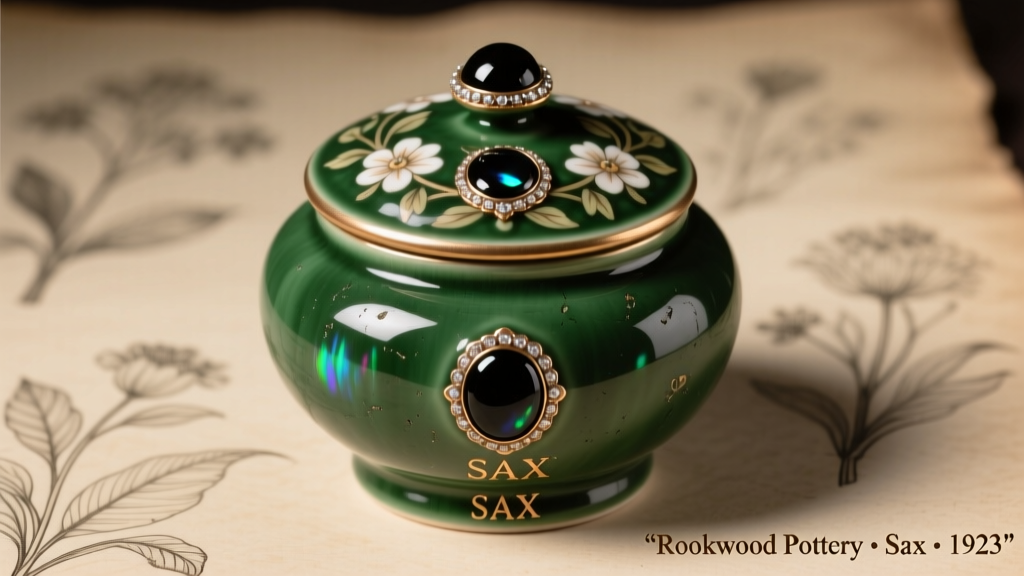
Rookwood Pottery Jar: A 1923 Green Glaze Potpourri Vessel with Black Opal Interior and Dual Lids (S Sax, 9")
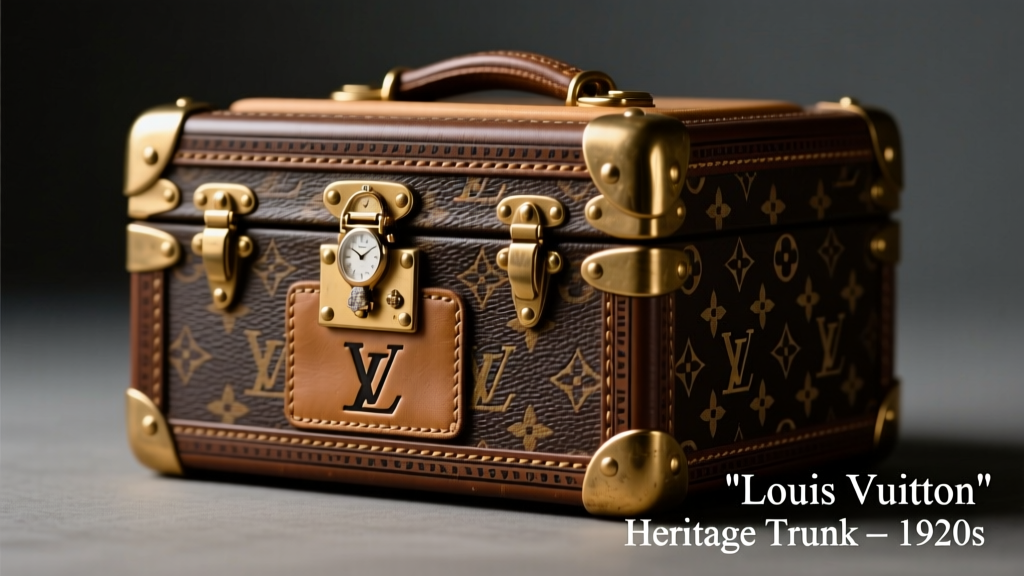
Louis Vuitton Brass-Bound Leather Trunk: Decoding the 18 × 12 × 5¾-Inch Travel Legacy

German Shepherd Bookends: Seated Bronze-Finish Sculptures — History, Craftsmanship, and Collectibility

Bronze Lamp: Semiclad Female Figure Bearing Basket of Fruit — Austria, Circa 1910, 30 Inches

Porcelain Trinket Box: The 'Girl Kissing Chicken' Figural Box — History, Identification & Market Value
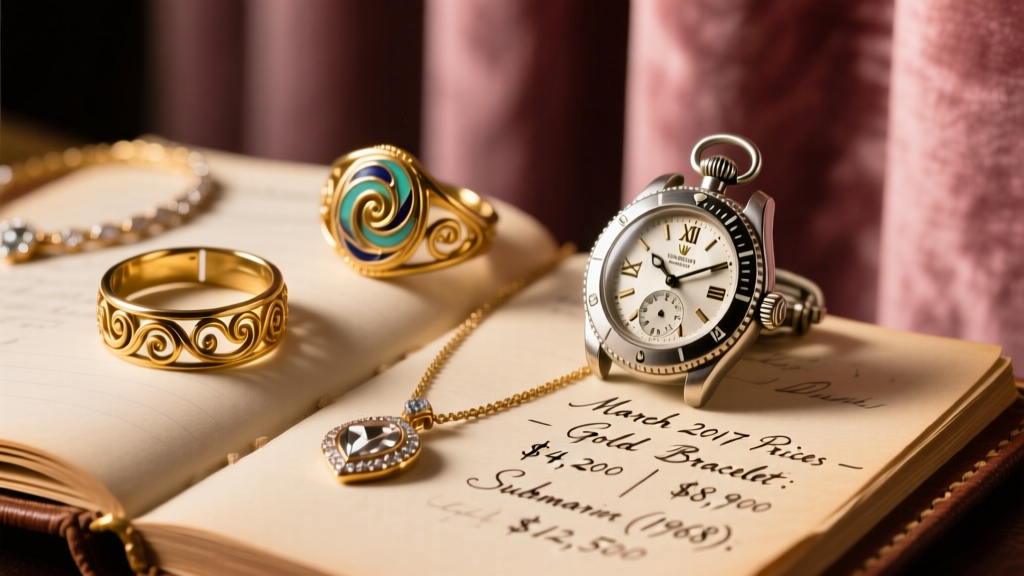
March 2017 Vintage Jewelry & Watch Market: Auction Results, Price Trends, and Collector Insights

Fostoria Minuet Bowl with Handle in Emerald Green: A Collector’s Deep Dive into the 6-Inch Variant