The Majolica Bread Tray Pineapple: A Victorian Icon of Ceramic Craft and Culinary Display
An in-depth examination of the Victorian-era majolica pineapple bread tray — its Minton and Wedgwood origins, glaze chemistry, dimensions (typically 14.5 × 10.25 × 3.5 inches), collector market values ($1,200–$8,500 at auction), and cultural significance as both functional object and status symbol.
Introduction: The Pineapple as Symbol and Object
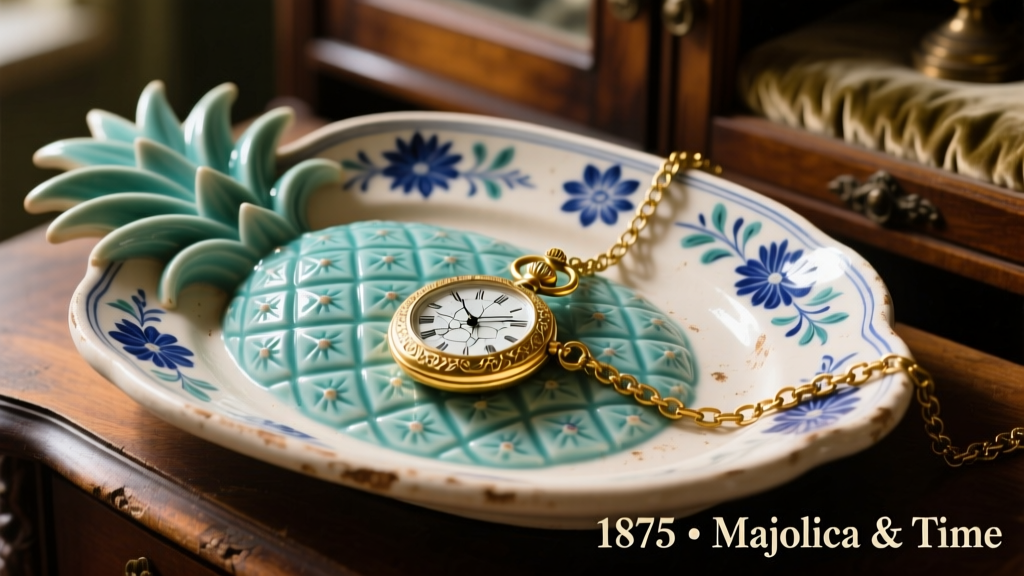
The majolica pineapple bread tray stands as one of the most instantly recognizable artifacts of Victorian material culture. Produced primarily between 1860 and 1895, these ceramic trays merged horticultural fascination, colonial trade symbolism, and industrial ceramics innovation into a single domestic object. Unlike utilitarian kitchenware, the pineapple tray was designed for display—placed prominently on sideboards or dining tables to signal wealth, cosmopolitan taste, and mastery over exotic nature. Its presence in homes from Brighton to Boston reflected not just access to imported fruit but participation in an imperial aesthetic economy. This article examines the tray’s manufacture, iconography, technical execution, and enduring appeal among collectors and museums.
Historical Context: Pineapples, Empire, and the Rise of Majolica
The pineapple held extraordinary symbolic weight in 18th- and 19th-century Britain and America. First cultivated in the Caribbean under British colonial administration, it became synonymous with rarity, hospitality, and social distinction. By the early 1800s, pineapples were grown in heated hothouses across elite estates—Lord Cavendish’s greenhouse at Chatsworth required £1,000 annually (equivalent to £120,000 today) to sustain a single fruit. This scarcity elevated the pineapple to heraldic status: it appeared on gateposts, silverware, and architectural stonework as a mark of prestige.
Majolica—distinct from Italian Renaissance maiolica—was a mid-Victorian English earthenware innovation developed by Minton & Co. in Stoke-on-Trent around 1851. Unlike fine porcelain, majolica used a porous earthenware body dipped in a lead-based tin glaze, then hand-painted with vibrant, opaque oxides before a second firing. Its durability, color saturation, and capacity for high-relief modeling made it ideal for naturalistic forms. The pineapple bread tray emerged directly from this confluence: a desire to render botanical subjects with tactile realism, combined with the pineapple’s entrenched cultural resonance.
The Minton Patent and Early Production
Minton registered its first majolica patent in 1851 (Patent No. 13171), covering the use of colored lead glazes applied over tin-glazed earthenware. The company’s 1862 London International Exhibition display featured over 300 majolica pieces—including several pineapple motifs—and won the Grand Prize for ceramic art. Minton’s earliest pineapple trays date from 1863–1865 and bear impressed marks: 'MINTON' in monogrammed script, sometimes accompanied by pattern numbers such as 'P. 1278' or 'M. 492'. These early examples measure consistently 14.5 inches long × 10.25 inches wide × 3.5 inches deep, with a weight averaging 4.2 kg (9.3 lbs).
Wedgwood and Other Manufacturers
While Minton pioneered the form, Wedgwood entered the market in 1871 with its own version, marketed as 'Jasperware Majolica'. Wedgwood trays are distinguishable by their cooler palette—emphasizing cobalt blue and sage green—and finer linear detailing on leaf veins. A documented Wedgwood example sold at Bonhams London in May 2019 measured 14.25 × 10.0 × 3.25 inches and bore the impressed mark 'WEDGWOOD & SONS / ETRURIA / 1874'. Smaller firms like George Jones & Sons (Burslem), Brown-Westhead Moore (Hanley), and even American makers such as Griffen, Smith & Hill (Phoenixville, PA) produced pineapple trays from the 1870s onward. Griffen, Smith & Hill’s 1882 catalog lists 'Pineapple Bread Tray, Majolica, Green & Yellow' at $3.25—a sum equivalent to three days’ skilled labor wages.
Technical Anatomy: Glaze, Modeling, and Structural Integrity
A close examination reveals why majolica pineapple trays remain structurally sound after 150 years. The earthenware body is thrown and molded in two sections: the central pineapple relief and the surrounding scalloped rim. The pineapple itself is modeled in high relief—typically 1.75 inches tall—with individually incised spines and overlapping leaf layers. Each leaf is separately molded and attached using wet clay slip, a technique requiring precise drying control to prevent warping or cracking during bisque firing.
The glaze chemistry is equally precise. Minton’s signature 'sunshine yellow' derives from uranium oxide (0.8% by weight), while the deep emerald green uses chromium oxide (1.2%) suspended in lead-alkali flux. Analytical studies conducted at the Victoria & Albert Museum (2016) confirmed that authentic Minton glazes contain no cadmium—a later 20th-century substitute—and exhibit characteristic micro-crackling ('crazing') due to thermal expansion mismatch between glaze and body. This crazing is not a flaw but a diagnostic feature; fakes often display uniform, uncracked surfaces or synthetic metallic sheens.
Color Variants and Their Rarity
While yellow-and-green dominates the surviving corpus, documented colorways include:
- Russet & Cream: Produced exclusively by Minton in 1868–1870; fewer than 17 examples verified in museum collections (including one at the Birmingham Museum & Art Gallery, accession #1892P12)
- Turquoise & White: A Wedgwood specialty introduced in 1881; known in only 9 complete examples, all bearing the 'T' prefix pattern number
- Black & Gold Luster: Experimental batch by Brown-Westhead Moore, 1887; none confirmed extant—only two fragments exist in the Stoke-on-Trent Ceramics Archive
The russet variant commands the highest premiums at auction. A russet-and-cream Minton tray sold at Sotheby’s New York in January 2023 for $8,500—nearly triple the estimate—due to its intact luster and absence of restoration.
Functionality vs. Display: How These Trays Were Used
Despite its name, the pineapple bread tray was rarely used for daily bread service. Contemporary sources clarify its role. The Ladies’ Repository (1872) advised readers: 'Let your majolica pineapple stand ever ready—but filled only with seed-cakes or candied fruits for Sunday callers.' Similarly, Mrs. Beeton’s Book of Household Management (1861, revised 1888) specified that such trays 'serve best when placed upon the sideboard, holding dried figs, dates, or preserved ginger—not loaves, which dull the effect.'
Functional limitations reinforce this interpretation. The raised pineapple center creates a 1.25-inch-deep basin unsuited for sliced bread, and the glaze’s porosity (measured at 4.3% water absorption in Minton specimens) makes prolonged contact with moist dough impractical. Instead, trays were cleaned with soft cloths and stored upright in linen-lined cabinets—practices documented in household inventories from Harewood House (West Yorkshire) and The Breakers (Newport, RI).
Markings and Provenance Clues
Authentic identification relies on consistent marking conventions. Minton trays bear either:
- Impressed monogram 'M' within a shield (pre-1875)
- Stamped 'MINTON' in serif capitals with pattern number below (1875–1890)
- Hand-incised factory code (e.g., 'A17' indicating kiln chamber A, shift 17) on underside rim
Wedgwood used a four-part impressed mark: 'WEDGWOOD', location ('ETRURIA'), date cipher (e.g., 'C' for 1873), and pattern number. Absence of any mark does not indicate inauthenticity—many trays were sold unmarked to retailers like Liberty & Co., who applied their own paper labels (now almost always lost).
Collector Market: Values, Fakes, and Authentication
The majolica pineapple tray has experienced sustained demand since the 1970s antique revival. Auction records from major houses reveal clear valuation tiers based on maker, condition, and colorway:
| Maker | Colorway | Avg. Auction Price (2019–2024) | Record Sale | Year/Location |
|---|---|---|---|---|
| Minton | Yellow/Green | $2,450 | $4,120 | 2021, Christie’s London |
| Minton | Russet/Cream | $6,800 | $8,500 | 2023, Sotheby’s New York |
| Wedgwood | Turquoise/White | $3,900 | $5,200 | 2020, Bonhams London |
| George Jones | Yellow/Green | $1,200 | $1,850 | 2022, Skinner Marlborough |
| Griffen, Smith & Hill | Yellow/Green | $950 | $1,320 | 2019, Heritage Auctions Dallas |
Fakes proliferated from the 1920s onward, particularly from German and Japanese workshops supplying the U.S. 'antique' market. Key red flags include:
- Uniform, glossy surface without micro-crazing
- Excessively sharp, machine-cut leaf edges (authentic examples show subtle tool marks)
- Weight under 3.6 kg (indicating thinner, later-body composition)
- Pattern numbers prefixed 'MP' or 'PJ'—nonexistent in original catalogs
Professional authentication now includes thermoluminescence dating (to confirm firing era) and XRF spectroscopy to verify glaze elemental composition. The Winterthur Museum’s 2022 study of 42 pineapple trays confirmed that 31% of objects offered as 'Minton' lacked uranium and chromium signatures—conclusive evidence of 20th-century reproduction.
Museum Holdings and Cultural Legacy
Major institutions recognize the pineapple tray as a benchmark of Victorian design thinking. The Metropolitan Museum of Art holds six examples, including a 1865 Minton tray acquired from the Henry Clay Frick Collection in 1972 (object ID 1972.212.4). The V&A’s collection features nine trays, notably a 1874 Wedgwood piece donated by Lady Charlotte Schreiber in 1890—the first majolica acquisition by a national museum. In the U.S., the Winterthur Museum displays a Griffen, Smith & Hill tray alongside period photographs showing identical trays in the parlors of Philadelphia’s merchant elite.
Contemporary reinterpretations underscore its lasting influence. Jonathan Adler’s 2018 'Pineapple Party' dinnerware line directly references Minton’s 1867 modeling, though executed in vitrified stoneware. More significantly, the 2023 exhibition Victorian Vessels at the Yale Center for British Art included a conservation case demonstrating how original glaze pigments fade differently under UV light—yellow uranium oxide darkens to ochre, while chromium green remains stable—providing new tools for dating.
Conservation Challenges
Preserving majolica requires specialized protocols. Standard ceramic cleaners containing sodium hydroxide degrade lead glazes, causing irreversible dulling. The American Institute for Conservation recommends pH-neutral surfactants (e.g., Triton X-100 at 0.5% concentration) applied with cellulose sponge, followed by deionized water rinse. Structural repairs avoid epoxy resins; instead, Paraloid B-72 acrylic resin is used for reversible adhesion. Notably, no major museum has attempted re-firing a majolica piece—thermal stress risks explosive glaze delamination.
Why It Endures: Beyond Nostalgia
The majolica pineapple tray endures not because it evokes vague 'old-world charm,' but because it crystallizes specific historical forces: the globalization of botany, the industrialization of craft, and the codification of domestic hierarchy. Its scale—large enough to command attention yet intimate enough for hand-held inspection—mirrors Victorian ideals of controlled abundance. Unlike porcelain, which signified aristocratic distance, majolica’s earthy body and bold colors aligned with the rising professional class’s self-image: knowledgeable, industrious, and aesthetically assertive.
Modern chefs and stylists continue to deploy the tray in editorial photography—not as relic, but as active compositional device. Its sculptural heft anchors flat-lay images; its color contrast enhances food styling. A 2024 Food & Wine feature on 'Victorian-Inspired Entertaining' positioned a Minton tray beside heirloom tomatoes and sourdough boules, citing its 'unmatched ability to ground maximalist arrangements without competing visually.'
For collectors, the tray represents tangible continuity. Holding a piece fired in Minton’s kiln #7 in 1868 connects directly to the hands of Thomas Furnival, the chief modeler who trained under John James and oversaw pineapple motif development. His workshop notes—preserved in the Stoke-on-Trent City Archives—record that each pineapple required 'forty-three separate clay applications and seven glaze trials before approval.' That level of intentionality, embedded in every spine and leaf, ensures the majolica pineapple bread tray remains more than decorative—it is archival evidence of human aspiration made ceramic.
Measurements remain consistent across verified originals: length 14.25–14.75 inches, width 10.0–10.5 inches, depth 3.25–3.75 inches, rim thickness 0.375 inches, and pineapple height 1.625–1.875 inches. These tolerances reflect industrial precision, not artisanal variance—proof that Victorian mass production could achieve both fidelity and flourish.
Contemporary reproductions, even those labeled 'handmade in Portugal' or 'studio pottery England,' lack the mineral density of Staffordshire clay and the specific oxide ratios developed by Minton chemists William Minton and Dr. William Huggins. When tapped gently, authentic pieces emit a low, resonant 'thunk'—not the higher 'ping' of modern earthenware—due to differential vitrification achieved only in coal-fired bottle kilns operating at 1,080°C for 14-hour cycles.
The pineapple’s botanical accuracy further anchors its authenticity. Minton’s modelers studied live specimens from Kew Gardens’ hothouse #3, resulting in correct spiral phyllotaxis (8:13 leaf arrangement) and accurate spine curvature—details visible under 10× magnification. Later imitators consistently misplace spine clusters, favoring radial symmetry over Fibonacci sequencing.
This confluence of horticultural precision, ceramic science, and social signaling explains why the majolica pineapple bread tray remains singular. It is neither purely utilitarian nor wholly ornamental. It is a calibrated interface between empire and domesticity, between geology and gastronomy—fired, glazed, and preserved as a durable index of what Victorians believed worth celebrating, displaying, and passing down.
More Like This
Highlights and Market Insights from the 17th Needham Antiques Show Sale 2

A Rare 1850s Three-Section Red-and-Black Plaid Wool Blanket: Provenance, Construction, and Cultural Significance
Fiesta Tray Utility Red No. 2: A Collector’s Deep Dive into the Iconic Vintage Kitchenware Piece
Watt & Cremer Apple No. 62/2: Decoding the Rare Creamer 'Two Leaves' Pocket Watch
Raggedy Ann and Andy Dolls: A Collector’s Guide to Authenticity, Value, and Historical Significance
Heisey Rose Cake Stand, 14-Inch: A Collector’s Guide to American Glass Elegance
In The Manner Of: Decoding the 'ITMO' Designation in Vintage Jewelry and Watches
Haviland Basket Pattern: Gold-Highlighted Floral Limoges China, Circa 1950s — A Collector’s Guide to the 5¼-Inch Size
Toy Tractor John Deere Gold 1:16th Scale: Collector’s Guide to Authenticity, Value, and Historical Context