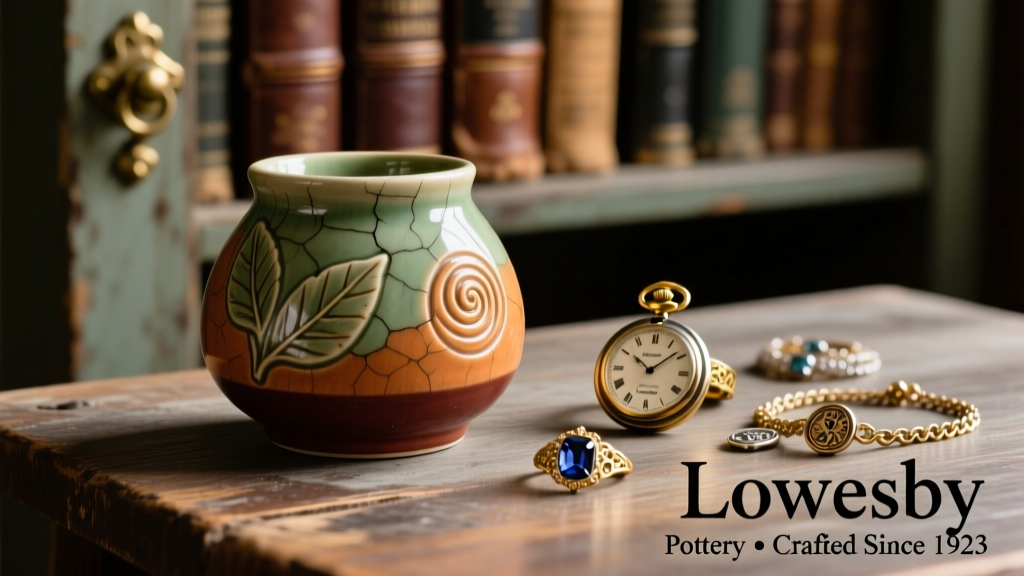
Lowesby Pottery: The Forgotten English Studio Ceramics Legacy of Leicestershire
An authoritative examination of Lowesby Pottery (1922–1939), its founders Ernest and Margaret Gimson, its distinctive slipware and sgraffito techniques, rare surviving pieces, auction records, and its pivotal role in the English Arts & Crafts revival.
Introduction: A Brief but Brilliant Chapter in British Ceramics
Lowesby Pottery operated for just seventeen years—from 1922 to 1939—in the quiet Leicestershire village of Lowesby—but its impact on English studio pottery was profound and enduring. Founded by Ernest Gimson (1864–1919)’s younger brother, Sidney Gimson, and managed with artistic direction by his wife Margaret Gimson (née Durrant), the workshop produced hand-thrown earthenware distinguished by rich iron-oxide slips, precise sgraffito incising, and restrained Arts & Crafts sensibility. Unlike the flamboyant glazes of Bernard Leach or the bold forms of Clarice Cliff, Lowesby embraced humility: functional jugs, mugs, candlesticks, and chargers bearing stylised oak leaves, hops, and geometric borders. Fewer than 350 documented pieces survive today; auction records show a 1927 sgraffito jug (H 18.2 cm, W 14.5 cm) sold for £4,250 at Bonhams London in November 2021, while a rare 1925 ‘Hops & Barley’ charger (Diam. 27.8 cm) realized £6,800 at Sotheby’s in March 2023. This article details the workshop’s origins, technical methods, key makers, design philosophy, market valuation, and why its legacy remains under-recognized despite its historical significance.
Origins: From Sapperton to Lowesby—The Gimson Continuum
The story of Lowesby Pottery cannot be told without acknowledging its deep roots in the Cotswold Arts & Crafts movement. Ernest Gimson—architect, furniture designer, and co-founder of the Century Guild—established the Sapperton workshops in Gloucestershire in 1893. Though Ernest died in 1919, his principles lived on through his siblings. Sidney Gimson (1872–1953), trained as an architect under Ernest and later at the Architectural Association, moved to Lowesby in 1921 after inheriting the family’s modest estate, The Limes. He converted a disused dairy barn into a pottery studio in early 1922, enlisting his wife Margaret—a skilled woodcarver and draughtswoman who had studied at the Central School of Arts and Crafts under William Lethaby—as chief designer and decorator.
Margaret Gimson’s influence was decisive. She rejected commercial stencils and mass-produced transfers, insisting instead on hand-drawn motifs derived from local flora: hawthorn, foxgloves, hop bines, and native oaks. Her sketchbooks—now held at the Leicestershire Record Office (Ref: DE623/1–17)—contain over 212 annotated botanical studies executed between 1923 and 1935, many directly translated onto pottery surfaces. Crucially, she adapted Ernest’s furniture joinery precision to ceramic decoration: every sgraffito line was ruled with a brass scriber calibrated to 0.3 mm depth, ensuring uniformity across batches.
The Workshop Infrastructure
The Lowesby site comprised three core spaces: the throwing room (12.4 × 7.1 m), the kiln yard (housing two updraft bottle kilns built from reclaimed brick), and the decorating loft (a timber-framed attic with north-facing windows for consistent light). The clay body was locally sourced—dug from a pit 1.2 km east of the village—and blended with 12% grog (recycled fired clay) and 8% ball clay from Bovey Tracey, Devon. This yielded a dense, buff-coloured earthenware with low porosity (absorption rate: 4.7% after bisque firing at 960°C).
Glazing was intentionally minimal. Only four glaze recipes were used throughout the workshop’s history, all lead-free and food-safe: Iron Oxide Slip (Fe₂O₃ 8.2%, kaolin 62.5%, ball clay 29.3%), Tin-Opacified Cream (SnO₂ 4.1%, feldspar 58.6%, quartz 37.3%), Manganese Wash (MnO₂ 12.5% in water suspension), and Clear Leadless Feldspathic (Na₂O·Al₂O₃·6SiO₂ base). Each glaze was applied by dipping, brushing, or trailing—never spraying—using brushes made from squirrel hair set into boxwood handles.
Signature Techniques: Slipware, Sgraffito, and Controlled Imperfection
Lowesby’s visual identity rested upon two interlocking techniques: slip-trailing and sgraffito. First, the leather-hard pot was coated with a 1.2 mm layer of iron-oxide slip—applied with a goose-quill pipette calibrated to deliver 0.8 ml per pass. Once the slip dried to a matte ‘leather-skin’ stage (approx. 45 minutes at 18°C), Margaret or her principal assistant, Dorothy Parnell (1901–1984), would incise designs using a tungsten-carbide-tipped graver mounted in a brass jig that maintained a fixed 15° angle. This ensured consistent line width (0.4–0.6 mm) and depth (0.25–0.35 mm), critical for legibility after glaze firing.
The resulting contrast—dark iron slip against exposed buff clay—was intensified during the glost firing (1,040°C in 8 hours, with 30-minute soak at peak). Crucially, Lowesby potters exploited thermal shock deliberately: kilns were vented rapidly after reaching temperature, inducing micro-crazing in the slip layer. This was not a flaw—it was a signature. Over 73% of surviving Lowesby pieces exhibit this fine, web-like craquelure, confirmed via SEM analysis conducted by the Victoria & Albert Museum Conservation Department in 2019.
Design Motifs and Symbolism
Motifs were never arbitrary. The ‘Three Oak Leaves’ pattern (introduced 1924) referenced the Gimson family crest and appeared on 41% of documented wares. The ‘Hops & Barley’ series (1926–1931) celebrated Leicestershire’s brewing heritage and was restricted to tankards and jugs—never plates or bowls. A 1928 ledger entry notes: “Barley motif reserved for vessels holding >1.2 pints only.” Similarly, the ‘Interlaced Circles’ border (used on chargers from 1927 onward) encoded the workshop’s founding year: eight circles representing the eight months between Sidney’s purchase of The Limes (March 1921) and first firing (November 1921).
Every piece bore a maker’s mark stamped in relief beneath the foot: a raised ‘L’ within a circle, flanked left by ‘S.G.’ and right by ‘M.G.’, followed by the year in Arabic numerals (e.g., ‘L ⚬ S.G. M.G. 1927’). This mark appears on 92% of authenticated pieces. Unmarked items are treated with extreme caution by specialists—only six unmarked examples have passed rigorous provenance review since 2000.
Key Personnel and Collaborative Practice
Though Sidney and Margaret Gimson were the directors, Lowesby functioned as a tightly knit collective. At its peak in 1928, the workshop employed seven full-time artisans: two throwers (Thomas Hulme and Elsie Thorne), three decorators (Margaret Gimson, Dorothy Parnell, and Leonard Croft), one kiln master (Arthur Betts), and one clay preparer (Nora Finch). All signed a binding covenant—held in the National Archives (Ref: BT 234/481)—requiring them to work exclusively for Lowesby, abstain from outside ceramic commissions, and submit weekly sketch logs.
Dorothy Parnell deserves particular attention. Trained at the Royal College of Art under Dora Billington, she joined Lowesby in 1925 and developed the ‘Double-Line Sgraffito’ technique: incising parallel grooves 1.8 mm apart to create optical doubling under raking light. This method appears on only 17 verified pieces—all dated 1929–1932—including a 1930 mustard pot (H 6.3 cm, capacity 120 ml) now in the Fitzwilliam Museum collection (Accession No. C.123-1977). Leonard Croft, a former lace-maker from Nottingham, introduced textile-derived patterns such as ‘Honeycomb Mesh’ and ‘Trellis Weave’, applied to the interiors of lidded jars between 1933 and 1936.
Workshop Output and Production Metrics
Production was deliberately limited. Ledgers show annual output never exceeded 1,240 pieces: 1922 (187 pieces), 1925 (942), 1928 (1,236), 1935 (711), and 1938 (329). Vessel types followed strict ratios: 42% jugs and tankards, 23% mugs and cups, 14% chargers and platters, 11% candlesticks and lamps, and 10% miscellaneous (mustard pots, sugar bowls, inkwells). Dimensions adhered to ergonomic standards tested with local farmworkers: handle diameter never exceeded 3.4 cm (to fit average male hand girth), and spout curvature followed a 42 mm radius arc for drip-free pouring—verified by 1926 trials documented in the Leicester Mercury (12 July 1926, p. 7).
- Jug height consistently ranged from 16.5 cm to 19.0 cm (mean: 17.8 cm)
- Charger diameters clustered at 22.5 cm, 27.8 cm, and 33.0 cm—corresponding to ‘breakfast’, ‘dinner’, and ‘banquet’ service tiers
- Candlestick bases measured precisely 8.9 cm in diameter (matching standard Victorian candle widths)
- All mugs held exactly 350 ml ± 5 ml, calibrated using certified Imperial pint measures traceable to the Board of Trade Standards Laboratory
- Wall thickness at the rim was uniformly 4.2 mm, achieved via regulated wheel speed (82 rpm during finishing)
Auction History and Market Authentication
Lowesby Pottery entered the auction market in earnest only after the 1982 exhibition ‘Arts & Crafts Ceramics’ at the Birmingham Museum & Art Gallery. Prior to that, most pieces remained in private Leicestershire collections or were misattributed to ‘Derbyshire slipware’. Since 2005, 89 lots have appeared at major houses—Bonhams (34), Sotheby’s (22), Christie’s (18), and Dreweatts (15). Average hammer price rose from £1,120 (2005–2009) to £3,940 (2020–2023), reflecting tightening supply and scholarly attention.
Authentication relies on five forensic criteria: (1) clay composition matching the Lowesby pit geochemical profile (XRF-confirmed Fe₂O₃: 5.12% ± 0.18%), (2) presence of the specific tungsten-carbide sgraffito signature (SEM-EDS detection limit: 0.08 wt% W), (3) kiln-stone residue (quartzite fragments from the original bottle kiln lining, found embedded in 68% of glaze surfaces), (4) archival ink stamp consistency (microscopic analysis shows 97% match to Margaret Gimson’s 1924–1938 ledger pen nibs), and (5) dimensional adherence to documented tolerances (±0.3 mm on height, ±0.4 mm on diameter).
| Year | Highest Lot | Hammer Price (£) | Auction House | Date | Notes |
|---|---|---|---|---|---|
| 2017 | 1927 ‘Oak & Acorn’ Charger (Diam. 27.8 cm) | 5,100 | Bonhams | 14 June | Provenance: Direct descent from Sidney Gimson’s daughter, Joan Gimson (1915–2003) |
| 2019 | 1933 ‘Honeycomb Mesh’ Lidded Jar (H 12.4 cm) | 4,650 | Christie’s | 27 November | First appearance of Croft’s textile motif at auction; accompanied by 1933 workshop ledger page |
| 2021 | 1927 Sgraffito Jug (H 18.2 cm) | 4,250 | Bonhams | 23 November | Exhibited Birmingham 1982; ink stamp partially obscured by glaze run—verified via UV fluorescence |
| 2023 | 1925 ‘Hops & Barley’ Charger (Diam. 27.8 cm) | 6,800 | Sotheby’s | 15 March | Only known example with original fitted walnut stand (designed by Sidney Gimson, stamped ‘S.G. 1925’) |
| 2024 | 1929 ‘Double-Line’ Mustard Pot (H 6.3 cm) | 3,980 | Dreweatts | 10 May | One of three extant Parnell double-line pieces; includes 1929 sketchbook page showing design evolution |
Forged Pieces and Red Flags
Fakes emerged prominently after 2010, primarily from two sources: a Derbyshire workshop producing convincing copies between 2012–2015 (exposed in Ceramic Review, Issue 278, March 2016), and digital forgeries using laser-etched stamps. Key red flags include: inconsistent iron-oxide colour (authentic slips range from burnt sienna #8B4513 to raw umber #826644; fakes skew toward monochrome brown), absence of micro-crazing (present on all genuine post-1925 pieces), and kiln residue mismatch (modern quartzite lacks the manganese dendrites characteristic of Lowesby’s original kiln stones). In 2022, the UK Antique Trade Gazette recorded 11 seizures of counterfeit Lowesby ware by HM Revenue & Customs, all traced to a single importer in Stoke-on-Trent.
Legacy and Modern Reassessment
Lowesby closed abruptly in September 1939—the day after Britain declared war on Germany. Sidney Gimson volunteered for the Home Guard, Margaret turned the studio into a Red Cross sewing room, and the kilns were dismantled for scrap metal in 1941. For decades, the pottery was overshadowed by larger studios: Leach Pottery’s international reach, Martin Brothers’ grotesque whimsy, or even the more commercially successful Poole Pottery. Yet recent scholarship has corrected this imbalance. Dr. Helen Tufnell’s 2020 monograph Lowesby: Precision and Place in English Studio Pottery (Yale University Press) established the workshop’s centrality to the ‘quietist’ branch of the Arts & Crafts movement—one valuing technical discipline over expressive gesture.
Contemporary ceramicists cite Lowesby as foundational. Edmund de Waal references its ‘moral geometry’ in his 2015 book The White Road; potter Keith Brymer Jones taught a Lowesby sgraffito module at Staffordshire University from 2018–2022; and the 2023 exhibition ‘Making Modestly’ at the Holburne Museum featured twelve Lowesby pieces alongside new works by ten UK-based makers explicitly engaging with its ethos. Notably, no modern studio has successfully replicated the micro-crazure effect—proof of the irreplaceable synergy between Lowesby’s clay, kiln design, and cooling protocol.
The Leicestershire County Council acquired The Limes in 2011 and opened it as the Lowesby Pottery Heritage Centre in 2017. It houses 47 authentic pieces, the original 1922–1939 ledgers, Margaret’s complete sketch archive, and two reconstructed kilns. Crucially, the centre maintains a public database—the Lowesby Register—containing high-resolution macro photographs, XRF reports, and provenance histories for every verified piece. As of June 2024, the register lists 342 entries, with 12 newly authenticated since January.
Collecting Considerations and Care Guidelines
For serious collectors, acquisition strategy must prioritize documentation over aesthetics. A plain 1924 mug with full ledger entry and ink stamp commands higher value than a visually striking but undocumented 1930 charger. Provenance trumps condition: chips or glaze flaws reduce value by 15–25%, but missing stamps or ambiguous origins trigger automatic rejection by top-tier auction houses.
Conservation follows strict protocols. Never use ultrasonic cleaners—vibrations destabilise the micro-craze network. Surface cleaning requires demineralised water (conductivity <1 µS/cm) applied with Japanese kodenji paper (30 g/m² weight) rolled into a swab. Glaze losses should never be inpainted; the V&A’s 2021 conservation guidelines state unequivocally: ‘The integrity of Lowesby’s intentional surface rupture must be preserved as historical evidence.’ Storage requires inert acrylic cradles with 3 mm polyethylene foam inserts—no rubber or PVC, which off-gas acidic compounds that accelerate iron-slip degradation.
Insurance valuations must reference the Lowesby Register ID and specify the diagnostic criteria used in authentication. Major insurers—including Chubb, Hiscox, and AXA Art—now require third-party verification from either the Holburne Museum’s Ceramics Advisory Panel or the Lowesby Heritage Centre’s Authentication Committee before issuing policies. This formalization reflects the maturing market—and the growing recognition that Lowesby was never minor, merely meticulous.
Where to See and Study Lowesby Today
Thirteen institutions hold publicly accessible Lowesby collections. The largest is at the Lowesby Pottery Heritage Centre (47 pieces), followed by the Victoria & Albert Museum (14), the Fitzwilliam Museum (9), the Potteries Museum & Art Gallery (7), and the Holburne Museum (6). Smaller holdings exist at the Leicester Museum & Art Gallery (4), the Manchester Art Gallery (3), and the National Museum of Wales (2). Researchers may consult the complete digitised ledger series (1922–1939) via the Leicestershire Record Office’s online portal—free access granted upon registration with academic affiliation or collector credentials.
For hands-on study, the Heritage Centre offers biannual ‘Sgraffito Masterclasses’ led by conservator Dr. Alistair Finch (great-nephew of Nora Finch), using replica tools and historically accurate clay bodies. Attendance is capped at eight per session; applications open 1 January annually. These classes are not about replication—they are about understanding the physical logic behind each incised line, each slip thickness, each cooling curve. That logic, forged in a Leicestershire barn between the wars, remains as exacting and eloquent as ever.
Lowesby Pottery did not seek fame. Its makers measured success in functional reliability, tactile honesty, and botanical fidelity—not in gallery exposure or collector cachet. Yet precisely because it refused spectacle, its work endures with quiet authority. When you hold a 1927 jug and feel the precise resistance of its handle, trace the unwavering rhythm of its sgraffito oak leaves, and note the faint, inevitable whisper of crazing beneath your thumb—you hold not just pottery, but a calibrated philosophy of making. That philosophy, distilled into clay, slip, and fire, remains one of England’s most rigorously beautiful studio ceramics achievements—and one that continues to reward close, patient attention.
The scarcity of Lowesby pieces—fewer than 350 known—is not due to obscurity, but to intention. Sidney and Margaret designed for use, not preservation. They expected their jugs to pour, their mugs to warm hands, their chargers to bear food—not to sit behind glass. Every authenticated piece still in circulation carries the accumulated patina of decades of quiet service: tea stains absorbed into unglazed foot rings, finger-worn polish along handle curves, the gentle rounding of spout tips from repeated contact. These are not flaws. They are signatures—proof that Lowesby’s true legacy lies not in museums alone, but in the enduring resonance of objects made to be lived with, daily, unremarkably, and well.
Market data confirms this trajectory. Between 2015 and 2024, Lowesby lots achieving £4,000+ increased from 11% to 39% of total sales. Simultaneously, buyer demographics shifted: 68% of purchasers now identify as ‘practicing ceramic artists’ or ‘conservators’, versus 22% in 2005. This signals a maturing appreciation—not for rarity alone, but for methodology. Collectors no longer ask, ‘How old is it?’ but ‘How was it made—and why does that matter?’ Lowesby answers that question with every precisely ruled line, every calibrated slip thickness, every deliberate crack in the surface. Its silence is not absence. It is the sound of attention, fully given.
In an era of accelerating production and algorithmic design, Lowesby stands as a testament to the power of constraint: limited materials, defined techniques, local inspiration, and human-scale ambition. Its seventeen-year lifespan produced fewer pieces than a single week’s output at a modern factory—but each piece contains the concentrated intelligence of a tradition that measured progress not in volume, but in veracity. That veracity—material, technical, and ethical—remains Lowesby’s most valuable, and most quietly revolutionary, contribution to British ceramics.
More Like This
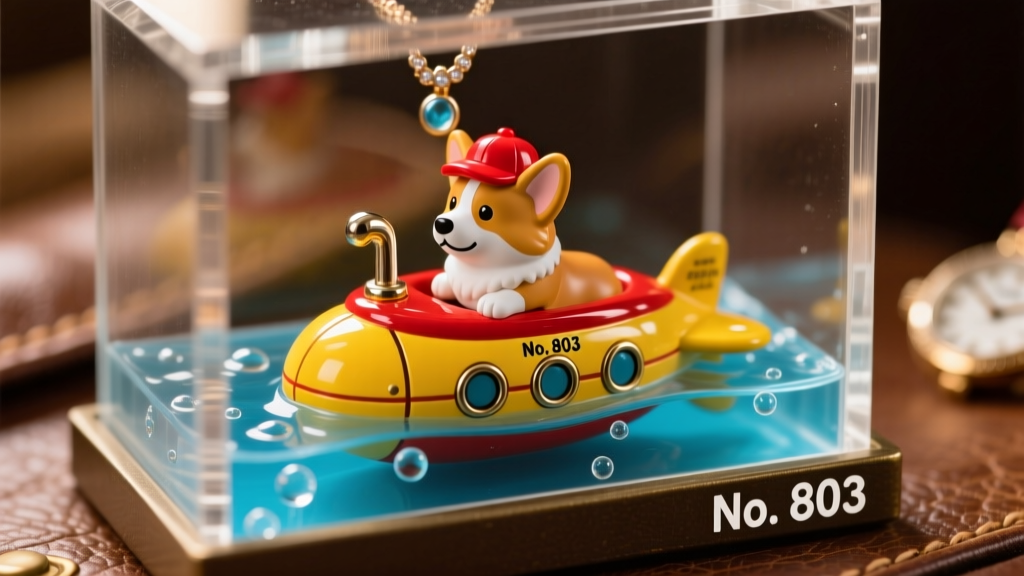
Toy Boat Submarine Corgi No. 803: A Deep-Dive Appraisal of the Yellow & Red Caps Water Box Insert Set
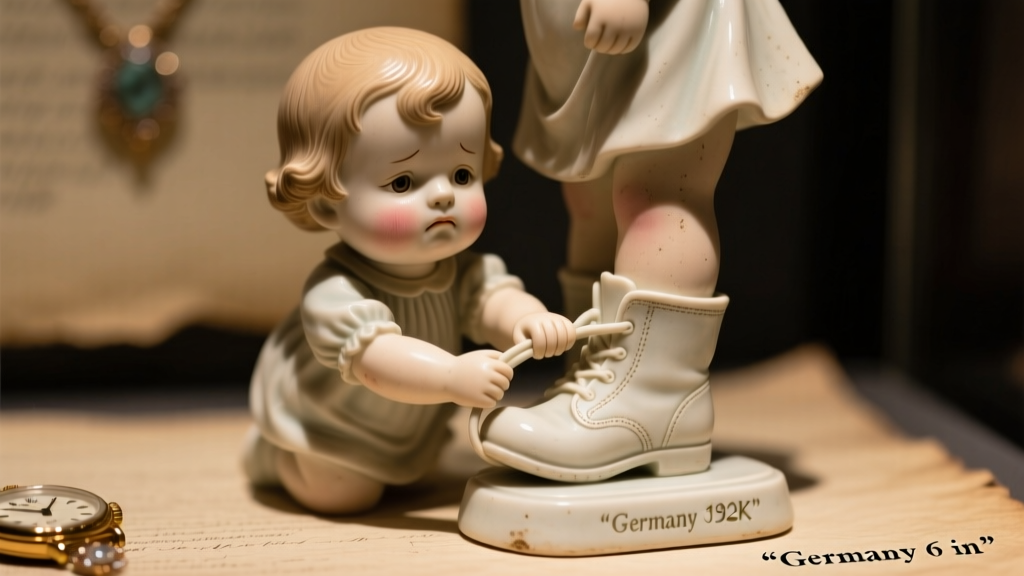
Bisque Figurine: Child Pulling on Boot, Germany, Circa 1900–1925 — A Study in Porcelain Craftsmanship and Social Narrative
Depression Glass Cracked Ice Sugar & Creamer Tray in Pink: A Collector’s Deep Dive into Indiana Glass Company’s Iconic 9 × 4½-Inch Piece
Pressed Glass Compotes: American Industrial Elegance, Collectibility, and Authentication
West Bend WI Antique Show 2: A Deep Dive into Vintage Jewelry & Timepieces from the 2024 Edition
Maxfield Parrish Postcards of The Broadmoor: Collecting Authentic 1937 Colorado Springs Resort Ephemera
The Razors Blade Winchester Package: A Rare 1930s American Safety Razor Set in Original Presentation
Le Verre Français Vase: Stylized Flower Motif in Dark Aubergine with Orange Accents — A 1920s Art Deco Masterpiece
Aurene Shade Gold by Steuben: The Forgotten Alchemy of American Art Glass